Table of Contents
- The Dawn of Conquest: Prussia in the Mid-13th Century
- The Prussian Tribes: Culture, Conflict, and Resistance
- The Teutonic Order: Mission and Military Ambitions
- The Road to Christburg: Prelude to Negotiation
- The Treaty of Christburg: Setting the Stage
- The Day of the Treaty: Christburg, 1249
- Key Provisions: Rights, Obligations, and Restrictions
- The Prussian Perspective: Acceptance and Ambivalence
- The Teutonic Order’s Strategy: Control through Law
- Immediate Aftermath: From Peace to Unease
- The Role of Religion: Conversion and Coercion
- The Social Impact on Prussian Society
- The Treaty in the Larger Crusading Context
- Breaking Points: How the Treaty Fueled Future Strife
- Legacy of Christburg: A Turning Point in Prussian History
- Reflections in Chronicles and Historical Memory
- Conclusion
- FAQs about the Treaty of Christburg
- External Resource
- Internal Link
The Dawn of Conquest: Prussia in the Mid-13th Century
In the thick mists of the early morning, 1249, the small town of Christburg stood at a crossroads—literally and metaphorically. Here, amidst the dense forests and marshes of northeastern Europe, two worlds collided: the indigenous Prussian tribes, fiercely independent and steeped in pagan traditions, and the relentless crusading fervor of the Teutonic Order, a monastic-military society with a vision of extending Christendom’s borders eastward. The Treaty of Christburg emerged not simply as a piece of parchment signed under diplomatic fanfare, but rather as a fragile lifeline tossed between hostility and reluctant coexistence.
It was more than a treaty; it was a battlefield’s shifting moment, a pause in a violent saga that had shaped the fate of peoples more resilient than many in medieval Europe imagined. The Prussians, warriors tied to land and lineage, faced the choice to bend or break—understanding, even in defiance, how the future would be decided by the words sworn at Christburg.
The Prussian Tribes: Culture, Conflict, and Resistance
To understand the Treaty of Christburg, one must first step into the world of the Old Prussians. A mosaic of Baltic tribes—Pomesanians, Pogesanians, Sambians, and others—who inhabited the wilds along the southeastern coast of the Baltic Sea, the Prussians lived fiercely close to nature, with a polytheistic faith that celebrated oak groves, sacred springs, and the rhythms of the seasons. Their society resisted feudal hierarchies, valuing personal loyalty and clan leadership over imposed monarchies.
But their lands were coveted by neighbors. The Polish dukes, the Lithuanians, and most notoriously the Teutonic Order sought to bring Prussia under their wings—by spiritual or political conquest. Their struggle was not only military but existential: maintaining their cultural identity or succumbing to foreign rule.
The decades leading up to 1249 had seen brutal campaigns, scorched earth tactics, and cycles of rebellion. The Prussians were neither passive victims nor mindless pagans; they were strategic, forming alliances and using guerrilla tactics to defend their homeland.
The Teutonic Order: Mission and Military Ambitions
Founded during the Third Crusade, the Teutonic Order had evolved by the 13th century beyond the Holy Land. With Papal support, it redirected its mission to the Baltic, aiming to “Christianize” the Prussians through both sword and conversion. These warrior-monks constructed forts, raised armies, and pursued an ambitious agenda of colonization and administrative control.
Their goal was twofold: extend Christendom’s boundary eastward and create a theocratic state ruled in obedience to the Order. The Prussian Crusade had become an integral part of their identity, blending religious zeal with political pragmatism.
Yet, their campaigns rubbed against the harsh realities of the region—dense forests, famine, and an implacable enemy. Negotiation was a tool as much as warfare.
The Road to Christburg: Prelude to Negotiation
By the late 1240s, exhaustion marked both sides. The Prussian resistance had dwindled, but not disappeared. The Teutonic Knights, despite their military superiority and fortified positions such as Christburg (modern Dzierzgoń), recognized the limits of endless battle. For the native tribes, sustained war threatened survival.
It was thus in this crucible of mutual fatigue that the dialogue leading to the Treaty emerged. The Knights, confident yet pragmatic, sought to consolidate their gains through legal means that would undermine future rebellions. The Prussians, meanwhile, searched for relief without relinquishing their honor or essence.
The talks held in Christburg were tense, layered with mistrust and unspoken threats. Yet both parties grasped the significance—the treaty would either be a pause or a prelude to escalation.
The Treaty of Christburg: Setting the Stage
Signed in 1249, the Treaty of Christburg was designed ostensibly to protect newly converted Christian Prussians and offer certain guarantees under the Knights’ rule. But the implications went far beyond the surface.
The document spelled out obligations regarding land rights, military service, tribute, religious adherence, and judicial protections. It endeavored to integrate Prussians into the Order’s growing state apparatus while dismantling pagan customs.
This treaty was among the first formal attempts to fuse conquest and compromise, an uneasy alliance between an indigenous people and an expansionist religious military order.
The Day of the Treaty: Christburg, 1249
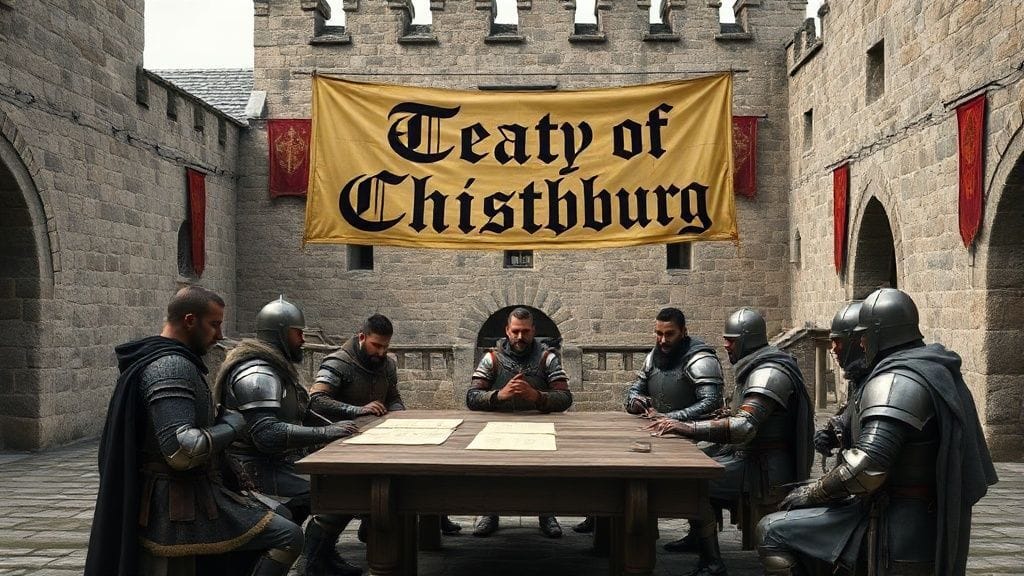
One can imagine the day at Christburg’s stone castle walls, officials and warriors assembling in a guarded courtyard. Ink met parchment beneath flickering torchlight. The Prussian leaders, clothed in traditional furs and ornaments, faced the austere knights’ armor gleaming in the northern sun.
Chants in Latin and prayers in ancient Baltic tongues whispered through air thick with smoke from cooking fires. The atmosphere was charged—no one trusted easily, but all sensed that a fragile peace was being etched into history.
The treaty was read aloud, with interpreters bridging language and culture. Some faces wore relief; others masks of skepticism. This was no mere ceremony, but a pivot.
Key Provisions: Rights, Obligations, and Restrictions
The treaty’s text laid out a framework that many historians describe as revolutionary for its time in eastern Europe. Among its critical elements:
- Conversion to Christianity was mandated for all Prussians under Teutonic control, granting them protection as “baptized subjects.”
- The Prussians were subjected to a tribute system, paying taxes to the Order but receiving limited legal rights within the new framework.
- The Order promised to protect Christian converts from violence, including from other Prussian pagans—a clause highlighting internal divisions.
- Military obligations: Prussian men were required to provide military service to the Order, effectively merging the conquered tribes into the Knights' forces.
- Judicial clauses sought to replace traditional Prussian customs with Latin Christian laws, subtly eroding indigenous identity.
Each clause represented a careful balance of coercion and concession, designed to integrate rather than annihilate.
The Prussian Perspective: Acceptance and Ambivalence
For the Prussians, the Treaty of Christburg was less a victory than a necessary compromise. Accounts from chroniclers reveal a dichotomy of emotions—relief to avoid immediate slaughter, but grief at the loss of ancestral freedoms.
Elders debated whether baptism was a safeguard or spiritual death. Young warriors bristled at the idea of serving foreign masters, even under nominally peaceful terms. The treaty was a tool for survival and a symbol of subjugation simultaneously.
In some villages, the treaty’s clauses led to fractures; some families accepted baptism and cooperation, others held fast to old gods and rebellion simmered beneath.
The Teutonic Order’s Strategy: Control through Law
The Order’s grand design was to use treaties such as Christburg not only as deeds of peace but as instruments of state-building. By imposing a legalistic framework, they sought to replace centuries of oral tradition with documented control.
This approach was innovative in the Baltic frontier, where assimilation rather than destruction was becoming the preferred method of expansion. Baptism was not just religious conversion but a political tool to legitimize dominion.
Their strategy anticipated creating a loyal, Christian population who might one day sustain their military and economic ambitions without external aid.
Immediate Aftermath: From Peace to Unease
Despite its promises, the Treaty of Christburg failed to bring lasting peace. The first years after 1249 saw sporadic uprisings, mostly fueled by those who rejected Christianity or the Knights’ authority.
The linguistic and cultural gap hampered genuine integration. While some Prussians adapted, others fled into forests, nurturing resentment. The Order responded with swift reprisals, tightening control and deepening divisions.
Thus, the treaty was less a resolution than a tense ceasefire in an ongoing conflict.
The Role of Religion: Conversion and Coercion
The Christianizing mission was central to the treaty and the wider Teutonic project. Baptism was the marker of new identity but also a source of bitter conflict within Prussian communities.
Conversion was often pragmatic rather than heartfelt. For some, it was the only path to survival. For others, a betrayal of ancestors. The Church, the Order, and Prussian clergy worked tirelessly to enforce religious conformity.
Yet pagan rituals survived clandestinely, often syncretized with Christian symbols—a testament to cultural resilience amidst pressure.
The Social Impact on Prussian Society
The treaty reshaped Prussian social fabric in profound ways. Traditional leaders were displaced or co-opted; new feudal settlers arrived. Land tenure changed as the Order redistributed estates to loyalists.
Communities fractured along religious and political lines. The concepts of private property, legal recourse, and loyalty underwent radical transformations.
Even daily rituals and language were affected, as Latin clerks and German-speaking knights imposed new cultural norms.
The Treaty in the Larger Crusading Context
The Treaty of Christburg was part of a broader pattern of medieval crusading, where military orders pursued not only spiritual goals but territorial states. The Baltic Crusades mirrored the campaigns in Iberia and the Mediterranean in blending religion and conquest.
The treaty showcased the evolving methods of the Church and warrior orders adapting from outright destruction towards governance and assimilation.
Its story exemplifies the complexities and contradictions of crusading beyond the Holy Land.
Breaking Points: How the Treaty Fueled Future Strife
Though designed as a peace accord, the Treaty of Christburg sowed seeds of future conflict. Prussian uprisings in subsequent years echoed grievances about lost autonomy, forced conversion, and social upheaval.
The Order’s failure to fully integrate the population meant underlying tensions persisted. Historians link the treaty directly to revolts of the late 13th century, notably the Great Prussian Uprising (1260–1274).
The fragile settlement became a flashpoint rather than a resolution.
Legacy of Christburg: A Turning Point in Prussian History
Looking back, the Treaty of Christburg stands as a watershed moment—a first formal treaty in the protracted and transformative conflict between the Prussians and the Teutonic Knights.
It illustrates the transition from violent conquest toward state-building based on law and religion, prefiguring the eventual absorption of Prussian lands into medieval European Christendom.
For modern historians, it offers a lens into the clash of civilizations, the complex dance of power and culture, and the enduring human quest for identity under duress.
Reflections in Chronicles and Historical Memory
Medieval chronicles such as the Chronicon Terrae Prussiae portray the treaty through the Teutonic perspective—as a deserved and holy victory. Meanwhile, fragments of oral tradition and later Baltic folklore preserve a memory of loss and resistance.
Modern scholarship attempts to reconstruct these silences and biases, exploring how this treaty shaped narratives of conquest and indigenous agency.
Understanding Christburg means grappling with layered histories written by both victors and the vanquished.
Conclusion
The Treaty of Christburg remains a poignant symbol of medieval Europe’s turbulent boundary zones, where faith, war, and identity intertwined. It was not a simple pact but a fragile truce, a gamble between coexistence and domination.
The story of Christburg teaches us about humanity’s enduring struggles—between preserving tradition and facing new orders, between cultural survival and political submission. It reminds us that treaties are not just legal texts but living stories of hope, fear, resistance, and change.
Amidst the stones of Christburg castle, one hears echoes of voices torn between worlds, a moment where history held its breath and the future was unwritten.
FAQs about the Treaty of Christburg
Q1: Why was the Treaty of Christburg signed in 1249?
A1: The treaty was signed as a pragmatic response to ongoing conflict—the Teutonic Order needed to stabilize conquered territories, while the Prussians sought reprieve from constant warfare.
Q2: What were the core demands placed on the Prussians in the treaty?
A2: Prussians were required to convert to Christianity, pay tribute, serve militarily under the Order, and accept new legal frameworks replacing their pagan customs.
Q3: How did the treaty affect Prussian religious practices?
A3: It enforced Christian baptism and church attendance, attempting to suppress paganism, though many local traditions persisted in secret or adapted forms.
Q4: Did the treaty achieve lasting peace?
A4: No; while it temporarily reduced hostilities, uprisings soon resumed, culminating in larger conflicts such as the Great Prussian Uprising.
Q5: Who benefited most from the treaty?
A5: The Teutonic Order benefited by gaining political legitimacy and legal control over Prussian lands, though it remained an uneasy victory.
Q6: How is the treaty viewed in modern historical scholarship?
A6: Scholars see it as a pivotal moment demonstrating the complexities of medieval conquest and cultural encounters in the Baltic region.
Q7: Did the treaty influence other regional treaties or crusades?
A7: Yes; it served as a model for integrating conquered peoples through legal and religious frameworks in similar crusading contexts.
Q8: What is the modern legacy of the Treaty of Christburg?
A8: It is remembered as a symbol of cultural conflict and adaptation, marking the beginning of Prussia’s incorporation into Christian Europe.

