Table of Contents
- The Aragonese Crusade: A Clash of Thrones and Faith
- The Death of Manfred and the Rise of Peter III
- Papal Ambitions and the Call to Arms
- The Catalan Crown and the Crown of Aragon
- France’s Motives: Ambition Beyond Piety
- The Papal Declaration of Crusade
- The Initial Invasion: French Forces Land in Catalonia
- The Siege of Girona and the Resistance of Aragon
- The Struggle for Control of the Mediterranean
- Naval Battles and the Role of the Crown of Sicily
- The Political Chessboard: Allies and Betrayals
- The Battle of the Col de Panissars and French Defeat
- The Collapse of the French Crusade
- Peter III’s Return from Sicily and Consolidation
- The Aftermath: Papal Power vs. Aragonese Independence
- Cultural Reverberations in Catalonia and Beyond
- The Legacy of the Aragonese Crusade in Mediterranean Politics
- Memory and Myth: How History Remembered the Crusade
- Conclusion: The End of One Crusade, the Dawn of Another
- FAQs
- External Resource
- Internal Link
1. The Aragonese Crusade: A Clash of Thrones and Faith
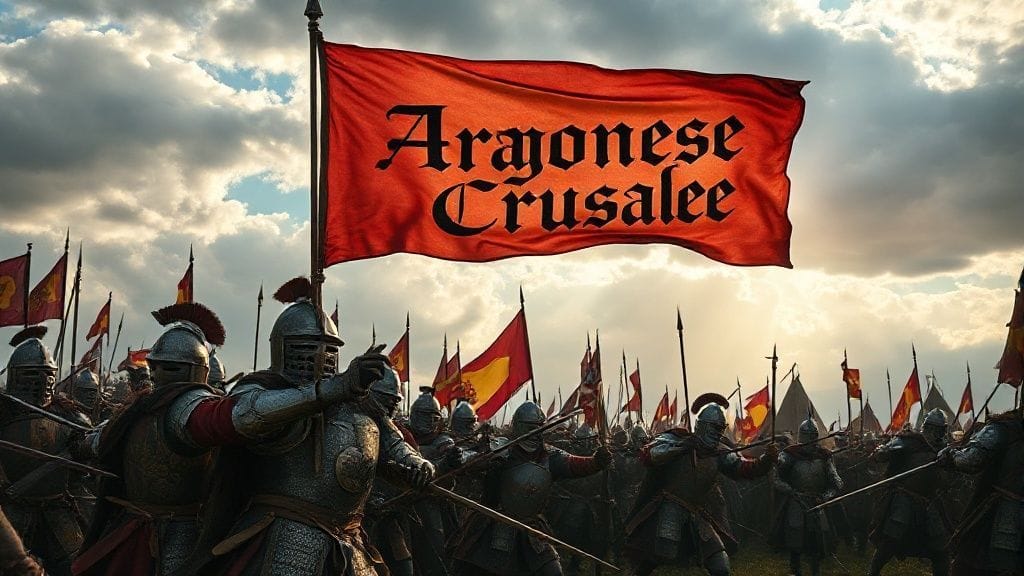
The summer sun hung high over the rugged mountains of Catalonia in 1284, as impassioned cries echoed through the ancient valleys. Spears clanged, horses thundered on cracked earth, and the fate of kingdoms teetered between faith and ambition. The Aragonese Crusade was not just a war of swords—it was a collision of dynasties, theology, and the fiercely independent spirit of Catalonia itself. This conflict was at once a papal crusade and a dynastic war, a saga of kings and popes, knights and commoners, all caught in the maelstrom of 13th-century Mediterranean politics.
As the French army marched into Aragonese lands, their pious banners fluttering alongside royal insignias, an unexpected resilience emerged from the heart of Catalonia. This was no ordinary crusade against Muslims in the Holy Land, but an internal Christian war—one which tested the limits of papal power and the burgeoning identity of the Crown of Aragon.
But how did this turbulent saga ignite, and what would it leave behind? To understand the Aragonese Crusade is to follow the tangled threads of politics, religion, and cultural pride that framed late medieval Europe.
2. The Death of Manfred and the Rise of Peter III
The roots of the Aragonese Crusade stretch back to the shifting map of southern Europe after the chaotic Hohenstaufen dynasty’s demise. Manfred of Sicily, the last truly mighty Hohenstaufen ruler and a thorn in the side of papal ambitions, had fallen at the Battle of Benevento in 1266. His defeat set off a violent power struggle for the control of Sicily and southern Italy.
Peter III of Aragon, married to Constance, Manfred's daughter, inherited not only a dynastic claim to Sicily but also an enemy. In 1282, the infamous Sicilian Vespers—an uprising against French Angevin rule—broke out, leading Peter to seize the opportunity to assert his right to the Sicilian crown. By doing so, Peter positioned himself against the French king, Philip III, and Pope Martin IV, who backed the Angevins.
This single act transformed the political landscape, turning a popular rebellion into an international conflict with Crusader undertones.
3. Papal Ambitions and the Call to Arms
Pope Martin IV, a staunch supporter of the Angevin cause, viewed Peter's conquest not only as a political affront but as heretical defiance of papal authority. For the papacy, control of Sicily was essential: it was the gateway to influence over the Mediterranean and a direct challenge to the temporal power of the Church.
In a decisive rebuke, Martin IV excommunicated Peter III and declared a crusade against him. The rhetoric echoed earlier crusading calls—not to the Holy Land, but to a Christian king regarded by Rome as a rebel and heretic. This was an unprecedented use of crusading legitimacy to endorse a war between Christian rulers, blurring the lines between spiritual warfare and political expediency.
4. The Catalan Crown and the Crown of Aragon
The Crown of Aragon was not merely a territorial entity but a federation of distinct realms—Aragon, Catalonia, and Valencia—each with its own laws, languages, and customs. Peter III’s authority was complex, balancing these multiple identities with his ambitions beyond the Pyrenees.
Catalonia, with its proud merchant cities and fiercely independent nobility, was pivotal during the crusade. The local support for Peter’s claim to Sicily was driven as much by economic interests and regional pride as by loyalty to the monarch. Thus, the war within Catalonia was as much internal as external, a defense of the Crown’s autonomy against French encroachment.
5. France’s Motives: Ambition Beyond Piety
King Philip III of France had inherited Angevin claims in southern Italy and faced pressure both from the papacy and from his nobles to respond to the Aragonese seizure of Sicily.
France’s motives were tinged with ambition. The northern kingdom sought to expand its influence onto the Mediterranean, thwart the rising power of Aragon, and solidify alliances through land and marriage. The crusade offered a veneer of religious legitimacy to what was essentially a dynastic and territorial campaign.
Yet the French court’s underestimation of the terrain and the Catalan populace’s tenacity would prove fatal.
6. The Papal Declaration of Crusade
In December 1283, Pope Martin IV issued the papal bull Persecutionem, officially branding Peter III a heretic and calling all Christian princes to arms against him.
This declaration was a masterstroke of medieval propaganda: the crusade was framed as a holy mission to restore order and faith. Princes who joined were promised indulgences and the same spiritual rewards granted to those who fought in the Holy Land.
This papal endorsement transformed the conflict into a geopolitical drama involving not only France but also Genoa, the Papal States, and other Italian powers.
7. The Initial Invasion: French Forces Land in Catalonia
In spring 1285, a formidable French expeditionary force, led by King Philip III himself, landed in the Roussillon region, a key frontier between France and Catalonia.
Their numbers were vast, possibly exceeding 30,000 men, including seasoned knights, mercenaries, and crossbowmen. Their arrival sent shockwaves through Catalonia, where the local lords hastened to rally behind Peter.
However, the terrain favored the defenders. Narrow mountain passes, fortified towns, and the resolute population transformed the invasion into a protracted siege war rather than a swift conquest.
8. The Siege of Girona and the Resistance of Aragon
The city of Girona, a strategic stronghold near the French border, bore the brunt of the initial assault.
For months, French forces besieged the city, deploying siege engines and attempting to breach the walls. But Girona’s defenders, led by local commanders and backed by loyal militias, held firm.
The siege became a symbol of Catalan resistance—a testament to the determination of a people fighting for their homeland and king.
9. The Struggle for Control of the Mediterranean
While the land war raged, the battle for dominance extended to the Mediterranean Sea. Control of coastal ports and naval routes was crucial.
Peter III’s claim to Sicily sparked a naval contest with the Angevins and their allies, particularly the Genoese, who had vested interests in maritime trade and power balance.
The Mediterranean became a chessboard of fleets vying for supremacy, with piracy, commerce, and diplomacy intertwined.
10. Naval Battles and the Role of the Crown of Sicily
Peter III’s Sicilian base provided a vital launching point for naval operations.
The Crown of Sicily’s fleet, though smaller than the Genoese or French, proved agile and well-led. Many naval engagements sabotaged French supply lines, hampered reinforcements, and insured that the French army remained isolated and exhausted on land.
Sea power played a subtle yet decisive role, helping to tilt the balance toward the Aragonese cause.
11. The Political Chessboard: Allies and Betrayals
Beyond the battlefield, alliances shifted like quicksand.
The papacy enlisted the support of the Templars and local Italian princes, while Peter sought alliances with rebellious noble houses and maritime republics suspicious of French dominance.
Intrigue and treachery added layers to the crusade’s narrative: nobles switched sides, bribes influenced commanders, and diplomacy veiled threats with smiling faces.
12. The Battle of the Col de Panissars and French Defeat
The turning point came in late 1285 at the Col de Panissars, a mountain pass near the French-Catalan border.
Exhausted, disease-ridden, and demoralized, the French army attempted a retreat. Peter III’s forces ambushed them, inflicting heavy casualties.
King Philip III himself died shortly after from illness exacerbated by the campaign.
The French retreat signaled the failure of the crusade and the resilience of the Aragonese Crown.
13. The Collapse of the French Crusade
With the death of Philip III and the defeat at Panissars, the French offensive crumbled.
Morale plummeted, logistics faltered, and political support blurred back in France, distracted by other conflicts and internal affairs.
The pope’s crusading dream had turned into a painful debacle.
14. Peter III’s Return from Sicily and Consolidation
Buoyed by victory, Peter III returned triumphantly from Sicily to his Catalan holdings.
His authority was strengthened not simply by military success, but by the spirit of unity forged through resistance.
The Aragonese Crown stood resilient against foreign invasion and papal opposition—a rare triumph for a medieval monarch against such overwhelming odds.
15. The Aftermath: Papal Power vs. Aragonese Independence
Though chastened, the papacy refused to abandon its claim over Sicily and southern Italy.
Tensions simmered for years, fueling further crusades and conflicts known as the War of the Sicilian Vespers.
The Aragonese victory, however, marked a significant check against papal overreach and laid the groundwork for a more autonomous Mediterranean polity centered around Catalonia and Aragon.
16. Cultural Reverberations in Catalonia and Beyond
The crusade left deep scars and fertile soil for a burgeoning Catalan identity.
Literature, song, and oral tradition immortalized the resistance—heroes emerged, and the conflict embedded itself in collective memory.
The struggle against French crusaders was not only political but cultural, affirming Catalonia’s unique place in medieval Europe.
17. The Legacy of the Aragonese Crusade in Mediterranean Politics
The Aragonese Crusade reshaped power balances in the western Mediterranean.
It weakened French influence, elevated Aragon as a naval and political power, and forged new alliances across Italy and the Iberian Peninsula.
It also signaled the growing complexity of crusading as a political tool rather than simply a religious campaign.
18. Memory and Myth: How History Remembered the Crusade
In the centuries after, chroniclers portrayed the crusade variously as a noble defense of Christendom or a regrettable internecine war.
The papacy’s use of crusade rhetoric came under scrutiny by historians, while Peter III’s image oscillated between that of a defender and a usurper.
The crusade’s story continued to inspire debates on power, faith, and identity.
19. Conclusion: The End of One Crusade, the Dawn of Another
The Aragonese Crusade against Peter III was more than a failed papal venture; it was a seismic event that forged new identities, challenged spiritual authority, and shaped Mediterranean history.
It reminds us that crusades were not always clear-cut wars of religion; they were often tangled with greed, legitimacy, and human passion.
In this clash of thrones and holy mandates, the enduring human drama of medieval Europe comes vividly to life.
Conclusion
The Aragonese Crusade offers a window into a tumultuous era when kings and popes wielded sword and sigil with equal zeal. Through the smoke of battle and the echo of papal bulls, the people of Catalonia emerged not only as defenders of a monarch but as bearers of a distinct cultural identity. The papal crusade against Peter III was a crucible of medieval politics, faith, and warfare, its reverberations felt long after the last lance was lowered. Yet, beyond the grandeurs of kings and the proclamations of popes, the story remains fundamentally human—a saga of resilience, pride, and transformation.
FAQs
Q1: Why did Pope Martin IV declare a crusade against Peter III?
A1: The Pope saw Peter’s claim to Sicily, gained from the Sicilian Vespers rebellion, as a direct challenge to papal authority and the Angevin dynasty, both of which Rome supported. Declaring a crusade was a way to delegitimize Peter and rally Christian princes against him.
Q2: How was the Aragonese Crusade different from other Crusades?
A2: Unlike classic Crusades aimed at reclaiming the Holy Land from Muslims, this was a crusade within Christendom itself, pitting Catholic monarchies against each other, blurring the lines between religious war and dynastic conflict.
Q3: What role did Catalan identity play in the conflict?
A3: Catalonia’s unique legal and cultural traditions fueled local resistance against the French invasion and strengthened unity under Peter III’s rule, making the crusade also a defense of regional autonomy.
Q4: What was the outcome of the crusade for France?
A4: France suffered a military defeat, the death of King Philip III, and a setback to its ambitions in the Mediterranean, weakening Angevin and papal influence in the region.
Q5: Did the crusade have long-term effects on papal authority?
A5: Yes, it exposed limits to papal power, especially when political motives overshadowed genuine spiritual causes, setting precedents for future conflicts between secular and ecclesiastical powers.
Q6: How did naval power influence the crusade?
A6: Control of the seas was crucial; Aragonese and Sicilian fleets disrupted French supply lines, preventing swift invasions and maintaining communication and reinforcement routes, proving decisive in the conflict’s outcome.
Q7: How is the Aragonese Crusade remembered today?
A7: Often as a complex episode illustrating the intersection of faith, power, and identity in medieval Europe, it remains emblematic of Catalan resistance and the turbulent nature of crusading politics.

