Table of Contents
- A Momentous Day in Medieval Europe: Paris, December 4, 1259
- The Long Shadow of the Capetian–Plantagenet Rivalry
- Origins of an Unyielding Rivalry: Roots in the 12th Century
- The Angevin Empire and Its Discontents
- The Rise of the Capetians: A Dynasty’s Perseverance
- The Hundred Years of Tensions Before the Treaty
- King Henry III of England: Ambition and Setbacks
- King Louis IX of France: The Peace-Seeking Monarch
- The Diplomatic Overture: Prelude to the Treaty of Paris
- The Negotiations in Paris: Strategy, Concessions, and Symbolism
- The Treaty Clauses: Territorial Adjustments and Feudal Bonds
- Normandy, Anjou, and Aquitaine: Lands on the Chessboard
- Personal Fealty: A King as a Vassal—A Humbling Pact
- Religious Dimensions: The Role of the Church in Shaping Peace
- Immediate Reactions: From Courts to Commoners
- Political and Economic Implications: A Calm after the Storm?
- The Treaty’s Limits: Seeds of Future Conflicts
- Legacy of the Treaty in Franco-English Relations
- Personal Lives Intertwined: The Monarchs Behind the Politics
- The Treaty in Historical Memory: Forgotten or Fateful?
- Conclusion: A Treaty That Quieted Wars but Echoed for Centuries
- FAQs: Exploring the Treaty’s Depth and Impact
- External Resource
- Internal Link
1. A Momentous Day in Medieval Europe: Paris, December 4, 1259
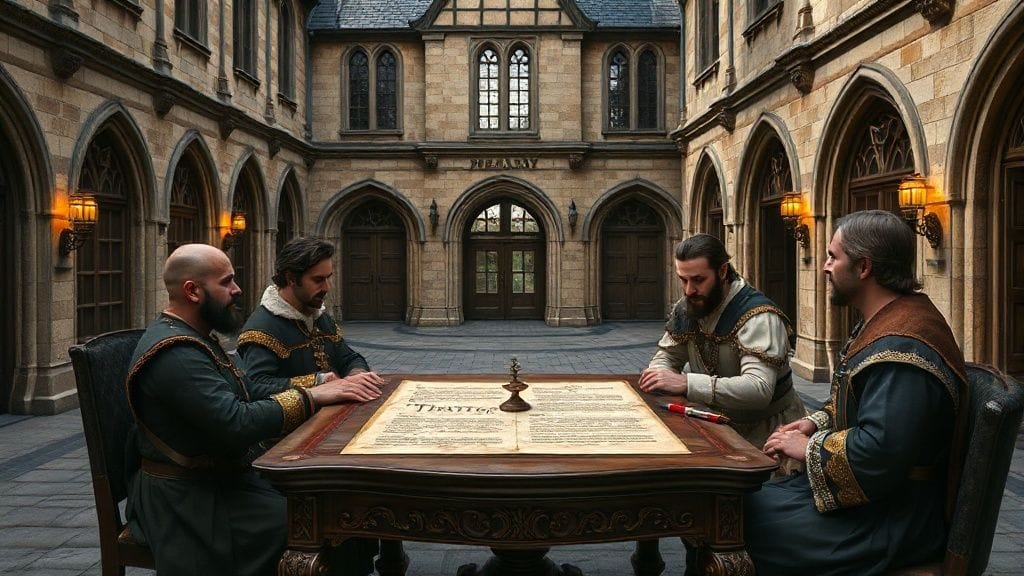
The cold December air in 1259 was thick with anticipation and the scent of fresh parchment. In the grand halls of the Louvre, beneath the soaring gothic arches, two kings sat not as fierce adversaries, but as reluctant partners seeking a fragile peace. The Treaty of Paris was about to be signed, marking the end of decades of bloodshed between the Plantagenet dynasty of England and the Capetians of France. The quills moved swiftly, ink stained fingers pressed royal seals onto the parchment, and history took a breath. For the first time in a long, bitter rivalry, hope for lasting peace flickered amid the candlelight glow.
Yet beneath the solemn ceremony lay the weight of centuries: claims, betrayals, battles, and personal vendettas woven into the fabric of the treaty’s lines. This was far from a simple document—it was a delicate balancing act between power and submission, pride and pragmatism, a testament to the complicated dance of medieval diplomacy.
2. The Long Shadow of the Capetian–Plantagenet Rivalry
To understand the significance of the Treaty of Paris in 1259, one must peer into the lingering shadow cast by one of medieval Europe’s longest-running dynastic conflicts. The Capetian and Plantagenet houses represented more than just monarchies; they embodied competing visions of sovereignty, feudal authority, and territorial dominance over the rump of what was once the Carolingian Empire.
Their rivalry was stitched into the borders of France and England, written into the ownership of castles and counties, and fought over bloodied fields stretching from Normandy to Gascony. Each battle was more than a military clash; it was a symbolic assertion of rightful rule, a contest for identity and legitimacy. The Treaty sought to draw a decisive line in the sand—yet the line proved more malleable than permanent.
3. Origins of an Unyielding Rivalry: Roots in the 12th Century
The roots of conflict plunge deep into the twelfth century with the marriage of Eleanor of Aquitaine to Henry II of England, Plantagenet King. This union catapulted vast swaths of French territory into English hands, creating what contemporaries dubbed the “Angevin Empire.” Far from a unified state, this empire was a patchwork of feudal obligations and competing allegiances.
Meanwhile, the Capetian kings of France, though less territorially expansive, cultivated an increasingly centralized monarchy intent on reining in their powerful vassals—including the English kings who held French lands. This tug-of-war for control unfolded through alliances, uprisings, and shifting loyalty, igniting the slow burn of enmity that flared into open conflict in subsequent generations.
4. The Angevin Empire and Its Discontents
The Angevin domains, stretching from Ireland to the Pyrenees, were as diverse as they were difficult to govern. Henry II’s descendants struggled to maintain authority across the scattered territories, facing resistance not only from the French crown but from fractious local lords. The logistical nightmare of ruling across the English Channel sometimes meant that each region was more a mini-kingdom than a part of a cohesive empire.
By the mid-13th century, Plantagenet rulers like Henry III confronted major challenges: rebellions, financial strains, and a growing sense that their French possessions were vulnerable. The empire’s once indomitable aura was fading, and with it, the possibility of outright dominance seemed increasingly illusory.
5. The Rise of the Capetians: A Dynasty’s Perseverance
In contrast, the Capetians steadily strengthened their grip on France. Even though they initially ruled just a fraction of the French territory compared to the expansive holdings of the Plantagenet kings, careful diplomacy and internal reforms enhanced royal authority.
King Louis IX—Saint Louis in the making—epitomized Capetian ambition married with moral gravity. His devoutness and sense of justice appealed to both the nobility and clergy, shoring up his legitimacy. He was a monarch who sought peace not only as a political necessity but as a reflection of divine will.
6. The Hundred Years of Tensions Before the Treaty
Though the Hundred Years’ War proper would erupt a century later, the roots of continuous disputes between the houses took deep hold during the 13th century. Several recent conflicts, including the Saintonge War (1242), revealed that neither side could impose complete supremacy. Each skirmish and siege only entrenched grievances and hardened attitudes.
For both kings and their nobles, fighting drained treasuries and men, risking destabilization at home. Paris in 1259 held a cautious court weary of war’s toll and eager to explore diplomatic avenues—even if suspicion lingered in every exchange.
7. King Henry III of England: Ambition and Setbacks
Henry III’s reign was marked by a dual desire to reclaim former Plantagenet glories in France and to stabilize England from internal dissent. His attempts to retake lost territories had mixed success, with costly failures dampening his prestige.
Politically, Henry faced baronial opposition that limited the resources he could commit abroad. On the continent, his position was precarious—former holdings had been lost or claimed by the French crown. Yet Henry clung tenaciously to the hope that careful treaty-making could preserve what power remained.
8. King Louis IX of France: The Peace-Seeking Monarch
Louis IX stood apart in medieval European history as a ruler driven as much by moral purpose as political calculation. His famed piety and patronage of justice painted him as a saintly figure—later canonized by the Church.
For Louis, negotiation was not just practical but sacred duty. Ending bloodshed between France and England would not only consolidate his realm but also fulfill religious ideals of peace. This ethos shaped the tone and substance of the Paris treaty talks.
9. The Diplomatic Overture: Prelude to the Treaty of Paris
The road to the 1259 treaty was paved with years of secret correspondence, emissaries crossing the Channel, and tentative meetings at neutral sites. Both monarchs recognized that endless warfare was unsustainable and costly.
Diplomats framed the treaty as a ‘peace’ born of mutual necessity rather than defeat. The English, though humbled, wanted to secure rights in Gascony and elsewhere; the French aimed to affirm sovereignty while offering leniency.
10. The Negotiations in Paris: Strategy, Concessions, and Symbolism
In the Louvre’s great chamber, negotiators paced a political tightrope. Louis IX, representing a rising monarchy, looked to assert French suzerainty over English-held territories. Henry III, aware of his weakened hand, sought favorable terms to retain crucial lands.
The delicate balance was struck through concessions on both sides—territorial revisions paired with homage owed by Henry to Louis. The very act of an English king swearing fealty to a French king was loaded with symbolism, underscoring a shifting European power dynamic.
11. The Treaty Clauses: Territorial Adjustments and Feudal Bonds
The Treaty’s articles carefully spelled out territorial holdings, ownership rights, and vassalage obligations. England renounced claims to Normandy, Maine, Anjou, and Poitou, acknowledging these as French.
In return, Louis IX confirmed Henry’s possession of Gascony and parts of Aquitaine, binding Henry as a vassal to the French crown for those lands. This feudal relationship was fraught with ambiguity but represented a compromise allowing both kingdoms breathing space.
12. Normandy, Anjou, and Aquitaine: Lands on the Chessboard
Each region carried its own economic and strategic importance. Normandy had been a Plantagenet jewel—a gateway to continental power. Anjou and Maine served as buffer zones restricting French reach. Aquitaine, with its wealth and access to the Atlantic, remained vital to English interests.
Through the treaty, France consolidated core territories at England’s expense, weaving a tighter fabric of control over northern and western France.
13. Personal Fealty: A King as a Vassal—A Humbling Pact
Perhaps the most striking aspect was Henry III’s formal submission as a vassal to Louis IX for his French lands—a protocol harking back to medieval feudalism’s complexities. This act, while legally symbolic, carried enormous political weight: the King of England humbling himself before the King of France.
For contemporaries, it was a public acknowledgment of shifting power, bruising English pride but serving as pragmatic politics to preserve peace and possessions.
14. Religious Dimensions: The Role of the Church in Shaping Peace
The Church played a quiet yet critical role in bringing about and upholding the treaty. Both kings sought papal approval and blessing for the accord, weaving spiritual authority into temporal politics.
Louis IX’s canonization shortly thereafter further sanctified the treaty’s peace aims, showcasing how medieval rulers intertwined faith and diplomacy to legitimize actions.
15. Immediate Reactions: From Courts to Commoners
News of the treaty rippled through courts and markets alike. French nobles heralded the growing strength of their crown, while English barons met the concessions with mixed feelings—relief balanced with resentment.
For common folk, weary of raids and taxes, peace offered hope, if fragile. Chroniclers recorded a shift from endless siege to cautious calm—yet many knew such peace was delicate and depended on vigilant enforcement.
16. Political and Economic Implications: A Calm after the Storm?
The treaty allowed for a period of relative tranquility in traditionally volatile border regions. Trade revived, and royal finances stabilized modestly with fewer military campaigns required.
Politically, it signaled a maturation of centralized monarchies—shifting from relentless war toward negotiated sovereignty grounded in feudal custom.
17. The Treaty’s Limits: Seeds of Future Conflicts
However, the Treaty of Paris was not a panacea. Its compromise clauses sowed ambiguity, particularly concerning vassalage and territorial jurisdictions.
Over ensuing decades, disputes over Gascony and homage rekindled old flames. The fragile peace, elegant on parchment, often faltered when tested by local ambitions and new generations’ claims.
18. Legacy of the Treaty in Franco-English Relations
Historians often see the treaty as a pivotal pause rather than a permanent peace. It reshaped the geopolitical landscape and set precedents for later diplomacy.
Its legacy echoes in the complex identity of Anglo-French relations—an oscillation between war and treaty, rivalry and alliance that continued to define medieval Europe.
19. Personal Lives Intertwined: The Monarchs Behind the Politics
Beyond politics, the treaty involved real people—monarchs with families, ambitions, fears, and faith. Henry III’s perseverance despite setbacks reveals resilience tinged with stubbornness.
Louis IX’s vision fused governance and spirituality, casting him as a uniquely influential figure whose legacy transcended this treaty.
20. The Treaty in Historical Memory: Forgotten or Fateful?
Despite its momentous signification, the Treaty of Paris 1259 often slips from popular memory, overshadowed by later, more famous conflicts like the Hundred Years’ War.
Yet for medieval chroniclers and political theorists, it represented an early paradigm of diplomacy, balancing might with dialogue and ambition with concession.
21. Conclusion: A Treaty That Quieted Wars but Echoed for Centuries
The Treaty of Paris signed on that chill December day was more than a cessation of warfare—it was a formative moment when medieval monarchs acknowledged the complex realities of power, territory, and sovereignty. It showcased the slow evolution from dynastic war to royal diplomacy, setting a tone echoed in centuries to come.
Though imperfect and temporary, the treaty carved a fragile peace from centuries of strife—a testament to the human capacity for both conflict and compromise.
Conclusion
In the flickering candlelight of the Louvre, two kings etched a fragile peace that sought to balance centuries of rivalry with a pragmatic future. The Treaty of Paris in 1259 did not merely redraw borders; it redrafted the rules of engagement between two powerful houses. It was a pause, a breath, in the ceaseless churn of medieval warfare—a moment when ambition met humility, and iron met ink.
Yet the treaty’s true legacy lies in its humanity. The recognition that even fierce enemies could stare across the table and forge a path toward peace—a lesson echoing far beyond the stone walls of Paris and the annals of history.
FAQs
Q1: What caused the prolonged conflict between the Capetians and Plantagenets?
A: The conflict stemmed primarily from territorial disputes following Henry II's marriage to Eleanor of Aquitaine, which gave English kings vast lands in France. The competing claims over these holdings and the question of feudal allegiance fueled animosity for generations.
Q2: Why was the Treaty of Paris in 1259 significant?
A: It symbolized a negotiated peace that redefined feudal relationships by having the English king recognize the French king’s overlordship for certain territories, effectively ending decades of warfare over contested lands and setting a diplomatic precedent.
Q3: What territories did England relinquish and retain under the treaty?
A: England renounced claims to Normandy, Maine, Anjou, and Poitou but retained control of Gascony and parts of Aquitaine, provinces in southwestern France crucial for trade and influence.
Q4: How did feudal homage influence the treaty’s dynamics?
A: By swearing homage to Louis IX for his French holdings, Henry III acknowledged French sovereignty in a manner that preserved some practical autonomy but marked a symbolic loss of equality between kings.
Q5: What role did religion play in the treaty’s formation?
A: Religion, especially Louis IX’s saintly reputation and ties to the Church, added moral weight to the peace process, with the papacy endorsing the treaty as a pathway to Christian harmony.
Q6: Did the treaty end hostilities permanently?
A: No. Although it ceased immediate warfare, the treaty’s ambiguous terms later contributed to renewed disputes, eventually leading to larger conflicts like the Hundred Years’ War.
Q7: How is the Treaty of Paris remembered in history?
A: Often overshadowed by later events, it remains a key example of early medieval diplomacy and the complex interplay of power, law, and ritual in shaping European history.
Q8: Who were the key monarchs involved, and what were their personal stakes?
A: Henry III of England, driven by a desire to restore Plantagenet prestige, faced political and financial challenges, while Louis IX sought peaceful consolidation of royal power guided by his devout Christian values.

