Table of Contents
- A City in Turmoil: Constantinople Before the Recapture
- The Fourth Crusade and the Latin Occupation: A City Divided
- The Empire in Exile: The Nicaean Struggle for Survival
- Michael VIII Palaiologos: The Man Who Would Reclaim an Empire
- The Path to Reconquest: Political Intrigue and Military Maneuvers
- The Night of July 25, 1261: The Seamless Return
- The Shock of the Latin Defeat: Panic and Flight
- Restoring the Byzantine Capital: Immediate Challenges
- Rebuilding a Wounded Empire: Political and Social Ramifications
- The Latin Empire’s Collapse and Its Aftermath
- Michael VIII’s Quest for Legitimacy and Diplomacy
- The Cultural Renaissance Stirred by the Recapture
- Economic Revival: Trade and Urban Life Reawakening
- Religious Dimensions: Orthodox Triumph and the Latin Legacy
- The Long Shadow of 1261: The Byzantine Empire in Retrospect
- Memory and Myth: How Constantinople’s Recapture Shaped History
- Conclusion: The City Reborn or the Beginning of the End?
- FAQs about the Recapture of Constantinople
- External Resource
- Internal Link
A City in Turmoil: Constantinople Before the Recapture
The city lay shrouded under an uneasy veil of shadows, its ancient walls still whispering stories of past glories and catastrophic defeats. Constantinople, heart of the Byzantine Empire and crown jewel of Christendom’s eastern realm, had transformed from a beacon of imperial might to a fractured refuge of despair. More than half a century had ebbed since the fateful year 1204, when armies of the Fourth Crusade sacked the Golden City, stripping it of its treasures and splintering its sovereignty. The scent of salt mingled with the iron tang of desperation, as remnants of Byzantium clung to hope like fragile tendrils, waiting for a moment—any moment—that might restore their shattered world.
That moment arrived on a midsummer night in 1261.
The Fourth Crusade and the Latin Occupation: A City Divided
The foundations of Byzantine grandeur, laid by Constantine the Great and nurtured through centuries, crumbled dramatically under the unexpected siege and conquest of 1204. The so-called Latin Empire, carved from Byzantine territories, was an alien presence atop centuries of Orthodox culture and imperial heritage. Western barons, Venetians, and crusading knights, blinded or indifferent to the complex political and religious tapestry of the city, imposed their rule with violence and opportunism.
Constantinople became a crucible of tension—between Latin rulers and Orthodox locals, Western Catholicism and Eastern Orthodoxy, conquerors entangled in fragile alliances. By 1261, the Latin Empire’s hold had weakened considerably, fractured by internal strife and external threats. The city’s population, a mosaic of grief, hope, and pragmatism, endured an uneasy status quo.
Yet, to see Constantinople only as a victim under foreign rule was to miss the relentless pulse of Byzantine resilience that never ceased beating beyond the city walls.
The Empire in Exile: The Nicaean Struggle for Survival
Following the disaster of 1204, the heart of the Byzantine political and cultural life had fled. The Empire of Nicaea, one of several successor states, emerged as the primary bastion of Byzantine legitimacy. Situated in western Asia Minor, Nicaea became the crucible where Byzantine traditions, hopes, and identity were preserved and fiercely defended.
Under successive emperors who nurtured both military and diplomatic strategies, Nicaea mobilized to oversee a slow and painstaking campaign to regain lost territories. This was no mere attempt at restoration—it was a survival of a complex civilization and an identity on the brink of extinction.
The Nicaean courts became centers of theological debate, artistic creation, and political intrigue, all tied to a singular purpose: the recapture of Constantinople and the restoration of the Byzantine Empire as a sovereign power.
Michael VIII Palaiologos: The Man Who Would Reclaim an Empire
Amid this desperate and hopeful landscape rose Michael VIII Palaiologos, a shrewd and ambitious aristocrat whose life would become entwined with the destiny of Byzantium itself. Crowned co-emperor of Nicaea in 1259, Michael quickly demonstrated political acumen and strategic brilliance beyond his years.
Unlike many predecessors who dreamed of glory, Michael balanced military competence with calculated diplomacy. His vision was clear—to restore the empire by reclaiming Constantinople, not merely through force, but through clever alliances, subterfuge, and the ability to exploit the weaknesses of his adversaries.
He understood that recapturing the city would not be just a military feat but also a symbolic reclamation of Byzantine identity and legitimacy. The eyes of Christendom and the Islamic world would watch intently.
The Path to Reconquest: Political Intrigue and Military Maneuvers
The 1260s saw a tense chess game unfold across the eastern Mediterranean. The Latin Empire, weakened and isolated, faced threats from rival claimants and local rebellions. Michael VIII capitalized on these fractures.
In a campaign marked by cunning rather than all-out warfare, agents of Nicaea penetrated Constantinople's defenses long before any sword was drawn. Rumors, espionage, and secret pacts formed the prelude to reconquest.
It was said Michael VIII maintained a network of sympathizers within the city—Orthodox inhabitants desperate for liberation, disaffected Latin nobles, and mercenaries seeking favor. His forces awaited but exact timing remained fluid, choosing patience over rash action.
The Night of July 25, 1261: The Seamless Return
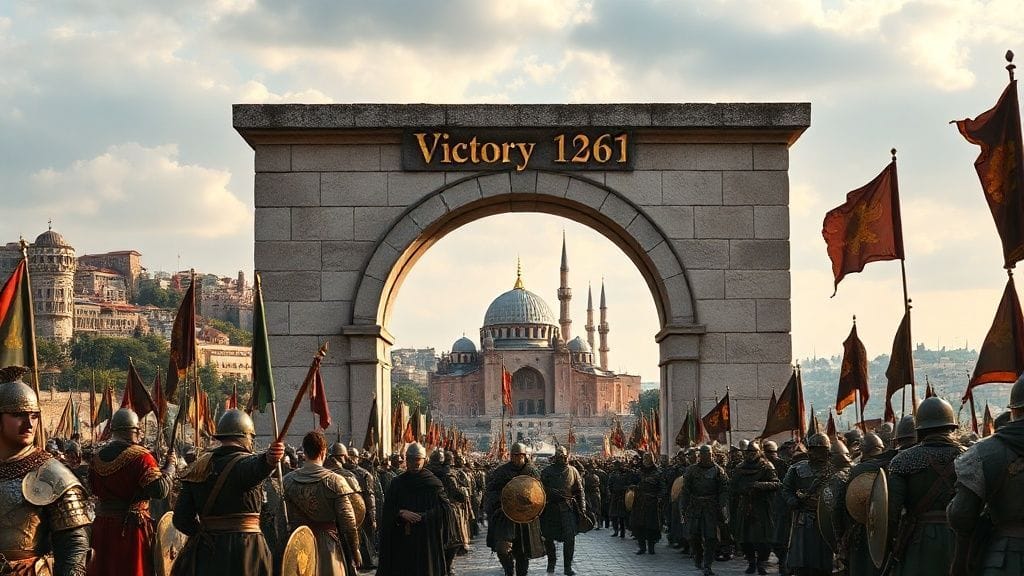
The summer night of the 25th of July was thick with anticipation. Under cover of darkness, a scouting party led by Alexios Strategopoulos, a general under Michael VIII, discovered that the Latin garrison guarding the city’s weaker northern defenses had been reduced. The Latin fleet was away, and the city was vulnerable.
In a daring and almost cinematic operation, Stratopoulos and his troops slipped through a poorly guarded gate, the Gate of the Spring (Porta Prua), slipping past sleeping guards. Within hours, the tide shifted irrevocably.
Constantinople’s defiant walls, which had witnessed centuries of invasion and revival, opened to welcome Byzantine forces once more. The Latins were thrown into chaos, fleeing to their ships or scattered into exile. Panic gripped the Latin elite, their rule shattered without grand battle or protracted siege.
The Shock of the Latin Defeat: Panic and Flight
For the Latin inhabitants of Constantinople, the sudden restoration of Byzantine control was a catastrophe. High-ranking nobles, merchants, and knights hastily abandoned their homes, ships, and fortunes to escape what they perceived as ruin.
Historical accounts tell of scenes marked by confusion, desperation, and sorrow. Ships crowding the Bosporus, carrying fugitives to territories still loyal to the Latin cause. The once-proud Latin Empire, already fragmented and beleaguered, now crumbled entirely.
Yet, for many common folk, both Latin and Greek, the events signalled the dawn of a new era; but what that era meant was far from certain.
Restoring the Byzantine Capital: Immediate Challenges
Recovery was no simple matter. Constantinople, despite its grand architecture and weakly defended walls, was scarred. Looted churches bore the marks of desecration; palaces had been plundered or converted. The city’s population was diminished dramatically.
Michael VIII faced the monumental task of restoring physical infrastructure and reestablishing administrative order. The reconquest was triumphant, but the empire was fragile. Cold winter months loomed with difficulty in feeding a starved city, repairs to aqueducts and walls demanded resources, and distrust simmered beneath a veneer of rejoicing.
Rebuilding a Wounded Empire: Political and Social Ramifications
The recapture brought not only the city but also a plethora of internal dilemmas. The return of the court to Constantinople meant managing the ambitions of aristocrats, redistributing lands, and rehabilitating the Orthodox Church, whose leadership had suffered under Latin occupation.
Ethnic and religious tensions pulsed under the surface. While Orthodox Christians celebrated, Latin Catholics found themselves marginalized. Michael VIII’s regime had to balance restoring Byzantine traditions while preventing alienation of minorities vital to the city’s economy and commerce.
Moreover, the empire’s military remained overstretched, its resources limited. Securing borders against the rising Turkish beyliks and Latin remnants would continually sap Byzantine strength.
The Latin Empire’s Collapse and Its Aftermath
With Constantinople lost, the Latin Empire's fate was sealed. It survived briefly on the defensive in enclaves like the Principality of Achaea, but its political influence waned drastically. The papacy’s hopes for a Catholic dominion in the East were dashed.
This collapse had wider European implications. Venice, the major Latin power affected, realigned its strategies, focusing more on trade and colonization elsewhere. The balance of power in the Eastern Mediterranean subtly shifted, presaging future conflicts involving the Ottoman Turks.
Michael VIII’s Quest for Legitimacy and Diplomacy
Michael VIII’s political genius extended beyond military reconquest. Recognizing the fragile nature of his victory, he sought recognition from Western Europe and even the Pope, albeit cautiously.
His efforts included attempts to negotiate Church reunification between Eastern Orthodoxy and Roman Catholicism, with limited success and fierce opposition by many Byzantine clerics and nobles wary of Western influence.
Diplomatically, Michael strived to secure alliances, neutralize threats from neighboring kingdoms, and preserve what stability he could while navigating a Europe still fractured by crusades and dynastic wars.
The Cultural Renaissance Stirred by the Recapture
The return of the Byzantine emperors to Constantinople sparked a renewed interest in art, literature, and scholarship—fields revered since the city’s Golden Age.
Patrons, invigorated by the restored prestige, encouraged the copying of manuscripts, the creation of lavish mosaics, and the rebuilding of churches, most notably the Hagia Sophia.
This cultural renaissance, though constrained by resources, reaffirmed Byzantine identity and contributed to a rich legacy that would influence Renaissance humanism centuries later.
Economic Revival: Trade and Urban Life Reawakening
Trade hubs along the Bosporus began to bustle once more, as merchants cautiously returned and new commercial treaties rekindled networks with Venice, Genoa, and beyond.
Constantinople’s unique position as a crossroads between East and West regained vitality, albeit unevenly and slowly. The city’s population began to inch upward from its low under the Latins, housing markets revived, and guilds were re-established.
This gradual economic renewal was critical for the empire’s survival, showing the indispensable link between political sovereignty and urban prosperity.
Religious Dimensions: Orthodox Triumph and the Latin Legacy
With the empire’s restoration came a passionate resurgence of Orthodox Christianity. Churches were cleansed of Latin symbols, Orthodox clergy reinstated, and religious festivals celebrated with renewed fervor.
The ecclesiastical victory was not merely spiritual—it underlined a rejection of Latin influence and a reassertion of Byzantine theological traditions. But the shadow of the Latin occupation lingered, complicating relations between Greeks and Latins and shaping religious dialogue for generations.
The Long Shadow of 1261: The Byzantine Empire in Retrospect
The recapture of Constantinople in 1261 is often portrayed as the last great Byzantine triumph. But while it restored the empire’s capital and its ruler’s prestige, it also marked the beginning of a long decline that would culminate in the city’s fall to the Ottomans in 1453.
Michael VIII’s reign was a delicate balancing act—seizing glory but inheriting vulnerabilities. Byzantium would never again be the dominant imperial power it had been before 1204, trapped by economic weakness, internal factionalism, and external enemies.
Yet, the event remains a testament to resilience and the indomitable will to reclaim identity and power.
Memory and Myth: How Constantinople’s Recapture Shaped History
Throughout centuries, the story of 1261 became mythologized—a symbol of hope, loss, and endurance. Byzantine chroniclers extolled the event; later historians viewed it with complexity, balancing its immediate success against its long-term consequences.
In modern scholarship, the recapture is analyzed as a pivotal moment when medieval worlds collided, and the fate of Eastern Christendom was decided in a confluence of military daring, faith, and realpolitik.
The city’s fall and rise encapsulate cycles of empire and human drama that continue to fascinate.
Conclusion
The return of Constantinople to Byzantine hands on that July night in 1261 was nothing less than a resurrection—of a city, an empire, and an identity. Michael VIII Palaiologos’s bold and delicate reconquest symbolized the persistent heartbeat of Byzantium, surviving amid ruin and fragmentation.
Yet, that night was both an end and a beginning. It ended over half a century of exile and occupation, but it also inaugurated a century of struggle against inevitable change. The Byzantines reclaimed their capital with stealth and courage but inherited an empire weakened and surrounded by rising powers.
The stones of Constantinople whispered tales of triumph and impending twilight, reminding us that history is a tapestry woven with threads of glory, loss, resilience, and transformation.
FAQs about the Recapture of Constantinople
Q1: Why was Constantinople so important to the Byzantine Empire?
Constantinople was the political, cultural, and spiritual heart of the Byzantine Empire. Its strategic location on the Bosporus controlled trade between Europe and Asia, making it a vital economic hub and military stronghold.
Q2: What caused the Latin occupation of Constantinople?
The Latin occupation resulted from the diversion and eventual sack of Constantinople during the Fourth Crusade in 1204, where Western crusaders attacked the city instead of proceeding to the Holy Land, motivated by political and economic interests.
Q3: Who was Michael VIII Palaiologos, and why is he significant?
Michael VIII was the Byzantine emperor who restored Byzantine rule in Constantinople in 1261. His combination of military strategy and diplomatic skill led to the empire’s restoration, albeit temporarily.
Q4: How did the recapture affect the Latin Empire?
The fall of Constantinople in 1261 led to the collapse of the Latin Empire, ending Western control of the city and weakening Latin influence in the region.
Q5: What were the main challenges after the reconquest?
Rebuilding the city’s infrastructure, managing religious tensions, restoring political order, and defending the empire’s borders were major challenges facing Michael VIII's regime.
Q6: Did the recapture lead to a lasting Byzantine revival?
While the recapture was a symbolic revival, the Byzantine Empire remained weakened and eventually fell to the Ottomans in 1453. The event delayed, but did not prevent, the empire’s decline.
Q7: How is the event remembered today?
It is remembered as both a miraculous restoration and a poignant moment of transition, symbolizing Byzantine resilience but also the fragility of empires.
Q8: How did the recapture influence Orthodox Christianity?
The event reaffirmed Orthodox religious dominance in Constantinople and intensified the divide between Eastern Orthodoxy and Roman Catholicism.

