Table of Contents
- A Frozen Dawn Over Benevento: The Eve of Battle
- The Kingdom Torn Apart: Background to a Fatal Confrontation
- The Rise of Manfred: Bastard King or Reluctant Ruler?
- Charles of Anjou: The French Prince with a Papal Mandate
- Papal Ambitions and the Guelph-Ghibelline Divide
- The Gathering Storm: Forces Assemble Near Benevento
- The Armies and Their Commanders: Clash of Ideologies and Bloodlines
- February 26, 1266: The Battle Unfolds
- Manfred’s Last Stand: Courage and Desperation in the Face of Defeat
- The Death of a King: The Fall of Manfred and Its Symbolism
- Charles of Anjou’s Victory: Triumph Beyond the Battlefield
- Political Earthquake: The End of Hohenstaufen Rule in Southern Italy
- The Kingdom of Sicily Recast: New Powers and New Orders
- Cultural Echoes: Art, Poetry, and Memory of the Battle
- The Papacy’s Golden Hour and the Politics of Power
- The Consequences for the Mediterranean World
- The Battle’s Place in the Guelph-Ghibelline Wars
- How Benevento Reshaped Medieval Italy’s Map
- Myths and Legends Born from the Battlefield
- The Legacy of Manfred and Charles in Historical Memory
- Benevento Today: The City as a Living Monument
- The Battle in Modern Scholarship and Public Imagination
- Lessons from Benevento: War, Power, and Destiny
- Conclusion: The Triumphs and Tragedies of Benevento
- Frequently Asked Questions
- External Resource
- Internal Link
1. A Frozen Dawn Over Benevento: The Eve of Battle
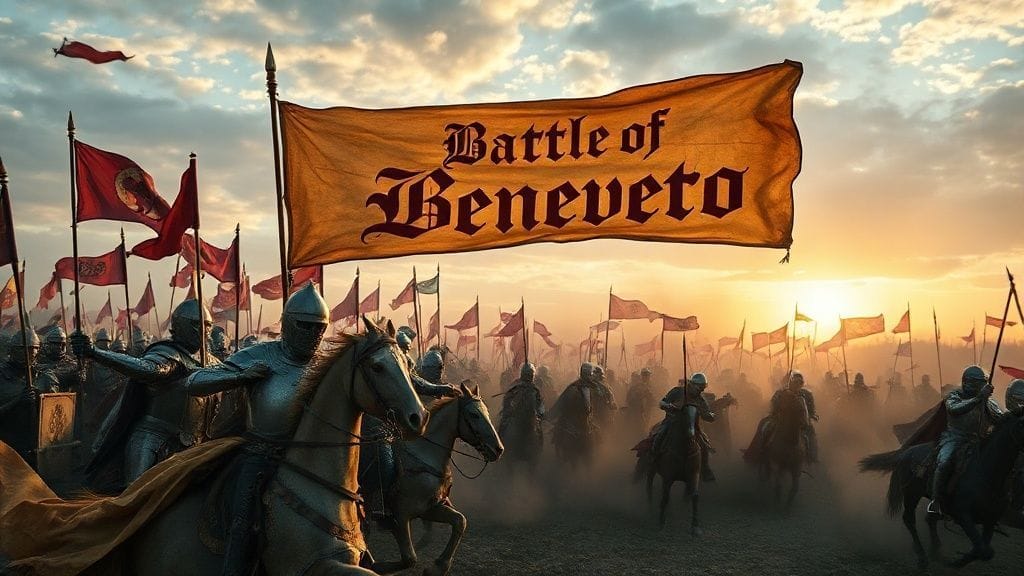
The winter air bit sharply across the plains near Benevento on that fateful morning of February 26, 1266. Mist clung to the earth, like a shroud drawn tight over the waiting armies. Soldiers gripped their weapons, breath steaming in the cold, eyes fixed not just on the enemy line but on the something far deeper—on what destiny might unfold this day. The drums echoed, a death knell in the brittle silence, before the crashing storm of steel and blood burst forth.
The Battle of Benevento, often overshadowed by other medieval conflicts in the popular imagination, was a turning point of monumental consequence. It was not just a war waged for land or crown, but a brutal clash of blood, faith, and power—a violent punctuation mark in the saga of Italy’s fractured identity during the 13th century. Here, on that icy field, the future of the Kingdom of Sicily and indeed much of southern Italy was sealed.
2. The Kingdom Torn Apart: Background to a Fatal Confrontation
To grasp the full gravity of Benevento, one must look beyond the immediate clash and peer into the tangled web of dynastic rivalries, Papal politics, and local factionalism shaping Italy. The Kingdom of Sicily, stretching across the island of Sicily and large parts of southern Italy, was a jewel coveted by Europe’s mightiest families and the Roman Church itself.
Since the death of Emperor Frederick II in 1250, the kingdom had fractured under the rule of his illegitimate son, Manfred, whose hold on power was both precarious and defying. The Hohenstaufen dynasty, proud bearers of imperial claims, but despised by the papacy for their ambitions and defiance, stood at odds with the Guelph faction led by the Pope. The Papacy, desperate to curtail Hohenstaufen influence in Italy, looked outward for a champion—Charles of Anjou, brother of the French king Louis IX.
This collision was not merely military but ideological: the entrenched imperial sovereignty against the spiritual and temporal reach of the Papacy. Benevento thus simmered for years, a boil waiting to explode.
3. The Rise of Manfred: Bastard King or Reluctant Ruler?
Manfred’s story is one painted with dark strokes of tragedy and tenacity. Born in 1232 as the illegitimate son of Frederick II, he grew into a formidable warrior and astute ruler. But legitimacy was a constant shadow over his court.
Following the death of Conrad IV, Frederick’s legitimate heir, Manfred acted as regent for his young nephew Conradin, yet the tides of rebellion and papal maneuvering forced him to declare himself king in 1258. Seen by many as a usurper but by others as a defender of order, Manfred’s reign was defined by fierce battles with the Papal states and the Guelph factions.
His military skill was undeniable. He was a clever tactician, a leader whose presence on the battlefield was both inspirational and chilling. Yet beneath the armor and the crown lay a man caught between duty, honor, and the ruthless game of medieval power.
4. Charles of Anjou: The French Prince with a Papal Mandate
Enter Charles of Anjou, a figure who might have seemed peripheral in the grand tapestry of Europe before the Benevento campaign, but whose fortunes rose dramatically thanks to his royal lineage and papal favor.
The younger brother of Louis IX of France, Charles had ambitions shaped as much by divine mandate as by dynastic claim. In 1263, Pope Urban IV and then Clement IV offered him the crown of Sicily, aiming to replace the Hohenstaufen dynast with a ruler loyal to Rome.
Charles was a man of contrasts: cultured yet ruthless, devout yet politically shrewd. His forces were a motley army of French knights, mercenaries, and Italian allies hungry for change. Behind his spotless armor hid a man ready to reshape the destiny of southern Italy with brute resolve.
5. Papal Ambitions and the Guelph-Ghibelline Divide
This battle cannot be understood without the backdrop of the age-old Guelph-Ghibelline conflict that split Italy’s city-states and noble houses into opposing camps. The Ghibellines stood for imperial power and the sacred rights of emperors like the Hohenstaufens; the Guelphs were defenders of Papal authority and often restless city liberties.
The Papacy’s campaign to wrest Sicily from the Hohenstaufens was part of a broader strategy to assert control over Italy and diminish imperial influence. Charles’s arrival was thus more than a replacement king’s arrival: it was the embodiment of Papal will armed with French steel.
Benevento was the spark that ignited this struggle, a marker of whether the Ghibellines or the Guelphs would dominate Italy’s destiny.
6. The Gathering Storm: Forces Assemble Near Benevento
By early 1266, manpower and supplies had converged on the strategic town of Benevento, a fortress and crossroads coveted by both sides. Manfred marshaled approximately 12,000 men—knights loyal to his banner and local troops hardened by years of warfare.
Charles commanded a comparable force, roughly 15,000, buoyed by French heavy cavalry, Italian Guelph allies, and mercenaries. The men encamped within sight of one another, setting the stage for confrontation.
Tensions ran high—letters were sent, emissaries interrogated, and the Pope’s blessing lent an almost sacred aura to Charles’s campaign. For both leaders, this was a moment to claim not merely the sword, but history itself.
7. The Armies and Their Commanders: Clash of Ideologies and Bloodlines
On the battlefield, each side reflected more than military might—it embodied conflicting visions of legitimacy and destiny. Manfred’s forces were seasoned fighters, inspired by the legacy of imperial Rome and a fiercely regional pride. Their banners bore the eagle of the Hohenstaufens, and their loyalty was personal, born of years of campaigning.
Charles’s knights carried the fleur-de-lys, bearing the French crown’s glory, and wielded a superior organization reflective of French military reforms. Underneath the helmets were men motivated by papal blessings, the lure of land, wealth, and redemption from chaos.
The commanders themselves were larger-than-life: Manfred, grim and experienced; Charles, confident and calculating. Their decisions, gestures, and tactics on that cold February morning would ripple through time.
8. February 26, 1266: The Battle Unfolds
The battle began with a thunderous charge of Charles’s cavalry, crashing against Manfred’s lines. The bells of Benevento tolled mournfully as both sides clashed in a cacophony of steel and cries. The ground shook with the fury of horses, the flash of lances, and the desperate fights of infantry.
At first, Manfred’s troops held firm, repelling the initial onslaught with disciplined formations and counter-strikes. Yet the numerical superiority and the tactical innovations of Charles slowly turned the tide.
A defining moment came when Manfred personally led a charge attempting to break the French center—a desperate gambit that would seal his fate. Wounded and outnumbered, Manfred’s forces began to falter, the lines breaking under the relentless push.
9. Manfred’s Last Stand: Courage and Desperation in the Face of Defeat
In the chaos, amidst the swirling fog of war, Manfred fought with the valor that would become legend. According to chroniclers, he refused to flee, rallying his men even after being wounded. But fate was cruel.
Captured or killed outright remains debated, but it is clear that Manfred fell in combat, his death marking the end of an era. His blood spilled on the frozen earth mingled with the hopes and fears of a kingdom torn apart.
10. The Death of a King: The Fall of Manfred and Its Symbolism
Manfred’s death was no mere casualty—it was a symbol of the demise of Hohenstaufen power in Italy. Contemporary accounts painted him as a tragic hero, a reminder of the costs of dynastic ambition and papal politics.
His body was initially left on the field, a grim spectacle, before being recovered with dignity by supporters. The fall reverberated through Europe, shaking the alliances and foreshadowing new conflicts.
11. Charles of Anjou’s Victory: Triumph Beyond the Battlefield
For Charles, victory was both a personal and divine mandate fulfilled. He rode triumphant into Benevento, bearing not just a trophy, but a crown that would redefine Italy’s political landscape.
Yet his triumph came shadowed by the heavy burden of rule—many Italians welcomed him as liberator but others bristled under foreign domination. Nevertheless, Benevento was his coronation in blood and steel.
12. Political Earthquake: The End of Hohenstaufen Rule in Southern Italy
With the defeat at Benevento, the centuries-long dominance of the Hohenstaufens in southern Italy ended abruptly. The Kingdom of Sicily shifted into new hands, becoming a crown for the Angevins under Charles.
This change destabilized old orders, provoking resistance, rebellions, and new alliances, as the territory adjusted to foreign governance.
13. The Kingdom of Sicily Recast: New Powers and New Orders
Charles sought to reshape Sicily politically, socially, and economically. He imposed French feudal structures, encouraged the arts—reflecting his brother Louis’s influence—and strengthened ties with the Papacy.
But Benevento foreshadowed decades of unrest, including the infamous Sicilian Vespers uprising in 1282, triggered by native opposition to Angevin rule.
14. Cultural Echoes: Art, Poetry, and Memory of the Battle
The Battle of Benevento inspired poets and chroniclers alike. From Italian troubadours lamenting Manfred’s fall to French ballads exalting Charles’s rise, the event infused medieval raconteurs with drama and pathos.
Manfred became a romantic figure—tragic and noble—while Charles’s image oscillated between divinely sanctioned king and foreign oppressor.
15. The Papacy’s Golden Hour and the Politics of Power
The papal victory was perhaps even more momentous than that of Charles. For a moment, the Popes flexed unrivaled political muscle, ending imperial threats and extending their influence.
Yet their triumph sowed the seeds of later conflicts, as papal interference would provoke resentment and instability in Italian politics for centuries.
16. The Consequences for the Mediterranean World
Benevento’s outcome rippled beyond Italy—shaping the Mediterranean geopolitical balance. It influenced crusader policy, maritime power distributions, and the complex relations between European kingdoms, Byzantium, and emerging Islamic states.
The Angevin rise in Sicily made it a central node in Mediterranean trade and diplomacy.
17. The Battle’s Place in the Guelph-Ghibelline Wars
Benevento was a pivotal chapter in the wider Guelph-Ghibelline saga, a symbolic and catalytic defeat for the Ghibellines.
This battle underscored the deep fissures that would continue to define Italy’s political landscape, and shaped the alliances and enmities of Italian city-states for generations.
18. How Benevento Reshaped Medieval Italy’s Map
The battle altered territorial control dramatically. The loss forced the collapse of Hohenstaufen fortresses and the realignment of northern Italian cities.
This new distribution of power shifted the trajectory of Italian unification hundreds of years ahead of its time.
19. Myths and Legends Born from the Battlefield
Stories proliferated—the ghost of Manfred wandering the battlefield, Charles’s ominous rise as a usurper, or the mysterious powers that some claimed tilted the fight.
These myths enriched local folklore and kept the memory alive long after the clashing armies faded.
20. The Legacy of Manfred and Charles in Historical Memory
Historians and storytellers have preserved Manfred as a figure of lost nobility and defiant resistance, a tragic king caught in forces beyond control.
Charles, meanwhile, stands as an archetype of medieval ambition and papal proxy—both hero and villain depending on who tells the tale.
21. Benevento Today: The City as a Living Monument
Modern Benevento still carries the echoes of its bloody past in its ancient walls, churches, and monuments. The site of the battle is marked and remembered, a place where past and present intersect.
Local commemorations and scholarly works ensure the battle remains an object of reflection and identity.
22. The Battle in Modern Scholarship and Public Imagination
Current historians debate the battle’s nuances—tactics, motivations, and its broader impact—with fresh perspectives from archaeology and manuscript studies.
Public imagination, meanwhile, often romanticizes the players, drawing parallels with timeless themes of fate and fortune.
23. Lessons from Benevento: War, Power, and Destiny
Benevento teaches us about the fragility of kingdoms, the interplay of divine and secular powers, and the human cost behind the shifting tides of history.
It invites reflection on leadership, legitimacy, loyalty, and the enduring consequence of conflict.
24. Conclusion: The Triumphs and Tragedies of Benevento
The Battle of Benevento was not merely a clash of armies—it was a crucible where the fate of southern Italy was forged in ice, blood, and ambition. Manfred’s fall and Charles’s rise encapsulate the eternal human drama of power wrested and lost, of dreams realized and shattered.
As the dust settled on that frozen February day, the course of the Mediterranean, the Papacy, and European politics changed irrevocably. Benevento remains a testament to the dramatic interplay of forces—human and divine—that shape history’s relentless march.
Frequently Asked Questions
Q1: What caused the Battle of Benevento in 1266?
A1: The battle was caused primarily by the struggle for the throne of the Kingdom of Sicily after the death of Frederick II and the contested rule of his illegitimate son Manfred, combined with the Papacy’s efforts to remove Hohenstaufen control and establish a loyal ruler in Charles of Anjou.
Q2: Who were the main leaders at the Battle of Benevento?
A2: The two central figures were Manfred of Sicily, the Hohenstaufen king defending his reign, and Charles of Anjou, the French prince backed by the Papacy seeking to claim the Sicilian crown.
Q3: How significant was the battle in the context of the Guelph-Ghibelline conflicts?
A3: Extremely significant—it marked a decisive Guelph victory that ended much of the Hohenstaufen (Ghibelline) influence in southern Italy and shifted the balance of power in favor of Papal-aligned forces.
Q4: What were the immediate consequences of Charles’s victory?
A4: Charles became King of Sicily, initiating Angevin rule in southern Italy, which altered local governance, provoked resistance, and reshaped political alliances.
Q5: How did the Papacy benefit from the outcome of Benevento?
A5: The Papacy weakened a major rival power, the Hohenstaufen emperors, solidifying its influence in Italy and asserting greater control over the peninsula’s political affairs.
Q6: What is the legacy of Manfred in history?
A6: Manfred is remembered as a tragic, valiant figure—sometimes villainized, sometimes romanticized—symbolic of resistance against papal dominance and the complex nature of medieval kingship.
Q7: Did the battle have any cultural impact?
A7: Yes, it inspired numerous poems, legends, and historical accounts, contributing to both French and Italian cultural memory and artistic expression.
Q8: How is the Battle of Benevento remembered today?
A8: It is commemorated locally in Benevento through monuments and academic studies, serving as a symbol of Italy’s layered medieval history and the tumultuous nature of power struggles.

