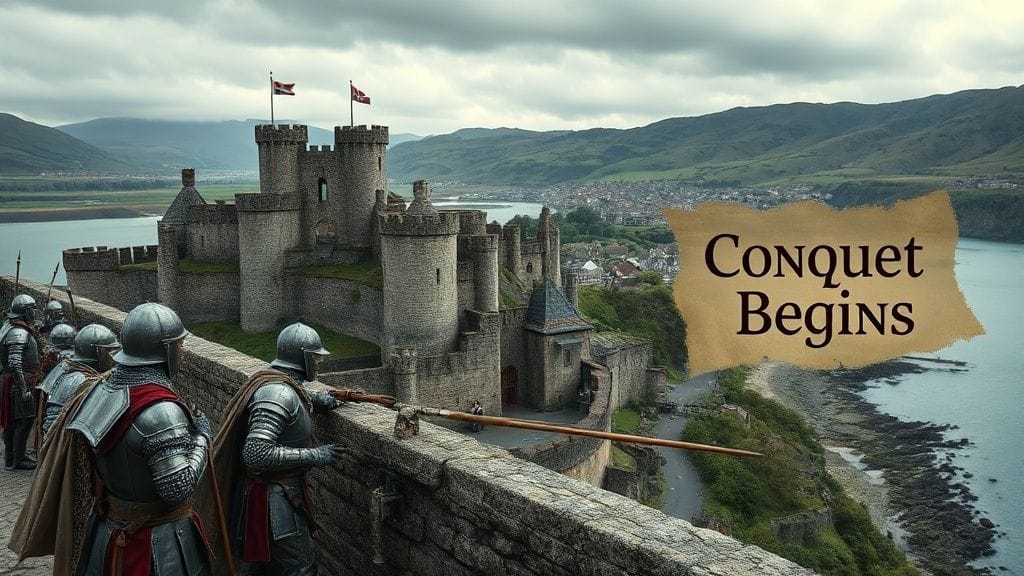
Table of Contents
- The Dawn of Conflict: Wales at the Crossroads of Power
- Llywelyn ap Gruffudd: The Last Native Prince of Wales
- Edward I’s Ambitions: A King’s Determination to Conquer
- The Marches and the Frontier: A Region on Edge
- 1277 – The First Campaign: Edward’s Invasion Begins in Earnest
- Conwy and Caernarfon: Castles of Power and Subjugation
- The Siege of Dolwyddelan and Subsequent Battles
- The Treaty of Aberconwy: A Temporary Truce Under Duress
- Renewed Hostilities: The War Resumes (1282–1283)
- The Death of Llywelyn: The Turning Point of Welsh Resistance
- The Capture and Execution of Dafydd ap Gruffudd
- Edward’s Towering Legacy: Castles as Symbols of Suppression
- The Imposition of English Law and Governance
- The Cultural and Linguistic Impact on Wales
- The Persistence of Welsh Identity Post-Conquest
- The English Conquest in the Wider Context of Medieval Britain
- Personal Stories from the Conquest: Nobles, Soldiers, and Commoners
- Archaeological Insights: What the Castles Tell Us Today
- The Conquest’s Legacy in Welsh National Memory
- Conclusion: The Conquest as a Defining Moment in Welsh History
The English Conquest of Wales Begins in Earnest, Conwy–Caernarfon, Wales | 1277–1283
The Dawn of Conflict: Wales at the Crossroads of Power
The mist clung low over the rugged landscapes of North Wales as the first banners of King Edward I’s army unfurled against the cold dawn sky. Through tangled woods and beside rushing rivers, the sound of marching feet echoed with an ominous promise. It was 1277, and the age-old struggle between the English crown and the Welsh princes was about to enter a fateful new chapter.
Wales in the late 13th century was a land shaped by fragmented principalities, fierce loyalties to lineage, and a fiercely independent Celtic culture still resilient after centuries of English encroachment. This rugged land had been the heart of violent contest since Norman times. Yet, by the 1270s, Llywelyn ap Gruffudd, often hailed as Llywelyn the Last, had unified substantial swathes of Wales under his rule, proclaiming himself Prince of Wales — a title and authority that challenged English sovereignty in the British Isles. It was a moment dense with tension, a tinderbox waiting to ignite.
The conquest would not only redefine the physical territories of Wales but reshape identities and histories for generations to come. But to understand the gravity of the English campaign sweeping in around Conwy and Caernarfon, one must first peer into the complex web of allegiance, power, and ambition that knitted medieval Wales and England together in a reluctant, violent embrace.
Llywelyn ap Gruffudd: The Last Native Prince of Wales
Llywelyn ap Gruffudd was no mere regional potentate; he was a symbol, a beacon of Welsh hopes for autonomy and unification. Ascending in the mid-13th century, Llywelyn inherited a fractured country from his grandfather Llywelyn the Great and dedicated much of his reign to consolidating fragmented Welsh territories into a singular principality.
Years of intermittent warfare, diplomacy, and alliances with both Welsh lords and the English crown marked Llywelyn’s tenure. His hold on north Wales, especially Gwynedd, was strong, cemented through both strategic marriages and military savoir-faire. In 1267, through the Treaty of Montgomery, King Henry III formally acknowledged Llywelyn’s title, a political triumph that sent ripples through the royal courts of England. Yet this recognition placed Llywelyn in the crosshairs of his ambitious successor, Edward I.
Llywelyn was beloved by many of his countrymen, admired for his leadership, but his growing influence was perceived as a dangerous threat that could reignite Welsh resistance on a scale the English crown was determined to quash forever.
Edward I’s Ambitions: A King’s Determination to Conquer
Edward I, who came to the English throne in 1272, was a monarch defined by military zeal and administrative rigor. His vision was to extend English rule and bring a long-term peace to the turbulent Welsh borderlands by force if necessary. More than a king, he was a builder and strategist, keenly aware that the age-old frontier between England and Wales remained a festering wound in his realm’s unity.
His campaign was as much about personal glory as about realpolitik; subjugating Wales would not only secure the western border of England but establish the young king’s reputation as the “Hammer of the Welsh.” Edward recognized that to truly pacify Wales required more than field victories; it demanded permanent symbols of domination and control.
Thus, the sieges and campaigns that began in 1277 would rapidly unfold into one of medieval Britain’s most significant military endeavors — from the rugged hills outside Conwy to the shores of Caernarfon, Edward’s forces sought to stamp an unshakeable English presence into the very soil. This campaign was meticulously planned, combining military might with a vision almost architectural in scale.
The Marches and the Frontier: A Region on Edge
To understand the deeper intensity of the conflict, one must not overlook the nature of the Welsh Marches — the borderlands where English and Welsh cultures collided violently for centuries. Marcher lords held quasi-independent power, establishing fortified settlements that often operated like mini-states. Their loyalties ran complex; sometimes loyal to the English crown, but often pursuing their own interests by alliances with Welsh lords or outright raiding.
These rugged borderlands posed a unique challenge to English kings. To rule effectively meant subduing not only external forces but internal magnates whose ambitions might run counter to the crown’s authority. Edward I’s strategy would therefore require both the military might to break Welsh resistance and political acumen to bring unruly lords into line.
Conwy and Caernarfon, ancient Welsh strongholds turned into fortresses of English royal power, would serve as the twin anchors for Edward’s campaign, sealing off Welsh autonomy in the north.
1277 – The First Campaign: Edward’s Invasion Begins in Earnest
The summer of 1277 marked Edward’s first major campaign into North Wales. His forces moved swiftly, well-equipped and disciplined, a striking contrast to the patchwork levies historically fielded by Welsh princes. The campaign relied heavily on siege warfare, a brutal and exhausting art that Edward’s army had mastered.
Conwy, strategically perched on the coast with an imposing castle that overlooked the bay, became an immediate focus. The castle’s construction symbolized not just military outpost but psychological dominance. As Edward’s royal standard flew over Conwy and Caernarfon, it became painfully clear to the Welsh that resistance was no longer merely defiance but rebellion against overwhelming royal authority.
Throughout the campaign, hundreds of Welsh families found themselves displaced; villages razed or scorched in reprisals. Llywelyn, pressed in a corner, had little choice but to negotiate. The resulting Treaty of Aberconwy drastically curtailed his powers, stripping him of control of large parts of Wales and confining him to Gwynedd alone.
Conwy and Caernarfon: Castles of Power and Subjugation
Edward’s castles at Conwy and Caernarfon were marvels of medieval military architecture. Built with stone quarried locally but crafted to English design, these fortresses were meant to be permanent symbols of subjugation. More than fortresses, they were manifestations of a new order — the physical assertion of English dominion in a land fiercely proud and fiercely independent.
Caernarfon in particular took on a special significance. Its position commanding the Menai Strait allowed control of maritime access and communication with Ireland and England. It was here Edward would later bestow the title “Prince of Wales” on his son, transforming a symbol of conquest into a royal tradition that persists over seven centuries later.
The castles functioned both as military bastions and administrative centers, stamping Edward’s governance deep into the Welsh landscape. They inspired awe, fear, resentment — and a deep undercurrent of resistance that simmered beneath the stony walls.
The Siege of Dolwyddelan and Subsequent Battles
While the imposing stone castles represented Edward’s intent to freeze his conquest, Welsh resistance flared up with notable ferocity. Smaller fortifications such as Dolwyddelan Castle, built by Llywelyn himself as a defensive stronghold, became focal points for protracted struggles.
Despite being outnumbered and often outgunned, Welsh warriors utilized their knowledge of the rugged terrain to harass English supply lines and rally local support. These skirmishes, while dwarfed in scale by Richard’s armies, symbolized a vital refusal to accept English rule unconditionally.
Many battles featured ambushes, mountain raids, and fierce stand-offs — a testament to a nation fighting for survival amid shifting alliances and brutal reprisals.
The Treaty of Aberconwy: A Temporary Truce Under Duress
The Treaty of Aberconwy in 1277 was less a peace than a truce compelled by the realities on the ground. Llywelyn was forced to recognize Edward’s superiority and surrender territory, but he retained his title as Prince of Wales, albeit hollowed of much power.
This treaty was emblematic of medieval power politics — a reluctant pause in hostilities rather than resolution. To many Welsh, it was a bitter pill, a moment where centuries of resistance seemed to falter.
But it was not the end. The treaty left many Welsh lords dissatisfied and eager for renewed rebellion alongside Llywelyn’s brother, Dafydd.
Renewed Hostilities: The War Resumes (1282–1283)
Barely five years passed before war resumed in full fury. Dafydd ap Gruffudd, Llywelyn's brother, sparked the conflict anew in 1282, attacking an English castle and effectively launching a revolt against English overlordship.
This uprising drew many Welsh nobles into the fight once more, though the tide invariably turned in favor of Edward. He responded with overwhelming force, determined to crush Welsh independence once and for all. His army invaded with brutal efficiency, systematically dismantling Welsh defenses and securing key strongholds.
The last years of the conflict were marked by fierce fights, shifting alliances, and personal tragedy.
The Death of Llywelyn: The Turning Point of Welsh Resistance
In December 1282, Llywelyn ap Gruffudd was killed during a skirmish in a remote valley in Snowdonia. His death was both a military and symbolic blow that broke the back of organized Welsh resistance.
Llywelyn’s demise threw Wales into disarray. The “Last Prince of Wales” became a martyr figure, his fall marking the end of traditional Welsh sovereignty in its highest form.
Edward’s forces swiftly capitalized on this turning point, moving quickly to secure the submission of remaining resistance.
The Capture and Execution of Dafydd ap Gruffudd
Dafydd ap Gruffudd, Llywelyn’s brother and last active leader of the revolt, was captured in 1283. His execution, ordered personally by Edward, was both brutal and unprecedented. Dafydd was the first nobleman in recorded history to be hanged, drawn, and quartered — a grisly symbol of the final, merciless step towards total conquest.
His death echoed throughout Wales, extinguishing remaining organized resistance and sending a chilling message to any would-be rebels.
Edward’s Towering Legacy: Castles as Symbols of Suppression
The castles of Conwy, Caernarfon, Harlech, and Beaumaris, constructed after the conquest, stand today as monumental testimonies to Edward’s ambition and the consolidation of English power. Beyond their military purpose, they embodied psychological conquest — cold, unyielding stone walls dwarfing the Welsh landscape and psyche alike.
These fortifications enabled England to maintain control over Wales for centuries and symbolized the loss of an autonomous Welsh polity.
Yet ironically, they also became focal points in later Welsh resistance and national memory — physical reminders of a painful past but also of resilience.
The Imposition of English Law and Governance
Following military conquest came administrative transformation. English law was gradually imposed, replacing native Welsh legal traditions that had governed for centuries under the Laws of Hywel Dda.
This legal and administrative overhaul was designed to integrate Wales into the English kingdom, fostering loyalty but often alienating the Welsh populace. English officials, sheriffs, and clerks filled roles once held by Welsh leaders, signaling a profound cultural and political subjugation.
The Cultural and Linguistic Impact on Wales
The conquest also accelerated cultural shifts. Welsh language and customs, while not eradicated, faced increasing pressure from English norms and governance. The imposition of English institutions created a marked social divide, sowing seeds of resentment but also complicity and adaptation.
Church life, education, and landholding patterns shifted in response to new ruling classes and laws, embedding English influence in the very fabric of Welsh society.
The Persistence of Welsh Identity Post-Conquest
Despite overwhelming odds, Welsh identity persisted. Poets, bards, and chroniclers preserved history and legend, weaving narratives of loss, heroism, and hope that would sustain Welsh culture deep into modern times.
The title "Prince of Wales," conferred upon Edward I’s heir, was itself a paradoxical symbol, intertwining English monarchy with Welsh symbolism, and setting the stage for complex future relations.
The English Conquest in the Wider Context of Medieval Britain
The conquest of Wales was part of Edward’s broader ambitions, including later campaigns in Scotland and Gascony. It reflected the growing centralization of power in England and the crown’s increasing military assertiveness.
Moreover, it set patterns of conquest, colonization, and resistance that would recur throughout British history.
Personal Stories from the Conquest: Nobles, Soldiers, and Commoners
Behind the grand narrative were countless individuals: English knights seeking glory, Welsh peasants forced from their homesteads, nobles who switched allegiance to survive, and families torn by war.
A memorably poignant moment comes from the chronicler’s account of a Welsh mother hiding her children in forests, hoping to shield them from the soldiers’ wrath—human stories of loss amidst history’s sweeping tides.
Archaeological Insights: What the Castles Tell Us Today
Modern archaeology has revealed much about Edward’s castles, exposing layers of construction, adaptation, and everyday life behind their forbidding walls.
These structures provide tangible links to the conquest and its aftermath, allowing us to grasp the scale, sophistication, and human costs of Edward’s campaign beyond the written record.
The Conquest’s Legacy in Welsh National Memory
The events of 1277–1283 have remained etched in the collective memory of Wales. Llywelyn ap Gruffudd is revered as a symbol of national pride and resistance.
Annual commemorations, literature, and cultural expressions keep alive the memory of conquest as both tragedy and a defining moment of Welsh identity—illuminating the past while inspiring future generations.
Conclusion
The English conquest of Wales between 1277 and 1283 was far more than a sequence of military campaigns; it was a profound collision between two worlds — a struggle not merely for land but for identity, sovereignty, and cultural survival. The stones of Conwy and Caernarfon stand today, silent witnesses, echoing stories of glory, resistance, and heartbreak.
Edward I’s military genius and ruthless determination imposed a new order, sealing the fate of Welsh independence for centuries. Yet amid the shadows of conquest, the spirit of Wales endured — through its language, poetry, and unyielding pride. This chapter of history reminds us that empires rise and fall, but the human yearning for self-determination never dims.
FAQs
Q1: Who was Llywelyn ap Gruffudd and why was he significant?
A1: Llywelyn was the last native Prince of Wales who unified much of the Welsh territories. His leadership represented the peak of Welsh independence and self-rule before English conquest.
Q2: What motivated Edward I to conquer Wales?
A2: Edward I aimed to secure his kingdom’s borders, consolidate power, and eliminate the Welsh threat to English sovereignty. His ambition was also partly driven by personal glory and the desire to build a lasting legacy.
Q3: Why were castles like Conwy and Caernarfon important?
A3: These castles were military strongholds and psychological symbols of English domination. Their construction helped solidify English control and served administrative purposes.
Q4: How did the Treaty of Aberconwy affect Welsh autonomy?
A4: The treaty curbed Llywelyn’s power by forcing territorial concessions and reducing his authority, setting the stage for future conflict.
Q5: What was the impact of the conquest on Welsh culture?
A5: English laws and governance reshaped Welsh society, pressuring language and customs. However, Welsh cultural identity persisted strongly through literature and traditions.
Q6: How is the conquest remembered in Wales today?
A6: It is seen as a tragic but defining period, with Llywelyn regarded as a national hero. The conquest influences Welsh identity and nationalist movements even now.
Q7: What role did Dafydd ap Gruffudd play?
A7: Dafydd led the final Welsh revolt against Edward after 1277 and was the last Welsh prince captured and executed, symbolizing the end of Welsh resistance.
Q8: How does this conquest relate to the broader history of Britain?
A8: It was a formative moment in the centralization of English royal power and set precedents for later conquests in Scotland and Ireland.

