Table of Contents
- The Dawn of a New Era: Edinburgh, March 17, 1328
- Scotland on the Brink: Decades of War and Resistance
- The Rise of Robert the Bruce: From Outlaw to King
- The Great Scottish Struggle for Independence
- England’s Tumultuous Reign under Edward II and Edward III
- Diplomacy in the Shadow of War: The Road to Edinburgh–Northampton
- The Negotiation Chambers: Personalities and Power Plays
- The Terms of the Treaty: What Was Agreed Upon?
- The International Context: France, England, and the Auld Alliance
- Celebrations and Skepticism: Immediate Reactions Across Borders
- Recognition and Reality: How Was Scottish Independence Enforced?
- The Treaty’s Impact on Scottish Governance and Society
- England’s Internal Struggles and the Treaty’s Fragility
- The Legacy of the Treaty in Scottish National Identity
- Long Shadows: How the Treaty Influenced Later British History
- Anecdotes from the Treaty’s Signing: Tales from Edinburgh
- Economic and Cultural Ripples in 14th Century Scotland
- The Treaty in Historical Memory: From Chroniclers to Modern Times
- Myths and Misunderstandings: Common Tales about the Treaty
- Conclusion: A Hard-Won Peace and the Birth of a Nation
- FAQs about the Treaty of Edinburgh–Northampton
- External Resource
- Internal Link
The Dawn of a New Era: Edinburgh, March 17, 1328
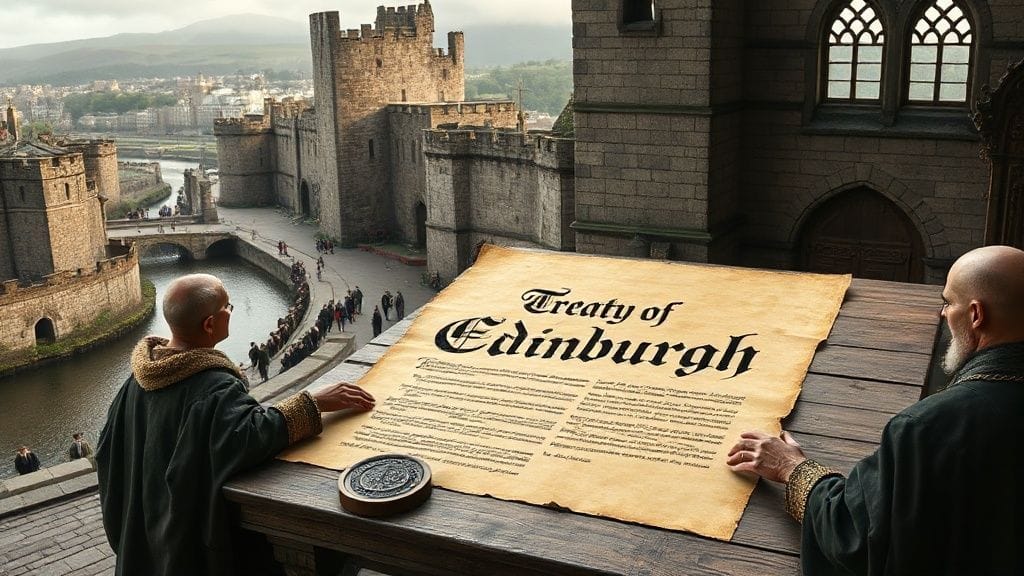
On a crisp spring day in Edinburgh, beneath a sky that seemed almost to hold its breath, an extraordinary chapter of medieval history was quietly sealed. The Treaty of Edinburgh–Northampton, signed on March 17, 1328, wasn’t merely a document inked on parchment; it was an act of recognition—a reluctant England acknowledging the fierce resilience and sovereignty of the Scottish people. The air was thick with solemn triumph and uncertain promise. For Scotland, battered and war-weary, it was a dawn of independence and hope after decades of brutal conflict. For England, it was a bitter concession, a formal acceptance of defeat in a war that had severely tested the crown’s power and prestige.
As the nobles and envoys exchanged signatures and seals within the somber halls of Edinburgh Castle, the echoes of years of struggle seemed to fade into the stone walls. Yet, few could tell if this fragile peace would endure, or if it was merely the calm before the inevitable storm. But that day marked the first time since the Wars of Scottish Independence that England officially recognized Scotland as a separate, independent kingdom—a diplomatic watershed with consequences reaching far beyond the misty borders of the Highlands.
Scotland on the Brink: Decades of War and Resistance
To understand the full weight of the Treaty of Edinburgh–Northampton, one must step back nearly three decades into a Scotland riven by war, sacrifice, and unyielding defiance. The seeds of conflict had been planted with the death of Alexander III in 1286 and the infant Queen Margaret's disappearance in 1290, plunging Scotland into a maelstrom of contested claims and political chaos. The vacuum invited England’s ambitious King Edward I, often called “Hammer of the Scots,” to stake a claim over Scotland, igniting the flames of war.
Through the 1290s and into the early 14th century, Scotland became a battleground where loyalty, rebellion, and survival intertwined. The Scots, armed with traditional clans and warriors, faced off against the well-organized English forces. Heroes emerged in this fierce crucible—Sir William Wallace, immortalized as a symbol of defiance, and later Robert the Bruce, a shrewd leader destined to alter the course of history.
This period was not just a military struggle but a battle for cultural identity, sovereignty, and the very soul of a nation desperate to remain free in the face of overwhelming odds.
The Rise of Robert the Bruce: From Outlaw to King
Robert the Bruce’s journey to kingship encapsulates the drama and complexity of these turbulent years. Born into Scottish nobility with competing claims to the throne, Bruce’s early political maneuvers were marked by opportunism and shifting loyalties. His most controversial moment came when he notoriously killed John Comyn, a rival claimant, in a church in 1306—a dark act that forced Bruce into outlawry but also cleared his path to the crown.
Bruce’s coronation at Scone was a bold proclamation, igniting a renewed phase of war aimed at securing Scotland’s independence. Employing guerrilla tactics, alliances with local clans, and calculated battles such as Bannockburn in 1314, he gradually dismantled English dominance. His leadership was a blend of charismatic inspiration and ruthless pragmatism. As England’s grip weakened, Bruce’s vision of an independent Scotland moved closer to reality.
The Great Scottish Struggle for Independence
The Wars of Scottish Independence, far from being a series of isolated battles, were a relentless campaign that tested the endurance of a fledgling kingdom against a juggernaut empire. The conflict was brutal and unyielding, marked by shifting fortunes on both sides. For the Scottish people, it was a war not only of swords but also of hearts and minds, as loyalty to the crown mingled with everyday survival.
The struggle was shaped by the complex network of loyalties among Scottish nobility, everyday villagers, and raiding clans. The interplay of international politics—especially the role of France as England’s adversary—added layers of intrigue. The war was also a test of identities, with Scotland asserting its ancient sovereignty despite centuries-long pressure.
England’s Tumultuous Reign under Edward II and Edward III
England’s political landscape was as turbulent as the battlefields. Edward I’s death left a young and inexperienced Edward II on the throne, whose reign was marred by military defeats, political discontent, and internal rebellion. Edward II’s failures, especially at Bannockburn, eroded English morale and resolve. The English nobility grew divided, and the monarchy’s prestige diminished.
When Edward III ascended, his kingdom was still grappling with the fallout. The wounds of the Scottish Wars were raw, and England’s position was fragile both at home and abroad. The English crown found itself forced into diplomatic negotiations it would rather have avoided—a tacit admission that the Scottish independence movement was a force to be reckoned with.
Diplomacy in the Shadow of War: The Road to Edinburgh–Northampton
The road to the Treaty was neither direct nor smooth. Scotland’s persistent military successes had pressured England, but prolonged conflict was draining resources and morale on both sides. Meanwhile, the complex web of European alliances—in particular, France’s support for Scotland—shaped the diplomatic environment.
Peace talks began tentatively, with mutual distrust and hard bargaining. Both kingdoms were weary yet wary. Scotland demanded recognition as a sovereign nation; England insisted on safeguards and reparations. Amid this high-stakes diplomacy, emissaries navigated a landscape of suspicion, ambition, and the fragile hope of peace.
The Negotiation Chambers: Personalities and Power Plays
The treaty negotiations were a theater of personalities as much as of policy. Robert the Bruce himself, though sometimes distant from direct negotiations, cast a long shadow. On the English side, representatives struggled to reconcile humiliation with pragmatism.
The envoys ranged from seasoned diplomats to noblemen whose loyalty was questioned. Behind closed doors, the interplay of egos, threats, and concessions shaped the treaty’s final form. Reports from chroniclers suggest moments of tension broken by unexpected compromises, revealing the very human nature of medieval diplomacy.
The Terms of the Treaty: What Was Agreed Upon?
The Treaty of Edinburgh–Northampton laid out the framework for peace and recognition. Its central clause was England’s formal recognition of Scotland as an independent kingdom, with Robert the Bruce as its lawful king. England agreed to renounce claims of overlordship, and both nations promised to cease hostilities.
Marriage alliances and reparations were woven into the treaty’s clauses, aiming to cement peace with familial and financial ties. The treaty also stipulated the return of captured lands and prisoners, and mutual promises to respect each nation’s sovereignty.
Though appearing comprehensive, the treaty reflected the tenuous balance of power—peace forged not in friendship but in exhaustion and necessity.
The International Context: France, England, and the Auld Alliance
The treaty did not exist in a vacuum. The ongoing rivalry between England and France—the Hundred Years’ War looming on the horizon—cast a significant shadow. France’s support of Scotland through the Auld Alliance was a strategic move to weaken England. The treaty effectively aligned Scotland more closely with France’s interests, creating a tripartite tension in Europe.
This international dimension added complexity, as each power sought advantage while preventing full-scale war on multiple fronts. The Treaty of Edinburgh–Northampton thus was a pivot not only in British but also in continental diplomacy.
Celebrations and Skepticism: Immediate Reactions Across Borders
For Scots, the treaty was a time of jubilation. Streets filled with cheering crowds hailed Robert the Bruce as the king who had delivered independence. Minstrels sang, and all corners of the kingdom rejoiced in a hard-fought freedom.
Yet across the border in England, the mood was far darker. Many saw the treaty as a humiliating capitulation, a stain on English pride. Skepticism abounded as to whether Scotland’s independence would endure or if this peace was merely a pause before renewed conflict.
Even within Scotland, some lords questioned whether complete peace could be guaranteed, given the recent history of betrayal and war.
Recognition and Reality: How Was Scottish Independence Enforced?
Recognition on paper, however, was just the beginning. Enforcing the treaty’s terms proved immensely challenging. Scotland still faced border skirmishes, mistrust, and the lingering presence of English garrisons in contested territories.
Robert the Bruce’s government had to solidify institutions and defenses to ensure sovereignty was respected. Diplomatic missions were sent to secure wider recognition, and the Scottish crown began the arduous work of state-building. The treaty was a foundation, but true independence demanded constant vigilance and resilience.
The Treaty’s Impact on Scottish Governance and Society
With formal peace came new opportunities and challenges for Scotland’s governance. The treaty marked the beginning of a period focused on consolidating royal authority and rebuilding a kingdom battered by war.
Legal reforms, efforts to standardize administration, and efforts to heal the divisions among Scottish nobility characterized this era. The sense of national identity strengthened, with the king’s court emerging as a center of governance and culture.
Social life, too, was affected—trade cautiously resumed, and cultural exchanges increased, even as scars from the conflict remained.
England’s Internal Struggles and the Treaty’s Fragility
Despite the treaty’s promise, England’s internal political struggles undermined its durability. Factionalism, rebellion, and the eventual deposition of Edward II kept English attention divided. Many English nobles never fully accepted Scotland’s independence, and sporadic raids along the borderlands continued.
These internal weaknesses meant the treaty was more a truce than a permanent peace. The future of Anglo-Scottish relations remained uncertain, with trust in short supply and competing ambitions simmering below the surface.
The Legacy of the Treaty in Scottish National Identity
The Treaty of Edinburgh–Northampton achieved far more than a ceasefire. It became a symbol—a declaration that the Scottish spirit, forged through struggle, would not be extinguished. For centuries, it has been a touchstone of Scottish nationalism, a proud reminder of a time when a small kingdom stood up and claimed its place among nations.
Bards sang of its significance, historians recounted its birth in the halls of Edinburgh, and the memory of this diplomatic victory became intertwined with the very narrative of Scottish independence.
Long Shadows: How the Treaty Influenced Later British History
The treaty’s ripples extended far beyond its immediate aftermath. It was an early episode in the long and complicated saga of British Isles politics—a precursor to centuries of struggle, union, and identity conflicts.
The recognition of Scottish sovereignty challenged English claims but also laid groundwork for future treaties, wars, and the eventual union centuries later. It influenced medieval diplomacy and demonstrated the power of persistence and legitimacy.
Anecdotes from the Treaty’s Signing: Tales from Edinburgh
Beyond the official record, stories from Edinburgh hint at the human dimension of this event. Chroniclers spoke of tense negotiations punctuated by moments of levity and human frailty. One envoy allegedly fainted under the strain, while another smuggled a letter promising personal gifts to smooth talks.
Local taverns retained tales of masked knights meeting under moonlight, and the castle’s stone walls echoed not only with proclamations but whispered fears about what the future might bring.
Economic and Cultural Ripples in 14th Century Scotland
The treaty also heralded subtle but important shifts in Scotland’s economic and cultural life. Markets that had once been sites of conflict began tentative exchanges. Merchant towns cautiously reopened trade routes. Artistic and literary efforts flourished under the patronage of a king eager to boost his kingdom's cultural prestige.
Economic recovery was slow, but the peace promised stability necessary for growth. New alliances opened doors to continental influences, spurring a blossoming of Scottish medieval culture.
The Treaty in Historical Memory: From Chroniclers to Modern Times
Through the ages, chroniclers like John of Fordun and later historians returned time and time again to the Treaty of Edinburgh–Northampton. Their narratives shaped how the event was remembered—sometimes romanticized, sometimes criticized.
In modern times, the treaty has been reclaimed as a symbol of legitimate sovereignty by both historians and political advocates. Exhibitions, books, and cultural celebrations celebrate it as a milestone of Scotland’s enduring quest for independence.
Myths and Misunderstandings: Common Tales about the Treaty
Despite thorough scholarship, myths continue to swirl around the treaty. Some tales exaggerate its finality, suggesting it ended all conflict immediately—a romantic but inaccurate notion. Others falsely attribute it to a grand gesture from England’s king rather than to Scotland’s persistence.
These myths reveal how history can be shaped as much by legend and nationalist passion as by fact. Untangling truth from fiction helps appreciate the treaty’s complexity and importance.
Conclusion: A Hard-Won Peace and the Birth of a Nation
The Treaty of Edinburgh–Northampton stands as a testament to endurance, diplomacy, and the unyielding desire for self-determination. It was no fairy tale ending but a painstaking doorway to nationhood. Scotland’s recognition by England did not guarantee peace forever, but it marked the emergence of a distinct and proud kingdom.
In the shadow of war’s devastation, the treaty lit a fragile flame of hope and sovereignty. Its legacy endures—not just as a medieval document but as a story of courage, identity, and the enduring power of a people to claim their freedom against daunting odds.
FAQs about the Treaty of Edinburgh–Northampton
Q1: What were the main causes that led to the Treaty of Edinburgh–Northampton?
A1: The treaty was the product of decades of violent conflict known as the Wars of Scottish Independence. England’s attempts to assert overlordship clashed with Scotland’s drive for sovereignty, culminating in military stalemates and diplomatic pressure, forcing England to recognize Scotland officially.
Q2: Who was Robert the Bruce, and what role did he play in this treaty?
A2: Robert the Bruce was the King of Scots who led Scotland’s fight for independence. His military victories and political leadership, including the famed Battle of Bannockburn, put Scotland in a strong position to demand recognition, directly influencing the treaty’s terms.
Q3: How did England react to the treaty?
A3: England’s reaction was mixed but largely negative in terms of public sentiment. Many English nobles saw the treaty as humiliating and resented the formal recognition of Scottish independence, contributing to ongoing tensions despite the peace agreement.
Q4: Did the treaty end all conflicts between Scotland and England?
A4: No. Although it formalized peace and recognition, border skirmishes and political disputes continued. The treaty was a significant milestone but not a conclusive resolution to centuries of conflict.
Q5: What was the significance of the treaty for Scotland’s national identity?
A5: The treaty became a foundational symbol of Scottish independence and resilience, reinforcing national pride and identity that would influence cultural and political movements in Scotland for centuries.
Q6: How did the treaty influence European politics?
A6: It affected the balance of power by solidifying the Auld Alliance between Scotland and France, complicating England’s foreign relations and contributing to the larger European rivalries of the 14th century.
Q7: Is the Treaty of Edinburgh–Northampton still relevant today?
A7: Yes. It is a historical landmark often cited in discussions about Scotland’s sovereignty and nationalism, representing an early assertion of Scotland’s distinct political and cultural identity.
Q8: Where exactly was the treaty signed?
A8: The treaty was signed in Edinburgh, Scotland, with significant proceedings taking place in Edinburgh Castle, a fortress symbolic of Scottish power and resilience.

