Table of Contents
- The Morning Mist over the Channel: Setting the Stage for Sluys
- Europe in Turmoil: The Hundred Years’ War Context
- The English Crown’s Ambitions and the French Crown's Defiance
- Naval Power in the 14th Century: A Game of Kings and Sea Dogs
- Edward III’s Strategic Vision: From Land Wars to Command of the Seas
- The French Fleet under Admiral Hugues Quiéret and Nicolas Béhuchet
- June 24, 1340: Dawn breaks above the Channel—Two fleets meet
- Clash of Titans: The Battle Unfolds in the Tides and Winds
- The Anatomy of Victory: English Longbows, Ships, and Tactical Mastery
- The French Catastrophe: Fires, Chaos, and Sinking Galleys
- Human Stories from the Waves: Courage, Desperation, and Death
- Immediate Aftermath: Control of the Channel Secured
- Political Reverberations: Shaking the Foundations of French Power
- The Battle’s Role in the Hundred Years' War Trajectory
- Myths and Legends Born at Sluys: The Chivalry and Bloodshed
- Technological and Tactical Lessons from the Battle
- Long-term Impacts on Naval Warfare in Medieval Europe
- The Sluys Legacy in English and French Memory
- Artistic Depictions and Chronicles: How History Remembered Sluys
- Reflecting on the Human Cost Behind the Glory
- Conclusion: The Tide that Turned a War and a Century
- FAQs: Delving Deeper into the Battle of Sluys
- External Resource
- Internal Link
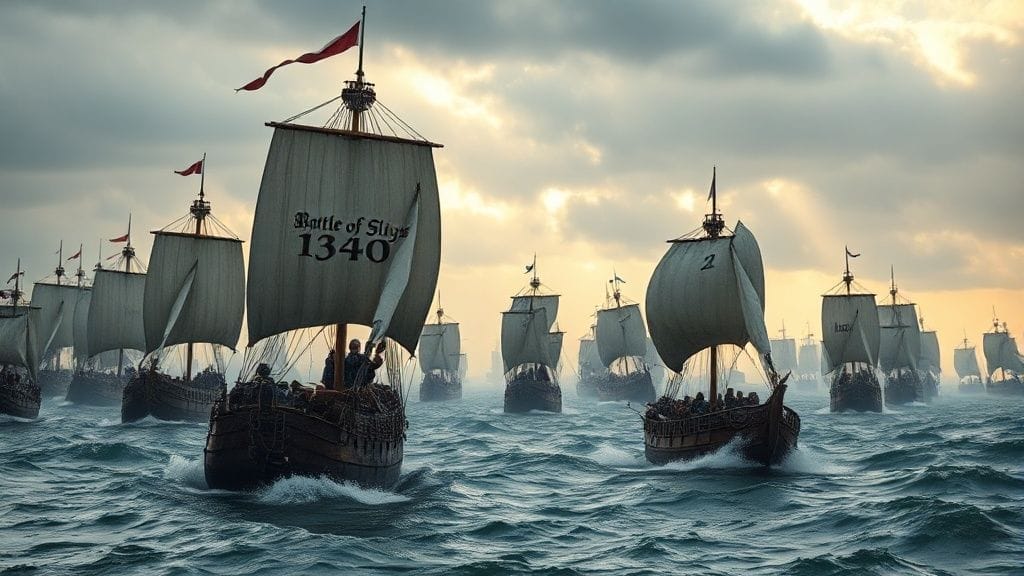
The morning sky was a pale, smoky gray, the sea calm but restless under the soft light that filtered through low-hanging clouds. The air smelled of salt and anticipation as two great fleets, each a floating fortress of wood, iron, and human ambition, faced off just off the shores of the Flemish port of Sluys. It was June 24, 1340, a day etched into the annals of history as the English fleet unleashed its might against the French, setting the course for centuries of conflict on both the land and the sea. The Battle of Sluys was not just a naval engagement—it was a cataclysmic moment when chivalry, strategy, and raw human endurance clashed against the relentless tides of war.
Europe in Turmoil: The Hundred Years’ War Context
To understand the significance of what unfolded off Sluys’ coast, we must return to the brewing storm that was the Hundred Years’ War—a struggle far more complex than a mere quarrel over a crown. The year was 1340, but tensions had simmered for decades. The English King Edward III had a claim to the French throne through his mother, a claim fiercely contested by the reigning French Valois dynasty. Dynastic pride, feudal loyalties, and burgeoning national identities tore apart alliances and pitted neighbor against neighbor.
France, under King Philip VI, had the numerical advantage on land and sea, its ports bustling with commerce and military preparations. England, smaller but no less determined, sought to exploit new military tactics and maritime strength to challenge French dominance. The contest was no longer simply about who sat on the throne but who would command the future of Western Europe.
The English Crown’s Ambitions and the French Crown's Defiance
Edward III was no ordinary monarch. A warrior king who fancied himself a chivalric hero, he understood the symbolic and practical power of naval supremacy. Command of the sea would secure supply lines, protect England from invasion, and allow him to strike at the French heartland.
The French, led by Admiral Hugues Quiéret and Constable Nicolas Béhuchet, organized a formidable fleet—larger, heavier, and bristling with galleys designed for ramming and boarding. Yet, beneath the polished armor and war paint, there were disagreements and tension among commanders. The English knew that to challenge France, they had to do more than meet their fleet—they had to defeat it decisively.
Naval Power in the 14th Century: A Game of Kings and Sea Dogs
Naval warfare in the early 1300s was an evolving art. Massive castles on water, galleys powered by oarsmen, and cogs driven by sails painted a vivid picture of medieval maritime might. But technology was as much about tactics as ship design. The longbow had already transformed land battles, and its reach was beginning to stretch over the waves.
Control of the narrow seas was essential—the English Channel was the artery connecting England to continental Europe. Whoever mastered it controlled not just trade but the fate of armies and kings.
Edward III’s Strategic Vision: From Land Wars to Command of the Seas
Edward had learned hard lessons from early campaigns that relied solely on land power. By 1340, he was turning his attention to naval strategy, understanding something most kings overlooked: wars are won by controlling movement and supply, often over vast distances.
This required building a fleet capable of not just blocking ports but of seeking out and engaging the enemy wherever they might hide. Edward gathered a diverse armada, combining merchant vessels enlisted for war and purpose-built fighting ships, manned by a mix of professional sailors, soldiers, and archers.
The French Fleet under Admiral Hugues Quiéret and Nicolas Béhuchet
The French fleet was formidable but flawed. Comprising roughly 250 vessels, it was a mix of galleys, cogs, and smaller ships. Admiral Hugues Quiéret, a seasoned commander, was charged with leading the action at sea, supported by Nicolas Béhuchet, the Constable of France, a man renowned for his ruthlessness.
When the two fleets met, the French were anchored near Sluys, hoping to block Edward's passage and deliver a decisive blow. Yet, their disposition—ships chained together in defensive lines—would soon reveal critical weaknesses.
June 24, 1340: Dawn breaks above the Channel—Two fleets meet
As sunlight pierced the mist, the English fleet approached. Around 200 ships strong, Edward’s fleet advanced in a tight formation punctuated by longbowmen ready to unleash a hailstorm of arrows. The sea was deceptively calm; tension crackled like static electricity across every deck.
The French, confident in their numbers and their defensive setup, awaited the assault. What happened next was a brutal, chaotic, and bloody confrontation that would reshape maritime warfare.
Clash of Titans: The Battle Unfolds in the Tides and Winds
The English opened fire with volleys of arrows aimed at French crews on deck and rigging. The longbowmen’s deadly precision disabled masts and sowed panic. English ships, smaller and more maneuverable, pressed in to grapple and board, turning sea combat into brutal hand-to-hand fighting.
French ships, chained in tight lines, became enormous, floating deathtraps. Unable to maneuver, many galleys were set ablaze or sunk, their crews trapped below deck or slaughtered on the decks.
Amid the chaos, cries of command mingled with the screams of the dying; the waters ran red with blood and desperation.
The Anatomy of Victory: English Longbows, Ships, and Tactical Mastery
What distinguished the English victory was not merely numbers but innovation and discipline. The longbowmen were the star performers — their arrows pierced armor and disabled ships. English crews exploited the inflexibility of the French chains; once the front line was broken by fire and arrows, the entire French fleet collapsed in disarray.
Edward’s men fought with ruthless efficiency, seizing French vessels and turning the tide of battle decisively. The sea, for the first time in years, belonged firmly to England.
The French Catastrophe: Fires, Chaos, and Sinking Galleys
The damage was catastrophic. Estimates suggest that the French lost nearly all their fleet, with some 15,000 men perishing—knights, sailors, and conscripted oarsmen alike. Fires devoured ships; drowning filled the waters near Sluys.
The death of Nicolas Béhuchet, who was captured and later executed, symbolized the French disaster. Hugues Quiéret was killed during the battle, and many survivors were taken prisoner or fled.
Human Stories from the Waves: Courage, Desperation, and Death
Survivors recounted endless hours of terror—men fighting to the last breath, comrades thrown overboard, and desperate attempts to flee the flaming hell. Among the English, tales emerged of individual heroism and grim determination.
One chronicler wrote: “The sea was stained with blood, and the air was filled with the groans of the dying. Yet, the English held fast, their bows singing death as the French were broken like waves upon the shore.”
Immediate Aftermath: Control of the Channel Secured
The victory at Sluys gave Edward control over the Channel, safeguarding supply routes and enabling future campaigns deeper into France. It marked a turning point: for decades, England would command the seas, projecting power and innovation.
For France, the loss devastated naval capacity, hobbling their ability to defend coastal towns or support armies across the Channel.
Political Reverberations: Shaking the Foundations of French Power
The defeat rattled the French court and nobility. King Philip VI faced criticism for failing to protect his fleet, and mistrust spread among commanders. On the English side, the victory galvanized Edward’s claim to the French throne and bolstered morale at home and abroad.
Diplomatic maneuvering intensified, and war would rage for decades in the wake of this pivotal naval engagement.
The Battle’s Role in the Hundred Years' War Trajectory
Sluys was more than a single battle; it was a declaration that England was a maritime power to be reckoned with. The outcome shifted the strategic balance, allowing England to mount sustained invasions and exert pressure on multiple fronts.
Though the war would drag on for more than a century, the importance of Sluys echoed in the tactics and ambitions of warriors who followed.
Myths and Legends Born at Sluys: The Chivalry and Bloodshed
Chroniclers embellished the heroics and horrors of Sluys with poetic flair. Some romanticized single combats between knights; others decried the cruelty and destruction of war at sea. The battle became a symbol of medieval chivalry's twilight, where old codes met brutal realpolitik.
Technological and Tactical Lessons from the Battle
The battle demonstrated the lethal effectiveness of the longbow at sea and exposed the perils of over-reliance on chained ships and slow galleys. It pushed naval innovation forward, inspiring changes in ship design and combat doctrine.
Long-term Impacts on Naval Warfare in Medieval Europe
Sluys inspired future commanders to prioritize maneuverability, firepower, and coordinated land-sea operations. It marked the beginning of England’s naval dominance, directly influencing the rise of great navies centuries later.
The Sluys Legacy in English and French Memory
In England, the battle was celebrated as a triumph of valor and strategy. In France, it was mourned and remembered as a painful defeat, a rallying cry for renewed resistance.
Over the centuries, the narratives diverged, adding layers of meaning to a conflict born from competing nationalisms.
Artistic Depictions and Chronicles: How History Remembered Sluys
From illuminated manuscripts to tapestry and later paintings, the Battle of Sluys has remained immortalized in art and literature, shaping public memory and national identity.
Reflecting on the Human Cost Behind the Glory
Behind the tales of kings and ships lie thousands of lost lives. The battle’s human cost reminds us that history is made up not just of grand strategies, but of mortal men and women caught in the maelstrom of war.
Conclusion
The Battle of Sluys was more than a clash of timber and steel on a June morning—it was a turning point in medieval warfare, a moment that redefined power, pride, and the very nature of naval combat. As longbows sang death amid smoky skies, the shaky balance of Europe teetered, setting the stage for a war that would last generations.
Yet beyond tactics and territory, Sluys reminds us of the fragile human lives woven into history’s vast tapestry. The courage, the sacrifice, the ambition—these remain ever relevant as we look back, not just at what was won or lost, but at the human stories that give history its lasting pulse.
FAQs
1. Why was the Battle of Sluys so crucial in the Hundred Years’ War?
It secured English naval dominance over the Channel early in the war, allowing sustained military campaigns in France and protecting England from invasion.
2. Who were the main commanders at the Battle of Sluys?
On the English side, King Edward III led the fleet. The French fleet was commanded by Admiral Hugues Quiéret and Nicolas Béhuchet, the Constable of France.
3. What tactics gave the English an advantage during the battle?
The English longbowmen devastated the French fleet, combined with superior ship maneuverability and the French fleet being chained together, which led to chaos and heavy losses when attacked.
4. How many men died at the Battle of Sluys?
Estimated casualties vary, but roughly 15,000 French sailors and soldiers died, a devastating loss compared to English casualties.
5. Did the battle end the Hundred Years’ War?
No, it was an important early battle that shifted momentum, but the war itself continued sporadically for over a century.
6. How did the Battle of Sluys influence naval warfare afterward?
It demonstrated the importance of ship maneuverability and ranged weaponry (like the longbow), influencing ship designs and naval tactics for generations.
7. Is the Battle of Sluys commemorated today?
Though not as widely remembered as other battles, it remains an important episode in English and French medieval history, studied by historians and reenacted in scholarly works.
8. What primary sources describe the Battle of Sluys?
Chronicles by Jean Froissart and other contemporary medieval historians provide detailed, if sometimes romanticized, accounts of the battle.

