Table of Contents
- The Dawn of August 26, 1346: A Battlefield Awakes
- The Hundred Years' War: A Prelude to Crécy
- The English King Edward III: Ambition and Resolve
- Philip VI of France: The Weight of Nobility and Duty
- Terrain and Timing: Why Crécy?
- The English Army: Longbows and Discipline
- The French Host: Chivalry and Cavalry
- The Battle Formations: Strategy Meets Tradition
- The Opening Salvo: Archers vs. Knights
- The Thunder of the Longbow: Decisive English Firepower
- The French Cavalry Charges: Valor Amidst Chaos
- The Role of the Genoese Crossbowmen: Missteps in Combat
- Death of the French Nobility: A Blow to the Chivalric Order
- Edward, the Black Prince: The Emergence of a Warrior Prince
- Nightfall and Aftermath: The English Claim Victory
- Human Cost: Casualties and Captives
- Political Ripples: Shaking the French Monarchy
- The Impact on Medieval Warfare and Military Tactics
- Chronicles and Legends: How Crécy Entered History
- The Battle’s Legacy in Anglo-French Relations
- Remembering Crécy: Monuments and Memory
- The Rise of the Longbow in European Warfare
- Conclusion: Crécy as a Turning Point in the Middle Ages
- FAQs
- External Resource
- Internal Link
The Dawn of August 26, 1346: A Battlefield Awakes
The morning mist hung heavy over the rolling fields of Crécy-en-Ponthieu, a quiet village in northern France. Yet on this August day, the calm was deceptive. Thousands of armored knights, foot soldiers, and archers scoured the horizon, their breaths visible in the cool air, their armor catching the early light like a forest of steel. The scent of wet earth mixed with the noise of distant horns and anxious murmurings. There was something different in the air; a tension pregnant with anticipation. This was not merely a gathering of men, but the stage for a clash that would reverberate across centuries.
For King Edward III of England and King Philip VI of France, this was the culmination of a drawn-out conflict, the largest war in a generation fighting over claims to crowns and territories—the Hundred Years’ War. The battlefield was set, and neither side fully understood how their clash would reshape the art of war and redefine chivalry itself.
The Hundred Years' War: A Prelude to Crécy
To grasp the meaning behind the Battle of Crécy, one must look back to the very origins of the Hundred Years’ War, which had roared quietly since 1337. The conflict centered on a tangled web of dynastic claims, feudal loyalties, and economic interests. Edward III, grandson of Philip IV through his mother, had laid claim to the French throne after the death of Charles IV, asserting his right against Philip VI, who was elected king by the French nobility.
But politics were not the sole drivers here. The burgeoning power of the English crown, seeking to protect its wealth in Gascony in southwestern France, and the proud French nobility, fiercely guarding their sovereignty and honor, stood on opposite sides of a mounting storm. The stage was primed for confrontation, fueled by centuries-old rivalries and a deep-seated sense of national identity beginning to take root.
The English King Edward III: Ambition and Resolve
Edward III, in his early thirties during the summer of 1346, had transformed his reign from one marked by internal consolidation into an outward-facing campaign of expansion. Described by chroniclers as a tall, commanding figure with piercing eyes, Edward carried the weight of inherited claims and the hunger for glory. His campaign in France was as much a political gambit as a military one—using the threat of war to draw concessions, but prepared to fight if the stakes demanded.
Aware of the evolving methods of warfare, Edward fostered innovation, valuing strategy as much as valor. The English army under him was not just composed of noble knights but of disciplined archers and foot soldiers, a militia bound by loyalty and pragmatism.
Philip VI of France: The Weight of Nobility and Duty
King Philip VI, older and more traditional, bore the heavy burden of defending the French crown’s legitimacy. His court was steeped in codes of chivalry where honor and noble lineage dictated battlefield conduct. To Philip, war was a matter of prestige as much as policy, a theater where the might of the cavalry and the valor of knights would decide the fate of kingdoms.
His forces were a vast assembly of nobility, each seeking personal renown as well as collective victory. Yet such personal ambitions often clouded command cohesion in a battle that demanded unity—something that would prove costly in the hours to come.
Terrain and Timing: Why Crécy?
Crécy-en-Ponthieu was not a randomly chosen battlefield. The English army had moved north through France, pursued by the French. Edward's forces sought a defensible position to offset the numerical superiority of Philip's army.
The terrain was a gentle slope surrounded by woods, marshy furrows, and hedges—a challenging landscape for cavalry charges but ideal for longbowmen. Edward arranged his troops on high ground, allowing archers to maximize their range and lethality. Timing also played a vital role: August’s dry weather had hardened the ground, facilitating movement but exposing foes in the open sun.
The English Army: Longbows and Discipline
One cannot discuss Crécy without paying homage to the English longbowmen. These soldiers wielded longbows capable of launching arrows with remarkable speed and accuracy over 250 yards. Trained from youth, often of peasant or lower-gentry origin, they were England’s secret weapon—a democratic force in a feudal battlefield.
The English formation was a testament to preparation: archers stationed behind stakes planted in the ground to deter cavalry, pikemen guarding the flanks, and mounted knights held in reserve. This blend of technology and tactical foresight would be decisive.
The French Host: Chivalry and Cavalry
On the other hand, the French army rode heavily armored knights in shining mail and plate, the epitome of medieval warfare tradition. Cavalry charges were considered the ultimate symbol of dominance, a brutal expression of power and nobility.
Behind these knights were crossbowmen, infantry, and other auxiliaries. Yet, unlike the English, coordination suffered. Different nobles controlled their contingents, leading to fragmented assaults lacking unified command—a factor that undermined the French approach.
The Battle Formations: Strategy Meets Tradition
Edward’s choice of terrain reflected his understanding of modern warfare’s changing face. His troops formed a defensive “V” shape anchoring the flanks on strong natural barriers. Archers formed the frontline, unlike typical battles where mounted knights led charges.
Philip, convinced his cavalry would shatter the English lines, ordered a series of charges to break their positions. This strategy stemmed from centuries of knightly warfare yet failed to account for the lethal rain of arrows that awaited.
The Opening Salvo: Archers vs. Knights
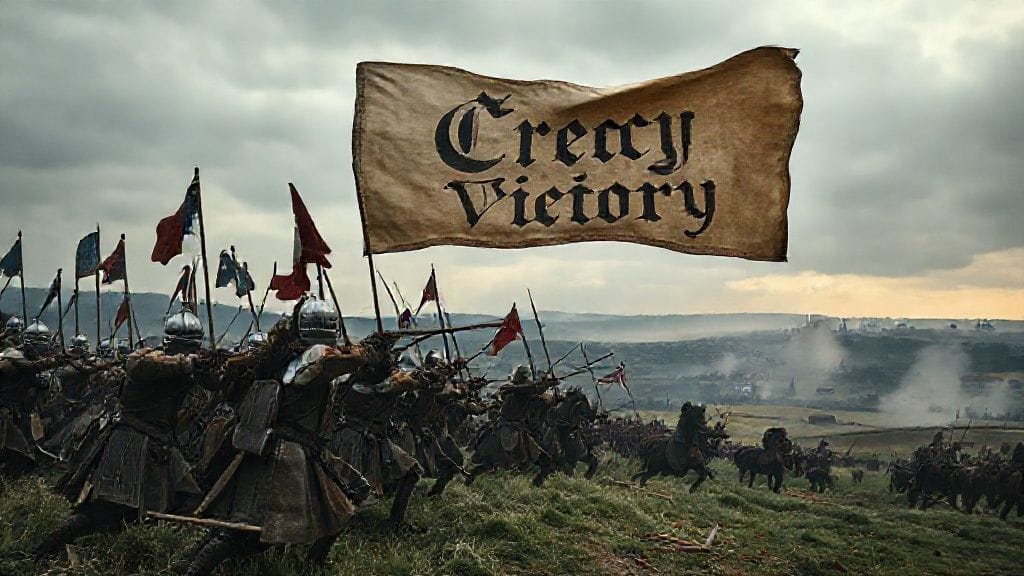
The climax began as the French cavalry advanced over the crest toward the English line. Suddenly, a volley of arrows darkened the air—the English longbowmen unleashed an almost relentless storm. Horse and rider alike were stricken before they could close the distance.
Survivors faltered, throws spears and swords unable to penetrate the sharpened English defenses. This opening phase set the tone, a brutal inversion of expectations where ranged troops dominated against traditional knights.
The Thunder of the Longbow: Decisive English Firepower
The longbow’s impact was overwhelming. Its rapid-fire capability shattered French charges repeatedly, shooting down horses, unraveling formations, and sowing chaos. The deafening sound of arrows ripping through leather and metal resonated like thunder.
A key anecdote relates how Edward watched with calm composure, knowing every arrow saved English lives and weakened the enemy. His army’s discipline—a symphony of movement, timing, and command—transformed raw weaponry into a tactical masterpiece.
The French Cavalry Charges: Valor Amidst Chaos
For all their valor, French knights found themselves trapped in a brutal maze of stakes and arrows. Charges crashed into hedges and ditches, turning what should be the moment of glory into futile desperation.
Among the legends born here was King John of Bohemia, who, blind from birth, famously charged into battle guided by his companions, embodying chivalric ideals even as disaster unfolded.
The Role of the Genoese Crossbowmen: Missteps in Combat
The Genoese crossbowmen, mercenaries hired by the French, were expected to soften English defenses. However, their attack fell victim to the unfolding chaos: rain made their crossbows ineffective, and the terrain frustrated their advance.
Unable to withstand the English longbow volley, many fled or were cut down, highlighting the unpredictability of medieval armies reliant on diverse troop types.
Death of the French Nobility: A Blow to the Chivalric Order
By day’s end, many of France’s highest nobles lay dead or captured, including seasoned commanders. This massacre of aristocracy was a shattering blow, striking at the heart of feudal power structures.
The loss was deeply felt: thousands of knights and men-at-arms perished, and the French morale was irrevocably dented. The chivalric code that celebrated personal honor had collided disastrously with evolving forms of warfare.
Edward, the Black Prince: The Emergence of a Warrior Prince
Among the spectators of this bloody day was Edward’s son, the future Black Prince, youthful but already showing the qualities of leadership and valor that history would remember.
His presence symbolized a new generation of warriors shaped by the blend of tradition and innovation, foreshadowing their role in the ongoing contest across the Channel.
Nightfall and Aftermath: The English Claim Victory
As darkness fell, the English stood victorious, a testament to strategy, discipline, and technological advantage. French forces limped away, their battle plans shattered and their pride wounded.
Edward’s army camped near the field, exhausted but undefeated. The victory was more than military; it was a psychological and symbolic cut into French invincibility.
Human Cost: Casualties and Captives
The battle’s toll was staggering: estimates suggest the French suffered up to 10,000 casualties versus a few hundred English dead. Thousands of nobles were captured, often ransomed for vast sums—warfare as both destruction and commerce.
Beyond numbers lie countless individual stories of valor, loss, and consequence, from the knight who fell defending his banner to peasants caught in the deadly crossfire.
Political Ripples: Shaking the French Monarchy
Crécy exposed weaknesses in French command and fractured unity among nobility. The political repercussions destabilized King Philip's reign and emboldened English claims not only to territories but to the French crown itself.
It also set a precedent for warfare where massed infantry and ranged weapons began to challenge the dominance of mounted nobility.
The Impact on Medieval Warfare and Military Tactics
Crécy marked a turning point in military history. The devastating use of the longbow challenged conventional reliance on cavalry and castle walls, signaling a slow but irrevocable shift toward combined arms and professional standing armies.
Strategists studied this battle for centuries, recognizing that innovation, terrain, and organization could triumph over sheer numbers and chivalry.
Chronicles and Legends: How Crécy Entered History
Chroniclers like Jean Froissart immortalized Crécy, painting vivid portraits of heroism and tragedy. Stories of the blind King John, daring archers, and Edward’s calm leadership became staples of medieval narrative, blending fact with legend.
These accounts fueled later mythologies surrounding the Hundred Years’ War and England’s martial identity.
The Battle’s Legacy in Anglo-French Relations
The psychological impact of Crécy deepened the animosities between England and France, hardening identities and entrenching hostilities that would flare and ebb over centuries.
This battle came to symbolize not just military prowess but also national pride, echoing in cultural memory and literature.
Remembering Crécy: Monuments and Memory
Even today, the fields around Crécy bear quiet witness to that fateful day. Memorials and plaques mark the spot, and annual reenactments bring history alive.
From museums to popular culture, Crécy remains a powerful symbol of medieval warfare and the transition of eras.
The Rise of the Longbow in European Warfare
Post-Crécy, the longbow spread in reputation and use, influencing armies far beyond England’s shores. It inspired adaptations and countermeasures yet never lost its mystique as a game-changer weapon.
Warfare would never again be the exclusive playground of armored knights charging under banners.
Conclusion: Crécy as a Turning Point in the Middle Ages
The Battle of Crécy was more than a military encounter; it was a crossroads of history where old and new worldviews collided in a tumult of steel and sinew. It showcased the birth of modern warfare, the fragility of traditions, and the raw human cost of ambition.
Edward III’s victory echoed across time, a stark reminder of how technology, leadership, and adaptability shape destinies. Yet, beneath the triumph lay stories of loss, courage, and transformation—patchwork of human experience that forever changed medieval Europe.
Conclusion
Crécy speaks across the centuries not only as a moment of martial genius but as a profoundly human drama. It was a day when the thunder of thousands of arrows silenced the charge of chivalry, where the valor of men met the irrefutable power of innovation.
This battle did not just tip the scales in a war; it nudged the course of history toward a new age, where might no longer belonged solely to the armored knight but to the calculated hand and sharpened eye of every soldier.
Remembering Crécy invites us to see history as a living tapestry—woven from tactics and technology, but ultimately shaped by the hopes, fears, and blood of those who dared to stand on that distant field in August 1346.
FAQs
Q1: What caused the Battle of Crécy?
The battle was caused primarily by the ongoing dispute over the French crown and territorial claims by Edward III of England, igniting the broader conflict known as the Hundred Years’ War.
Q2: Why was the English longbow so effective at Crécy?
The longbow’s range, rapid fire, and power, combined with the disciplined positioning of English archers behind protective stakes, allowed them to decimate French cavalry before contact.
Q3: Who were the main commanders at the Battle of Crécy?
King Edward III led the English forces, while King Philip VI commanded the French army. Notably, Edward’s son, the Black Prince, was also present.
Q4: What was the significance of the death of French nobles during the battle?
The death and capture of many French nobles beleaguered the feudal command structure, demoralized the French army, and weakened political power in the kingdom.
Q5: How did the Battle of Crécy change medieval warfare?
It demonstrated the effectiveness of ranged infantry and defensive tactics over heavily armored cavalry charges, signaling a shift towards more modern military strategies.
Q6: What role did terrain play in the battle?
Edward III’s choice of a defensible, elevated ground with natural obstacles hindered French cavalry and advantaged English archers significantly.
Q7: How is the Battle of Crécy remembered today?
Crécy is commemorated with monuments and historical reenactments, symbolizing medieval warfare’s turning point and the enduring legacy of the Hundred Years’ War.
Q8: Did the Battle of Crécy end the Hundred Years’ War?
No, it was an early but decisive battle that bolstered English momentum but the Hundred Years’ War continued intermittently for over a century afterward.

