Table of Contents
- The Dawn of Conflict: Poland and the Teutonic Order in the 14th Century
- The Polish–Teutonic War: Origins and Immediate Causes
- The Kingdom of Poland’s Strategic Position in 1343
- The Rising Tensions Leading to Open Hostilities
- Warfare in the Baltic Region: Armies, Strategies, and Battles
- The Contest for Pomerelia: Economic and Political Stakes
- The March Toward Kalisz: Negotiations Begin Amidst War
- The Role of King Casimir III the Great in Peace-Making
- The Teutonic Order’s Perspective and Leadership
- July 8, 1343: The Signing of the Treaty of Kalisz
- Terms of the Treaty: Concessions and Compromises
- Immediate Reactions From Poland and the Teutonic Order
- The Treaty as a Temporary Peace: A Fragile Balance
- Political Ramifications Across Central and Eastern Europe
- The Treaty’s Impact on Polish National Identity and Sovereignty
- Economic Consequences: Trade and Territorial Stability
- Cultural Exchanges and the Aftermath of War
- The Treaty in the Eyes of Chroniclers and Historians
- Long-Term Effects: Prelude to Further Conflict and Alliances
- Reflections on Diplomacy and Warfare in Medieval Europe
- Conclusion: The Treaty of Kalisz as a Turning Point
- FAQs about the Treaty of Kalisz and the Polish–Teutonic War
- External Resource: Wikipedia on the Treaty of Kalisz
- Internal Link: Visit History Sphere → https://historysphere.com/
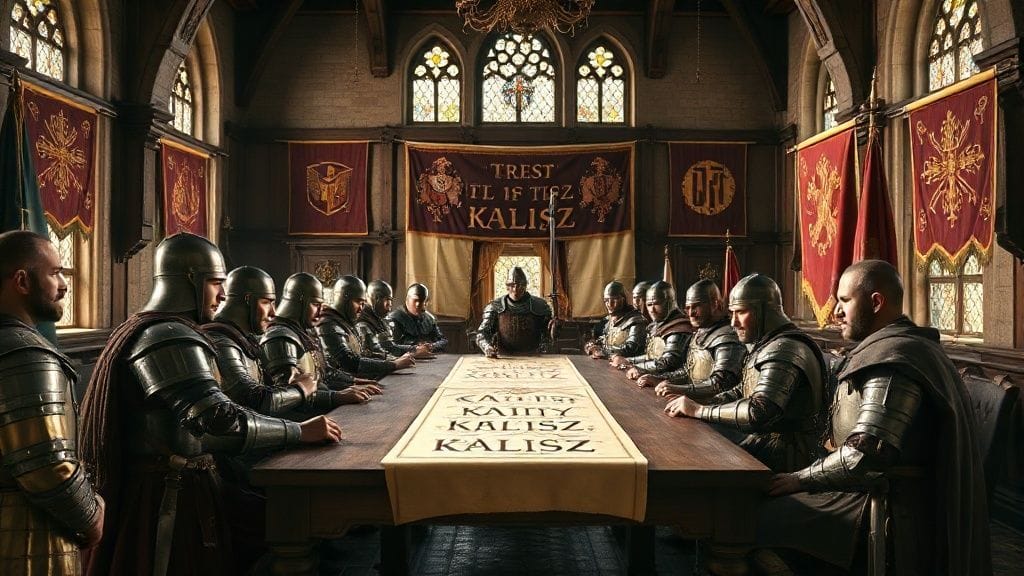
The summer sun hung low over the cobblestone streets of Kalisz, the air thick with anticipation and cautious hope. Delegates and knights draped in the heraldry of two great powers—the Kingdom of Poland and the Teutonic Order—assembled within the fortified town walls. It was July 8, 1343, a day that would etch itself into the annals of medieval diplomacy and warfare as the culmination of years of bitter conflict. The Treaty of Kalisz, quietly yet decisively signed on that summer afternoon, marked an uneasy peace, a temporary armistice born out of exhaustion, pragmatism, and the shared desire to stop the bleeding of lives and resources. But this peace, fragile as it was, held within it the volatile seeds of future rivalry and broader geopolitical shifts in Central Europe.
The Dawn of Conflict: Poland and the Teutonic Order in the 14th Century
To understand the significance of the Treaty of Kalisz, one must first travel back to a volatile borderland where the ambitions of emerging medieval powers collided. The early 14th century was a period marked by shifting alliances, territorial disputes, and a complex tapestry of religious, economic, and ethnic tensions. The Teutonic Order, a militarized monastic order founded during the Crusades, had established a powerful presence along the southeastern shores of the Baltic Sea. Their crusades against pagan Baltic tribes had gradually expanded their autonomy and landholdings.
Conversely, the Kingdom of Poland, under the astute and ambitious leadership of King Casimir III, sought to restore and unify its realm after a period of fragmentation. The strategic region of Pomerelia (modern-day Gdańsk and its surroundings) was particularly contentious—this coastal stretch was not only an economic prize due to its access to Baltic trade routes but also a symbol of sovereignty and political legitimacy.
The Polish–Teutonic War: Origins and Immediate Causes
At the heart of the conflict lay a bitter rivalry over Pomerelia. The Teutonic Order claimed the territory as part of their conquest and Christianizing mission, while the Polish crown asserted hereditary rights, lineage claims, and historical sovereignty. The contest was fueled by decades of unsettled treaties, shifting loyalties of local nobility, and underlying disputes over commerce and taxation.
The immediate cause of the Polish–Teutonic War (1339–1343) was the death of King Władysław I the Elbow-high in 1333, leading to disputes about control of the contested areas. King Casimir III inherited this contentious legacy and soon found himself embroiled in open warfare against a well-organized and formidable military order.
The Kingdom of Poland’s Strategic Position in 1343
Poland’s position in 1343 was delicate. Casimir III had managed to consolidate his authority internally, but external pressures remained immense. The kingdom was threatened not only by the Teutonic Order but also by the Kingdom of Bohemia and Hungary, both eager to expand their influence in the region. Economically, the loss or control of access to the Baltic Sea meant devastating consequences for trade and revenue.
Yet Casimir was no firebrand ruler; he was known for his diplomatic acuity and a pragmatic approach to governance. His military campaigns were measured, designed as much to preserve resources and morale as to win decisive victories.
The Rising Tensions Leading to Open Hostilities
Despite attempts at negotiation, the war erupted with brutal efficiency. Raids, sieges, and skirmishes punctuated the landscape. The Teutonic Order’s knights, disciplined and ruthless, conducted military operations aimed at swiftly undermining Polish hold over contested towns and fortresses. Meanwhile, Polish forces, motivated by a sense of national defense and loyalty to Casimir, fought fiercely to reclaim lost ground.
The war tested not only armies but the resolve and endurance of both societies. Entire populations suffered displacement and hardship. Fields lay fallow as peasants fled violence, and trade caravans braved constant danger.
Warfare in the Baltic Region: Armies, Strategies, and Battles
The military engagements of the Polish–Teutonic War showcased the era's complexities: heavily armored knights clashed with infantry pikemen and archers, while siege engines battered stone walls. Naval engagements, though limited, were instrumental in the struggle for control over port cities.
The Order’s prowess in logistical organization allowed them to maintain supply lines and fortifications. Conversely, Polish forces adapted by leveraging local knowledge, unconventional tactics, and alliances with neighboring powers.
The Contest for Pomerelia: Economic and Political Stakes
Pomerelia was not merely a territory; it was the gateway to the Baltic trade network. Control over its ports meant influence over commerce that fed into the riches of Hanseatic cities like Gdańsk and Danzig. For the Kingdom of Poland, regaining Pomerelia was central to economic revitalization and political stature.
The Teutonic Order’s hold over the region was not only a strategic triumph but also a lucrative source of revenue, spurring their unwillingness to concede control despite mounting costs of war.
The March Toward Kalisz: Negotiations Begin Amidst War
By 1343, both parties had endured a grueling conflict. The toll on military manpower and finances prompted a tentative move toward peace talks. Kalisz, a royal city with convenient access and symbolic standing, was chosen as the meeting place.
The negotiations were tense, reflecting decades of enmity but also mutual recognition that the war was unsustainable. Mediators and envoys engaged in complex diplomatic wrangling, balancing honor, demands, and pragmatic needs.
The Role of King Casimir III the Great in Peace-Making
King Casimir III, later known as "the Great," played a pivotal role in steering his kingdom toward peace. Understanding the limitations of continued warfare, he approached the negotiations with strategic patience and a focus on long-term stability.
He sought to secure as many gains as possible without provoking future conflict, thereby preserving his realm’s unity and resources.
The Teutonic Order’s Perspective and Leadership
From the perspective of the Teutonic Order, peace was a necessary compromise. Despite their militaristic reputation, they were also a political and religious institution aware of the limits of force. Their leadership balanced militant zeal with diplomatic calculation.
By the time of the treaty, the Order recognized that consolidating their existing possessions by peaceful means could be more advantageous than risking protracted warfare.
July 8, 1343: The Signing of the Treaty of Kalisz
On that pivotal day at Kalisz, beneath banners fluttering in a warm summer breeze, the two sides formally sealed their accord. The Treaty of Kalisz was signed with great ceremony, witnessed by nobles, clerics, and diplomats.
The document, painstakingly drafted, reflected a rare moment of consensus in the fractured political landscape of medieval Eastern Europe.
Terms of the Treaty: Concessions and Compromises
The Treaty’s key provisions saw Poland renounce claims over Pomerelia, effectively acknowledging Teutonic control. In exchange, the Order made generous concessions regarding territories elsewhere and agreed to respect certain Polish rights.
The compromise was, in many ways, a strategic pause rather than a final solution.
Immediate Reactions From Poland and the Teutonic Order
News of the treaty elicited mixed feelings. In Poland, some heralded it as a necessary peace that saved the kingdom from further devastation; others decried it as a humiliating loss. The Teutonic Order celebrated victory but remained wary of the fractured nature of the truce.
Among the nobility and merchant classes, debates brewed about the treaty’s implications for sovereignty and prosperity.
The Treaty as a Temporary Peace: A Fragile Balance
Far from ending hostilities forever, the Treaty of Kalisz established a fragile, uneasy peace that would last only until shifting alliances and ambitions reignited conflict decades later.
Nevertheless, it introduced a precedent for diplomatic resolution, foreshadowing the complex interplay of war and diplomacy that characterized the late medieval period.
Political Ramifications Across Central and Eastern Europe
The treaty’s reverberations were felt throughout Europe. Neighboring realms recalibrated their alliances, watching for opportunities amid the truce. The balance of power in the Baltic and surrounding regions subtly shifted, with implications for the Holy Roman Empire and the Polish crown’s ambitions.
The Treaty’s Impact on Polish National Identity and Sovereignty
In the long view, the Treaty of Kalisz influenced Polish national consciousness. It underscored the vulnerability and resilience of the Polish kingdom, fueling a narrative of struggle and perseverance that would persist through subsequent generations.
King Casimir’s reign, punctuated by this treaty, remains a benchmark for leadership amid adversity.
Economic Consequences: Trade and Territorial Stability
Economically, the treaty temporarily stabilized trade routes, allowing merchants and townspeople to rebuild. However, the loss of Pomerelia’s full integration within Poland’s domain meant lingering challenges in gaining full access to Baltic commerce.
The peace created breathing room for recovery but left many economic questions unresolved.
Cultural Exchanges and the Aftermath of War
Peace ushered in more than just the cessation of armed conflict; it opened avenues for cultural exchange between Polish and Teutonic domains. Religious, artistic, and intellectual currents navigated old fault lines to engender a shared, though complex, regional milieu.
The Treaty in the Eyes of Chroniclers and Historians
Medieval chroniclers recorded the treaty with a mixture of triumph and lamentation, embedding it within their political and moral frameworks. Modern historians interpret it as a nuanced episode—a case study in medieval diplomacy, the limits of military power, and the endurance of contested sovereignty.
Long-Term Effects: Prelude to Further Conflict and Alliances
Though the treaty offered a pause, it was ultimately a prelude. The simmering disputes over Pomerelia and Baltic dominance continued to shape conflicts that would erupt in the following decades, culminating in renewed wars and shifting treaties.
The Treaty of Kalisz stands as a moment of both closure and beginning.
Reflections on Diplomacy and Warfare in Medieval Europe
This episode reveals how medieval rulers balanced martial ambition with pragmatic peacemaking. The Treaty of Kalisz illustrates that war and diplomacy were intertwined forces shaping the political landscape, each influencing the other in sometimes unexpected ways.
Conclusion
The Treaty of Kalisz, signed on July 8, 1343, was more than a mere truce—it was a delicate, hard-won balance between two ambitious powers navigating a turbulent medieval world. For King Casimir III and the Teutonic Order, this treaty marked a pause to reflect, rebuild, and reposition within the ever-shifting map of Central Europe.
Its story resonates with themes of resilience, pragmatism, and the enduring human cost of territorial ambition. In the fragile peace that followed, one sees not just the end of a war, but the complexity of a time when diplomacy and conflict danced on a knife’s edge.
Far from being a final chapter, the Treaty of Kalisz was a gateway to the future—shaping identities, economies, and politics for generations. It reminds us that history is often a tapestry of unfinished stories, where even a signed parchment carries the restless echoes of what is yet to come.
FAQs
1. What triggered the Polish–Teutonic War that ended with the Treaty of Kalisz?
The war was primarily triggered by competing claims over Pomerelia, a strategically valuable Baltic region. The death of King Władysław I and disputes over succession and sovereignty exacerbated tensions between Poland and the Teutonic Order.
2. Who were the main figures involved in the Treaty of Kalisz?
King Casimir III the Great of Poland, known for his shrewd leadership, was the driving force on the Polish side. The Teutonic Order was led by its Grand Master, who balanced military and diplomatic strategies.
3. What were the main terms of the Treaty of Kalisz?
Poland renounced its claim over Pomerelia, granting the Teutonic Order control, while the Order made concessions elsewhere and agreed to respect certain Polish rights. The treaty established a fragile peace but left major issues unresolved.
4. How did the treaty affect Polish sovereignty?
Though Poland lost claims to valuable territory, the treaty stabilized the kingdom and allowed Casimir III to focus on internal reform and strengthening the realm, contributing to a developing sense of national identity.
5. Did the Treaty of Kalisz bring a lasting peace?
No. The treaty was a temporary armistice. Hostilities resumed in later decades as unresolved territorial disputes and regional ambitions reignited conflict.
6. What role did economic factors play in the conflict and treaty?
Control over Baltic trade routes via Pomerelia was critical. Both sides recognized the economic importance of the region, influencing military campaigns and peace negotiations.
7. How is the Treaty of Kalisz viewed by historians?
Historians see it as a significant example of medieval diplomacy and the limits of warfare. It exemplifies the balancing act between force and negotiation in a fractious and complex political landscape.
8. What legacy did the Treaty of Kalisz leave for Eastern Europe?
It reshaped territorial boundaries, influenced future conflicts, and contributed to the formation of Polish national identity. It also set precedents in diplomacy in the Baltic region.

