Table of Contents
- A Thunderstorm on the Horizon: The Prelude to Devastation
- The Black Prince: Prince Edward’s Rise to Command
- The Hundred Years’ War: A Europe in Turmoil
- Aquitaine in the Mid-14th Century: Wealth and Vulnerability
- The Strategic Gamble: Planning the Chevauchée
- Igniting the Flame: The Beginning of the Raid
- The Path of Destruction: From Gascony to the Loire
- Towns in Flames: Lessons in Terror and Chaos
- The Battle of Saintes: Testing Strengths and Wills
- The Siege of Carcassonne: Resistance and Retribution
- Crossing the Loire: Deep Into the Enemy’s Heart
- French Response: King John II and the Call to Arms
- The Human Cost: Stories of Suffering and Survival
- The Military Innovations and Tactics in the Chevauchée
- The Aftermath in Aquitaine and the Loire Valley
- Political Shockwaves: The Chevauchée and the French Crown
- Economic Ruin or Resilience? The Region’s Recovery
- The Chevauchée’s Role in the Evolution of Medieval Warfare
- Edward’s Reputation: The Legend of the Black Prince
- Memory and Myth: The Chevauchée in Chronicles and Literature
- Conclusion: A Raid that Shaped a Continent’s Destiny
- FAQs: Answering Your Burning Questions
- External Resource: Wikipedia Link
- Internal Link: Visit History Sphere
A Thunderstorm on the Horizon: The Prelude to Devastation
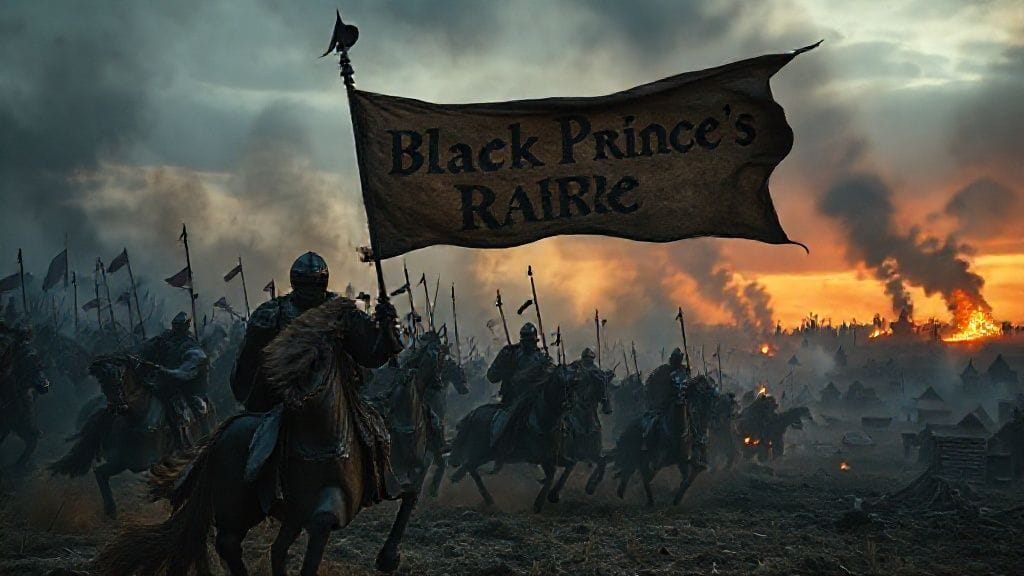
It is the late summer of 1355. The air is thick with the scent of ripe grapes and drying hay across the rolling fields of Aquitaine and into the fertile Loire Valley. Yet ahead, the heavy clouds of war and suffering gather to blot out the sun’s warm glow. From the horizon comes a thunderous gallop: the Black Prince, mounted on fierce destriers, leads a force that will soon blaze a trail of fiery destruction through some of the richest lands in France. Villagers clutch their children. Merchants shutter their shops. Monks whisper prayers. It is not merely an army but a storm of iron, fire, and broken lives.
The Black Prince's chevauchée—or rapid mounted raid—is not just a military tactic; it is a deliberate instrument of terror designed to break the will of the French crown. This is the story of how Prince Edward of England brought devastation from Aquitaine to the Loire in 1355 and 1356, carving a path that would shake the foundations of medieval Europe.
The Black Prince: Prince Edward’s Rise to Command
Edward, Prince of Wales, the heir to the English throne, carried his sobriquet—the “Black Prince”—not from a dark armor or mythical origins, but from tales of ruthless efficiency and a presence as fearsome as a shadow at dawn. Son of King Edward III, Edward was raised amid the turbulent atmosphere of war. By the time he reached his early twenties, he was already a seasoned knight and leader.
His emergence as a commander was crucial for England’s ongoing conflict with France, the stage for what would become the prolonged, and devastating, Hundred Years’ War. Edward’s charisma and tactical brilliance made him the ideal figure to spearhead England’s military campaigns on French soil.
The Hundred Years’ War: A Europe in Turmoil
The conflict between England and France, known as the Hundred Years’ War, was less a continuous battle and more a series of inherited grievances, territorial claims, and dynastic rivalry. Since 1337, the struggle for the French crown had spread across France and England like wildfire, tearing communities apart and reshaping political alliances.
At its core, the war reflected questions of identity, sovereignty, and power. For Edward III and his son, the claim to the French throne was not just personal ambition, but a strategic lever to weaken a rival power. France, under King John II, was equally determined to repel English advances and maintain unity.
Aquitaine in the Mid-14th Century: Wealth and Vulnerability
Aquitaine, the jewel of southwestern France, was a region of vineyards, salt marshes, and thriving trade. It was also an English-held territory since the marriage of Eleanor of Aquitaine to Henry II of England over two centuries earlier, imbuing the region with a precarious mixed allegiance.
The land was wealthy but politically fragmented; local lords often found themselves torn between loyalty to the French crown and ties to English overlords. Its landscape was dotted with fortified towns and prosperous villages, which, paradoxically, made it a prime target for a bold chevauchée designed to disrupt agriculture, commerce, and morale.
The Strategic Gamble: Planning the Chevauchée
Edward’s plan was bold and brutal—rather than laying siege to heavily fortified cities, his force would strike rapidly into enemy territory, ravaging towns, destroying crops, and forcing French armies into costly pursuits or defensive postures.
The chevauchée served multiple purposes: to weaken French control, to procure food and supplies for English troops, and to terrorize the civilian population so that allegiance might shift or fractures appear in French authority.
At roughly 5,000 men, mostly mounted archers and knights, the English army placed speed and surprise at the core of their strategy. The plan was part military necessity, part psychological warfare.
Igniting the Flame: The Beginning of the Raid
In late October 1355, Edward’s troops departed from English-held Bordeaux. What followed was not a classic military campaign but a terrifying ride through the heartlands.
The raid began with swift assaults on towns and villages, often accompanied by their plundering, burning, and destruction. Wine cellars sabotaged, farmhouses razed, and peasantry driven into flight: these were the trademarks of the chevauchée.
The English forces took care to avoid prolonged sieges; speed was paramount to maintaining the element of surprise and to prevent the French armies from mobilizing an effective counterattack.
The Path of Destruction: From Gascony to the Loire
The initial stages of the raid moved northeast towards the Loire River. The road was littered with the remnants of feudal estates and poorly defended villages caught in the path. Troyes, Poitiers, and other towns lay in alarmed silence—or flames.
Entire swaths of countryside were reduced to ashes. Food stores were seized or destroyed, crippling the French war effort and the local economy. The chevauchée’s destructive momentum was merciless, creating refugee crises and disrupting trade routes stretching from the Atlantic coast into central France.
Towns in Flames: Lessons in Terror and Chaos
Witnesses of the raid described scenes of chaos—churches burned, markets looted, fields trampled by mounted knights, and communities left without shelter as winter approached. Chroniclers wrote of terrified peasants fleeing into forests or rivers to escape the merciless invaders.
The psychological impact was immense. For the French nobility and common folk alike, the chevauchée embodied the grim reality that no place was truly safe. The scorched earth seemed to mock the very idea of feudal protection, shaking the pillars of medieval society.
The Battle of Saintes: Testing Strengths and Wills
Not all engagements were one-sided. At Saintes, the English army encountered spirited French resistance. The clash, though smaller than some of the great battles of the Hundred Years’ War, tested the discipline and resolve of the knights and archers.
It was a reminder that despite the havoc wrought by the Black Prince, the French crown would not yield easily. Such encounters punctuated the chevauchée, injecting moments of tension and brutal combat into the largely destructive campaign.
The Siege of Carcassonne: Resistance and Retribution
Though many towns suffered swift fall or flight, Carcassonne stood as a resilient fortress. The siege attempted by Edward’s forces was marked by frustration and costly skirmishes, underscoring the limits even of a swift raid.
The siege, while failing to take the city outright, demonstrated the interplay of military technology, fortifications, and sheer will that characterized medieval warfare during this turbulent period.
Crossing the Loire: Deep Into the Enemy’s Heart
Perhaps the most audacious aspect of the Black Prince’s chevauchée was pushing that assault into the Loire Valley, beyond the traditional theatres of war. Entering this densely populated and prosperous area sent shockwaves through the French court.
The Loire, a natural defensive line, was crossed with a daring speed that left neighboring provinces scrambling to organize defense or negotiate perilous truces.
This incursion foreshadowed even larger clashes soon to come.
French Response: King John II and the Call to Arms
King John II of France could no longer afford to treat the chevauchée as a mere nuisance. With the kingdom’s resources strained by previous conflicts and internal strife, the call to arms became urgent.
Mobilizing a large army, John sought to intercept and trap the English forces before more damage could be done. The responses included raising new levies, reinforcing castles, and rallying the nobility under the crown’s banner.
But divisions among French leaders and logistical challenges hampered a decisive counterattack for months.
The Human Cost: Stories of Suffering and Survival
Beyond the smoke and sword, the chevauchée left deep scars on ordinary lives. Families forced to flee their homes, peasants starved by burned harvests, children orphaned by raids—these stories form the human dimension of the raid.
Monastic records and letters reveal tales of heroic resistance, compassion in hardship, and the endurance of communities despite brutal deprivation.
It was a war not just of kings and knights but of human tragedy writ small across the map.
The Military Innovations and Tactics in the Chevauchée
The Black Prince’s chevauchée highlighted the growing importance of mobility and ranged firepower in medieval warfare. The prevalence of mounted archers allowed rapid advances combined with deadly effectiveness.
Rather than relying solely on sieges, these raids exploited speed and psychological impact. The chevauchée became a precursor to more modern concepts of total war and economic disruption.
The tactical lessons learned here influenced both English and French military doctrines in subsequent years.
The Aftermath in Aquitaine and the Loire Valley
When the flames finally died down, Aquitaine and the Loire bore the visible wounds of war. Agricultural lands lay fallow, towns struggled to rebuild, and the economy was destabilized for years.
Yet not all outcomes were negative for the English cause; regions weakened in France gave England temporary advantages which shaped political negotiations for the conflict’s next phases.
Moreover, the raid cemented the Black Prince’s reputation as both heroic and feared, a figure who dominated the imagination of contemporaries and historians.
Political Shockwaves: The Chevauchée and the French Crown
The raid inflicted more than material damage—it undermined the legitimacy and authority of King John II by exposing the weakness of royal control over his own territories.
This erosion of power contributed to internal dissent, including the tensions in the Estates General of France, eventual capture of John at Poitiers, and the worsening financial crisis.
In some ways, the chevauchée hastened the political transformations that would shape late medieval France.
Economic Ruin or Resilience? The Region’s Recovery
The economy of Aquitaine and surrounding regions was devastated—vines uprooted, mills burned, and markets disrupted. Trade slowed dramatically and famine threatened.
Yet, historical records also show remarkable resilience. Villages rebuilt, trade networks reconnected, and new social arrangements emerged in the wake of war’s destruction.
The human drive to recover and adapt was a testament to endurance even amidst the darkest times.
The Chevauchée’s Role in the Evolution of Medieval Warfare
Historians often view the 1355–56 chevauchée as a transformative moment in medieval military strategy. The use of fast-moving mounted troops to inflict economic and psychological damage changed how wars were fought.
It signaled a shift from border skirmishes and set-piece battles to prolonged campaigns aimed at breaking enemy morale—a key development leading into the later phases of the Hundred Years’ War and beyond.
Edward’s Reputation: The Legend of the Black Prince
After the chevauchée, Edward the Black Prince ascended to near-mythical status. Poets and chroniclers lauded his bravery, chivalry, and leadership. Yet, beneath the legend lay the reality of ruthless warfare and calculated terror.
His image became a complex one: a heroic prince to his countrymen, a scourge to the French, embodying both the valor and the cruelty of medieval knighthood.
Memory and Myth: The Chevauchée in Chronicles and Literature
The chevauchée left a lasting imprint on historical writing and popular memory. French chroniclers expressed horror and tragedy; English accounts praised its military genius.
Over time, the raid entered the literature of medieval Europe as symbol—of noble glory and tragic conflict. It shaped cultural identity narratives and historical consciousness in both nations.
Conclusion: A Raid that Shaped a Continent’s Destiny
The Black Prince’s chevauchée of 1355–56 was more than a military campaign. It laid bare the harsh realities of medieval conflict: brutal, swift, devastating, yet strategic.
Crossing from Aquitaine to the Loire, this raid tore through the fabric of French society, challenged medieval notions of warfare, and forever changed the trajectory of the Hundred Years’ War.
In the embers left behind, we find stories of courage, suffering, and resilience—a human tapestry woven into the vast chronicles of history.
FAQs
Q1: What triggered the Black Prince’s chevauchée in 1355?
The chevauchée was planned as a strategic raid during the Hundred Years’ War to weaken French control, disrupt the economy, and force the French crown into a vulnerable position. The English sought to exploit the fractured political landscape of Aquitaine and the inability of the French to field decisive forces early on.
Q2: Who was the Black Prince and why was he important?
Edward of Woodstock, known as the Black Prince, was the eldest son of King Edward III of England. He was the English commander responsible for leading several successful military campaigns during the Hundred Years’ War. His leadership and tactical innovations significantly influenced medieval warfare.
Q3: How did the chevauchée affect civilian populations?
Civilians suffered greatly; towns were burned, crops destroyed, and many were displaced or killed. The raid caused widespread famine and economic disruption. Monasteries, villages, and towns were left vulnerable, shattering the medieval social order in affected regions.
Q4: What was the reaction of the French crown to the chevauchée?
King John II rallied his forces to respond, eventually confronting the English in battles such as Poitiers in 1356. The raid exposed the weaknesses of the French military and administration, contributing to internal tensions and financial crises within France.
Q5: How did the raid influence the course of the Hundred Years’ War?
The chevauchée boosted English morale and bargaining power, demonstrating the effectiveness of fast, mobile warfare. It weakened French territorial integrity and set conditions for further English advances, although it also galvanized French resistance.
Q6: Did the Black Prince’s chevauchée have any long-term military significance?
Yes. The raid exemplified and popularized the tactic of chevauchée—rapid mounted raids aimed at terror and economic destruction—which became a standard feature in later medieval warfare. It showcased the tactical value of mounted archers and mobility over static siege warfare.
Q7: What happened to Aquitaine and the Loire after the raid?
These regions endured economic hardship and social disruption after the chevauchée but gradually recovered. The political landscape shifted, with increased instability and changing allegiances. The damage inflicted, however, left lasting scars on local populations and infrastructure.
Q8: How is the chevauchée remembered today?
It remains a symbol of both chivalric prowess and the brutal realities of medieval warfare. The Black Prince’s raid is studied as a turning point in the Hundred Years’ War and medieval military history, remembered through chronicles, literature, and modern historical analysis.

