Table of Contents
- The Twilight of Feudal France: Setting the Stage for Revolt
- The Black Death and the Cracks in Medieval Society
- Taxation, War, and the Seeds of Revolt
- The Outbreak of the Jacquerie: Spark in Île-de-France
- Peasant Fury: Rage of the Paysans
- The Role of Leadership: Guillaume Cale and the Peasant Command
- The Nobles’ Response: Fear and Fury in the Aristocracy
- Battles and Breakdowns: The Clash at Mello
- The Brutal Suppression: Outline of the Royal and Noble Retribution
- The Psychological Warfare: Terror as Control
- Consequences for the Peasantry: Devastation and Repression
- The Jacquerie’s Place in the Hundred Years’ War Turmoil
- The Social Fabric Shattered: Long-Term Impact on Feudal Relations
- The Voice of Chroniclers: Chronicles and Propaganda
- Memory and Myth: The Jacquerie in French Cultural Imagination
- Historiographical Debates: Reassessing the Jacquerie’s Causes and Legacy
- A World in Upheaval: The Jacquerie Beyond France
- Conclusion: Echoes of a Peasant Revolt in History
- FAQs: The Jacquerie Questions Unveiled
- External Resource
- Internal Link
The Twilight of Feudal France: Setting the Stage for Revolt
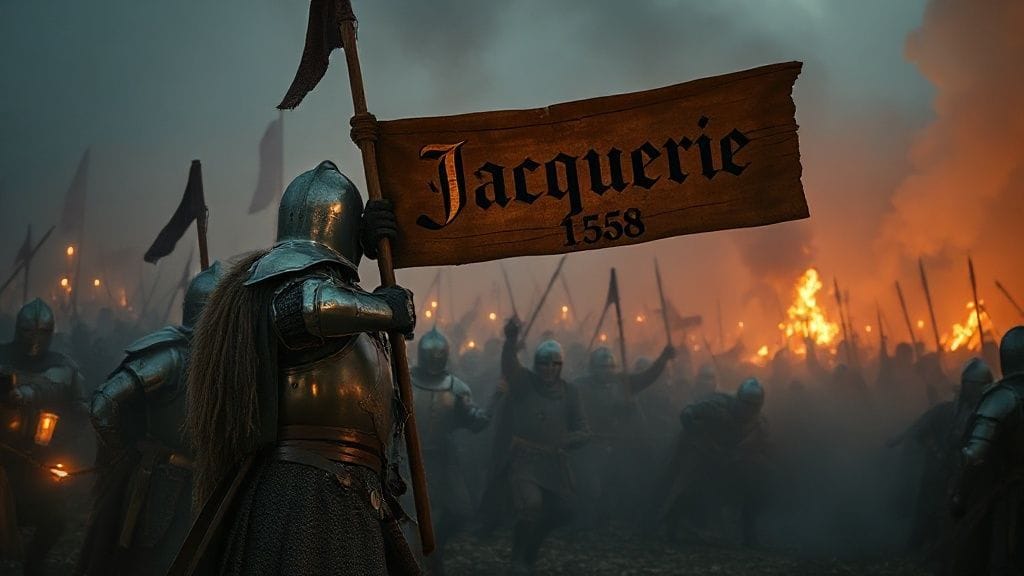
It was a gloomy summer day in 1358, in the heartlands of Île-de-France. A tense wind swept across the fields and villages, whispering of change and of wrath long buried now erupting. The sky above the scattered hamlets was heavy, as if mourning the fates to come. Across these lands, the peasantry—long downtrodden and weary—gathered in clandestine bands, their faces marked with desperation and determination. This was the moment when an explosive rage, called the Jacquerie, culminated, shaking the foundations of medieval society in France and challenging the very edifice of feudal order.
The Jacquerie, often dismissed as a rabble’s fury in the annals of history, was no mere spontaneous uprising. It was the boiling point of centuries of oppression, fear, and hardship. As the peasants marched and fought, their rebellion bore the scars of famine, war, and crushing taxation—symbols of a social contract frayed to its last thread. But this was not just a clash of swords; it was a collision of worlds: a world of servitude and subjugation straining against the dawn of new social realities.
The Black Death and the Cracks in Medieval Society
The mid-14th century was a time of profound crisis in Europe. The Black Death—arriving in 1347—had swept through France, leaving death and desolation in its wake. Nearly half the population perished, and with such catastrophic losses, the social and economic structures that bound society began to falter.
Labor shortages meant peasants could, for a fleeting moment, demand better conditions, yet the nobility, terrified of losing their grip, cracked down harder, increasing taxes and tightening their hold on traditional privileges. The catastrophic demographic collapse exacerbated the strains between lords and peasants, banks and guilds, townsfolk and countryside. The deep inequalities of feudalism became impossible to ignore.
The shock did not dissipate quickly; instead, it simmered beneath the surface. Peasants faced famine, economic despair, and brutal working conditions, feeling more like serfs in an age that cried out for reform and justice.
Taxation, War, and the Seeds of Revolt
Compounding this suffering was the ongoing Hundred Years’ War between England and France. The conflict drained the royal treasury and demanded ever more resources and manpower. To feed a seemingly endless war machine, King John II and his court imposed heavy taxes on the peasantry, often extracting tithes and levies with ruthless efficiency.
The nobles themselves were called upon to supply men and money, but many used violence and extortion to maintain their privileges, further inflaming class resentment. The countryside—already ravaged by war, famine, and plague—became an unbearable prison for the peasants caught in the cycle of tax and tribute.
This was fertile ground for rebellion. Rumblings began in small villages, distant fields, and market towns, where peasants, known derisively as Jacques by the ruling classes, slowly began to organize in defiance. Their ambitions were not revolutionary in the modern sense, but rooted in justice and survival—an attempt to repel the extortion and cruelty that marked their daily lives.
The Outbreak of the Jacquerie: Spark in Île-de-France
The Jacobin uprising ignited in early May 1358 in the Île-de-France region, around the village of Saint-Leu. The catalyst was instinctive fury at the unbearable burdens and abuses administered by local nobles and officials, many of whom had fled or been captured during the war.
Peasant bands quickly grew in size and audacity, armed with farming tools, pitchforks, and any weapons they could muster. Their numbers fluctuated, but at their height, tens of thousands of peasants took up the banner of revolt—a challenge to the very feudal codes that had governed rural France for centuries.
These uprisings were not isolated; they coincided with other rebellions, including the more politically charged revolt in Paris led by Étienne Marcel—the powerful provost of merchants. The rural Jacquerie, however, remained primarily a social revolt, though connected indirectly to the larger political chaos gripping the French crown.
Peasant Fury: Rage of the Paysans
The peasants’ anger was visceral. The noble estates—symbols and instruments of oppression—were attacked, burned, and looted. Churches and castles suffered alongside tax offices. The rebellion revealed deep fractures in the social order: violent vengeance against oppressive lords, but also moments of solidarity and desperate hope for change.
Peasants expressed their boiling rage with cries to reclaim their dignity and protection. “Enough of hunger! Enough of blood!” echoed through villages. Chroniclers of the time, often nobles themselves, depicted the Jacquerie as savage and mindless, but beneath this portrayal lay a clear, anguished cry for justice.
One of the most notable leaders emerging from this chaos was Guillaume Cale, a man of modest origin but sharp intelligence and resolve, who sought not only to avenge but to negotiate a better future for his people.
The Role of Leadership: Guillaume Cale and the Peasant Command
Guillaume Cale rose as a unifying figure for the fragmented peasant bands. He was elected captain, a rare and dangerous position for a peasant in medieval society. Cale advocated for organized resistance rather than chaotic violence, attempting to turn the uprising into a more disciplined force.
Despite their limited military training, Cale’s leadership allowed the peasants to mount effective guerrilla strikes and avoid outright destruction. His careful diplomacy and strategy posed a genuine threat to the local nobility, who found themselves suddenly vulnerable against a force they had long considered beneath contempt.
Guillaume’s vision hinted at a nascent social consciousness, though its survival depended on navigating the deadly enmity of the aristocracy and the crown.
The Nobles’ Response: Fear and Fury in the Aristocracy
To the nobles, the Jacquerie was an apocalyptic nightmare. An uprising of peasants reversed centuries of hierarchical order and threatened the sanctity of property and privilege. Nobles from nearby towns organized militias to crush the rebellion with overwhelming force.
Many nobles fled to fortified châteaux, issuing decrees calling for brutal suppression. They saw the revolt as both a threat to their wealth and an existential challenge to medieval society itself. Panicked, they coordinated with royal forces and other loyalist militias.
This fear transformed into savage retribution—where mercy was rare, and entire villages faced massacre as a grim warning to others contemplating revolt.
Battles and Breakdowns: The Clash at Mello
The defining military engagement of the Jacquerie took place near the town of Mello in late May 1358. There, Guillaume Cale’s forces confronted a well-armed noble militia led by Charles II of Navarre, an aristocrat infamous for his political ambition and ruthlessness.
Despite their courage and superior numbers, the peasants lacked the training and heavy weaponry of their opponents. Their lines broke under the lance charges and disciplined cavalry assaults. Guillaume Cale was captured—betrayed by local nobles—and executed shortly thereafter.
The failure at Mello was a fatal blow, shattering the peasant forces and signaling the beginning of the rebellion’s brutal end.
The Brutal Suppression: Outline of the Royal and Noble Retribution
Following the defeat, a campaign of terror swept through the Île-de-France. Nobles, emboldened by victory, exacted savage punishment—massacres, torture, and scorched earth tactics were common. Villages suspected of harbouring rebels were razed, and surviving peasants were flogged, imprisoned, or executed.
The king’s forces, now more assertive after King John II’s return from captivity in England, supported this crackdown ruthlessly. The Jacquerie’s ideals were buried beneath the ashes of brutal repression.
Terrified peasants returned to their fields, cowed but forever changed by the memory of resistance.
The Psychological Warfare: Terror as Control
The suppression was more than physical—it was psychological. The nobility’s message was clear: rebellion equaled annihilation. Public executions and displays of torture sent a frightening message beyond Île-de-France, throughout rural France and beyond.
This reign of terror re-emphasized the hierarchy, enforcing submission through fear. But it also left deep wounds—fear mingled with resentment, a volatile legacy that simmered beneath the surface for generations.
Consequences for the Peasantry: Devastation and Repression
The aftermath left the French countryside devastated. Population numbers were reduced, economies ruined, and feudal bonds hardened rather than loosened. Peasants’ access to justice and rights was curtailed, and many lords enforced harsher local laws.
Yet, paradoxically, the revolt revealed the indispensable role of peasants in sustaining the economy and warfare, planting seeds for future social changes despite immediate failure.
The Jacquerie’s Place in the Hundred Years’ War Turmoil
The Jacquerie cannot be understood outside the wider chaos of the Hundred Years’ War. The war’s pressures—not only fiscal but psychological—helped set the stage for peasant anger.
It also illustrated the vulnerabilities of the French monarchy, fractured nobility, and the social order’s brittleness. The monarchy’s later reforms and policies were shaped by the lessons harshly learned during these revolts.
The Social Fabric Shattered: Long-Term Impact on Feudal Relations
Though crushed, the Jacquerie weakened the unquestioned authority of the nobility. The symbolic violence against lords spoke to a social reality that would not remain static forever.
The revolt exposed the contradictions of feudalism and contributed, in the long run, to the slow decline of serfdom and the rise of a more modern social contract in France.
The Voice of Chroniclers: Chronicles and Propaganda
Most contemporary chroniclers were nobles, whose disdain for peasants shaped the narrative. They depicted the Jacquerie as savage but often exaggerated its brutality.
Yet, these texts also provide valuable insights into the fears and attitudes of the time. Later historians have worked to re-balance these portrayals, giving voice to the peasants’ suffering and motives.
Memory and Myth: The Jacquerie in French Cultural Imagination
Over centuries, the Jacquerie acquired a mythic status in French cultural memory—sometimes romanticized as the peasants’ fight for justice, other times vilified as destructive chaos.
Writers, artists, and historians have revisited this episode, each generation interpreting it through the prism of their own social struggles.
Historiographical Debates: Reassessing the Jacquerie’s Causes and Legacy
Modern historians debate whether the Jacquerie was primarily a social revolt, a proto-class struggle, or a desperate survival insurgency. Some emphasize economic factors, others political destabilization.
This scholarly reevaluation has enriched understanding of medieval social dynamics and the complexities of popular resistance.
A World in Upheaval: The Jacquerie Beyond France
Finally, the Jacquerie fits into a broader pattern of 14th-century upheavals—similar rural revolts echoed across Europe, revealing common strains within medieval feudalism and the struggle of common people to assert their rights.
It marks a moment when the old order wavered under the pressures of demographic disaster, war, and social change.
Conclusion
The Jacquerie of 1358 was more than a peasant riot; it was a profound cry for dignity and justice amid the turbulence of medieval life. Though brutally suppressed, its flames illuminated the fractures within feudal society and foreshadowed the slow transformation of European social structures.
Remembering the desperate courage of the Jacques reminds us that history is not only shaped by kings and nobles but also by the silent, relentless force of ordinary people refusing to remain invisible. Their story, often muted by time and power, continues to speak across centuries—a testament to human resilience and the perennial quest for justice.
FAQs
Q1: What were the main causes of the Jacquerie uprising?
A1: The Jacquerie was primarily caused by the social and economic devastation wrought by the Black Death, heavy taxation due to the Hundred Years’ War, and brutal feudal oppression.
Q2: Who was Guillaume Cale, and why was he important?
A2: Guillaume Cale was a peasant leader who unified scattered rebel groups, leading a more organized resistance before his capture and execution marked the turning point of the revolt.
Q3: How did the nobles respond to the Jacquerie?
A3: The nobility responded with fear and overwhelming military force, crushing the rebellion through brutal battles followed by massacres and widespread repression.
Q4: In what ways did the Jacquerie affect medieval French society long-term?
A4: While immediately suppressed, the Jacquerie exposed the fragility of feudal order, contributing to long-term erosion of serfdom and a gradual evolution of social relations.
Q5: How is the Jacquerie remembered in French culture?
A5: The Jacquerie is alternately remembered as a symbol of peasant resistance or as violent chaos, inspiring various artistic and historical interpretations throughout the centuries.
Q6: Was the Jacquerie unique to France?
A6: No, similar peasant revolts occurred across Europe in the 14th century, reflecting widespread social tensions caused by plague, war, and economic hardship.
Q7: How reliable are contemporary accounts of the Jacquerie?
A7: Many contemporary chronicles were written by nobles who often exaggerated peasant violence and condemnation, so modern historians critically reassess these sources.
Q8: Did the Jacquerie influence later revolts?
A8: Yes, it served as a stark lesson for both rulers and rebels, influencing later uprisings by illustrating both the risks of revolt and the power of popular resistance.