Table of Contents
- The Twilight of Ambitions: Brittany on the Cusp of War
- The Breton Succession Crisis: Roots of a Royal Dispute
- The Players in a Dangerous Game: War of Claims and Loyalties
- The Fractured Duchy: A Land Divided Between Two Crowns
- The Spark Ignites: Early Clashes and Political Maneuvering
- The War’s Toll: A Provincial Battlefield in a Hundred Years’ Shadow
- The Prelude to Auray: Alliances Forged and Broken
- September 29, 1364: Dawn of the Battle of Auray
- The Clash of Titans: Strategy, Valor, and Chaos in the Field
- Decisive Blows: The Death of Jean de Montfort
- Triumph and Tragedy: The Aftermath of Auray
- The Treaty of Guérande: Diplomatic Resolution and Its Terms
- The Limits of Victory: Brittany’s Place between England and France
- The War’s Broader Impact: Reflections on the Hundred Years’ War
- Legacy of the Breton Succession War: Memory and Myth
- The Dukes to Come: Brittany’s Path into the Early Modern Era
- Human Faces of the Conflict: Stories of Courage and Loss
- Reflections on Sovereignty: Feudal Rights vs. Emerging Nationhood
- The Cultural Resonance: How Brittany’s Identity Was Shaped
- Conclusion
- FAQs
- External Resource
- Internal Link
1. The Twilight of Ambitions: Brittany on the Cusp of War
The mist hung heavy over the rolling hills of Brittany on the damp morning of September 29, 1364. A chill breeze swept through the ancient forests and stone villages dotting the landscape, as if nature herself braced for the storm that was about to break. In the air was the unmistakable tension of history’s turning point—a duchy’s fate wavered on the blade’s edge. On that day, near the town of Auray, two claimants to the Duchy of Brittany clashed in a brutal confrontation that would not only end a bitter war of succession but also etch its echoes into the vast tapestry of medieval Europe’s dynastic struggles.
Away from the grandeur of royal courts, on a bloodied field, the future of Brittany would be forged in a cacophony of steel and screams. The battle that unfolded was not merely a quarrel among nobles: it was a collision of claims bound by inheritance, ambition, and the tangled loyalties between England and France, whose long shadow—the Hundred Years’ War—loomed large over the contest. Here, in this borderland of culture, language, and power, history was about to pivot in ways that few yet seemed to understand.
2. The Breton Succession Crisis: Roots of a Royal Dispute
The origins of the War of the Breton Succession are best understood through the labyrinthine web of medieval laws, dynastic rights, and international politics. Brittany, a duchy located on the western edge of France with a fiercely independent spirit and its own Celtic heritage, had long existed in a delicate balance. The death of Duke John III of Brittany in 1341 without a direct male heir thrust the duchy into chaos.
Two principal claimants emerged: John of Montfort, half-brother to the late duke, and Jeanne de Penthièvre, niece by blood and wife to Charles of Blois, a French royal cousin. Their claims were steeped in centuries of contested inheritance law. John pressed the right of male succession, while Jeanne’s claim leaned on heredity through the female line. The French crown, under Philip VI, lent its weight to Charles of Blois, triggering a political tug-of-war that soon escalated beyond mere legal debate.
For the people of Brittany, this was not a simple quarrel of aristocrats but a fracture of identity, loyalty, and local governance. Nobles were forced to choose sides, towns fortified their walls, and villages wrestled with their future amid the looming threat of war.
3. The Players in a Dangerous Game: War of Claims and Loyalties
Conflicts are rarely distilled to simple binaries, and the Breton Succession War epitomizes this complexity. John of Montfort represented a faction that saw the English crown—rivals of France— as an indispensable ally. His cause was bolstered by Edward III of England, whose own conflict with France set the larger backdrop: the Hundred Years’ War, a protracted struggle for dominance over French territory and the English claim to the French crown itself.
On the other side, Charles of Blois enjoyed the full favor of the French monarchy, which sought to maintain Brittany firmly within France’s sphere. Their intertwined interests transformed Brittany into a proxy battlefield, where local ambitions and continental disputes collided.
Yet, within these titans’ shadows were countless individuals: knights bound by chivalry, peasants conscripted into service, clergy attempting to mediate or bless the cause, and townspeople caught in the crossfire.
4. The Fractured Duchy: A Land Divided Between Two Crowns
During those tense years from 1341 onwards, Brittany became a patchwork of alliances. Montfortist strongholds in the west and north often aligned with English interests, while the eastern parts and many urban centers leaned towards the Blois faction and France.
This division permeated every aspect of life: commerce suffered, the countryside lay under the shadow of pillaging armies, and ancient familial rivalries were exacerbated by political necessity. Moreover, Brittany’s strategic position—its ports along the Atlantic and proximity to England—added a crucial layer of military and economic interest for both foreign monarchs.
The regional nobility, caught between personal loyalty, the prevailing winds of power, and survival, often switched sides or fought for autonomy rather than absolute allegiance, underscoring the fragmented nature of medieval power.
5. The Spark Ignites: Early Clashes and Political Maneuvering
The initial two decades of the war were marked by intermittent fighting, siege warfare, and diplomatic chess. In 1342, John of Montfort was captured and imprisoned, leaving the war’s leadership in the hands of his wife, Jeanne de Flandre, whose fierce determination kept the Montfort cause alive. Her role exemplified the exceptional agency rare for noblewomen of the time—she rallied troops, negotiated with English support, and inspired her faction.
Meanwhile, Charles of Blois achieved victories including the capture of several key fortresses, yet his campaigns were costly and extended the destruction throughout Brittany. The war became a grinding contest of attrition, punctuated by brutality toward civilians and shifting fortunes.
Both sides invested heavily in garnering support from the crowns of England and France, who were themselves embroiled in confrontation. Brittany became a crucial theater within the broader macrocosm of the Hundred Years’ War.
6. The War’s Toll: A Provincial Battlefield in a Hundred Years’ Shadow
Beyond battles and diplomacy, the conflict devastated Brittany’s social fabric. Famine, displacement, and destruction of agricultural land were widespread. Medieval chroniclers recorded harrowing details: burned villages, starving children, and a countryside turned to battleground. The duchy’s wealth eroded, trade was stunted, and lawlessness flourished.
The common folk endured not just the immediate horrors of war but also the enduring anxiety of living in a contested land. For many, the distant claims of dukes and kings felt abstract compared to the palpable suffering they witnessed.
This human cost fostered bitter memories and local legends that colored Brittany’s historical identity for centuries.
7. The Prelude to Auray: Alliances Forged and Broken
By 1364, the war had stagnated into a grim stalemate. Neither Montfort nor Blois could claim absolute control, yet peace efforts failed repeatedly amid deep mistrust. Both Charles of Blois and John of Montfort gathered their forces for a decisive confrontation.
Strategically, Auray, with its access to vital routes and defensive terrain, became the focal point. The armies, numbering several thousand knights, men-at-arms, and infantry, prepared for what was anticipated to be a defining battle.
Behind the scenes, alliances shifted subtly. Some Breton lords hedged their bets; the English and French monarchs watched with vested interest but remained cautious about direct intervention lest the conflict spiral beyond control.
8. September 29, 1364: Dawn of the Battle of Auray
The morning of September 29 was tense and expectant. The sky was a muted gray, but beneath it surged the drumbeats of war. John of Montfort’s forces held ground near the town, learning the terrain to maximize their defensive advantage. Charles of Blois’ army, larger but perhaps overconfident, advanced with enthusiasm.
Chivalric codes still structured battlefield encounters, but the stakes transcended medieval pageantry. The combatants knew the outcome would shape not only the duchy’s fate but also the broader chessboard of European power.
Civilians nearby watched from rooftops and huddled behind walls, silent witnesses to a confrontation that would carve its legend into Brittany’s soul.
9. The Clash of Titans: Strategy, Valor, and Chaos in the Field
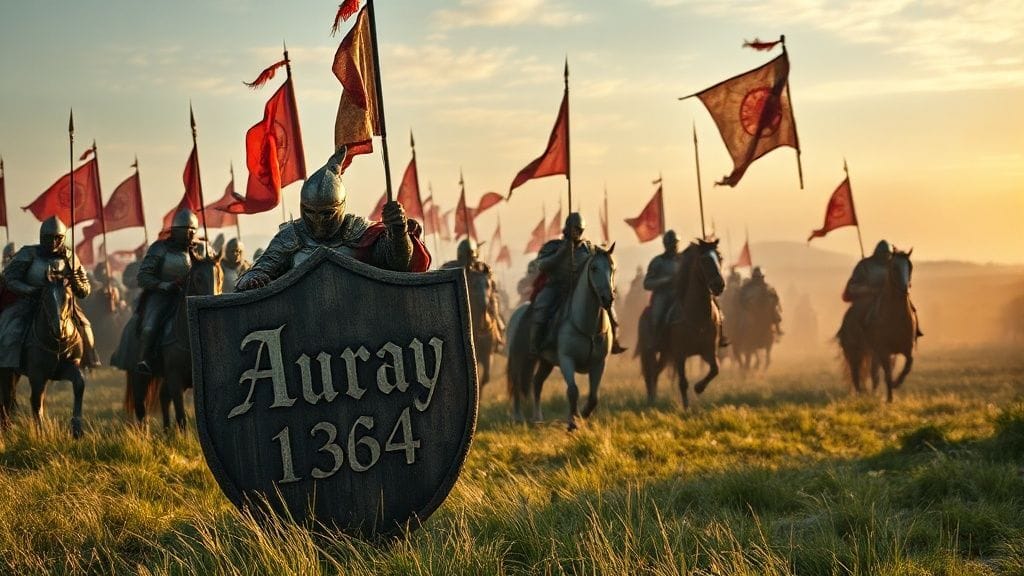
The battle unfolded with a brutal immediacy. Montfort’s forces, though outnumbered, utilized the terrain expertly, setting ambushes and defensive positions that blunted Charles of Blois’ advance. The clash of swords and lances resonated through the hills; banners unfurled under an ominous sky.
At the heart of the combat was an extraordinary display of medieval warfare’s paradox: valor and horror interwoven. Knights charged gallantly, knights fell heroically, but the toll was appalling. The fighting was close, savage, and unforgiving.
Montfort’s commanders executed a pivotal cavalry charge at a critical moment that shattered Blois’ center. The decisive coordination demonstrated that tactics and leadership outweighed mere numbers.
10. Decisive Blows: The Death of Jean de Montfort
Amid the chaos, tragedy struck on the Blois side. Charles of Blois, seeing ranks falter, rushed into the thickest fighting. His death, felled by a lethal blow from an English archer’s arrow—or some chroniclers say a Montfort knight’s lance—was a supernatural turning point.
His fall left his army leaderless and demoralized, and the battle quickly tipped toward Montfort’s favor. With victory near, John of Montfort’s cause gained an irreversible advantage.
Yet this triumph was sobered by the costly price paid in lives on both sides, heralding a fragile peace more than simple celebration.
11. Triumph and Tragedy: The Aftermath of Auray
The bloodied field near Auray marked the end of open warfare but not the end of contestation. John of Montfort secured his position as Duke of Brittany, crowned with English support, yet the duchy remained fragile, a pawn in greater geopolitical games.
The war officially ended with the Treaty of Guérande in 1365, which recognized Montfort’s descendants as rightful dukes but preserved some privileges to the Blois line, preventing absolute erasure.
Brittany’s recovery was slow; the scars—economic, social, and psychological—linger in local memory. For the nobility, a new era of cautious rule began, overshadowed by the future challenges of sovereignty and external pressures.
12. The Treaty of Guérande: Diplomatic Resolution and Its Terms
Signed in 1365, the Treaty of Guérande is a testament to medieval diplomacy’s pragmatic nature amid brutal conflict. The accord recognized John IV (son of John of Montfort) as Duke of Brittany.
It stipulated peace between both factions, with the Penthièvre family retaining some estates and privileges but refraining from further claims. The treaty also enforced neutrality in the larger Hundred Years’ War, though Brittany would later fall again into the orbit of Franco-English conflicts.
Thus, the treaty preserved a fragile peace—a compromise born out of exhaustion and balance of power.
13. The Limits of Victory: Brittany’s Place between England and France
Although Montfort’s victory brought temporary stability, Brittany existed in the shadow zone of two powerful kingdoms. Its sovereignty was a constant negotiation: fealty to the French crown balanced against English alliances.
This delicate positioning affected Breton politics for centuries. Brittany’s dukes maneuvered diplomatically, sometimes precariously, to preserve autonomy while benefiting from patronage.
The War of the Breton Succession thus illuminated the broader medieval tension: regional identity striving against emerging nation-states.
14. The War’s Broader Impact: Reflections on the Hundred Years’ War
The Breton Succession War was more than a localized dynastic dispute; it was a microcosm of the greater entanglements of the Hundred Years’ War. England’s intervention in Brittany was a strategic endeavor to carve a foothold on the continent.
For France, holding Brittany was vital to prevent English encirclement. The conflict intensified rivalries and shaped alliances that would persist for generations.
Moreover, it demonstrated how regional conflicts could rapidly gain international dimensions—an early illustration of the complex interplay between local and global politics.
15. Legacy of the Breton Succession War: Memory and Myth
Over the centuries, the War of the Breton Succession has inspired tales of chivalry, tragedy, and identity. Breton culture remembers the conflict as a defining moment—mixing fact with legend.
Heroes like Jeanne de Flandre emerge as symbols of resilience; battles like Auray become emblematic of sacrifice and fate. The war’s legacy informs Brittany’s distinct regional pride even today, underscoring a historical narrative of struggle for autonomy and survival.
This humanization of history keeps alive the memory beyond dry records into the realm of shared cultural consciousness.
16. The Dukes to Come: Brittany’s Path into the Early Modern Era
Following the war, Brittany’s leadership faced the task of rebuilding and navigating increasingly centralized French authority. The Montfort line maintained the ducal crown, fostering relative peace but always wary of external influence.
By the late 15th century, Brittany’s incorporation into the French crown was accelerated through marriage and political alliances, culminating officially with Duchess Anne of Brittany’s union with King Charles VIII of France. Yet, Celtic traditions and a strong sense of identity preserved a unique Breton identity.
The succession war’s resolution thus seeded the complex history of a duchy grappling with integration and resistance.
17. Human Faces of the Conflict: Stories of Courage and Loss
Beneath armies and alliances were individual stories that history often overlooks. Jeanne de Flandre’s steadfast leadership as a widow fighting for her son’s inheritance stands out—a testament to unexpected female power in a patriarchal world.
The experiences of common soldiers, many conscripted and displaced, provide glimpses into the human cost beyond chivalric idealism. Chroniclers describe harrowing sieges, acts of heroism, and tragic betrayals.
Such narratives remind us that history is forged by people—caught in the tides of events far beyond their control.
18. Reflections on Sovereignty: Feudal Rights vs. Emerging Nationhood
The War of the Breton Succession sits at a historical crossroads: the fading of purely feudal claims and the rise of centralized monarchies. The contest between inherited ducal claims and the influence of crowns foreshadowed the modern nation-state’s emergence.
Brittany’s struggle forced questions about the nature of sovereignty: who had ultimate authority, the duke, the king of France, or the people themselves? These debates would reverberate through European history.
Thus, the war serves as a prism through which to understand medieval political transformation.
19. The Cultural Resonance: How Brittany’s Identity Was Shaped
The conflict reinforced Brittany’s cultural distinctiveness. Its Celtic roots, language, and traditions developed alongside the political turmoil, becoming intertwined with resistance and autonomy.
Literature, folklore, and communal memory shape the duchy’s story, where the succession war appears as a powerful chapter in a broader saga of identity preservation.
This cultural resilience explains why Brittany remains uniquely aware of its history within France and Europe.
Conclusion
The War of the Breton Succession settled at Auray in 1364 was far more than a dynastic skirmish: it was a crucible in which the fate of a duchy, the ambitions of kingdoms, and the lives of countless individuals were irreversibly entwined. On a misty September morning, as swords clashed and banners fluttered in the wind, a story unfolded that captured the paradoxes of medieval Europe—honor and brutality, loyalty and treachery, identity and power.
This conflict laid bare the complexities of sovereignty when regional identity confronted the forces of centralization. It vividly illustrated how local disputes could ripple across continents, shaping alliances and rivalries that defined an era. Even as peace treaties sealed its immediate fate, Brittany’s story remained one of persistent struggle—a duchy forever balancing on the knife’s edge between independence and subjugation.
Remembering Auray is to grasp the human dimension of history; the hopes kindled and the sacrifices endured. It is a reminder that behind every banner waved and every sword lifted are people—bound by honor, driven by ambition, and shaped by the relentless tides of their time.
FAQs
Q1: What caused the War of the Breton Succession?
The war began after Duke John III of Brittany died without a male heir in 1341, triggering a dispute between John of Montfort and Jeanne de Penthièvre over rightful succession. Competing interpretations of inheritance laws and claims by French and English monarchs escalated the conflict.
Q2: Who were the main claimants in the war?
John of Montfort, supported by England, and Charles of Blois, husband to Jeanne de Penthièvre and backed by France, were the principal rivals vying for the ducal crown of Brittany.
Q3: How did the War of the Breton Succession relate to the Hundred Years’ War?
It was a regional conflict caught within the greater Anglo-French struggle for dominance. England and France supported opposing sides to advance their interests, making Brittany a proxy battlefield.
Q4: What was significant about the Battle of Auray?
Fought on September 29, 1364, it was the decisive engagement ending the war. John of Montfort’s forces defeated Charles of Blois’ army, who was killed during the battle, securing Montfort’s claim.
Q5: What were the consequences of the war for Brittany?
The conflict devastated Brittany economically and socially but ultimately resulted in the Montfort line securing the ducal title. The Treaty of Guérande formalized peace but left Brittany a duchy caught between French and English influence.
Q6: How did the war impact Brittany’s cultural and political identity?
It reinforced Brittany’s distinct regional identity and autonomy aspirations, influencing its politics and cultural memory for centuries, even as it gradually integrated into the French kingdom.
Q7: Who was Jeanne de Flandre, and what role did she play?
Jeanne de Flandre was John of Montfort’s widow who led and sustained the Montfort cause during John’s imprisonment, demonstrating exceptional leadership and determination in a male-dominated society.
Q8: Is the War of the Breton Succession remembered today?
Yes, particularly in Brittany, where it holds a place in cultural heritage and historical memory, symbolizing the region’s medieval struggles for self-determination and identity.

