Table of Contents
- The Oxford Air Thick with Tension: Setting the Stage for Debate
- John Wycliffe: The Scholar Who Shook the Foundations
- Theological Cracks in the 14th Century Church
- The Birth of Wycliffite Thought: Scriptures and Sovereignty
- The University of Oxford: Intellectual Battleground
- The Rising Tide: Wycliffite Debates Churning Youth and Clergy
- The Role of Lollardy: The Movement Beyond the Academy
- Key Figures Opposing Wycliffe: The Establishment's Response
- The Heresy Trials Begin: Oxford's Unseen Courtrooms
- From Academic Disputes to Political Ripples
- The English Crown and the Church: Uneasy Companions
- The Impact of the Black Death: A Catalyst for Change
- Wycliffe’s Translation of the Bible: Power to the People
- The Conflicts Escalate: Condemnations and Banishments
- Legacy of the Debates: Seeds of Reformation Planted
- The Cultural Aftershocks: Literature, Thought, and Society
- The Human Cost: Persecution and Martyrdom
- International Echoes: Wycliffe’s Ideas Beyond England
- Revisiting the Oxford Debates in Modern Scholarship
- Conclusion: The Enduring Flame of Wycliffite Reform
- FAQs
- External Resource
- Internal Link
The winter wind bit sharply against the ancient stone walls of Oxford in the early 1370s. Within the hallowed halls of one of Europe’s premier centers of learning, a storm was quietly raging—not of swords or armies, but words, ideas, and beliefs that challenged centuries of ecclesiastical authority. The debates that unfolded in the cloistered chambers of Oxford would ignite questions so incendiary that the Church itself felt threatened to its core. This was the crucible from which reform would eventually emerge, reshaping religious consciousness in England and across the continent.
1. The Oxford Air Thick with Tension: Setting the Stage for Debate
In the decades following the ravages of the Black Death, Europe was no longer the same. Social hierarchies were questioned, plagues had shaken faith, and whispers of reform even in sacred institutions found fertile ground. Oxford University was no exception. Against this backdrop of uncertainty and change, cloaked scholars debated fiercely on theology, authority, and scripture. Their vigorous exchanges echoed far beyond academic walls, speaking to broader issues: who held divine truth, and by what right?
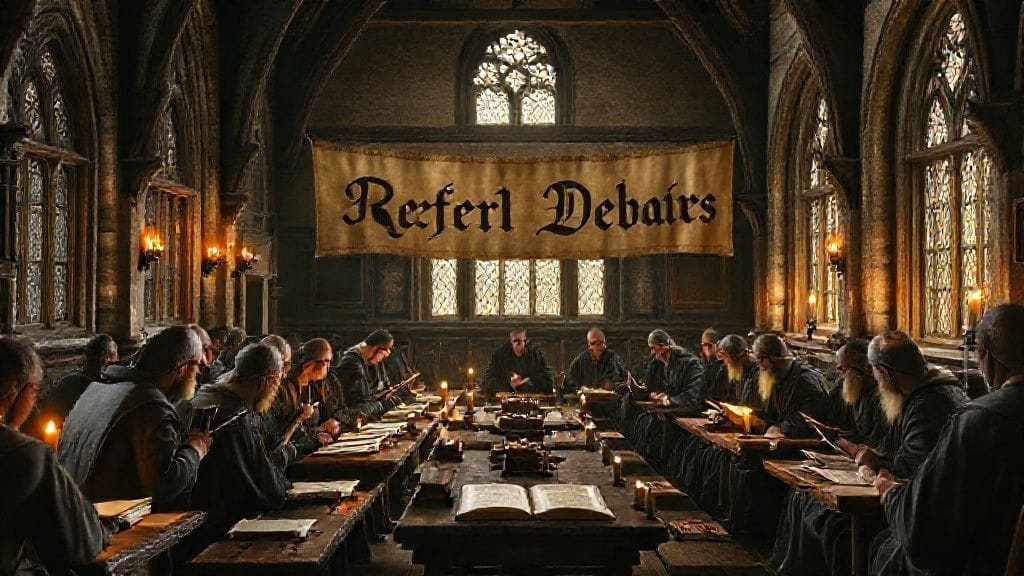
It was here in Oxford, amidst candlelit rooms and stained-glass shadows, that the Wycliffite debates took shape—a series of intellectual confrontations challenging the very heart of the medieval Church’s monopoly on religious knowledge and power.
2. John Wycliffe: The Scholar Who Shook the Foundations
At the epicenter stood John Wycliffe, a formidable English scholar and theologian known for his bold questioning of Church dogma. Born around 1320, Wycliffe rose through Oxford’s ranks to become a master, deeply committed to scriptural authority and the idea that the Bible should be accessible to all, not just the clerical elite. His teachings were radical for their time, proposing that the Church's wealth and corruption undermined its spiritual mission.
Wycliffe’s critiques of transubstantiation, papal authority, and Church property ownership directly confronted powerful interests. Yet, he was no mere heretic shouting from the margins—his scholarly rigor and deep humanist concern gave his ideas weight and attracted disciples, sparking fierce debate.
3. Theological Cracks in the 14th Century Church
The 14th century was a period fraught with turmoil for Christendom. The Avignon Papacy had severed Rome’s monopoly, while the hundred years’ war and internal corruption fed distrust of religious authorities. Laypeople and clerics alike began questioning why the Church hoarded vast lands and wealth while ordinary believers struggled.
Theological discontent grew, especially over doctrines such as the Eucharist and confession. Wycliffe’s insistence that scripture alone held supreme authority clashed with the prevailing scholastic tradition that elevated Church fathers and councils. These ideological fissures created an intellectual tinderbox eager for flame.
4. The Birth of Wycliffite Thought: Scriptures and Sovereignty
Wycliffe’s call for the primacy of Scripture over institutional edicts was revolutionary. He asserted that the Bible should be read in the vernacular, undermining the gatekeepers of Latin texts. This pivot toward direct engagement with holy texts inspired lay piety and empowered the laity to interpret Christianity themselves.
Furthermore, Wycliffe challenged the notion of papal infallibility and the very basis of the Church’s temporal power, suggesting that clergy who strayed from scripture had no divine mandate. His ideas proposed a radical democratization of faith—a crack in the armor of ecclesiastical absolutism.
5. The University of Oxford: Intellectual Battleground
Oxford itself became the perfect forge for this ideological smelting. As a meeting place of scholars from across Europe—religious clerics, secular leaders, and emerging thinkers—the university’s disputations shaped medieval thought. These debates were public, formal, and rooted in rigorous dialectics.
Wycliffe’s theses ignited controversies in lecture halls and cloisters. Students and faculty alike took sides, reproducing Wycliffe’s arguments fervently or mounting defenses for Church traditions. The ferment produced not only academic disputes but heated factionalism within Oxford’s precincts.
6. The Rising Tide: Wycliffite Debates Churning Youth and Clergy
Wycliffe’s ideas resonated particularly with younger scholars disillusioned by Church corruption and the inefficacy of the clergy. These debates transcended philosophical arguments—they stirred emotions and loyalties, drawing a growing movement of adherents calling for profound reform.
Challenging centuries of accepted dogma was dangerous, but the energy was irresistible. Public disputations grew more frequent, drawing attention beyond Oxford’s walls and precipitating wider social unrest.
7. The Role of Lollardy: The Movement Beyond the Academy
Named originally as an insult meaning “mumble” or “mutter,” the Lollards emerged as the lay movement embodying Wycliffite ideology outside academic confines. They sought vernacular translations of the Bible and criticized clerical wealth and abuses, spreading among ordinary people across England.
The Lollards’ preaching and pamphleteering directly challenged the Church’s authority, turning the Wycliffite debates into a religious movement intertwined with burgeoning calls for social justice and accountability.
8. Key Figures Opposing Wycliffe: The Establishment's Response
Predictably, the established Church hierarchy fought back fiercely. Notable figures like Archbishop William Courtenay confronted Wycliffe by denouncing his teachings as heretical. Papal nuncios and local bishops pushed for condemnation, seeing Wycliffe’s ideas as threats to Christendom’s unity.
The Oxford Chancellor and University authorities were torn between academic freedom and church loyalty. In official statements and censure, the establishment moved to contain the debate and restore order.
9. The Heresy Trials Begin: Oxford's Unseen Courtrooms
By the late 1370s and into the 1380s, formal ecclesiastical inquiries were launched. Accusations of heresy brought Wycliffe and his followers before tribunals. Though Wycliffe himself was protected by powerful patrons and remained undefeated in formal trials, many followers were prosecuted.
These proceedings marked a chilling escalation, wherein intellectual debate transformed into juridical suppression, setting a precedent for dealing with dissent that would echo in centuries.
10. From Academic Disputes to Political Ripples
The Wycliffite debates did not remain a cloistered academic affair—they permeated English politics. The English monarchy and Parliament watched warily. King Richard II’s reign intersected with growing tensions between secular rulers, the Church, and reformist factions.
Some in power saw potential in using Wycliffite critiques to limit ecclesiastical power, while others feared destabilizing effects. Thus, Wycliffism became a political dilemma, not solely a theological one.
11. The English Crown and the Church: Uneasy Companions
The relationship between monarchy and Church was complex. The Crown relied on ecclesiastical support but was also cautious of papal overreach and Church wealth. Wycliffe’s ideas about the Church’s temporal power struck at this very nexus.
Richard II’s support was at times ambivalent—it shifted as court politics evolved. This oscillation reflected the broader tension in late medieval England between evolving national identities and transnational religious authority.
12. The Impact of the Black Death: A Catalyst for Change
The devastating Black Death, which had ravaged Europe mid-century, left deep scars not only on population but on collective faith. Many questioned why the Church, guardian of souls, could not protect the masses.
Economic hardship pushed for social reforms, and Wycliffe’s calls for reducing clergy wealth resonated with a populace grappling with suffering. The plague’s aftermath thus fed reformist zeal, amplifying the urgency of the debates at Oxford.
13. Wycliffe’s Translation of the Bible: Power to the People
Perhaps Wycliffe’s most enduring legacy was his translation of the Bible into Middle English, completed by the early 1380s. This monumental achievement broke the monopoly of Latin-only interpretation and empowered laypeople with direct access to scripture.
The translation, forbidden by many church authorities, spread widely. Its existence was a powerful symbol of Wycliffe’s conviction that divine truth should be free, communal, and undeniable.
14. The Conflicts Escalate: Condemnations and Banishments
With the growing popularity of Wycliffite ideas and their translation into vernacular, the Church intensified repression. Condemnations were formalized at the Council of Oxford in 1382, under Archbishop Courtenay.
The council pronounced Wycliffe’s key doctrines heretical, condemning the Bible translation and Lollard activities. Some followers fled, while others faced imprisonment and execution. The intellectual ferment entered a dark phase of persecution.
15. Legacy of the Debates: Seeds of Reformation Planted
Though suppressed, the Wycliffite debates planted seeds that would blossom centuries later during the Protestant Reformation. Ideas about scripture’s primacy, clerical accountability, and vernacular accessibility re-emerged with renewed force.
Reformers such as Jan Hus in Bohemia drew inspiration from Wycliffe’s critiques. Thus, Oxford’s heated disputations echoed far beyond England’s shores and time.
16. The Cultural Aftershocks: Literature, Thought, and Society
Wycliffe’s challenges to authority rippled through medieval culture. The Lollard movement inspired new forms of religious poetry and debate. His vernacular Bible influenced English literature and the development of the language itself.
The debates also sparked discussions on governance, social justice, and individual conscience, shaping evolving notions of citizenship and freedom.
17. The Human Cost: Persecution and Martyrdom
Behind the academic debates and political maneuvers were real people facing harsh consequences. Lollards were persecuted relentlessly—publicly whipped, imprisoned, and executed for heresy.
The personal stories of faith, courage, and suffering provide a poignant counterpoint to the intellectual history, reminding us that reform often comes at great risk.
18. International Echoes: Wycliffe’s Ideas Beyond England
Wycliffe’s writings and translations traveled beyond England. Notably, Jan Hus in Bohemia adopted many Wycliffite principles before his own martyrdom, triggering the Hussite Wars.
The ripple effects from Oxford’s debates thus played a role in shaping broader European religious transformations.
19. Revisiting the Oxford Debates in Modern Scholarship
Today, historians view the Wycliffite debates as pivotal in the trajectory toward the Reformation. Renewed archival discoveries and critical analysis reveal the complexities of Wycliffe’s theology, political maneuvers, and the grassroots nature of Lollardy.
Rather than a simple precursor, these debates are seen as a dynamic interaction of ideas, power, and society that opened cracks in medieval orthodoxy.
20. Conclusion: The Enduring Flame of Wycliffite Reform
The dusty halls of 14th century Oxford witnessed more than scholastic banter; they birthed a challenge that questioned an empire built on spiritual and temporal authority. Wycliffe and his followers dared to ask who truly holds the key to divine truth, laying intellectual groundwork for centuries of religious upheaval.
Though faced with persecution, their courage to confront orthodoxy inspired movements that reshaped history. The Wycliffite debates stand as testament to the power of ideas to ignite reform and the human yearning for access to sacred knowledge.
Conclusion
The Wycliffite debates at Oxford were more than theological quarrels; they were the vibrant sparks of a larger struggle between entrenched power and the demand for spiritual authenticity and accessibility. John Wycliffe's challenge to the Church’s authority, his insistence on scripture in the vernacular, and the rise of Lollardy were revolutionary acts that echoed across time. They questioned not just religious doctrine but the very nature of knowledge, authority, and power.
The courage of these thinkers and believers—braving condemnation, exile, and death—reminds us that progress is often born in conflict, nurtured by debate, and carried forward by those who dare to ask difficult questions. These Oxford debates stand as a powerful chapter in the story of human thought, reformation, and freedom, their flame still flickering in the light of modern religious and intellectual life.
FAQs
Q1: Who was John Wycliffe and why is he important?
John Wycliffe was an English theologian and scholar who lived during the 14th century. He is important for challenging the authority and practices of the medieval Church, advocating for scripture’s supremacy, and translating the Bible into English. His ideas laid groundwork for Protestant Reformation centuries later.
Q2: What were the Wycliffite debates about?
The debates centered on theological disputes over Church authority, scripture, and practices such as transubstantiation and clerical wealth. They questioned who held the right interpretation of Christian doctrine and whether laypeople should have access to the Bible.
Q3: How did the Church react to Wycliffe’s teachings?
The Church condemned many of Wycliffe’s ideas as heretical. Ecclesiastical authorities, including Archbishop William Courtenay, led efforts to suppress his teachings and those of his followers through trials, bans, and persecution.
Q4: What was Lollardy?
Lollardy was a religious reform movement inspired by Wycliffe’s teachings. It emphasized scripture’s accessibility, criticized Church corruption, and spread among the English laity. Lollards faced persecution but influenced later reformers.
Q5: Did Wycliffe's translation of the Bible make a difference?
Yes, translating the Bible into Middle English broke the monopoly of Latin clergy over scripture. It allowed laypeople to read and interpret the Bible themselves, empowering a more personal and direct religious experience.
Q6: How did these debates influence the wider Reformation?
Wycliffe’s ideas, especially about scripture and clerical authority, influenced later reformers such as Jan Hus and Martin Luther. The debates planted intellectual and theological seeds that blossomed in the 16th-century Protestant Reformation.
Q7: Were the Wycliffite debates only academic?
No, although they began in Oxford’s academic circles, the debates quickly influenced society, politics, and popular religion, notably through the Lollard movement and the Crown’s uneasy stance toward Church authority.
Q8: What risks did followers of Wycliffe face?
Followers, especially Lollards, faced trials for heresy, imprisonment, torture, and execution. Despite this, many continued to preach reformist ideas, demonstrating deep conviction and courage.

