Table of Contents
- The Quiet Prelude: Europe on the Brink in the Late 14th Century
- France and England: Decades of Frayed Allegiances
- The Hundred Years’ War: A Protracted Struggle for Prestige and Power
- Leulinghem, 1389: Setting the Stage for the Truce
- The Diplomats Gather: Voices of Reason Amidst the Chaos
- Terms of the Treaty: A Fragile Pause in Hostilities
- The Truce Negotiations: Tensions, Rivalries, and Hope
- The Role of Philip the Bold and Richard II: Monarchs of Contrasting Fortunes
- The Impact on the French Kingdom: Recovery and Resilience
- England’s Political Turmoil: Struggles Behind the Truce
- The Breton War of Succession and Its Influence on the Negotiations
- The Truce’s Effects on Borderlands and Civilians
- Economic Underpinnings: Trade, Tribute, and Warfare Costs
- The Church’s Mediating Hand: Spiritual Authority in Political Affairs
- The Limits of the Truce: Fragility and Omissions
- Literary and Cultural Resonances: How the Truce Was Remembered
- Aftermath and Renewed Conflict: The Truce as a Temporary Halt
- Legacy of the Treaty of Leulinghem in the Hundred Years’ War
- Historical Interpretations: Revisionism and Modern Scholarship
- Lessons from Leulinghem: Diplomacy in an Age of War
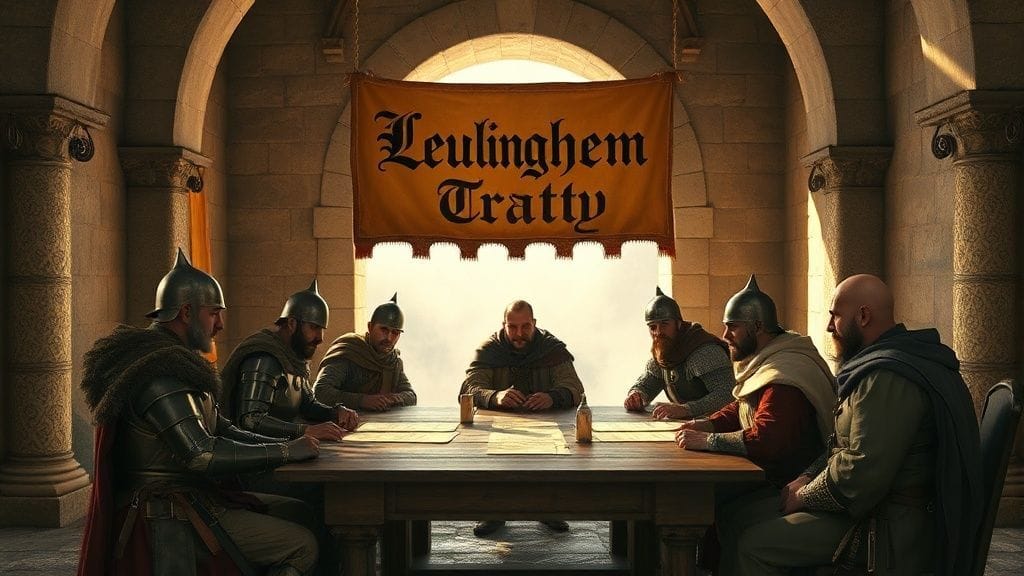
On a damp autumn morning in November 1389, under the shadowy skies of the small French village of Leulinghem, a fragile silence began to settle over a continent long torn by strife. For the first time in years, armored knights ceased their patrols, banners lowered, and weary foot soldiers rested from their endless campaigns. The Treaty of Leulinghem Truce promised a temporary reprieve—an elusive ceasefire that might, just might, turn the tide of exhaustion plaguing both England and France. Yet, beneath the aspiring calm, the heartbeat of conflict throbbed uncertainly, as tangled ambitions and raw memories shaped what was, in essence, a pause rather than an end.
This treaty was not merely the cessation of swords and arrows; it was a testament to the convoluted dance of medieval power, diplomacy, and survival. It marked an interlude in the protracted agony of the Hundred Years’ War—a conflict spat out by dynastic claims, shifting loyalties, and the ceaseless hunger for territory and prestige. At Leulinghem, amidst the gusty winds and the cold earth, kings and envoys brokered silence, hoping to nurse their realms back to strength or to outwait their rivals’ next move.
But what led these ancient enemies, locked in decades of bloodshed, to sit at the negotiating table? Who were the players behind the parchment, and what ambitions drew them into a so-called truce? To understand the Treaty of Leulinghem is to unravel the fabric of late medieval Europe—the intricate web of politics, religion, economics, and mortality that shaped the late 14th century.
The Quiet Prelude: Europe on the Brink in the Late 14th Century
The latter half of the 14th century was fraught with upheaval. Europe reeled from the Black Death's catastrophic toll, wiping out nearly a third of its population. Kingdoms staggered under economic strain and social unrest. In England and France, the echoes of plague mingled with the clangor of war, leaving societies desperately seeking stability amid the turmoil.
The Hundred Years’ War, a seemingly endless saga punctuated by moments of devastating combat and uneasy pauses, had become a backdrop to these convulsions. By 1389, neither side had managed a conclusive victory. Instead, intermittent fighting left borderlands scorched and populations weary, begging for breath between conflicts.
France and England: Decades of Frayed Allegiances
The origins of the Treaty of Leulinghem trace back to fractured claims and bitter legacies. The English crown, through Edward III’s claim via his mother, felt entitled to the French throne—a claim Paris rejected fiercely. The war that followed was not just about kings and their crowns; it was about nationalism in burgeoning form, questions of sovereignty, and the law of inheritance.
French territories changed hands like game pieces, with Gascony, Aquitaine, and parts of the more northern realms staging brutal episodes of sieges and raids. The English, fueled by intermittent military successes such as the Battle of Crécy and the triumph of Poitiers decades earlier, pushed forth, while French kings struggled to unify their feudal lords and mount a cohesive defense.
Yet internal fractures plagued both camps. France wrestled with the power of its nobles and the intrigues of the Valois dynasty, while England found itself vulnerable under the young rule of Richard II, whose reign was beset by noble factionalism and financial woes.
The Hundred Years’ War: A Protracted Struggle for Prestige and Power
Before plunging into the treaty itself, it is vital to appreciate why the war endured so long. Unlike many medieval conflicts, the Hundred Years’ War was less about fast-moving campaigns than slow attritions of power. Control of towns, fortresses, and strategic marriage alliances took years of diplomacy and intermittent violence.
Costly battles like Agincourt in 1415 still lay in the future. By 1389, the war was threaded with localized skirmishes, economic embargoes, and a chess game of alliances—some shifting unpredictably, others deeply entrenched.
This background explains why so many high-ranking figures—monarchs, dukes, bishops—found it pragmatic to press for a truce. It was about preserving resources, shoring up political capital, and at the very least catching their breath.
Leulinghem, 1389: Setting the Stage for the Truce
Leulinghem, a quiet village near Calais, seemed hardly a befitting venue for such a vital political event. Yet its proximity to the contested English-held Pale of Calais made it an ideal neutral ground. The selection of this location underscored the need for compromise while keeping the English close to home turf.
Negotiations began under heavy guarded watch. Envoys carried messages that balanced scorn with reluctant respect. The air was thick with the scent of damp earth and the palpable fatigue of men burdened by endless campaigning.
It is said that during the talks, murmurs of cynical disbelief were pervasive. After all, previous truces had come and gone with little lasting impact. Yet hope, muddled and fragile, persisted.
The Diplomats Gather: Voices of Reason Amidst the Chaos
The Treaty of Leulinghem was not the work of kings alone but of intricate diplomacy. On the French side, representatives of King Charles VI, still young and considered mentally fragile, included experienced nobles and church officials, tasked with balancing demands and limiting concessions.
England’s delegation was steered by trusted advisors under Richard II’s supervision, grappling with their monarch’s relative inexperience but keen ambitions to recover lost prestige after prior setbacks.
The Church played a subtle yet significant mediator’s role. Both powers understood that papal support lent gravitas to peace overtures, and in this era, faith mingled inexorably with governance.
Terms of the Treaty: A Fragile Pause in Hostilities
Officially, the Treaty of Leulinghem declared a truce of three years and nine months—or 13 lunar months, the medieval period’s way of marking time. Hostilities in France and the adjacent English territories would cease, with specific provisions about the maintenance of existing borders.
Hostages and prisoners-of-war issues were delicately addressed, and trade was allowed to resume under certain restrictions designed to avoid further provocations. Both parties agreed to stop raids and pillaging, an essential concern for suffering civilians.
Yet the treaty’s wording left much open to interpretation. The absence of a definitive resolution to the core dynastic disputes meant that many observers suspected it was only a breathing spell rather than a foundation for lasting peace.
The Truce Negotiations: Tensions, Rivalries, and Hope
The climate of negotiations was titillated by distrust and cautious optimism. Letters from the period reveal sharp tongues and veiled threats, balanced by moments of politeness that barely concealed the exhaustion that war inflicted on both sides.
An anecdote from the French chronicles — that English heralds arrived clad in rich blue velvet, a symbol of dignity and power — contrasts with reports of their French counterparts’ more austere presentation, reflecting differing styles of diplomacy and perhaps underlying economic conditions.
It was, as some scribes noted, a paradoxical meeting: war’s wearied combatants speaking the language of peace but weighing each word with suspicion.
The Role of Philip the Bold and Richard II: Monarchs of Contrasting Fortunes
Philip the Bold, Duke of Burgundy and uncle to Charles VI, was an indispensable figure whose influence extended across political and military spheres. His support for the treaty reflected his desire for stability within France and to secure his own duchy’s position.
Richard II, England’s youthful king, yearned to consolidate his authority, but his reign was plagued by unrest at home. The truce offered him a chance respite to quell insurrections and stabilize his rule. His complex personality—simultaneously idealistic and caught between powerful nobles—shaped England’s approach to the treaty.
Their interactions, though indirect, symbolized the larger contest between emerging centralized monarchies and the traditional feudal fracturing.
The Impact on the French Kingdom: Recovery and Resilience
For France, battered by war and internal factionalism, the truce allowed a moment to regroup. Royal lands could be replenished; fortresses repaired; peasantry spared the immediate horrors of conflict.
Yet Charles VI’s gradual descent into bouts of madness soon complicated governance, empowering nobles like Philip the Bold and sowing seeds of civil strife. Thus, while the treaty limited open conflict with England, France soon faced internal battles that would shape its destiny in the coming decades.
England’s Political Turmoil: Struggles Behind the Truce
England’s situation was no less volatile. The Lollard movement preached religious reform, nobles wrestled for influence at court, and economic pressures tightened.
Richard II’s fragile position demanded careful navigation. The truce allowed English leadership to focus inward, but rumors persisted that many English lords were impatient for renewed military glory abroad.
Thus, the Treaty of Leulinghem was as much about politics at home as on foreign soil.
The Breton War of Succession and Its Influence on the Negotiations
Linked to the wider conflict was the Breton War of Succession, a struggle for control of Brittany involving English and French factions. This war complicated negotiations, as each kingdom sought to maintain influence there, making the truce's terms particularly sensitive regarding proxy conflicts.
Although the treaty addressed direct hostilities, auxiliary wars dragged on, underscoring the limited reach of the peace.
The Truce’s Effects on Borderlands and Civilians
For the people dwelling in contested zones, the treaty wielded immediate significance. Villages spared from pillaging saw their fields harvested, markets reopened, and a faint hope of normalcy.
Chroniclers recorded grateful testimonies from such border dwellers, though skepticism lingered, as truces often proved to paper realities rather than lasting peace for those caught in the crossfire.
Economic Underpinnings: Trade, Tribute, and Warfare Costs
Behind the banner-waving and sword-clashing lay grim arithmetic. War drained treasuries, disrupted trade routes, and diminished agricultural output.
The truce revived commerce, particularly wool trade critical to England and textile industries in Flanders that relied on English raw materials. Ceasing hostilities thus had direct economic benefits that extended beyond battlefield lines.
Yet the costs of sustaining armies during the ceasefire remained a source of tension, reminding all parties that the war’s financial undercurrent was never far from view.
The Church’s Mediating Hand: Spiritual Authority in Political Affairs
The Papacy, though weakened by the Avignon Papacy crisis, still carried moral weight. Clerics advocated peace as a Christian ideal, urging rulers to temper their ambitions.
The Church’s role in legitimizing the truce, via envoys and spiritual sanctions, further highlights how religion and politics intermingled intimately in medieval conflict resolution.
The Limits of the Truce: Fragility and Omissions
Despite its formal declarations, the Treaty of Leulinghem was neither comprehensive nor enduring. Its vague terms on prisoner exchanges and ambiguous border definitions sowed seeds for future disputes.
Factions within both realms chafed at the restrictions, and none could guarantee their enforcement fully, especially in outlying regions where local lords operated semi-autonomously.
Literary and Cultural Resonances: How the Truce Was Remembered
Though overshadowed by larger battles that followed, the treaty found echoes in contemporary poetry and chronicles. Some Romanticized it as a fleeting peace, a glimpse of reason against war’s madness.
Yet other voices lamented it as a missed opportunity for reconciliation. The literature offers a window into how contemporaries processed this moment—a brief fold in an otherwise turbulent narrative.
Aftermath and Renewed Conflict: The Truce as a Temporary Halt
As time passed, the treaty's fragile balance unraveled. Hostilities resumed in various theatres, culminating in renewed campaigns that would redefine the Hundred Years’ War in the 15th century.
But the Treaty of Leulinghem remained a crucial waypoint, reminding medieval Europe that even the longest wars require, at times, moments of reprieve—however brief.
Legacy of the Treaty of Leulinghem in the Hundred Years’ War
In the long sweep of history, the treaty represents the first recognition that endless war was unsustainable. It set a precedent for future truces and negotiations.
Though overshadowed by subsequent definitive treaties such as those at Calais or Troyes, Leulinghem captured the medieval reality: war was never total, peace never absolute, and diplomacy a constant balancing act.
Historical Interpretations: Revisionism and Modern Scholarship
Modern historians debate the treaty’s significance. Some see it as a diplomatic footnote; others highlight its importance as a window into late medieval political culture.
Recent scholarly focus on the interplay of internal politics with external war offers richer understandings. The treaty illustrates the complex spectra of power, survival, and pragmatism that defined the era.
Lessons from Leulinghem: Diplomacy in an Age of War
Ultimately, the Treaty of Leulinghem teaches timeless lessons on conflict resolution. It exemplifies how even amidst deep animosity, rulers seek common ground—whether out of weakness or wisdom.
In this ancient border village, nature and power briefly shook hands, reminding us that peace, however fragile, is always worth striving for.
Conclusion
The Treaty of Leulinghem in 1389 emerges from the mists of medieval history not simply as a paper truce but as a human moment of respite amid ceaseless conflict. It embodied the aspirations and anxieties of two monarchies exhausted by decades of war, reflecting the tangled realities of 14th-century Europe—a world of shifting loyalties, fragile health, endemic mistrust, and the ever-present lure of power.
Yet, this treaty reminds us that history’s grand narratives are composed of pauses and breaths. Leulinghem was a fragile peace, underscored by hope but shadowed by future strife. It teaches us the enduring difficulty of translating war into peace and highlights the ceaseless effort required to tame forces larger than rulers themselves.
Remembered as a fleeting calm before the storm, the Treaty of Leulinghem whispers through the ages that even in darkness, the human spirit clings to the possibility of peace.
FAQs
Q1: What was the main purpose of the Treaty of Leulinghem?
A1: The treaty primarily sought to establish a truce and halt hostilities in the ongoing Hundred Years’ War, granting both England and France a temporary respite from war to recover militarily and politically.
Q2: Why was Leulinghem chosen as the negotiation site?
A2: Leulinghem’s location near English-held Calais made it a practical and relatively neutral location for diplomatic talks, balancing proximity for England with accessibility for French representatives.
Q3: How long did the truce last, and was it effective?
A3: The treaty stipulated a truce of approximately three years and nine months. While it temporarily reduced open conflict, underlying tensions and unresolved disputes meant lasting peace was not achieved.
Q4: Who were the key figures involved in negotiating the treaty?
A4: Important figures included King Charles VI of France (represented by nobles like Philip the Bold) and King Richard II of England, along with their respective envoys and clergy who played vital diplomatic roles.
Q5: Did the Treaty of Leulinghem end the Hundred Years’ War?
A5: No, the treaty was a ceasefire in a protracted conflict. The war continued intermittently for several more decades until its eventual resolution in the mid-15th century.
Q6: What were the social and economic impacts of the truce?
A6: The truce allowed for the resumption of trade, relief for war-weary civilians, and economic recovery in war-torn regions, particularly benefiting the wool and textile industries.
Q7: How did the treaty affect the civilians living in border regions?
A7: Civilians experienced a temporary reduction in violence and pillaging, giving them crucial time to rebuild and harvest crops, though the peace was fragile and often localized.
Q8: What role did the Church play in the Treaty of Leulinghem?
A8: The Church acted as a mediator, lending spiritual authority to the peace process and advocating for the Christian ideal of peace amidst widespread war.

