Table of Contents
- The Dawn of Destiny: June 28, 1389, on Kosovo Polje
- The Balkan Crossroads: A Land Ripe for Conflict
- The Rise of the Ottoman Empire: Expansion and Ambition
- Serbian Kingdom under Dušan and Lazar: Power and Preservation
- The Brewing Storm: Tensions Before Kosovo
- Preparing for Battle: Leaders and Armies Gather
- The Commanders: Sultan Murad I and Prince Lazar Hrebeljanović
- The Clash Begins: The First Hours on Kosovo Field
- Turning Tides: Strategies and Sacrifices
- Death and Chaos: The Fall of Sultan Murad I
- The Twilight of Prince Lazar: Honor and Martyrdom
- Aftermath on the Battlefield: Who Remained Standing?
- Serbia’s Fate: Vassalage and Resistance under Ottoman Rule
- The Battle’s Place in Mythology and National Identity
- Kosovo Polje in Medieval European Politics
- Ottoman Consolidation in the Balkans: A New Order
- The Legend Lives On: Cultural Memory through Centuries
- Archaeology and Historical Debates: Separating Fact from Fiction
- The Battle’s Legacy in Modern Balkan Conflicts
- Memory and Commemoration: Rituals and National Celebrations
- The Battle’s Echo in Literature, Art, and Music
- Revisiting Kosovo Polje: Challenges of Historical Interpretation
- Conclusion: The End of an Era, The Birth of a Legend
- FAQs on the Battle of Kosovo Polje
- External Resource
- Internal Link
The Dawn of Destiny: June 28, 1389, on Kosovo Polje
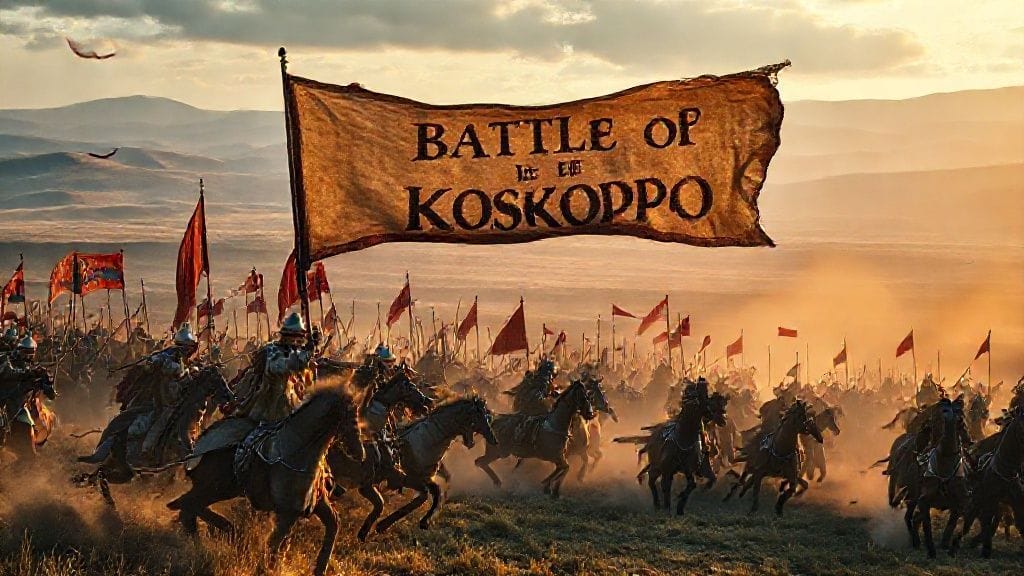
A warm June sun rose over the vast Kosovo polje—a broad, flat plain stretching like an ancient stage beneath the bright blue sky. The morning air was heavy with anticipation, tension so thick it might have been cut with a sword. Thousands of men, clad in armor glittering under the sun, stood massed on either side of the field. The fate of a kingdom, a people, and the balance of power in Southeast Europe hung trembling in the air.
On June 28, 1389, two titans faced off: the Serbian Prince Lazar Hrebeljanović and Sultan Murad I of the ascending Ottoman Empire. This was not merely a battle. It was a moment etched in the consciousness of the Balkans—an event where faith, freedom, and fate intertwined in a bloody tapestry whose threads continue to be pulled even today.
The Balkan Crossroads: A Land Ripe for Conflict
The Balkans in the late 14th century resembled a delicate patchwork quilt. The threads of ethnicity, religion, and competing sovereignties were frayed and worn, yet held in place by fragile alliances and the specter of outside forces. Positioned between the expanding Ottoman Empire and the declining remnants of medieval Christian kingdoms, the region became a contested frontier charged with age-old rivalries and new ambitions.
Serbia, once a mighty empire under the remarkable Stefan Dušan, had seen its zenith fade. The death of Dušan in 1355 fractured Serbia's power, leaving it vulnerable to outside envelopments. The Ottomans, meanwhile, were not just invading armies—they were heralds of a changing era, bringing a new imperial order stretching from Anatolia deep into Europe.
The Rise of the Ottoman Empire: Expansion and Ambition
The Ottoman Empire’s rise was meteoric. Once a small Turkic beylik (principality) in Anatolia, Ottoman control blossomed, fueled by disciplined military innovations, the fervor of ghazis (warriors of faith), and an agile state apparatus. By the 1380s, the Ottomans had crossed the Dardanelles and were aggressively pushing into the Balkans, threatening to engulf the fracturing Christian realms.
Sultan Murad I, a skilled and politically astute ruler, had already secured key victories against Balkan lords, making the conquest of Serbia an inevitable objective. His forces were well-organized, mixing cavalry, infantry, and the devastating use of early artillery and archery, embodying the military revolution of the age.
Serbian Kingdom under Dušan and Lazar: Power and Preservation
Serbia’s glory under Stefan Dušan was remembered as a golden age—a time of legal reforms, empire expansion, and cultural prosperity. Yet the vacuum left by his death led to fragmentation. Various nobles carved their own domains out, warring for power while the Ottoman shadow grew larger.
By the late 14th century, Prince Lazar emerged as a leader seeking to unite the Serbian lands in defense of Christianity and sovereignty. His domain was smaller and less powerful than Dušan’s empire but symbolically vital. Lazar embodied resistance—not through overwhelming force, but through diplomatic networks, alliances, and a steadfast vow to resist Ottoman domination.
The Brewing Storm: Tensions Before Kosovo
Skirmishes and border conflicts had long preceded the battle. The Ottomans pursued Serbian nobles, who oscillated between submission and defiance. The capture of key fortresses, raids across borders, and political intrigue set the stage. Both sides understood that a decisive confrontation was unavoidable.
Prince Lazar rallied a diverse coalition, including Serbs, Bosnians, Albanians, and other Balkan peoples, all united by the threat of the Ottoman tide. Murad gathered a formidable force comprising not only Turks but also Balkan vassals and mercenaries.
Preparing for Battle: Leaders and Armies Gather
As the summer of 1389 progressed, both armies converged on Kosovo Polje, the great field that would soon bear witness to one of the Middle Ages' most fateful encounters. The Ottoman forces were larger in number—estimates suggest between 30,000 and 40,000 men—while the Serbian-led coalition counted perhaps 20,000 to 30,000 warriors.
Murad commanded a disciplined and battle-hardened army, while Prince Lazar’s troops, though fewer in number, fought with religious zeal and determination. Each side understood not just the military stakes but the cultural and spiritual significance of the clash.
The Commanders: Sultan Murad I and Prince Lazar Hrebeljanović
Sultan Murad was a veteran of many campaigns, known for his pragmatism and ruthlessness. His reign marked transformation from chieftainship to organized empire. Murad’s forward-thinking incorporated janissaries—a newly formed elite infantry corps recruited through the devshirme system—into his forces, expanding Ottoman military efficiency.
Prince Lazar, though less imposing than the sultan, was a man of principle and vision. His leadership rested on the idea of defending the Serbian realm and Orthodox Christianity against foreign domination. His personal courage was as legendary as his political acumen.
The Clash Begins: The First Hours on Kosovo Field
The armies opened battle with volleys of arrows and fierce cavalry charges. The field shook as thousands of armored warriors charged and collided. The initial skirmishes tested formations, discipline, and resolve.
According to chroniclers, the battle was grueling, lasting from dawn until dusk, a brutal dance of offense and defense. Neither side quickly gained a decisive advantage. The heat of the day and the weight of armor took their toll.
Turning Tides: Strategies and Sacrifices
The Serbian forces attempted to exploit their knowledge of the terrain, while the Ottomans relied on their superior numbers and formations. The battle was marked by moments of staggering heroism and tragic losses.
One of the defining moments was the deployment of heavy cavalry by Prince Lazar, charging to break the Ottoman lines. Despite initial successes, the Ottomans counterattacked fiercely.
Death and Chaos: The Fall of Sultan Murad I
A dramatic, almost legendary event occurred in the battle’s carnage: Sultan Murad was killed. According to some sources, he was struck down by Miloš Obilić—a Serbian knight who supposedly infiltrated the Ottoman camp under a flag of truce.
Murad’s death sent shockwaves through the Ottoman camp. Murad’s son, Bayezid I, swiftly took command, rallying the Janissaries and securing victory despite the emperor’s demise.
The Twilight of Prince Lazar: Honor and Martyrdom
Prince Lazar himself was captured and executed after the battle, refusing conversion to Islam and embracing martyrdom. His death symbolized the ultimate sacrifice for faith and homeland, cementing his position as a Serbian national hero.
The Serbian army, exhausted and leaderless, retreated; despite heavy losses on both sides, the Ottomans emerged tactically victorious.
Aftermath on the Battlefield: Who Remained Standing?
The battlefield was a scene of devastation—thousands lay dead or wounded. The victory cost the Ottoman Empire dearly but opened the path for deeper penetration into the Balkans.
The results implied a harsh new reality: Serbia was now a vassal state, its independence gravely compromised.
Serbia’s Fate: Vassalage and Resistance under Ottoman Rule
Following the battle, the Serbian state entered a period of vassalage under Ottoman suzerainty. Many Serbian nobles accepted Ottoman overlordship, though sporadic uprisings punctuated the century.
The Serbian Orthodox Church became a center of cultural preservation, nurturing the embers of national identity amidst foreign domination.
The Battle’s Place in Mythology and National Identity
Kosovo Polje transcended history to become a powerful myth. Serbian epic poetry immortalized the battle as a sacred struggle between Christendom and Islam, freedom and subjugation.
Prince Lazar was venerated as a martyr-king, the ideal ruler who chose spiritual salvation over earthly life—a narrative that inspired generations and shaped the Serbian national consciousness.
Kosovo Polje in Medieval European Politics
European powers, from Hungary to Byzantium, watched anxiously as the Ottoman advance reshaped the continent’s eastern frontier. The battle underscored the waning influence of medieval Christian states in the Balkans and heralded an era dominated by Ottoman power.
However, limited western intervention meant the Ottomans faced little organized resistance for decades.
Ottoman Consolidation in the Balkans: A New Order
The Ottomans rapidly consolidated their rule, imposing administrative reforms, tax structures, and converting key locales into imperial outposts.
The empire’s millet system allowed religious communities relative autonomy, aiding in governance yet cementing Ottoman dominance.
The Legend Lives On: Cultural Memory through Centuries
Kosovo Polje became a cornerstone of Balkan cultural memory. Its retelling, through oral tradition and later literature, echoed themes of sacrifice, loyalty, and tragic heroism.
In Serbia, Kosovo Day (Vidovdan) became a day of remembrance and national identity affirmation.
Archaeology and Historical Debates: Separating Fact from Fiction
Modern historians and archaeologists grapple with the paucity of contemporary sources and contradictory accounts. Disentangling myth from reality challenges scholars, as the battle’s legendary status often distorts factual inquiry.
Recent excavations aim to shed light on troop movements and battlefield geography, offering more nuanced perspectives.
The Battle’s Legacy in Modern Balkan Conflicts
The memory of Kosovo 1389 has been invoked as a powerful symbol in 20th- and 21st-century Balkan politics, especially during the turbulent years of Yugoslavia’s dissolution.
Different groups have claimed conflicting narratives to support nationalist agendas, confirming the battle’s enduring emotional resonance.
Memory and Commemoration: Rituals and National Celebrations
Every year, thousands gather at Kosovo Polje to honor the fallen. Monuments, churches, and memorials dot the landscape, testifying to the battle’s unyielding place in collective memory.
These commemorations blend religious ritual with national pride—an emblem of identity and perseverance.
The Battle’s Echo in Literature, Art, and Music
Artists, poets, and musicians have kept Kosovo’s memory alive, creating works that blend historical evocation with emotional depth. From medieval frescoes to contemporary songs, the battle pulses with creative energy.
The Serbian national epic, featuring figures like Miloš Obilić and Prince Lazar, remains a literary touchstone.
Revisiting Kosovo Polje: Challenges of Historical Interpretation
The battle’s legacy is inseparable from modern political issues. For historians, balancing nationalist mythmaking and rigorous scholarship remains a difficult but vital task.
Understanding Kosovo 1389 offers insight into how history and memory interplay—and how the past shapes the present.
Conclusion
The Battle of Kosovo Polje was more than a medieval clash of swords and spears. It was an epic crucible forging identities, faiths, and political futures. The sun that set over the bloodied field on June 28, 1389, did not only darken the sky but illuminated a path of sacrifice and enduring myth.
Serbia’s martyrdom, the Ottoman rise, and the birth of a legend have rippled through centuries, shaping not only the Balkans but the collective soul of a people. To understand Kosovo Polje is to see beyond the carnage—to the complex human stories of courage, loss, and the eternal struggle for freedom.
History remembers it not only as an ending but as a beginning—the dawn of an era and the heartbeat of a nation.
FAQs
Q1: What caused the Battle of Kosovo Polje in 1389?
The battle was the culmination of escalating Ottoman expansion into the Balkans and Serbia’s resistance under Prince Lazar to preserve sovereignty and Christianity.
Q2: Who were the key figures in the battle?
Sultan Murad I led the Ottoman forces, while Prince Lazar Hrebeljanović commanded the Serbian coalition. The legendary knight Miloš Obilić is famed for allegedly assassinating Murad.
Q3: What was the outcome of the battle?
Although the battle was tactically indecisive, it resulted in the death of both leaders. The Ottomans secured political dominance, turning Serbia into a vassal state.
Q4: Why is the battle so important in Serbian culture?
It symbolizes sacrifice, faith, and national identity, celebrated through epic poetry, religious commemoration, and cultural memory as a defining moment.
Q5: How did the battle affect the Ottoman Empire?
It solidified Ottoman control over the Balkans and marked their ascendancy in Europe, paving the way for further expansion.
Q6: How reliable are historical accounts of the battle?
Sources are scarce and often contradictory; later mythologizing complicates interpretations, but archaeological work continues to clarify events.
Q7: Does the battle still influence modern politics?
Yes, it remains a potent symbol in Balkan nationalisms and political discourse, influencing conflicts and identity debates even today.
Q8: Where can I learn more about the Battle of Kosovo Polje?
The Wikipedia page on the Battle of Kosovo offers detailed summaries and references for further reading.