Table of Contents
- The Dawn of a New Alliance: The Union of Krewo, 1385
- Europe on the Brink: The Political Landscape of the Late 14th Century
- The Grand Duchy of Lithuania: A Pagan Power in a Christian Sea
- The Kingdom of Poland: Seeking Stability and Strength
- Jogaila and Queen Jadwiga: The Fateful Marriage of 1386
- The Act of Krewo: A Document That Shaped Nations
- Behind the Scenes: Negotiations, Ambitions, and Realpolitik
- Christianization of Lithuania: The Dawn of a New Era
- The Union’s Immediate Impact: Political and Military Alliances
- Resistance and Rivalries: Nobles and Neighbors React
- The Expansion of Influence: Poland and Lithuania in Eastern Europe
- The Creation of a Dual Monarchy: Challenges of Unity
- Cultural Fusion: Language, Religion, and Identity in Flux
- The Role of the Church: From Paganism to Catholicism
- The Union of Krewo and Its Place in European Diplomacy
- A Precursor to the Polish–Lithuanian Commonwealth
- Consequences for the Teutonic Order and Regional Powers
- Economic Transformations: Trade, Cities, and Nobility
- Long Shadows: The Union’s Role in Shaping Modern Poland and Lithuania
- Historical Memory: Celebrations, Controversies, and National Narratives
- Conclusion: The Union of Krewo as a Turning Point
- FAQs on the Union of Krewo
- External Resource
- Internal Link
The Dawn of a New Alliance: The Union of Krewo, 1385
The summer of 1385 in the modest town of Krewo, nestled within the rugged landscapes of Lithuania, was a moment suspended between the past and the future. On the surface, it was an assemblage of nobles and clerics—figures draped in fur and silk, debating and pledging. But beneath the stone walls and through the whispering forests, a decision was unraveling, a decision that would echo through centuries. The proclamations made there, promises sworn in solemn voices, were to unite two powerful realms: the Kingdom of Poland and the Grand Duchy of Lithuania. It was an alliance borne not merely of convenience, but of survival, ambition, and the profound desire for identity and power. This was the Union of Krewo—an event that, for the first time, bound disparate peoples under a shared destiny and set the stage for one of medieval Europe's most remarkable political enterprises.
Europe on the Brink: The Political Landscape of the Late 14th Century
To understand the gravity of the Union of Krewo, one must imagine the web of political tensions that cracked across Europe in the late 1300s. The continent was a chessboard of kingdoms and duchies, constantly maneuvering for territorial gain, religious influence, and dynastic security. The Teutonic Order, a militant religious entity, pressured Lithuania relentlessly, its crusading zeal fueled by the stubborn paganism of the Lithuanian rulers. Poland, scarred by internal strife and external threats, sought to consolidate its standing amid the shifting allegiances of Central and Eastern Europe.
Amid these pressures, the neighboring states eyed each other warily. The Grand Duchy of Lithuania was the last robust pagan polity standing amidst a sea of Christian powers, its rulers reluctant yet pragmatic. Poland, likewise, was hungry for a stable throne and an alliance that might buffer it against the threat of the Holy Roman Empire and the Teutonic Knights. The late 14th century was a crucible of uncertainty, where old loyalties faded and new alliances became lifelines.
The Grand Duchy of Lithuania: A Pagan Power in a Christian Sea
Lithuania in 1385 was vast—stretching from the Baltic shores far east into the forests and rivers of what is now Belarus and parts of Ukraine. Its rulers acted as stewards of a pagan tradition that refused to vanish quietly into the Christianization sweeping Europe. This resilience both fascinated and alarmed their neighbors. The Lithuanian elites governed a multi-ethnic population, often engaging in diplomatic marriages and military campaigns to consolidate power.
Yet Lithuania was not merely defensive; it was expanding. Its military might posed a consistent threat to the Teutonic Order, whose crusades against "heathens" had long dominated the political narrative of the Baltic. But Lithuania’s paganism isolated it. Without Christian allies, it found itself surrounded, vulnerable to siege and diplomatic isolation. The urgency for change simmered, and the idea of aligning with Christian Poland grew in allure.
The Kingdom of Poland: Seeking Stability and Strength
Poland, by contrast, was a kingdom navigating its own storms. The death of the last Piast king, Casimir III the Great, in 1370 without a male heir had left the throne contested and unstable. Queen Jadwiga, crowned a child monarch, symbolized hope and continuity. Her reign, however brief, faced the daunting tasks of political consolidation and external defense.
Poland’s elite understood that alliance was key to survival—they needed military support against external threats and a legitimate claim to interregional authority. Merging dynastic lines through marriage offered a promising path. Enter Jogaila, the Lithuanian Grand Duke, whose acceptance of Christianity and ascendance to the Polish throne could unite two sprawling realms.
Jogaila and Queen Jadwiga: The Fateful Marriage of 1386
On February 15, 1386, perhaps one of the most significant royal marriages in medieval Europe took place. Jogaila, who adopted the Christian name Władysław upon baptism, married Jadwiga, king and queen forging a bond meant to transcend religion and ethnicity. The ceremony was more than a union of two sovereigns; it symbolized the political and spiritual transformation of two states.
This marriage was both a personal and a political gamble. Jadwiga was young, strong-willed, and beloved, and Jogaila was a shrewd tactician aware of the immense challenges ahead—not least the need to convert a vast pagan population. Their wedding in Kraków was not only a festive affair but a beacon of hope that two cultures, often at odds, could merge to face common foes.
The Act of Krewo: A Document That Shaped Nations
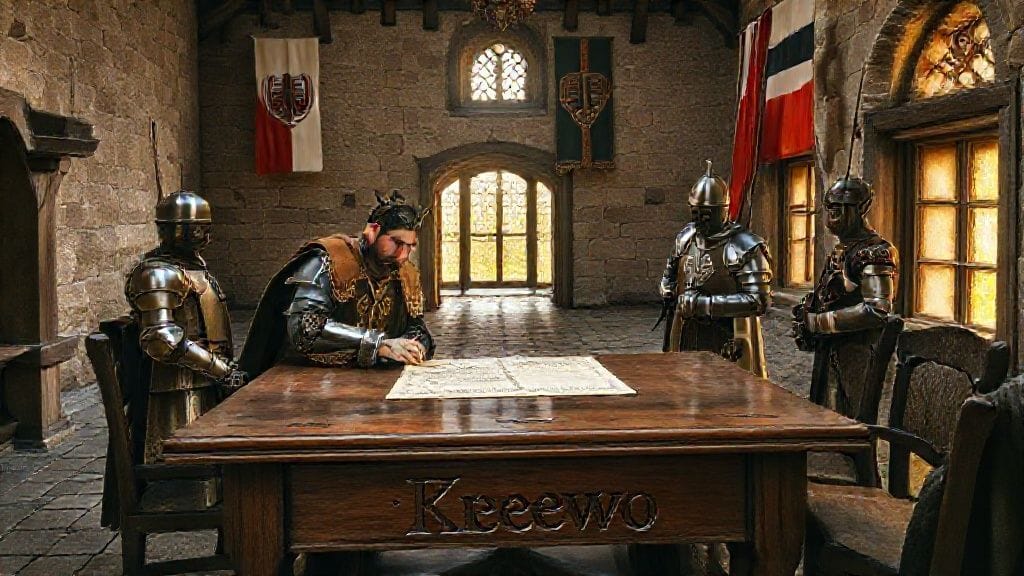
The formal basis of this union is found in the Act of Krewo, signed in the eponymous castle in 1385. The text, brief yet potent, pledged Jogaila’s conversion to Christianity, his marriage to Jadwiga, and the mutual support of the kingdoms. It also promised to integrate Lithuanian lands into the Christian fold and offered a framework for cooperation.
But this document was far more than legalese. It was a declaration of a new political vision. Jogaila committed to “baptizing himself and all his people,” a promise that carried vast cultural and religious consequences. The Act signaled the dawn of a shared monarchy whose influence would stretch far beyond the immediate borders of Poland and Lithuania.
Behind the Scenes: Negotiations, Ambitions, and Realpolitik
The Union of Krewo was not an idyllic fusion but a product of tense negotiations. Lithuanian nobles, wary of Christian dominance and Polish influence, were divided. Jogaila’s court maneuvered carefully to maintain internal cohesion while appealing to Poland's elite. The Papacy, eager to expand Christendom, played a diplomatic role, balancing ecclesiastical ambitions with political realities.
Meanwhile, the Teutonic Knights watched uneasily. Their crusade against Lithuanian paganism now faced a new, politically reinforced enemy. Yet the union was as much about consolidating power internally as about confronting external foes. Personal ambitions, political necessity, and religious changes created a tangled web behind the stately proclamations in Krewo.
Christianization of Lithuania: The Dawn of a New Era
Perhaps the most transformative aspect of the Union was the Christianization of Lithuania—a painful and complex process. Baptism was more than ritual; it meant societal upheaval. Pagan temples fell silent, new churches were built, and the Lithuanian elite gradually embraced the Latin rite.
Yet conversion was uneven and resisted in some regions. Pagan customs persisted in the hinterlands, and conflict between old and new beliefs simmered. The church’s presence grew, webbing Lithuanian society tighter into the networks of European Christendom. This spiritual shift was foundational, marking the end of an era and the beginning of another.
The Union’s Immediate Impact: Political and Military Alliances
With Poland and Lithuania united under a common crown, military collaboration intensified. The formidable armies of the Grand Duchy gained new resources and legitimacy, while Poland reinforced its eastern borders. This bolstered the capacity to repel Teutonic incursions and to contest influence in the lands of Ruthenia.
Politically, the union offered a platform for centralization and stability. However, the challenge of governing sprawling territories with diverse peoples and legal traditions remained daunting. The alliance’s strength was undeniable but fragile, relying on shared interests and fragile personal loyalties.
Resistance and Rivalries: Nobles and Neighbors React
Not all parties welcomed the union with open arms. Internal opposition in Lithuania persisted among nobles who feared loss of autonomy and cultural identity. Similarly, some factions in Poland doubted their new ruler’s loyalty or the wisdom of absorbing a pagan realm.
Rival powers, especially the Teutonic Order, sought to exploit these divisions. The conflict between order and union stretched beyond battlefields into courts and capitals. This resistance shaped the initial decades of the union, fueling tensions that required careful diplomacy and often, martial strength.
The Expansion of Influence: Poland and Lithuania in Eastern Europe
The union markedly altered the balance of power in Eastern Europe. Together, Poland and Lithuania stood as a bulwark against the Mongol successor states to the east and the ambitions of the Teutonic Order. They projected influence over Ruthenian principalities and negotiated with the vast, declining Golden Horde.
This territorial and political expansion was not just military but also cultural. Slavic populations in Lithuanian domains encountered a Polish-led Christian monarchy, setting the stage for complex inter-ethnic dynamics that would resonate for centuries.
The Creation of a Dual Monarchy: Challenges of Unity
Despite the union, Poland and Lithuania remained distinct entities with separate laws, traditions, and languages. Creating a cohesive monarchy demanded delicate governance. Lithuanian nobles insisted on retaining privileges, while Polish magnates sought influence.
The resulting dual monarchy was a pioneer model of medieval polity—united yet decentralized. It tested medieval concepts of sovereignty and foreshadowed the later Polish–Lithuanian Commonwealth’s political innovations, which balanced aristocratic freedoms with monarchical power.
Cultural Fusion: Language, Religion, and Identity in Flux
In the years following Krewo, cultures began to intermingle. Polish became the language of court and administration in shared domains, while Lithuanian and Ruthenian dialects persisted. Catholicism spread, melding with folk traditions and local sensibilities.
This fusion was neither seamless nor linear. Identity became layered, with nobles often adopting Polish customs while villages clung to indigenous ways. It set in motion a cultural and linguistic evolution that shaped the region’s unique character.
The Role of the Church: From Paganism to Catholicism
The Church emerged as a central actor in consolidating the Union’s spiritual and political authority. Bishops and clergy served as intermediaries between the crown and the populace, promoting literacy, law, and ideology.
Monasteries multiplied, and ecclesiastical courts gained power. The papal endorsement lent legitimacy to the new rulers. Yet this spiritual role was also contested—the church had to navigate a path between Latin doctrine and local traditions, a balancing act laden with tension.
The Union of Krewo and Its Place in European Diplomacy
Beyond the immediate region, the Union of Krewo captured the attention of European powers. It represented a significant shift: a large pagan territory formally accepted Christianity and aligned with an established kingdom. This repositioned Poland and Lithuania as players in continental politics.
Marriage bonds, papal approval, and combined military strength made the union a more formidable entity. It influenced alliances, conflicts, and the strategic maps drawn by courts from Paris to Constantinople.
A Precursor to the Polish–Lithuanian Commonwealth
Though not a formal state merger in the modern sense, the Union of Krewo laid the foundation for the later and famous Polish–Lithuanian Commonwealth of 1569. The Commonwealth would become one of Europe’s largest and most enlightened polities of the early modern era.
Krewo’s political and symbolic legacy endured through centuries, inspiring complex systems of co-governance and nobility power sharing. The union truly transformed from a battlefield alliance to a political experiment in coexistence.
Consequences for the Teutonic Order and Regional Powers
The Union dealt a critical blow to the Teutonic Knights, whose raison d’être had been to Christianize Lithuania by force. Now, with Lithuania embracing Christianity through dynastic marriage, the order’s legitimacy weakened.
This shift triggered decades of warfare and diplomacy, as the knights resisted the new power bloc. Neighboring states recalibrated alliances. The balance of power in the Baltic and Eastern Europe shifted towards a more multipolar dynamic.
Economic Transformations: Trade, Cities, and Nobility
The union accelerated integration of economic networks. Trade routes expanded, especially in grain, fur, and amber. Cities under Polish and Lithuanian control grew, their merchant classes gaining importance.
The nobility benefited from new lands and titles, but also encountered new political responsibilities. These developments catalyzed urban growth and economic modernization, benchmarking Eastern Europe’s evolving medieval economy.
Long Shadows: The Union’s Role in Shaping Modern Poland and Lithuania
In the long view of history, the Union of Krewo refashioned the destinies of two nations. Polish and Lithuanian identities, though fluctuating, merged politically for centuries, affecting national narratives, language, and memory.
Later conflicts and partitions would not erase the foundational ties forged in 1385. For modern observers, Krewo is a symbol—of union, tolerance, contradiction, and the fraught complexity of national identity.
Historical Memory: Celebrations, Controversies, and National Narratives
Today, the Union is commemorated and debated. Some see it as a triumph of diplomacy and integration; others emphasize cultural loss or political domination. Lithuania often highlights the Christianization as a pivotal heritage moment; Poland reminds of shared greatness and common destiny.
The Union’s legacy dances between celebration and critique, illustrating how history is lived and reinterpreted continuously.
Conclusion
The Union of Krewo in 1385 stands as a testament to the power of political vision in times of uncertainty. It was a leap of faith from pagan isolation into a Christian, dynastic, and cultural partnership that reshaped Eastern Europe. This alliance was more than a treaty; it was a crucible of identity and power, where two nations gambled with tradition and future.
Emerging from baptismal fonts into the tumult of medieval politics, Poland and Lithuania chose unity over division. The ripples of that choice would define the map, the culture, and the history of thousands of lives for centuries to come. Krewo was no mere episode in annals—it was the seedbed of a flourishing yet complex partnership, reminding us how history is often forged in moments of daring and hope.
FAQs
1. What was the Union of Krewo?
The Union of Krewo was a political and dynastic agreement signed in 1385 between the Kingdom of Poland and the Grand Duchy of Lithuania. It pledged the conversion of Lithuania to Christianity, the marriage of Jogaila (Lithuanian Grand Duke) to Queen Jadwiga of Poland, and the creation of a personal union between the two realms.
2. Why was the union important?
It ended Lithuania’s pagan isolation by integrating it into Christian Europe, formed a powerful military alliance against common enemies like the Teutonic Order, and laid the groundwork for the later Polish–Lithuanian Commonwealth, one of Europe’s major powers.
3. Who were the main figures involved?
Jogaila (later Władysław II Jagiełło), the Grand Duke of Lithuania, and Jadwiga, the young queen of Poland, were central. Church authorities and regional nobles also played key roles in negotiating and implementing the union.
4. How did the union affect the Teutonic Order?
The union undermined the Teutonic Order’s justification for military crusades against Lithuania since the latter became officially Christian. This led to extended conflicts over territorial and political dominance in the Baltic region.
5. What challenges did the union face?
Resistance from Lithuanian nobles, cultural and religious tensions amid Christianization, and difficulties in uniting two distinct legal and political systems posed ongoing challenges.
6. How did the union influence culture?
It accelerated the spread of Catholicism, facilitated Polish cultural influence in Lithuania, and set the stage for a unique multicultural polity with complex linguistic and religious identities.
7. Is the Union of Krewo celebrated today?
Yes, especially in Poland and Lithuania, where it is recognized as a defining historical moment, though its interpretation varies—seen either as a union of equals or as a moment of Lithuanian subordination.
8. What was the Act of Krewo?
The Act of Krewo was the document signed in 1385 forming the basis of the union. It outlined commitments to marriage, conversion, and mutual political support.

