Table of Contents
- The Day That Changed Austria: September 9, 1379
- The Warring House of Habsburg: A Family Divided
- The Road to Neuberg: Intrigue and Power Struggles
- Rival Claims and Factions: The Sons of Albert II
- The Treaty of Neuberg Signed: A Fragile Peace in the Austrian Alps
- The Division of the Habsburg Lands: Geography and Politics
- Albert III and Leopold III: Brothers at Odds
- The Economic Dimensions: Wealth and Territory Lost and Gained
- Impact on the Holy Roman Empire: Realms and Rivalries
- The Aftermath and Shifting Alliances
- Cultural and Social Effects on Austrian Nobility and Peasantry
- The Treaty’s Role in Shaping Central European Politics
- Lessons in Dynastic Partition: Unity vs Fragmentation
- The Habsburg Legacy: Seeds of Future Empires
- Reflections on Medieval Diplomacy and Family Feuds
- Conclusion: The Treaty of Neuberg’s Enduring Echoes
- FAQs: Unpacking the Treaty and Its Historical Ripple Effects
- External Resource
- Internal Link
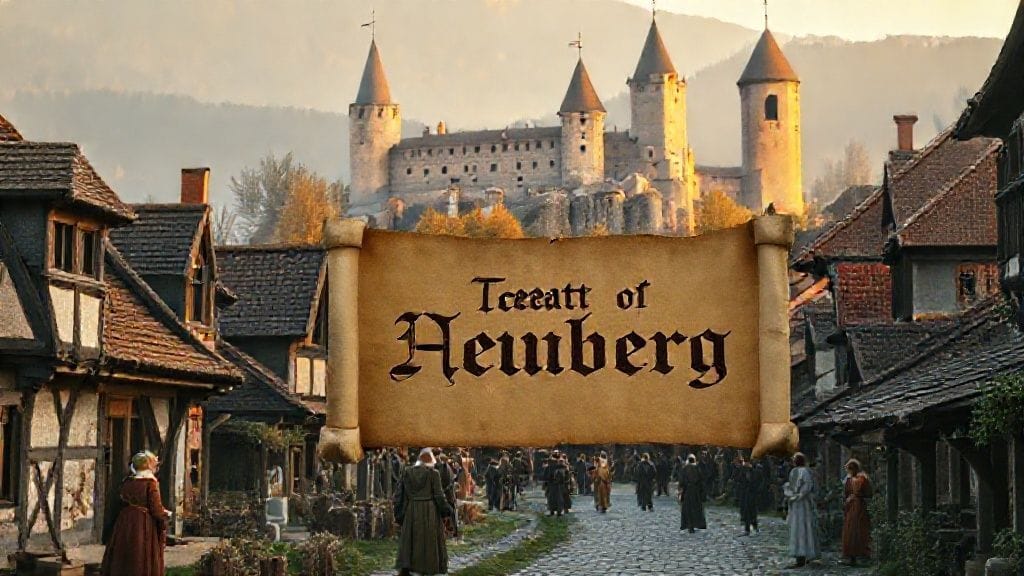
On a crisp September day in 1379, the quiet town of Neuberg an der Mürz nestled in the Austrian Alps became the unlikely stage for a drama that would mold the future of Central Europe. The air was thick with tension; the fate of the mighty House of Habsburg hung in the balance. Brothers, bound by blood but divided by ambition, came together not with swords drawn but with quills poised to ink a document that would fracture their dominion. The Treaty of Neuberg was more than a mere agreement—it was a moment where fraternal loyalty bowed to political necessity, a fissure that echoed through centuries.
The sun cast long shadows over the mountain ridges as envoys and nobility gathered, their faces etched with whispers of rivalry and weary hopes for peace. Yet, behind the solemnity lurked a relentless competition, a game of thrones played not in a distant court but in the heartlands of an empire. This treaty would partition the Austrian Habsburg lands, creating divergent paths that both threatened and cemented the dynasty’s future.
Before we explore the treaty’s text and consequences, we must first understand the origins of the conflict that brought these brothers to Neuberg’s hearth.
The House of Habsburg, by the mid-14th century, was fast developing into one of Europe’s most potent dynasties. Yet like many royal houses, its strength was also its vulnerability: a familial web of ambitions, claims, and rivalries that could either unite or shatter their realms. The death of Duke Rudolf IV in 1365 left his brother Albert II navigating a labyrinth of power struggles and territorial claims. Albert II’s sons—Albert III and Leopold III—grew under the shadow of legacy and expectation.
Following Albert II’s death in 1358, the Habsburg inheritance became the prize for his heirs. Albert III, the elder son, claimed primacy, but Leopold III, younger and ambitious, was no less determined to carve out his domain. The brothers clashed not openly with swords—yet—but through political maneuvering and seizing of towns and counties scattered through their Austrian heritage. The tension escalated, leading the family council and advisors to seek a solution to avoid internecine war.
Negotiations culminated in Neuberg an der Mürz, where the Treaty was signed on September 9, 1379. The division was formal and systematic: Albert III took control of the Archduchy of Austria proper—often called Austria above the Enns—while Leopold III received Inner Austria, comprised notably of Styria, Carinthia, and Carniola. This partition symbolized both a practical approach to governance and a fragile truce between ambitions.
Yet, beyond the lines drawn on maps, the division carried seismic shifts in governance, economics, and alliances. Albert III's holdings formed the core of Habsburg power, rich in towns like Vienna and endowed with strong trade links, while Leopold III's territories, more geographically diverse but less centralized, required deft administration to maintain coherence.
The Holy Roman Empire—which the Habsburgs served as territorial princes—watched closely. This fragmentation of an emergent power underlined the delicate balance of decentralization and dynastic ambition that characterized the Empire itself. The Treaty of Neuberg illustrated a profound medieval dilemma: how to reconcile family loyalty with political necessity, unity with the realities of governance.
In the years that followed, the brothers governed separate courts but remained irrevocably connected by blood and mutual interest. Their alliances shifted with marriages, papal politics, and regional disputes. The peasantry and nobility below them—caught between changing lords—had to navigate a shifting political landscape that affected taxation, military levies, and cultural life.
The Treaty’s legacy went far beyond its immediate effects. It planted seeds of division that would reappear in later generations, with parts of the Habsburg lands occasionally reuniting under strong rulers but often fracturing anew. These partitions shaped the trajectory of Central European politics for centuries, contributing to the rise and fall of dynasties, the cultural melding of diverse peoples, and the shaping of modern Austria and its neighbors.
It is remarkable to consider that such a treaty, signed in relative quiet among mountains, could reverberate through history with such lasting impact. Yet, the Treaty of Neuberg remains a testament to the complexities of medieval rulership—a delicate balancing act where family, power, territory, and diplomacy intertwined inextricably.
1. The Day That Changed Austria: September 9, 1379
Imagine the cool morning mist wrapping Neuberg an der Mürz as lords and clerics gathered in the austere chambers of a mountain abbey’s hall. The scent of burning candles mezcla with whispered conversations, the rustle of parchment echoed softly. This was no ordinary day. It was the moment when Albert III and Leopold III, sons of the late Duke Albert II, laid down the foundation stone of a divided Austria.
Their signatures on that treaty would redraw political maps and family borders — dividing the Habsburg dominion between two lines irrevocably. This act was both a concession and a bold assertion of power, revealing the strains within a family that many believed would shape European destiny.
While the outside world awaited the next stage of the Hundred Years’ War or the rise of the Ottoman Empire, Austria’s moment of fragmentation quietly initiated a chain reaction with profound consequences.
2. The Warring House of Habsburg: A Family Divided
The Habsburg dynasty in the late 14th century was relatively young but rapidly expanding. Originating from the modest castle of Habsburg in today's Switzerland, the family had steadily risen through strategic marriages, military campaigns, and astute political maneuvering.
Duke Albert II's reign saw further consolidation, but his death exposed weaknesses. His sons inherited not just lands and titles but also rival ambitions shaped by the turbulent politics of the Holy Roman Empire. Albert III, the elder, was reserved and calculated, favoring central authority. Leopold III, younger but charismatic, rallied support among various noble factions.
This rivalry was not unique in medieval Europe—fragmentation of lands among male heirs was common—but the stakes for the Habsburgs were particularly high as they occupied key territories bridging Germanic lands and the Slavic realms of Eastern Europe.
3. The Road to Neuberg: Intrigue and Power Struggles
The years leading to 1379 were marked by subtle struggles. Albert III initially enjoyed recognition as head of the family and custodial ruler of Austria proper. However, Leopold III demanded his share—and wasn’t willing to accept nominal posts.
Courts buzzed with intrigue; local lords aligned with one brother or the other. Towns like Graz and Klagenfurt saw shifting allegiances. Clergy, especially from influential bishoprics, played diplomatic roles, seeking to prevent outright civil war. Papal influence lingered in the background, with the Avignon papacy watching the stability of the region closely.
Enough pressure mounted that advisors convened, proposing partition as the only peaceful solution.
4. Rival Claims and Factions: The Sons of Albert II
Albert III, heir to the older Austrian lands—known as Austria above the Enns—held Vienna and its environs, the economic heart of the Habsburg domains. Leopold III pushed for control of Inner Austria, a patchwork of duchies including Styria and Carinthia, regions with their own local identities and nobility.
Each brother built a retinue of supporters—knights, councilors, and mercantile interests—that anticipated the outcome. Their rivalry was at once political and personal. Chroniclers of the time hint at late-night debates, accusations of betrayal, and courtly displays meant to assert dominance.
5. The Treaty of Neuberg Signed: A Fragile Peace in the Austrian Alps
On September 9, 1379, after days of tense negotiations, the Treaty of Neuberg was finalized, a document that carved the Habsburg lands and promised mutual respect between brothers.
The text — preserved in fragments— details territorial boundaries, feudal rights, and succession terms. Both received titles reaffirmed by the Holy Roman Emperor Wenceslaus IV, though with a cautionary emphasis on their future cooperation.
The treaty was neither a full reconciliation nor a peace guaranteed for eternity—more a ceasefire inscribed on parchment amid fears of violent clash.
6. The Division of the Habsburg Lands: Geography and Politics
Austria above the Enns, under Albert III, included rich valleys and the burgeoning city of Vienna, positioned as a commercial hub. In comparison, Leopold III’s Inner Austria spanned mountainous territories with diverse ethnic groups—Slavic and Germanic—demanding flexible governance.
This geographic split influenced political strategies greatly. Albert III could capitalize on trade routes and urban growth, while Leopold III faced the challenge of administering dispersed territories with less infrastructural cohesion.
7. Albert III and Leopold III: Brothers at Odds
The Treaty did not erase tensions. Their courts remained rivals in ceremony, warfare, and diplomacy. Albert III often portrayed himself as the rightful head, while Leopold sought alliances that would bolster his claim.
In the political theater of medieval Europe, power was never steady. Occasional skirmishes along border areas, rivalry for imperial attention, and disputes over succession ignited new bouts of friction.
Yet, there were moments when brotherhood prevailed—joint military campaigns against external threats reminded them of shared interests.
8. The Economic Dimensions: Wealth and Territory Lost and Gained
Economically, the split reflected in taxation, trade control, and resource distribution. Albert III’s domain, with Vienna as an emerging trade crossroads, had advantages. Leopold III’s lands, rich in minerals and forests, offered raw materials but required investment.
The partition also meant complicated customs and toll systems on internal borders, affecting merchants and peasants alike. While peace was the treaty’s goal, economic rivalry remained a powerful force.
9. Impact on the Holy Roman Empire: Realms and Rivalries
The Habsburgs were significant players within the Empire, which itself was a mosaic of semi-autonomous principalities. The Treaty of Neuberg thus carried wider implications—fragmentation weakened the possibility of a unified Habsburg front against rival dynasties like the Wittelsbachs or Luxembourgs.
Emperor Wenceslaus IV’s cautious endorsement revealed imperial strategy: keep noble houses balanced, preventing any single power from dominating.
10. The Aftermath and Shifting Alliances
Following the Treaty, both Albert III and Leopold III engaged in steady alliance-building. Marriages linked them to neighboring powers such as Hungary and Bohemia. Through diplomacy, they sought to secure their positions, aware that internal strife weakened their standing.
Still, the partition laid the groundwork for future reunification attempts, notably by Leopold’s successors, who inherited both ambition and inherited rivalry.
11. Cultural and Social Effects on Austrian Nobility and Peasantry
For the nobility, the treaty meant shifting allegiances, as lordships changed hands and fiefs transferred. Many knights had to navigate a changing landscape, balancing loyalties with opportunity.
Peasants felt the effects in taxation and justice administration. Regional differences in law and custom hardened, creating distinct cultural identities within the divided realm.
12. The Treaty’s Role in Shaping Central European Politics
The Treaty of Neuberg is a pivotal chapter in the broader story of Central Europe’s political evolution. It illustrates how dynastic concerns transcended borders, influencing the German-speaking heartlands, Slavic territories, and beyond.
The fragmentation of the Habsburg lands mirrors the complexities of medieval European governance—a patchwork of allegiances and jurisdictions yet to evolve into modern nation-states.
13. Lessons in Dynastic Partition: Unity vs Fragmentation
The Treaty exemplifies the medieval dilemma: dividing a realm to appease competing heirs often resulted in weakening the whole. Yet, the alternative—civil war or usurpation—carried greater immediate risks.
This balance between short-term peace and long-term fragmentation resonates in history from England's Anarchy to the partitions of Poland centuries later.
14. The Habsburg Legacy: Seeds of Future Empires
Despite the partition, the Habsburg dynasty endured and flourished. Their ability to eventually reunite their territories and expand onwards shaped an empire that would dominate Europe for centuries.
The Treaty of Neuberg was thus a step in a longer journey—a moment of division that paradoxically sowed unity through struggle and adaptation.
15. Reflections on Medieval Diplomacy and Family Feuds
The Treaty is an instructive window into medieval politics. It was diplomacy born from necessity, shrouded in rituals, negotiation, and fraught personal ties. Fraternal feud transformed into formal agreement; chaos into managed order.
Its story reminds us that behind grand empires are human dramas—families wrestling with legacy and survival.
Conclusion
The Treaty of Neuberg was more than a mere document inscribing territorial lines—it was a living testament to the complexities of power, family, and governance in medieval Europe. On September 9, 1379, two brothers sought to preserve their dynasty by dividing it, hoping peace would prevail over conflict.
Yet, this very division would ripple through centuries, shaping the destinies of peoples and kingdoms. It teaches us that history is seldom the tale of simple victories or defeats, but rather a tapestry woven from ambition, compromise, and the indelible human desire to endure.
Through the Treaty of Neuberg, the House of Habsburg demonstrated its capacity for adaptation amid adversity—a legacy that propelled them from mountain castles to imperial thrones.
FAQs
1. What triggered the Treaty of Neuberg in 1379?
The treaty was triggered by escalating rivalry between Albert III and Leopold III, brothers who each claimed the right to portions of the Habsburg inheritance after their father Albert II’s death. To avoid civil war, they agreed to partition their lands.
2. Which territories did each brother receive under the treaty?
Albert III received Austria above the Enns, including Vienna and the core Austrian lands, while Leopold III acquired Inner Austria, comprising Styria, Carinthia, and Carniola.
3. How did the treaty affect the Holy Roman Empire?
The treaty fragmented Habsburg power within the Empire, altering alliances and power balances. It prevented a unified Austrian front which would have strengthened their position in imperial politics.
4. Were there any immediate conflicts after the treaty?
While the treaty was meant to prevent conflict, tensions between the brothers continued. Border skirmishes and political rivalries persisted, though no large-scale war ensued immediately.
5. How did the treaty influence the common people living in those lands?
Commoners experienced changes in governance, taxation, and legal systems due to the administrative division. Peasants and townsfolk had to adapt to new lords and shifting economic arrangements.
6. Did the Habsburgs reunite their lands after the partition?
Yes, future generations of Habsburgs worked to reunite fragmented territories, culminating in a more consolidated empire that played a central role in European politics.
7. What does the Treaty of Neuberg tell us about medieval dynastic politics?
It illustrates the tension between family loyalty and political ambition, and how partition was often used to manage succession disputes, albeit at the cost of long-term division.
8. Is the Treaty of Neuberg well documented today?
Documents remain in fragmented form, supplemented by contemporary chronicles and later historical analyses that reconstruct the treaty’s terms and context.

