Table of Contents
- The Dawn of a Northern Alliance: Scandinavia on the Eve of Union
- The Political Fragmentation of Late 14th-Century Scandinavia
- The Rise of Queen Margaret I: Architect of Unity
- The Diplomatic Prelude: Negotiations Begin in Kalmar, 1397
- The Competing Monarchs and Claimants of the Scandinavian Crowns
- The Role of the Hanseatic League and External Powers
- Key Figures Around the Negotiation Table
- The Challenges of Union: Sovereignty vs. Solidarity
- The Treaty of Kalmar: Terms and Agreements
- The Symbolic Coronation and the Birth of the Kalmar Union
- The Immediate Political and Social Reactions in Denmark, Norway, and Sweden
- Economic Implications: Trade, Tariffs, and the Hanseatic Rivalry
- The Religious and Cultural Dimensions of the Union
- The Internal Power Struggles and Regional Resistance
- The Kalmar Union’s Early Diplomatic Maneuvers in Europe
- The Legacy of Kalmar Union: A Century and Beyond
- Lessons from Kalmar: The Perennial Quest for Scandinavian Unity
- Conclusion: Reflecting on the Fragile Dream of Nordic Union
- FAQs about the Kalmar Union and its Negotiations
- External Resource
- Internal Link
The Dawn of a Northern Alliance: Scandinavia on the Eve of Union
In the bitter winter of 1397, beneath a sky heavy with the weight of centuries-old rivalries, the ancient city of Kalmar stood poised at the crossroads of history. The cold Baltic winds whispered through the cobblestone streets as delegates from Denmark, Norway, and Sweden converged, their breaths forming pale clouds in the frosty air. The hope was almost tangible: a fragile, trembling dream of unity among three kingdoms that had long wrestled with each other over sovereignty, religion, and influence. This moment was not simply a diplomatic gathering; it was the birth pangs of a bold endeavor—the Kalmar Union.
The air hummed with anticipation and tension. Each representative arrived with ambitions as sharp as the edged swords hidden beneath their furs. Monarchs and nobles, clergy and merchants – all felt the stakes of these negotiations, for what was to be decided in Kalmar was more than a mere treaty; it was the fragile weaving of a political fabric meant to bind centuries of Nordic discord into a single tapestry.
Yet, this was also a moment drenched with uncertainty. Could three proud and fiercely independent kingdoms truly set aside their differences? Was this union a symbol of hope or the prelude to centuries of struggle? The answers awaited within the narrow chambers where history was about to be shaped.
The Political Fragmentation of Late 14th-Century Scandinavia
To grasp the significance of the Kalmar negotiations, one must understand the fractured political landscape of late 14th-century Scandinavia. The three kingdoms—Denmark, Norway, and Sweden—were distinct in history, culture, and governance, yet intertwined by bloodlines and borders. Each bore scars from internal disputes, external pressures, and a relentless quest for dominance.
Denmark, under the House of Estridsen, sought to assert its influence beyond its traditional boundaries. Norway, faded from its medieval zenith as a Viking empire, clung to its territories and maritime power, weakened but still holding on. Sweden was a patchwork of noble factions and emerging urban centers, its throne hotly contested by rival kings and local aristocracy. The threat of encroachment by the Germanic Hanseatic League further destabilized the balance.
Political fragmentation bred not only rivalry but deep vulnerability. External enemies, particularly the Teutonic Knights and the expanding influence of the German states, threatened the independence of the Nordic kingdoms. Internally, dissent simmered as nobles chafed under royal authority, and common folk suffered from the economic hardship following the Black Death, which had decimated populations throughout Europe just a few decades prior.
Amidst this turbulence, the idea of unity began to emerge—not merely as a goal but as a necessity. The kingdoms recognized that only by combining their strengths could they hope to stand against external threats and internal strife. Yet, this was easier conceived in theory than forged in reality.
The Rise of Queen Margaret I: Architect of Unity
No discussion of the Kalmar Union can omit the towering figure of Margaret I of Denmark. Born into royalty, Margaret’s ascent was marked by intelligence, political savvy, and a rare ability to command loyalty across fractured realms.
Widowed young, she maneuvered skillfully to secure the regency of Denmark and later, of Norway and Sweden. Through shrewd marriages, alliances, and a combination of diplomacy and military action, Margaret transcended traditional female political roles of her era. She was not merely a queen by name but a ruler who understood that the future of the Nordic countries depended on unity.
Margaret’s vision was profound and pragmatic: a Northern alliance strong enough to confront German mercantile dominance and to stabilize internal conflicts. Her iron will kept fragile alliances intact even when tempted by rebellion and betrayal. She was the linchpin holding together diverse interests, adeptly navigating the power play that would come to define the Kalmar negotiations.
It was under her guidance that the fragmented Scandinavian crowns converged in Kalmar in 1397, setting the stage for the historic union.
The Diplomatic Prelude: Negotiations Begin in Kalmar, 1397
As spring thawed the frozen Baltic shores, the city of Kalmar transformed into a hive of diplomatic activity. Delegates arrived bearing letters, gifts, and guarded resolve. The negotiations were not a single event but a series of meticulous meetings fraught with tension.
The primary objective was to unite the three kingdoms under a single monarch—Margaret’s grandnephew, Eric of Pomerania—thus ensuring a dynastic continuity that would symbolize unity. However, behind this seemingly straightforward goal lurked simmering doubts, competing interests, and decades of grievances.
Delegates discussed not only kingship but the distribution of power within the union: Should the kingdoms remain autonomous internally? How to manage taxation, military conscription, and foreign policy? The balance between centralized authority and regional privilege was delicate.
Countless hours were spent drafting documents, revising texts, and bargaining over precise formulations. Every phrase was scrutinized for its political implications. Protocol and ceremony played as large a role as legal precision—where to seat each envoy, the order of speeches, the colors of banners—because symbolism mattered deeply.
Yet, this was also a spectacle for the common citizens, who gathered outside the castle walls, listening to rumors and exchanging hopes and fears. For them, the union promised peace, stability, but also uncertainty about the future.
The Competing Monarchs and Claimants of the Scandinavian Crowns
The late 14th century was an age of rival claimants and contested crowns across Scandinavia. No concept of unity could ignore the complex web of dynastic claims, each backed by powerful nobles or foreign alliances.
Sweden was particularly contentious, marked by the rivalry between King Albert of Mecklenburg and supporters of Margaret’s regency. Albert’s German origin made him unpopular to many Swedish nobles, who longed for native rule but also feared Danish domination.
Norway’s throne, once occupied by a native dynasty, faced pressure from both Denmark and emerging Scandinavian interests. The intertwined lineages made any direct claim complex.
Denmark, while internally more consolidated, still had to prove its capacity to manage and appease its neighbors.
These intersecting claims made the Kalmar negotiations a high-wire act: balancing legitimacy and power while ensuring that no kingdom felt subjugated.
The Role of the Hanseatic League and External Powers
No story of Scandinavia’s politics is complete without acknowledging the looming presence of the Hanseatic League. This powerful coalition of German merchant cities controlled much of the Baltic and North Sea trade, exerting economic and sometimes military pressure.
The Hanseatic merchants were both beneficial and threatening. Their wealth flowed into the Scandinavian markets, bringing prosperity, but their dominance also constrained the autonomy of local rulers.
European powers such as the Holy Roman Empire and the Kingdom of Poland watched closely. The Kalmar Union, if successful, could shift balances of power in Northern Europe, challenging the Hanseatic hold and altering trade routes.
Negotiators knew they had to craft agreements that could counterbalance these forces without provoking a broader conflict, a daunting challenge.
Key Figures Around the Negotiation Table
While Margaret I is the star of this grand tale, the union’s formation was also shaped by other pivotal men and women: noble delegates fiercely guarding their regional interests, bishops negotiating ecclesiastical freedoms, and advisors whispering counsel in shadowed halls.
Eric of Pomerania, young and relatively inexperienced, was both a symbol and a pawn—his ascension was carefully orchestrated, yet it meant he would inherit a precarious throne burdened by expectations and factionalism.
Figures such as Bo Jonsson Grip, a Swedish noble, and Henning Podebusk, Danish chancellor, played critical roles in negotiations, their political acumen enabling compromises where brute force failed.
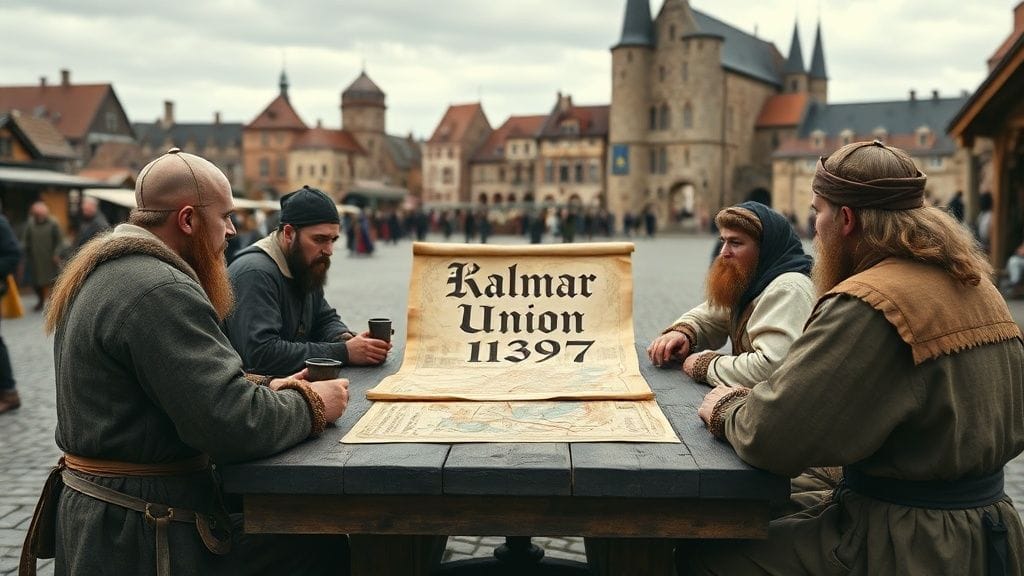
Across the table sat envoys charged with protecting their kingdoms’ privileges and wary of the promises made. Their names may be lost to time, but their voices echoed in the agreements that emerged.
The Challenges of Union: Sovereignty vs. Solidarity
At the heart of the Kalmar negotiations lay a question as old as kingdoms themselves: how to unite without erasing identity? The treaty and ensuing union had to reconcile the fierce sense of sovereignty of each kingdom with the necessity of political and military solidarity.
Swedish nobles feared Danish centralization. Norwegian elites worried their traditions would be overshadowed. The challenge was to create a federalist arrangement recognizing these concerns while allowing the union to act as a single actor on the international stage.
This tug-of-war created tension not only in Kalmar’s chamber but for generations ahead, revealing how challenging it is to forge unity from independence.
The Treaty of Kalmar: Terms and Agreements
The culmination of months of negotiation was the Treaty of Kalmar.
Signed on June 25, 1397, the treaty declared the union of Denmark, Norway, and Sweden under the single monarch Eric of Pomerania. It stipulated that each kingdom would retain its laws and governance structures, but cooperate on foreign policy, defense, and certain taxation.
Importantly, it established a council of representatives from each kingdom to advise the monarch, an early form of shared governance.
The treaty was careful to emphasize equality among the kingdoms, a nod to the sensitivities roused during negotiations.
Yet, ambiguities remained—persistent seeds of future conflict lurked in clauses whose meanings could be contested.
The Symbolic Coronation and the Birth of the Kalmar Union
The treaty’s signing was swiftly followed by a dramatic coronation ceremony in Kalmar Cathedral. Draped in regal robes, Eric of Pomerania was crowned King of Denmark, Norway, and Sweden—a symbolic act meant to bind the kingdoms not just politically but spiritually.
The ceremony was rich with medieval symbolism: crowns, sceptres, and anthems, attended by clergy, nobles, and foreign ambassadors. It captured the hopes of peace and prosperity but also the gravity of the responsibility now resting on young Eric’s shoulders.
To the people watching, this moment was electrifying—a shared moment of collective identity emerging from decades of rivalry.
The Immediate Political and Social Reactions in Denmark, Norway, and Sweden
News of the union swept through Scandinavian lands with mixed reactions. In Denmark, the union was largely welcomed as a triumph of Margaret’s diplomacy and a boon against external threats.
In Norway, responses were more cautious—many valued their autonomy and viewed the union as a necessary, though uneasy, alliance.
Sweden’s response was the most complex. While some nobles embraced the new order, others harbored resentment, seeing Danish influence as a threat to Swedish sovereignty. This tension would simmer to the surface in later decades.
For common folk, the union promised stability but also anxiety—would their taxes rise? Would new laws change their lives? The answers remained unclear, shadows cast by the grand political maneuvering.
Economic Implications: Trade, Tariffs, and the Hanseatic Rivalry
The union had significant economic stakes. For centuries, the Baltic Sea had been a crossroads of commerce; the Hanseatic League dominated this trade route, extracting wealth and wielding commandeering power.
The centralized authority promised by the union offered an opportunity to negotiate stronger terms against the League and revitalize local commerce. The union sought to coordinate tariffs and protect merchant guilds within its borders.
However, disparities among the economies of the three kingdoms presented complications. Sweden’s mining wealth, Norway’s fishing and timber, and Denmark’s agriculture were distinct sectors that needed harmonization.
The Kalmar Union initially strengthened Scandinavian bargaining power but also sowed discord as regional interests conflicted.
The Religious and Cultural Dimensions of the Union
Beyond politics and economics, the Kalmar Union was a cultural and religious project.
Catholicism was the dominant faith, and the Church played a pivotal role in legitimizing the union through endorsement and ceremonial participation.
Cultural exchange accelerated between the kingdoms, with artists, clergy, and scholars moving more freely, fostering a nascent pan-Nordic identity.
Yet, centuries-old local traditions and languages persisted, highlighting the tension between unity and diversity.
The Internal Power Struggles and Regional Resistance
Despite the union’s legal foundation, it was riven almost immediately with internal conflict.
Swedish nobles, in particular, resisted what they perceived as Danish dominance, leading to periodic rebellions and power struggles. Norway, far from the political center, felt marginalized.
Royal authority oscillated between strength and vulnerability, with regional leaders challenging the king’s edicts.
These fractures underscored the enduring difficulty of maintaining such a complex union, especially when decades-old rivalries and mistrust lingered beneath formal agreements.
The Kalmar Union’s Early Diplomatic Maneuvers in Europe
With Kalmar giving birth to a united front, the Scandinavian kingdoms engaged more confidently in European diplomacy.
The union established new alliances, negotiated marriages, and positioned itself as a counterweight to German, Polish, and Russian ambitions.
Its voices grew louder in councils, trade forums, and military coalitions, shifting the geopolitics of Northern Europe.
This new status brought benefits but also new challenges, as the union confronted a web of alliances and enmities across the continent.
The Legacy of Kalmar Union: A Century and Beyond
Though initially promising, the Kalmar Union proved fragile. Over the next century, it faced periodic crises, marked by revolts and secessions. Eric’s inability to fully command the loyalty of all factions, compounded by economic strains and regional rivalries, would undermine unity.
Yet, its legacy endured. The idea of Nordic cooperation persisted, influencing future political endeavors and shaping national identities.
Modern historians see the union as a pioneering experiment in supranational governance—a medieval precursor to the concept of shared sovereignty.
Lessons from Kalmar: The Perennial Quest for Scandinavian Unity
The Kalmar Union’s story offers enduring lessons about union-building: the fragile balance between sovereignty and cooperation, the importance of equitable power sharing, and the challenges posed by cultural and regional diversity.
It speaks to the universal human quest for peace and stability amid rivalry and distrust.
Centuries later, Scandinavian countries continue to seek collaboration through organizations such as the Nordic Council, echoing Kalmar’s vision in modern forms.
Conclusion: Reflecting on the Fragile Dream of Nordic Union
The Kalmar Union, born amid icy winds and political turbulence, was more than a mere treaty—it was a bold attempt to forge unity from fragmentation in a region shadowed by rivalry. It reflected the aspirations of visionary leaders like Margaret I and the compromises of wary nobles.
Though it never fully quelled internal tensions, its creation marked a watershed in Scandinavian history—an experiment in cooperation that set the stage for future dialogues on national identity and international alliance.
The dream of Kalmar was fragile and fraught, yet it endures as a testament to the complexities of uniting distinct peoples. It reminds us how history’s grand projects hinge on human ambition, trust, and the eternal hope for peace.
FAQs About the Kalmar Union and Its Negotiations
Q1: What were the main reasons behind the formation of the Kalmar Union?
A1: The union was primarily motivated by the need for political stability among the Scandinavian kingdoms, the desire to counter German and Hanseatic League economic dominance, and the vision of Queen Margaret I to unite the region under a single monarch.
Q2: Who was Margaret I and what role did she play in the union?
A2: Margaret I was the Queen of Denmark, Norway, and Sweden who orchestrated the union through adept diplomacy, political alliances, and military strength. She acted as regent and the key architect of the union’s formation.
Q3: Why was Eric of Pomerania chosen as the monarch of the united kingdoms?
A3: Eric was Margaret’s grandnephew and a dynastic compromise candidate. His youth and external origins made him an acceptable figure to multiple factions, symbolizing unity while allowing Margaret to maintain control as regent.
Q4: What challenges did the Kalmar Union face after its formation?
A4: The union struggled with internal dissent, especially from Swedish nobles who resented Danish dominance, economic disparities, power struggles among regional elites, and difficulty maintaining a cohesive foreign policy.
Q5: How did the Hanseatic League influence the political dynamics of Scandinavia during this period?
A5: The Hanseatic League controlled Baltic trade and exercised significant economic pressure on the Scandinavian kingdoms. The union sought to counterbalance this by consolidating political authority but faced constant tensions with the League.
Q6: How long did the Kalmar Union last and what was its ultimate fate?
A6: The union lasted in various forms for over a century, roughly from 1397 until the early 16th century, when Sweden effectively broke away, leading to the union’s gradual dissolution.
Q7: What is the historical legacy of the Kalmar Union today?
A7: It serves as an early example of regional cooperation and supranational governance, influencing modern Nordic cooperation and shaping Scandinavian political and cultural identity.