Table of Contents
- The Fiery Morning of July 6, 1415: A Martyr’s Last Dawn
- Bohemia on the Brink: Seeds of Spiritual Rebellion
- Jan Hus: From Parish Priest to Voice of Reform
- The Crack in Christendom: Church and Empire in Turmoil
- The Council of Constance: A Stage Set for Judgment
- Hus’s Summons: Between Promises and Peril
- Arrival at Constance: The Pilgrim’s Burden
- The Trial Begins: Faith, Politics, and Power Collide
- The Heresy Charge: Defiant Words Against Tradition
- Hus’s Defenses: Courage Amidst Condemnation
- The Sentence: Burning a Man, Igniting a Cause
- Flames and Faith: The Execution on the Council’s Orders
- Echoes in the Bohemian Hills: The Outcry and Insurrection
- The Hussite Wars: Rebellion Born from Ashes
- The Fracture of Christendom: Shifting Religious Sands
- The Legacy of Jan Hus: Prophet, Martyr, and Reformer
- Influence on Later Reformers: From Luther to Modernity
- The State–Church Rift: Enduring Lessons from Constance
- Cultural Memory: Hus in Art, Literature, and National Myth
- Re-examination and Rehabilitation: Echoes Through Centuries
- Constance’s Council: A Turning Point for Catholic Europe
- Historians’ Perspectives: Debates and Interpretations
- The Human Cost: Lives Changed and Lost in the Turmoil
- Conclusion: The Flame That Would Not Die
- FAQs — Understanding Jan Hus and His Epoch
- External Resource: Wikipedia Link
- Internal Link: Visit History Sphere
1. The Fiery Morning of July 6, 1415: A Martyr’s Last Dawn
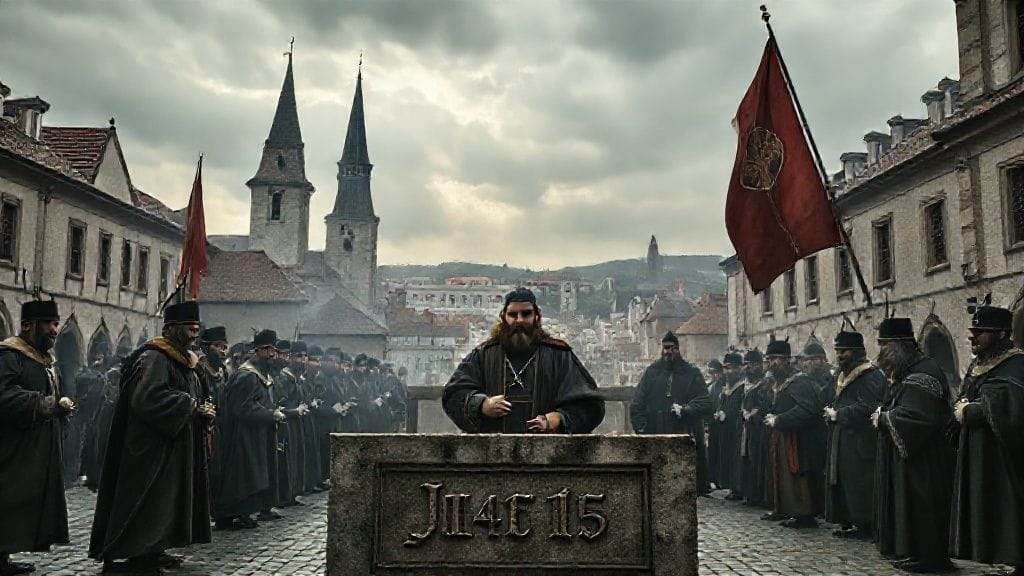
It was a morning shrouded in dread and irony: the dawn of July 6, 1415, as Jan Hus was led through the cobbled streets of Constance toward the pyre that awaited him. The sky, pale and overcast, seemed to mourn the death of a man whose voice had ignited a continent. His hands, bound but steady, held the small book of his teachings — a testament to faith and conscience in defiance of an empire and church that branded him heretic. Around him, the crowd murmured: some with sorrow, others with triumph. The flames would soon lick the dry wood, consuming flesh but unable to extinguish a flame that would continue to burn in the hearts of many beyond time.
This was no ordinary execution. It marked a rupture — political, spiritual, and cultural — between the might of empire and the awakening of conscience. It signaled a shift that few then could foresee but which would reshape Europe forever.
2. Bohemia on the Brink: Seeds of Spiritual Rebellion
To understand the magnitude of Hus’s fate, one must journey westward, to the lands of Bohemia, where discontent simmered beneath the surface of medieval Christendom. The kingdom was a vibrant mosaic of culture and politics, yet it wrestled with growing frustration toward the Catholic Church, criticized for corruption, greed, and moral decadence. The local clergy’s failure to address these concerns, compounded by foreign domination influences, inspired a hunger for reform.
The Czech people were proud, protective of their language and traditions, and eager for spiritual renewal. Jan Hus would become their voice – a preacher who dared to speak truths that many whispered but none dared proclaim aloud.
3. Jan Hus: From Parish Priest to Voice of Reform
Born around 1372 in Husinec, Jan Hus was a scholar, priest, and cobbler’s son who rose through the intellectual ranks of Charles University in Prague. Immersed in the writings of John Wycliffe — the English reformer condemned decades earlier — Hus grew convinced that the Church’s hierarchy had strayed from the Gospel. His sermons, passionate and piercing, called for clerical poverty, scriptural authority, and communion in both kinds for laity.
Hus was no mere dissenter; he was a theological visionary whose eloquence garnered both admiration and enemies. His public appeal unsettled Church authorities who feared the spread of “heretical” ideas threatening their power.
4. The Crack in Christendom: Church and Empire in Turmoil
Europe in the early 15th century was a stage of overlapping crises. The Papacy, weakened by the Babylonian Captivity in Avignon and the Great Schism, struggled to assert unified authority. Around the same time, Emperor Sigismund of Luxemburg, King of Hungary and of Germany, pursued consolidation of imperial power, often tangled in negotiations with the Pope.
The volatile mix of politics and theology made reform movements like Hus’s impossible to ignore. While many rulers viewed the Church as an indispensable pillar, others saw in reformist agitation both threat and opportunity. Hus found himself trapped amid a web of ecclesiastical power plays and the ambitions of imperial authority.
5. The Council of Constance: A Stage Set for Judgment
By 1414, the Council of Constance was convened with monumental goals: to end the Papal schism by electing a single pope, quash heresies, and restore the Church’s moral authority. Hus, accused of heresy for preaching Wycliffite doctrines, was summoned to appear. Promises of safe conduct were extended by Emperor Sigismund — a guarantee meant to reassure Hus but later bitterly betrayed.
Constance itself was a city of contradictions: a hub of diplomacy and deception, adorned with cathedral spires yet cloaked in shadowy intrigue. Here, a simple Bohemian priest’s fate would intertwine with the destiny of a fractured Christendom.
6. Hus’s Summons: Between Promises and Peril
The summons to Constance was both an honor and a trap. Hus understood the dangers but recognized an opportunity to confront his accusers, defend his beliefs, and appeal for reform. As the humble man from Bohemia set out for the council, few could guess the storm ahead.
The Emperor’s guarantee was a slender thread of hope — one that soon unraveled beneath political expediency and fear of scandal. Hus’s pilgrimage thus began under a shroud of tension, marked by hope and foreboding.
7. Arrival at Constance: The Pilgrim’s Burden
Jan Hus arrived in Constance in late 1414, greeted with curious eyes from clerics, nobles, and citizens alike. His simple garb and resolute demeanor contrasted with the opulent courts around him. The journey from Prague had been arduous, but his resolve remained unshaken.
Yet the city soon revealed its darker face. Hus was detained — no longer a guest but a prisoner chosen for humiliation and interrogation. Here, surrounded by inimical forces and amidst echoes of political plotting, Hus’s courage would be tested.
8. The Trial Begins: Faith, Politics, and Power Collide
The proceedings launched with familiar accusations: heresy, schism, and defiance of Church doctrine. But beyond theology, the trial was a spectacle of power struggle. Members of the clergy sought to crush dissent before it spread, while imperial officials balanced the need for order with political pragmatism.
Hus faced relentless questioning, urged to recant his “errors.” The trial became a battle of wills — doctrine versus conscience, orthodoxy versus reform. Despite threats and isolation, Hus’s resolve hardened. His words echoed with prophetic fire, unsettling even his fiercest adversaries.
9. The Heresy Charge: Defiant Words Against Tradition
Accused chiefly of embracing Wycliffe’s condemned ideas — including the rejection of papal indulgences and the call for a church cleansed of corruption — Hus refused to disavow his teachings. His remarks questioned the moral legitimacy of clergy who lived in luxury while neglecting their flocks.
The council saw his heresy as a cancer infecting Christendom’s unity. In a world where conformity was survival, Hus’s steadfast honesty appeared reckless, even dangerous. Yet his words resonated deeply with common people yearning for spiritual sincerity.
10. Hus’s Defenses: Courage Amidst Condemnation
Throughout the trial, Hus argued with clarity and humility. He pleaded not for personal safety, but for truth and reform. “I would die today willingly if God's Word is being glorified,” he reportedly told the council.
His defense was less a legal ploy than a moral stand. He embraced the Gospel’s authority over papal decrees and denounced worldly ambitions that distorted the Church’s mission. His refusal to recant sealed his fate but immortalized his voice.
11. The Sentence: Burning a Man, Igniting a Cause
On July 6, 1415, the verdict was proclaimed: Jan Hus was a heretic condemned to death by fire. The sentence was both a demonstration of Church authority and a desperate attempt to stem the tide of reformist fervor.
The ritual was macabre and poignant. Hus was stripped of his priestly vestments, bound to the stake, and offered a final chance to recant, which he steadfastly refused. As the torch was thrown, the flames consumed his body, but not the ideals he embodied.
12. Flames and Faith: The Execution on the Council’s Orders
As the wood crackled and black smoke billowed above Constance, witnesses reported Hus’s calm acceptance of death. He reportedly urged the assembled crowd to remain firm in faith and truth.
This moment marked a defining rupture: the execution was intended to silence a dissenter but instead ignited a spiritual inferno. News of Hus’s martyrdom spread rapidly, sparking outrage in Bohemia and stirring unrest across Europe.
13. Echoes in the Bohemian Hills: The Outcry and Insurrection
Back in Bohemia, Hus’s death was a nightmare come true. His followers — the Hussites — galvanized by grief and righteous anger, mobilized in defense of his teachings. What began as calls for reform escalated into a full-scale social and religious movement.
The death of Hus became a symbol of imperial oppression and ecclesiastical corruption, inspiring peasants, nobles, and clergy alike to challenge established order.
14. The Hussite Wars: Rebellion Born from Ashes
From 1419 to 1434, Bohemia was engulfed in the Hussite Wars — a series of fiercely fought conflicts pitting the Hussite forces against imperial crusaders and papal armies. These wars were not mere skirmishes but massive upheavals involving innovative tactics, ideological fervor, and deep social transformation.
The Hussites’ resilience fractured the hegemony of the Catholic Church in the region and exposed the limits of empire’s reach over spiritual matters.
15. The Fracture of Christendom: Shifting Religious Sands
Hus’s martyrdom and the ensuing wars accelerated the fracturing of medieval Christendom. His critique of Church abuses foreshadowed the seismic changes that the Reformation would unleash a century later.
The idea that spiritual authority might rest beyond papal hierarchy challenged the foundations of religious and political life, reshaping European identities and alliances through the centuries.
16. The Legacy of Jan Hus: Prophet, Martyr, and Reformer
Jan Hus emerged as a towering figure — not merely a victim but a prophet of conscience and reform. His life and death symbolized the struggle for integrity in faith, courage to confront prevailing power, and the sacrifice required for renewal.
His legacy informed Czech national identity and became a beacon for those seeking religious liberty and social justice.
17. Influence on Later Reformers: From Luther to Modernity
Martin Luther himself acknowledged Hus as a forerunner, drawing inspiration from the Bohemian martyr’s boldness. Hus’s criticisms of indulgences, clerical immorality, and scriptural primacy echoed loudly during the Reformation.
The ripple effects extended beyond theology, influencing political thought and modern notions of individual rights and conscience.
18. The State–Church Rift: Enduring Lessons from Constance
The trial and execution exemplify the perennial tension between secular and spiritual authorities. Emperor Sigismund's broken promise of safe conduct illustrated the cost of political expediency.
The fissures laid that day reveal the complexities of governing faith and power, dilemmas still relevant in modern societies negotiating the roles of state and religion.
19. Cultural Memory: Hus in Art, Literature, and National Myth
Jan Hus has been immortalized in countless works of art, poetry, and folklore. Statues stand in Prague and beyond; his feast day commemorated in religious calendars; his narrative woven into Czech national mythos as a symbol of resistance.
These cultural representations capture more than history — they encapsulate identity, resilience, and moral aspiration.
20. Re-examination and Rehabilitation: Echoes Through Centuries
Centuries after his death, Hus’s reputation underwent evolving interpretations. The Catholic Church canonized him only as a heretic for centuries, but later centuries witnessed partial rehabilitations, especially after the modern era.
In 1999, Pope John Paul II named Hus a “pioneer of reform,” a testament to shifting perspectives on his contested legacy.
21. Constance’s Council: A Turning Point for Catholic Europe
The Council of Constance, while ending the Papal Schism, exposed the fragility of Church unity. Its harsh stance against Hus and others signaled an empire struggling to maintain control over divergent spiritual currents.
This council marked the beginning of transitions leading to modernity — centralization but also contestation.
22. Historians’ Perspectives: Debates and Interpretations
Scholars continue debating Hus’s theological nuances, political affiliations, and the motivations of his judges. Some portray him as a proto-Protestant martyr; others emphasize his medieval context and complexities.
The trial is studied as a microcosm of late medieval power dynamics, highlighting the interplay of belief and politics.
23. The Human Cost: Lives Changed and Lost in the Turmoil
Beyond theology and power, Jan Hus’s story is one of human suffering and sacrifice. Families broken by war, societies torn by division, and individuals who lived in fear or hope — the echoes of 1415 reverberate in countless untold personal stories.
Remembering Hus demands acknowledging both the idealism and tragedy woven into historical change.
Conclusion
Jan Hus’s trial and execution in Constance stand as a vivid testament to the enduring conflict between conscience and authority, reform and tradition. His tragic death lit the flames of a movement that challenged the medieval order and prefigured the seismic religious upheavals to come.
Yet, beyond political maneuvering and doctrinal disputes, Hus’s story remains profoundly human — a portrait of courage in the face of oppression, the price of speaking truth to power, and the undying hope for a purer expression of faith. The flames that consumed his body could not erase his voice; instead, they transformed it into a beacon that would guide generations toward renewal and freedom.
History remembers Jan Hus not only as a heretic or martyr but as a man whose life reflects the eternal struggle for justice, integrity, and spiritual authenticity.
FAQs
1. Why was Jan Hus summoned to the Council of Constance?
Hus was summoned primarily to answer charges of heresy related to his criticisms of the Church’s moral failings and his support of Wycliffe’s reforms. The Council sought to suppress dissent and unify the Church.
2. What promises were made to Hus before his trial?
Emperor Sigismund granted Hus a safe conduct guarantee, promising he would not be harmed during the trip or trial. This promise was later broken when Hus was imprisoned and tried.
3. What were the main accusations against Hus?
He was accused of heresy for opposing indulgences, church corruption, advocating communion for laity in both kinds, and promoting Wycliffite doctrines considered heretical by the Church.
4. How did Hus respond to demands to recant?
Hus refused to recant his teachings, believing they aligned with Scripture and conscience. His steadfastness contributed to his condemnation.
5. What immediate impact did Hus’s execution have in Bohemia?
His execution sparked outrage, leading to the Hussite Wars — a significant religious and social rebellion challenging imperial and papal authority.
6. How did Hus influence later Protestant reformers?
Figures like Martin Luther cited Hus as a visionary who prefigured many Reformation principles, including critique of clerical abuses and the authority of Scripture.
7. What does the Hus trial reveal about church-state relations?
It highlights the complex and often fraught relationship, including how political expediency could override promises and religious justice.
8. How is Jan Hus remembered today?
He is commemorated as a national hero in the Czech Republic, a martyr for religious reform, and a symbolic figure in broader narratives of conscience and resistance.

