Table of Contents
- The Dawn of a New Era: Bourges, 1438
- Medieval Europe in Crisis: A Landscape of Power and Conflict
- The Faltering Authority of the Papacy in the 15th Century
- Charles VII: The Monarch Who Challenged the Holy See
- The Pragmatic Sanction of Bourges: Origins and Motivations
- Crafting the Sanction: Political Maneuvering and Negotiations
- The Text in Detail: Key Provisions of the Pragmatic Sanction
- The Reaction from Rome: Papal Displeasure and Resistance
- French Clergy and Nobility: Divided Loyalties and Pragmatism
- Impact on the French Church: Autonomy and Reform
- Broader European Repercussions: Between Conciliarism and Papalism
- The Pragmatic Sanction in the Context of the Hundred Years’ War
- Voices of Dissent and Support: Chroniclers and Theologians
- The Legal and Ecclesiastical Legacy of the Sanction
- The Waning of Papal Political Authority in France
- The Sanction's Role in Shaping the French Nation-State
- Intersection with the Conciliar Movement: The Council of Basel
- Economic Implications: Church Revenues and Royal Finances
- The Human Aspect: Clergy, Commoners, and Confessional Life
- The Pragmatic Sanction’s Afterlife: From Renaissance to Revolution
- Lessons from Bourges: Sovereignty, Authority, and Religion
- Conclusion: The Pragmatic Sanction as a Landmark of Ecclesiastical Independence
- FAQs
- External Resource
- Internal Link
1. The Dawn of a New Era: Bourges, 1438
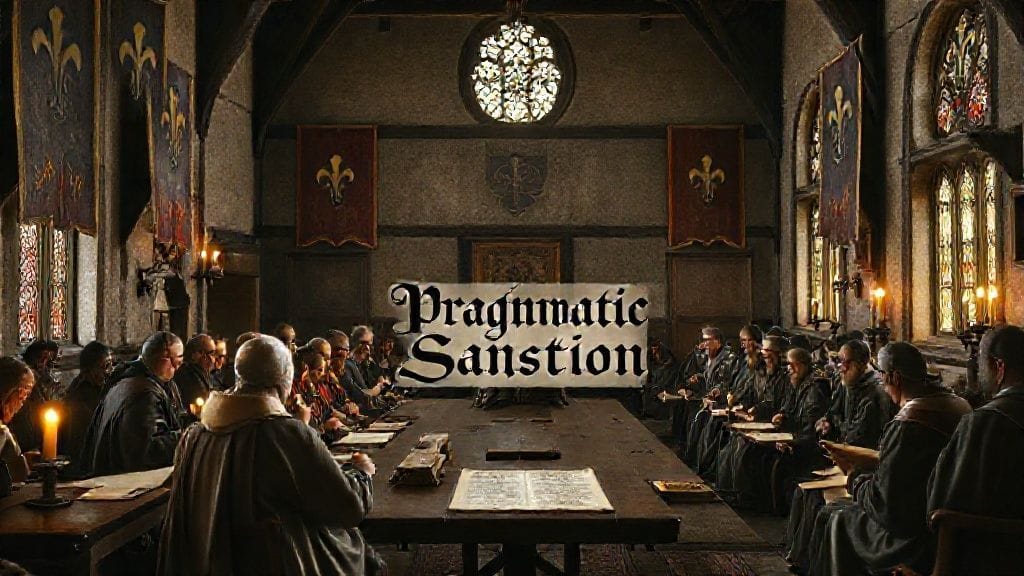
On a crisp June morning in 1438, beneath the towering spires of Bourges Cathedral, a decree emerged that would reshape the relationship between the Kingdom of France and the papacy in Rome. The air buzzed with tension and anticipation. King Charles VII, weary from decades of war and political fragmentation, had summoned his advisers, church leaders, and nobles to enact a bold legal instrument: the Pragmatic Sanction of Bourges. The hall echoed with murmurs—some hopeful, others apprehensive—as this edict aimed to reclaim a measure of control over the French Church and its vast resources, curtailing centuries of papal dominance. This moment, ripe with political intrigue and ideological fervor, marked more than a political act—it was a seismic shift in sovereignty, legitimacy, and faith.
2. Medieval Europe in Crisis: A Landscape of Power and Conflict
To grasp the significance of the Pragmatic Sanction, one must first wander the labyrinthine alleys of 15th-century Europe. The continent was a patchwork of kingdoms, principalities, and city-states, embroiled in conflicts both between themselves and within their own borders. The Hundred Years’ War between England and France was dragging into its twilight years, a devastating saga that left wounds not only on the battlefield but in the collective psyche.
The Catholic Church, meanwhile, faced its own turmoil. The Great Schism, which had riven papal authority between rival claimants in Rome and Avignon, lingered in memory like a festering wound. The papacy’s moral and political authority was contested not only by secular rulers but by voices within the Church itself. Against this backdrop, questions of governance, spiritual authority, and national identity reached fever pitch.
3. The Faltering Authority of the Papacy in the 15th Century
By the early 1400s, the papal throne—once indisputably supreme—faltered under the weight of internal corruption, political manipulation, and the rise of rival centers of power. The papacy’s habit of appointing bishops and collecting revenues across Europe without regard for local rulers’ interests generated widespread resentment.
This period witnessed the rise of Conciliarism, a theological and political movement arguing that Church councils held supreme authority over popes. The Council of Constance (1414-1418) and then the Council of Basel (1431-1449) embodied this challenge to papal supremacy, questioning Rome’s right to unilaterally dominate Christendom’s spiritual and temporal affairs.
4. Charles VII: The Monarch Who Challenged the Holy See
Charles VII, king since 1422, was no passive monarch. Having struggled through the humiliations of English invasions and the near-collapse of his realm, he was determined to restore not only France’s territorial integrity but its institutional sovereignty. Unlike many predecessors, he appreciated the necessity of curbing external influences over his kingdom’s governance.
Aware of the Church’s dominance over French lands, law, and loyalty, Charles sought to reclaim control over ecclesiastical appointments and revenues. To him, the French Church should be a national institution—loyal to France above all—rather than a mere branch of papal bureaucracy. His vision was revolutionary, yet grounded in pragmatism: a Church reformed, autonomous, and a pillar of royal authority.
5. The Pragmatic Sanction of Bourges: Origins and Motivations
The Pragmatic Sanction was not conjured overnight. It was the product of prolonged negotiations, political calculations, and a shifting European religious climate. Its inception lies at the intersection of royal ambition and conciliar reformist thought. French bishops and legal experts, themselves divided between loyalty to Rome and national interests, played crucial roles in formulating the text.
The term “pragmatic” here carries weight—it reflects a practical, somewhat utilitarian approach to church governance, designed to address pressing problems rather than lofty dogma. At heart, it was about limitation: limiting papal interference in the appointment of French clergy, restricting Rome’s financial exactions, and reinforcing the authority of councils and the king.
6. Crafting the Sanction: Political Maneuvering and Negotiations
The path to the Sanction was riddled with political intrigue. Charles VII convened the Estates-General, the assembly of clergy, nobility, and commons, at Bourges to secure consent for his bold project. The king’s agents worked tirelessly to build alliances, promising privileges to nobles and concessions to clerics willing to embrace reform.
Meanwhile, papal emissaries sought to dissuade the French court, arguing that such measures would fracture Christendom and weaken the Church’s unity. Yet the momentum was unstoppable. The specter of the Avignon papacy’s costly financial demands, combined with the ideological fervor inspired by the council movement, swayed opinion.
7. The Text in Detail: Key Provisions of the Pragmatic Sanction
The Sanction’s articles formed a comprehensive legal code governing church-state relations in France:
- The king claimed the right to oversee episcopal elections, effectively reducing papal nominations to formalities.
- General and provincial church councils were affirmed as supreme authorities, superseding papal decrees.
- The Papal Curia was forbidden from demanding financial contributions (annates) without royal consent.
- Appeals to Rome were restricted, requiring the approval of the French royal court.
- Clerical abuses such as simony and nepotism were condemned and subject to royal oversight.
This array of provisions carved out unprecedented autonomy for the French Church. It resonated as both a pragmatic solution and a bold assertion of sovereign rights.
8. The Reaction from Rome: Papal Displeasure and Resistance
Unsurprisingly, the pope reacted harshly. Pope Eugenius IV condemned the Pragmatic Sanction as heretical and invalid. The Curia issued bulls denouncing the decree, threatening censures and excommunications against those who enforced it.
But Charles VII, backed by his subjects and a reenergized Church of France, did not relent. This defiant posture signaled a fundamental shift: the papacy no longer commanded obedience by divine right alone. Political calculation, force, and national identity shaped realities on the ground.
9. French Clergy and Nobility: Divided Loyalties and Pragmatism
French clergy stood divided. Some, especially those dependent on papal favor or advantageous Roman positions, opposed the Sanction. Others welcomed the reform as a chance to curb abuses and regain control.
Nobles, balancing their own interests and royal loyalty, largely supported the move as it enhanced the king’s authority and limited papal interference in local affairs. This confluence of pragmatic interests facilitated the Sanction’s endurance.
10. Impact on the French Church: Autonomy and Reform
In practice, the Pragmatic Sanction strengthened the Gallican Church—a nationalist Catholic Church within France with distinct privileges and rights vis-à-vis Rome. It fostered clerical reform aimed at rooting out corruption, bolstered the rights of cathedral chapters, and reduced violations of canonical procedures by papal legates.
The Catholic faith flourished with a renewed focus on order and discipline, even if tensions with Rome simmered below the surface.
11. Broader European Repercussions: Between Conciliarism and Papalism
The Sanction echoed far beyond French borders. It invigorated movements across Europe that questioned papal absolutism. The Conciliar movement, embodied by the Council of Basel convened simultaneously, found in France a powerful ally.
Conversely, staunch papalists saw the Sanction as an illegal infringement threatening the universal Church’s unity. This dynamic presaged the eventual fissures that would erupt during the Reformation a century later.
12. The Pragmatic Sanction in the Context of the Hundred Years’ War
The protracted struggle between England and France lent urgency to the Sanction. Charles VII’s authority needed legitimacy bolstered by a church aligned with his objectives. Further, the Sanction’s reduction of papal influence curtailed English attempts to exploit Rome’s power for political gain.
This synergy between national sovereignty and church reform became a crucial underpinning of France’s renaissance after decades of war and upheaval.
13. Voices of Dissent and Support: Chroniclers and Theologians
Chroniclers such as Georges Chastellain and theologians like Jean Gerson offered vivid, often conflicting portraits of the Sanction. Some celebrated its courage in confronting corruption; others lamented what they saw as dangerous fractures in Christendom.
Their writings reveal a medieval society grappling with monumental questions about faith, authority, and identity—questions still resonant today.
14. The Legal and Ecclesiastical Legacy of the Sanction
Legally, the Pragmatic Sanction laid foundation stones for the tradition of Gallicanism: the doctrine asserting the independence of the French Church in temporal matters while maintaining spiritual unity with Rome.
Its influence endured in French legal codes and ecclesiastical practice until the French Revolution, when revolutionary ideals began to dismantle centuries-old institutions. Even then, echoes of the Sanction survive in debates over church-state relations.
15. The Waning of Papal Political Authority in France
The Sanction symbolized the papacy’s waning political authority within Europe’s emerging nation-states. It prefigured the gradual relocation of church power from a universal authority to particular national contexts.
France was among the first to assert such bold independence, a harbinger of the modern nation-state where religion and sovereignty negotiate their complex boundaries.
16. The Sanction's Role in Shaping the French Nation-State
By asserting control over the Church, Charles VII advanced the centralization of administrative and legal power essential for modern governance. The Pragmatic Sanction contributed to a conceptual shift: the king’s authority was not only secular but intimately tied to spiritual oversight.
This strategic intertwining of crown and church underscored France’s evolution into a powerful, centralized state with distinct national identity.
17. Intersection with the Conciliar Movement: The Council of Basel
The Council of Basel (1431–1449) paralleled the Sanction’s aims, emphasizing conciliar authority over popes and reform of the Church hierarchy. France’s Pragmatic Sanction echoed these principles at a national level.
This synergy illustrates how local political imperatives and broader ecclesiastical theories interfaced, challenging papal absolutism on multiple fronts.
18. Economic Implications: Church Revenues and Royal Finances
By limiting papal taxes (annates) and curtailing the Curia’s financial reach, the Sanction had immediate economic benefits for the French crown and nobility. It maintained ecclesiastical wealth within France, enhancing the kingdom’s fiscal health in a period of reconstruction.
This financial reorientation was no mere side effect—it was a central motive driving the Sanction’s adoption.
19. The Human Aspect: Clergy, Commoners, and Confessional Life
Beyond politics and law, the Sanction affected priests, monks, and laypeople. Clerics found themselves more answerable locally, altering parish dynamics and exposing corruption to scrutiny. Lay believers experienced a Church that balanced tradition with emerging nationalism.
This human dimension—of faith negotiated in daily life—accentuates the Sanction’s role as a lived historical reality, not abstract legislation.
20. The Pragmatic Sanction’s Afterlife: From Renaissance to Revolution
Although the Sanction’s enforcement waxed and waned in subsequent decades, its spirit endured. Gallicanism grew increasingly sophisticated, influencing religious debates up to the Revolution of 1789 and even beyond, shaping Napoleon’s Concordat and later French secularism.
The Pragmatic Sanction remains a touchstone for understanding France’s complex church-state relations through centuries.
21. Lessons from Bourges: Sovereignty, Authority, and Religion
Bourges in 1438 teaches us about the interplay between political power and religious authority—a dance neither side could dominate completely. It reveals early modern struggles over sovereignty that resonate in contemporary debates on nationalism, religious freedom, and institutional autonomy.
The Sanction’s pragmatism underscores the necessity of adaptation and negotiation in governance.
Conclusion
The Pragmatic Sanction of Bourges stands as a milestone in the long journey toward national sovereignty and ecclesiastical reform. It was not merely a royal edict but a declaration of France’s will to shape its spiritual destiny alongside its political future. In a time fraught with war, religious turmoil, and shifting alliances, Charles VII’s Sanction boldly redefined the balance between church and state.
Yet its legacy is subtle and complex: a mixture of progress and conflict, reform and resistance. It foreshadowed the fragmentation of medieval Christendom and the eventual emergence of modern nation-states balancing faith with political realities.
More than six centuries later, the Pragmatic Sanction of Bourges teaches us about the enduring human quest for authority—not as absolute domination, but as negotiated power, shared between governments and communities shaped by history, belief, and pragmatic necessity.
FAQs
Q1: Why was the Pragmatic Sanction of Bourges enacted in 1438?
A1: It was enacted to curtail papal authority over the French Church, particularly regarding bishop appointments and financial demands, thus reinforcing royal control and addressing widespread concerns about ecclesiastical abuses.
Q2: How did the pope react to the Pragmatic Sanction?
A2: Pope Eugenius IV condemned the Sanction, denouncing it as heretical and invalid, and threatened excommunication against supporters, reflecting the deep conflict between French royal interests and papal claims.
Q3: What role did the Conciliar Movement play in the Sanction?
A3: The Sanction reflected Conciliar ideas, emphasizing the authority of general church councils over popes; it paralleled reforms sought at the Council of Basel and bolstered efforts to limit papal absolutism.
Q4: How did the Pragmatic Sanction affect relations between the French monarchy and the Church?
A4: It significantly enhanced royal influence over the Church in France, creating a model of Gallicanism that balanced spiritual authority with national sovereignty.
Q5: What were the economic impacts of the Sanction?
A5: By restricting papal taxes and financial extractions, it preserved church revenues within France, strengthening royal finances and limiting Rome’s wealth accumulation from French lands.
Q6: How long did the Sanction’s effects last?
A6: While enforcement varied, its principles underpinned French church-state relations for centuries, influencing ecclesiastical policies up through the Revolution and beyond.
Q7: Did the Pragmatic Sanction lead to outright schism?
A7: No formal schism occurred, but it contributed to ongoing tensions between Rome and France, laying groundwork for national churches with relative independence.
Q8: How is the Pragmatic Sanction remembered today?
A8: It is seen as a foundational moment in the history of French sovereignty and ecclesiastical reform, a legal act symbolizing early modern struggles over authority that still echo in contemporary church and state relations.

