Table of Contents
- The Winter’s Frigid Dawn: Setting the Stage for Towton
- The Wars of the Roses: A Nation Torn Apart
- The Clash of Houses: York versus Lancaster
- Edward IV’s Rise and Ambitions
- The March to Towton: Armies on the Move
- The Morning of March 29, 1461: Gathering Storms and Murmurs of War
- The Battlefield Unfolds: Geography and Weather as Deadly Allies
- The First Blows: Arrow Storms and Cavalry Charges
- The Tide of Battle: Shifting Fortunes Amidst Snow and Blood
- The Role of Leadership: Courage, Strategy, and Ruthlessness
- Casualties and Chaos: The Human Cost of Towton
- The Aftermath: Yorkist Triumph and Lancastrian Flight
- Political Repercussions: Edward IV’s Coronation and Consolidation
- Towton’s Place in Memory: Myth, Legend and Historical Debate
- The Wider Impact: Towton and the Future of England
- Towton’s Legacy in Culture and Historiography
- Conclusion: The Silent Voices Beneath the Snow
- FAQs about the Battle of Towton
- External Resource
- Internal Link
1. The Winter’s Frigid Dawn: Setting the Stage for Towton
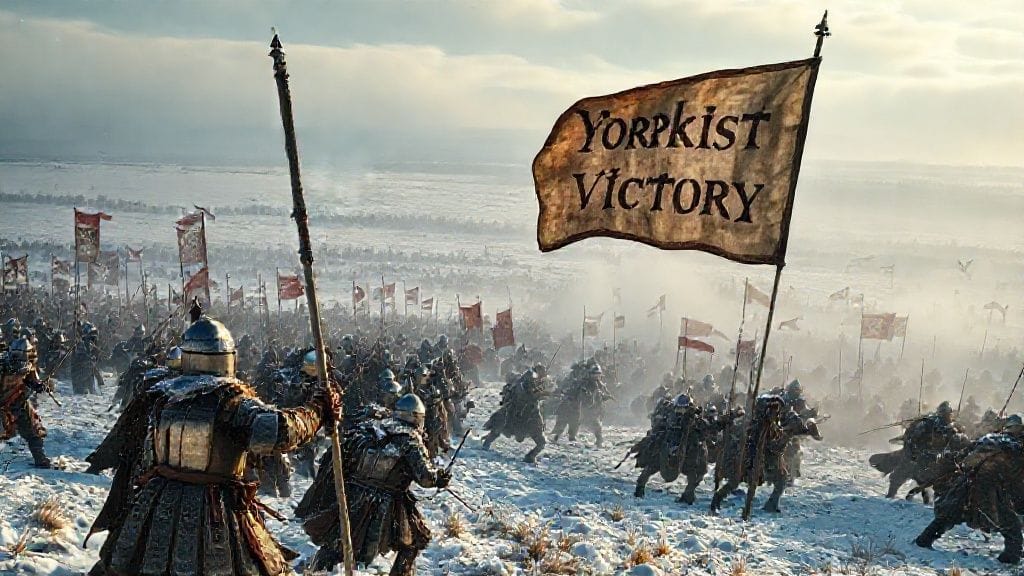
It was a bitter morning on March 29, 1461, as the pale sun struggled through a steel-gray sky above the bleak Yorkshire moors. A biting wind swept over the fields near the village of Towton, stirring snowflakes that clung to the frozen soil like shards of glass. Here, in the heart of England’s north, two enormous armies — bound by blood, ambition, and desperation — prepared to clash in what would become the bloodiest battle ever fought on English soil.
Men shivered in their armor, clutching weapons slick with frost, while the distant clang of metal and calls of commanders echoed in the cold. Yet beneath the physical chill loomed a far deadlier cold — the icy grip of civil war, ideological fracture, and familial betrayal that had sundered the realm for decades. This was the moment England’s fate would hang in the balance.
Towton was not just a tumultuous military engagement; it was a brutal reckoning with identity, loyalty, and power — one that would cast a long shadow over the Wars of the Roses and shape the kingdom’s future for generations.
2. The Wars of the Roses: A Nation Torn Apart
To grasp the enormous magnitude of Towton, one must first understand the deep fissures that had cleaved England since the late 1450s. The Wars of the Roses, a devastating dynastic struggle, pitted two rival branches of the royal House of Plantagenet — the Yorks, bearing the white rose, and the Lancasters, symbolized by the red.
This conflict was not merely a battle of crowns; it was a complex web of shifting alliances, disputed claims, and bitter resentments. The legitimacy of King Henry VI, a Lancastrian, was continually challenged by Richard, Duke of York, who claimed superiority through his bloodline and capability to rule. Henry’s recurrent bouts of mental illness plunged the kingdom into chaos, prompting factions to vie for dominance in a volatile political landscape.
The wool-clad shires and grand castles alike became testing grounds of loyalty as nobles chose sides for reasons entangled in greed, survival, honor, and love — often all at once.
3. The Clash of Houses: York versus Lancaster
By 1461, after years of conflict marked by shifting victories and brutal skirmishes, the war reached a pivotal juncture. Edward, Earl of March, heir apparent of Richard, Duke of York, was determined to assert his family’s claim and end the turmoil once and for all. Opposing him was the Lancastrian loyalist faction, determined to preserve the fragile reign of Henry VI and prevent the Yorkists from seizing power.
Each army reflected the fractured society they fought over: knights and archers, local levies and mercenaries, noble retainers and common foot soldiers, all drawn into a deadly vortex where personal vendettas intertwined with national destiny.
Towton was destined not only to be the largest battle of the Wars but also a fulcrum on which the entire conflict might pivot.
4. Edward IV’s Rise and Ambitions
Edward of York was a man with a keen mind and a burning ambition. At just 18, he was exceptionally young for someone stepping into the brutal game of medieval politics and warfare. Yet his confidence was palpable, forged in the crucible of previous battles such as Mortimer’s Cross and Northampton.
Edward envisioned a united England under a stable, effective monarchy—one free from the weak rule and factionalism embodied by Henry VI. His claim was not only legal but served a narrative of necessary reform and restoration of order. However, to seize the crown, he would need to defeat the Lancastrian forces decisively.
5. The March to Towton: Armies on the Move
In the days leading to the battle, two massive forces converged on a narrow stretch of land near Towton. The Yorkists, led by Edward himself, were estimated around 20,000 men, while the Lancastrians, under the command of the Earl of Somerset and other nobles, gathered close to 30,000 troops.
The logistics of moving such numbers in early spring were staggering — men had to be fed, armed, and directed amid uncertain terrain and hostile winter weather. Yet fresh intelligence and fierce determination spurred both sides forward, each hoping to deliver a fatal blow to its rival.
6. The Morning of March 29, 1461: Gathering Storms and Murmurs of War
As dawn broke through the mist, the armies prepared for combat with a grim sense of destiny. The Lancastrians positioned on the higher ground, hoping to advantage their larger numbers and use the wind to scatter arrows. The Yorkists, eager and disciplined, lined up across the frosted fields, ready to confront the coming onslaught.
Contemporary chroniclers would later describe an atmosphere thick with tension — the quiet before the storm tinged by prayers and grim resolve. The cold, bitter air seemed a cruel accompaniment to what was to come.
7. The Battlefield Unfolds: Geography and Weather as Deadly Allies
Towton’s open fields were deceptively simple — but the topography would play a crucial role. The slope chosen by the Lancastrians granted initial tactical advantage, yet the sequences of hills and bogs created opportunities for ambush and confusion.
Most significantly, the weather turned suddenly violent. A fierce snowstorm swept across the battlefield, obscuring vision and chilling the combatants to their core, swirling around arrows and blurring commands. This tempest added chaos to an already chaotic fight, forcing soldiers to rely on instinct and courage amid the whiteout.
8. The First Blows: Arrow Storms and Cavalry Charges
At the battle’s onset, Yorkist archers unleashed a relentless hail of arrows, darkening the sky. The Lancaster archers responded in kind. The air was torn by the deadly whistling of missiles, falling on armor and flesh alike.
Then came the thunder of horses — lances shivered against shields, men clashed steel with steel in brutal charges and counter-charges. The initial Yorkist assaults tested the Lancastrian lines, creating pockets of intense struggle that spilled across the fields like wildfires.
9. The Tide of Battle: Shifting Fortunes Amidst Snow and Blood
Towton was not a swift engagement — it dragged on for hours, with neither side able to claim early victory. Blood stained the snow, muddy with crushed bodies and scattered weaponry.
The cold took its toll nearly as fiercely as the enemy. Men fought bare-faced against frostbite and exhaustion. Some froze where they fell; others fought on despite wounds and fatigue.
Edward’s leadership was pivotal — he repeatedly rallied faltering lines, organized reinforcements, and exploited weaknesses. Over time, Yorkist discipline and determination began to turn the tide against a weary Lancaster force.
10. The Role of Leadership: Courage, Strategy, and Ruthlessness
Edward IV’s abilities as commander became evident. His youthful vigor contrasted with the aged and divided Lancaster command, which struggled with internal disagreements and miscommunication.
The ruthless nature of medieval warfare revealed itself; no quarter was given. Lancastrian prisoners were often executed on the spot, and fleeing soldiers cut down. To Edward, victory required not only strength but also terror as a tool to dissuade resistance.
11. Casualties and Chaos: The Human Cost of Towton
By day’s end, estimates suggest that between 20,000 and 28,000 men lay dead — an appalling loss unprecedented in English history. The scale of slaughter overwhelmed the landscape; bodies clogged streams and clustered under frozen branches.
Families were shattered, villages emptied, and the social fabric stretched to breaking. The cries of the wounded and dying lingered in the minds of survivors, haunting the land itself.
12. The Aftermath: Yorkist Triumph and Lancastrian Flight
With the Lancastrians routed, Edward quickly consolidated his position. The defeated nobles fled south or sought refuge abroad, their cause severely crippled. Edward advanced to London, where he was hailed as king, his coronation accelerating the Yorkist claim.
Yet pockets of Lancastrian resistance remained, sparking further conflict, but the battle’s immediate effect was to establish Edward as the most powerful man in England — at least for a time.
13. Political Repercussions: Edward IV’s Coronation and Consolidation
The Yorkist victory at Towton reshaped England’s political landscape. Edward’s coronation in June 1461 was both a triumph and a message: the legitimacy and authority of the new regime would not be questioned lightly.
However, the fragile nature of medieval kingship required continuous vigilance. Edward spent the following years suppressing rebellions, forging alliances, and restoring governance — all under the shadow of continuing instability.
14. Towton’s Place in Memory: Myth, Legend and Historical Debate
Towton entered English historical consciousness as a symbol of brutal conflict and decisive resolution. Chroniclers and poets later framed it in epic terms, emphasizing valor and sacrifice, but sometimes glossing over the horrors.
In the centuries that followed, historians debated details—troop numbers, tactics, the battle’s exact location—and the moral implications of the carnage. Folk memory infused Towton with ghost stories and tales of restless spirits, a grim reminder of the war’s toll.
15. The Wider Impact: Towton and the Future of England
Beyond immediate political consequences, Towton shaped England’s trajectory towards centralized monarchy and relative stability under the Tudors, descendants of both York and Lancaster.
The battle underscored the devastating cost of civil war, influencing future governance and succession practices. Towton was also a lesson in military organization and the stark realities of medieval combat.
16. Towton’s Legacy in Culture and Historiography
Today, Towton remains an object of passionate study and remembrance. Archaeological excavations have uncovered weapons and remains that speak to the battle’s ferocity.
Portrayals in literature, film, and reenactments keep the story alive, blending facts and fantasy. Historians continue to explore its complexities, ensuring that Towton is not forgotten as a pivotal moment in England’s past.
17. Conclusion: The Silent Voices Beneath the Snow
Towton was more than a battle. It was a crucible in which England’s identity and future were forged, soaked in blood and imbued with tragedy. Thousands died not as names in history books, but as sons, fathers, and friends — their stories lost beneath layers of snow and time.
Yet, in remembering Towton, we confront the bitter costs of ambition and division, as well as the resilience of a nation striving toward peace. The battle endures not just in chronicles, but in the silent echoes of its fallen, teaching us the profound price of civil conflict and the enduring hope for reconciliation.
FAQs about the Battle of Towton
Q1: What was the main cause of the Battle of Towton?
A1: The battle was caused by the dynastic struggle of the Wars of the Roses, primarily to determine who would legitimately control the English throne — the Yorkist claim under Edward IV or the Lancastrian King Henry VI.
Q2: Why is Towton considered the bloodiest battle in English history?
A2: Estimates suggest that between 20,000 and 28,000 soldiers died on a single day, an unprecedented loss at the time, marking it as the deadliest battle fought on English soil.
Q3: How did weather conditions affect the outcome of the battle?
A3: A fierce snowstorm reduced visibility, hampered communication, and increased chaos during fighting, affecting the Lancastrians stationed on higher ground as wind direction shifted, aiding the Yorkists.
Q4: Who was Edward IV and what role did he play at Towton?
A4: Edward IV was the Yorkist leader and future king, whose youthful leadership and tactical decisions were instrumental in turning the tide and securing victory at Towton.
Q5: What happened to the Lancastrian forces after Towton?
A5: The Lancastrians were decisively defeated and many fled or were killed. Their cause continued through resistance and exile, but Towton severely weakened their hold on power.
Q6: How did Towton influence the political landscape of England?
A6: Towton secured Edward IV’s claim to the throne, enabling a Yorkist monarchy that lasted over a decade and altered the path of English governance by reducing Lancastrian influence temporarily.
Q7: Is the location of the battle well known today?
A7: Yes, Towton is located near York in northern England, with battlefield parks and commemorations marking the site, though some details of exact troop positions remain debated among historians.
Q8: Why does Towton still resonate in English history?
A8: Towton symbolizes the brutality of civil war and the struggle for power with its enormous human cost and pivotal role in shaping England’s monarchy, offering lessons in conflict and reconciliation.

