Table of Contents
- The Dawn Before the Storm: Otranto on the Eve of Invasion
- The Geopolitical Chessboard: Europe and the Ottoman Empire in the Late 15th Century
- Mehmed II’s Grand Strategy: Expansion and Ambition Toward Italy
- The Ottoman Fleet Sets Sail: Preparation and Crossing the Adriatic
- The Siege of Otranto Begins: August 11, 1480
- The Defenders of Otranto: Resilience Amidst Overwhelming Odds
- The Fall of Otranto: How the City Was Taken by Force
- The Martyrs of Otranto: Courage and Tragedy at the Edge of Europe
- The Ottoman Occupation: Administration and Daily Life Under New Rule
- The European Response: A Call to Arms Across Christendom
- The Siege Lifted: King Ferdinand’s Campaign to Retake Otranto
- The Recapture and Its Aftermath: Retribution and Reconstruction
- Ripples Through Time: How Otranto Shaped Mediterranean Power Balances
- Memory and Myth: The Legacy of the Ottoman Invasion in Italian and European Culture
- Lessons from Otranto: Understanding Early Modern Warfare and Clash of Civilizations
- Conclusion: Otranto — A Threshold Between Worlds, A Moment Frozen in History
- FAQs About the Ottoman Capture of Otranto
- External Resource
- Internal Link
1. The Dawn Before the Storm: Otranto on the Eve of Invasion
The salty breeze of the Adriatic Sea carried more than just the scent of summer in August 1480; it bore the tension of a world on edge. Otranto, a fortified coastal city in Apulia, Italy, basked quietly in the golden Mediterranean sun, unaware that its fateful encounter with the tides of history was imminent. Fishermen went about their routines, children played near the old city walls, and the bells of the cathedral echoed softly through the narrow streets. But to the east, across the waters, a formidable Ottoman armada was sailing relentlessly toward this peaceful port, heralding a clash of civilizations that would shake the very foundations of southern Europe.
2. The Geopolitical Chessboard: Europe and the Ottoman Empire in the Late 15th Century
By the late 15th century, the Ottoman Empire, under the stirring leadership of Sultan Mehmed II, had already transformed from a rising dynasty into an empire that seemed destined to dominate the eastern Mediterranean. The fall of Constantinople in 1453 had sent shockwaves across Christian Europe, signaling a new age in warfare, religion, and imperial ambition. The Mediterranean basin had long been a theater where Christian and Muslim powers contested trade routes, territories, and prestige, with Venice, Naples, and the Papacy wary of Ottoman influence inching closer to their shores.
Otranto, strategically perched on the heel of Italy’s boot, was a jewel coveted not only for its location but for its symbolic significance. It was a gateway to the Italian peninsula, a threshold through which the Ottomans might step into Western Christendom. The city represented both a challenge and an opportunity.
3. Mehmed II’s Grand Strategy: Expansion and Ambition Toward Italy
Mehmed II was no mere conqueror; he was a visionary architect of empire with a keen eye for opportunity. Following his swift and definitive capture of Constantinople, he set his ambitions on dismantling Europe’s fragmented defenses, aiming to control key maritime routes and to foment instability among Christian states by projecting Ottoman power westward. The invasion of Otranto was a statement—a demonstration that even the supposedly impregnable hearts of Europe could be pierced.
The choice of Otranto was tactical. It was less fortified than other Italian ports and promised a valuable base for Ottoman fleets to continue raids and potentially open a corridor into the peninsula. It also sent a clear message to the Pope and the Christian monarchs that the Ottoman reach knew no bounds.
4. The Ottoman Fleet Sets Sail: Preparation and Crossing the Adriatic
In the sweltering summer heat of 1480, a fleet of nearly 90 ships, including galleys and transports, was assembled in the Ottoman ports on the eastern Adriatic coast. Commanded by Gedik Ahmed Pasha, a trusted and experienced general, the fleet carried over 18,000 soldiers, a blend of elite Janissaries and seasoned sailors, all driven by a single purpose: seize Otranto.
The crossing was perilous—storms, navigational challenges, and possible interception loomed. Yet, the determination of the Ottoman sailors was unbreakable. As the fleet approached the tranquil shores of Otranto, the natives could only stare in disbelief as the seemingly endless armada darkened the horizon—a force of nature poised to unleash havoc.
5. The Siege of Otranto Begins: August 11, 1480
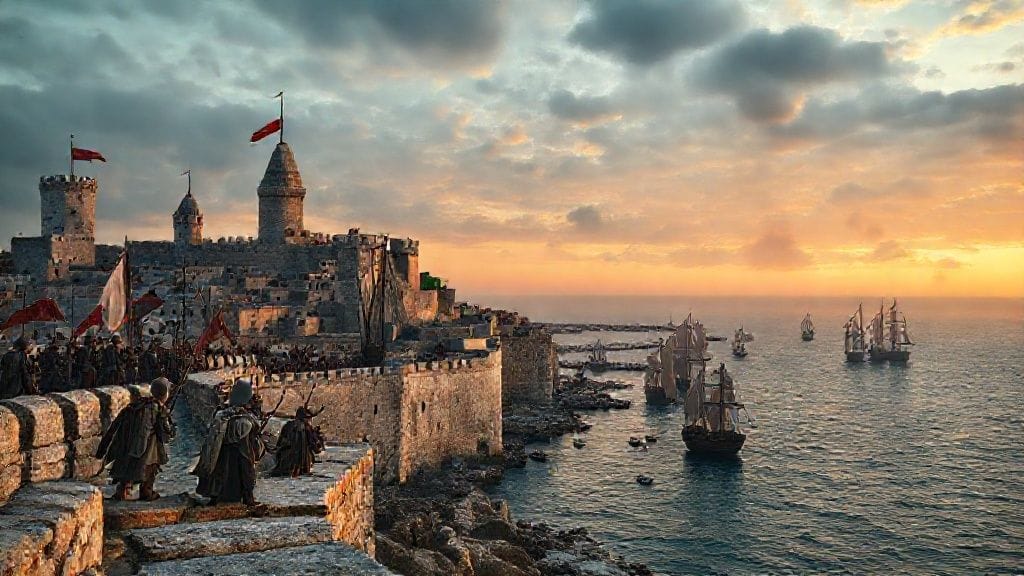
On a blistering summer day, the siege of Otranto began with thunder and fury. Ottoman cannon fire hammered the city walls as infantry disembarked under relentless musket and arrow volleys. Defenders scrambled along battlements and ramparts, ringing warning bells and racing to hold breaches under an assault marked by brutal hand-to-hand combat.
Otranto's fortifications, though old and not designed for such a modern offensive, bore the initial assault bravely. But the city's defenders were vastly outnumbered. The Ottoman forces employed sophisticated siege tactics alongside sheer brutality, making quick work of outer walls and slowly overwhelming the city's inhabitants.
6. The Defenders of Otranto: Resilience Amidst Overwhelming Odds
To understand Otranto’s fate is to understand its defenders’ courage. The city was garrisoned by a modest force led by Alfonso of Aragon, a nobleman whose resolve was emblematic of Otranto’s citizens. Soldiers, clergy, and civilians alike took up arms—often improvised—and mounted a gritty defense.
One vivid anecdote recounts how women and clergy aided the archers on the walls, passing arrows and water, embodying a communal defiance. Amid rising casualties and dwindling supplies, hope flickered unyieldingly, even as Ottoman soldiers tunneled beneath walls and battering rams shattered gates.
Yet, exhaustion and fear were overwhelming. With breaches mounting, the defenders faced an impossible choice—fight to the death or yield to a merciless enemy.
7. The Fall of Otranto: How the City Was Taken by Force
After two weeks of cataclysmic siege warfare, Otranto’s walls finally gave way. On August 29, 1480, Ottoman troops flooded the city, engaging in widespread slaughter, looting, and destruction. Eyewitnesses would later recount the grisly scenes: homes set aflame, sacred sites desecrated, and citizens dragged from their beds or forced into captivity.
The scale of the carnage was staggering. It is estimated that nearly 7,000 inhabitants were killed or enslaved. The city’s defenses had crumbled, but the suffering of Otranto’s people was the true ruin—a bitter testament to the ferocity of the conquest.
8. The Martyrs of Otranto: Courage and Tragedy at the Edge of Europe
Among the dead were 800 men and boys who refused to abandon their faith or convert to Islam. These men, later canonized as the Martyrs of Otranto, endured horrific torture and execution in the city’s cathedral. Their story transcended the tragedy, becoming a powerful symbol of religious conviction, sacrifice, and resistance to invasion.
The chilling accounts of their brutality—beheadings, floggings, and threats to their families—were recorded by survivors and missionaries, searing their memory into the Christian collective consciousness. Their sacrifice became a holy rallying cry against Ottoman encroachment.
9. The Ottoman Occupation: Administration and Daily Life Under New Rule
Despite the initial violence, the Ottomans soon set about consolidating authority in Otranto. They established garrisons, imposed new taxes, and implemented Islamic legal norms alongside practical accommodations to win over some segments of the local populace.
Trade routes adapted to new realities as Ottoman control over the eastern Adriatic fostered temporary shifts in commerce and political allegiances. Some local families converted or collaborated, whereas others maintained underground resistance and pro-Christian sympathies.
This period would last for less than a year but left a complicated legacy of occupation, trauma, and uneasy coexistence.
10. The European Response: A Call to Arms Across Christendom
News of Otranto’s fall leapt swiftly beyond Italy’s borders, igniting alarm across Christian Europe. Pope Sixtus IV, once criticized for political maneuverings, seized the moment to call for a holy crusade. Monarchs from Naples, Sicily, and even France sent troops and funds to reclaim the city and push back the Ottoman tide.
Diplomats scrambled, armies mobilized, and alliances converged. The invasion exposed Europe’s vulnerabilities but also its potential for unity when faced with existential threats. The call to arms was relentless—the defense of Christendom itself seemed to hinge on the fate of Otranto.
11. The Siege Lifted: King Ferdinand’s Campaign to Retake Otranto
By the spring of 1481, King Ferdinand I of Naples launched a determined counterattack. Combining forces with papal troops and mercenaries, the Neapolitans besieged the Ottoman garrison, who were increasingly isolated and weakened by supply shortages.
After months of grinding siege warfare and fierce skirmishes, the Ottoman forces surrendered in May 1481. The recapture of Otranto was a symbolic victory for the Christian kingdoms—proof that the Ottoman advance could be checked, even reversed.
Yet, the cost was great—much of the city lay in ruins, its population decimated, and the wounds not easily healed.
12. The Recapture and Its Aftermath: Retribution and Reconstruction
The liberation of Otranto was met with a mixture of relief and grim retribution. Many captured Ottomans were executed or enslaved; the few survivors expelled. A comprehensive rebuilding effort began, fueled by papal funding and local determination to restore the city’s walls, churches, and homes.
Monuments were raised, and the memory of the siege was enshrined in chronicles and art, serving both as a reminder of the horrors of war and a testament to resilience. The event became ingrained in the cultural fabric of the region, shaping Apulian identity for generations.
13. Ripples Through Time: How Otranto Shaped Mediterranean Power Balances
Although the occupation lasted less than a year, its reverberations were felt widely. The siege highlighted urgent defensive needs across Italian states, instigated military reforms, and intensified efforts to fortify coastal cities against seaborne threats.
It also underscored the importance of a united Christian front, prompting early diplomatic efforts that would later culminate in larger coalitions resisting Ottoman expansion. Strategically, it confirmed the Adriatic Sea as a vital frontier—a stage where East and West would confront each other repeatedly for centuries.
14. Memory and Myth: The Legacy of the Ottoman Invasion in Italian and European Culture
Otranto’s siege entered the realm of myth and memory, inspiring poets, painters, and chroniclers who wrestled not only with the facts but with the meaning of such a profound trauma. Stories of martyrdom, heroism, and betrayal mingled with legend, crafting a narrative of steadfast faith against overwhelming darkness.
In modern Italy, monuments and liturgies commemorate the fallen; in Europe, Otranto echoes as an early symbol of the complex interactions between Christian Europe and the Ottoman Empire—marked by both violence and cultural exchange.
15. Lessons from Otranto: Understanding Early Modern Warfare and Clash of Civilizations
The Ottoman capture of Otranto provides historians with a window into the transition from medieval to early modern warfare. It encapsulates the shift towards gunpowder artillery, the fusion of naval and land forces, and the brutal realities of ideological conflict.
Moreover, it challenges simple narratives of good versus evil by revealing nuanced human experiences—soldiers, civilians, negotiators caught in the maelstrom of empire, belief, and survival. Otranto is a powerful case study of how geography, faith, and ambition combine to reshape history.
16. Conclusion: Otranto — A Threshold Between Worlds, A Moment Frozen in History
As the sun sets over the Adriatic, the stones of Otranto’s ancient walls whisper stories of siege, sacrifice, and resurgence. The Ottoman capture was more than a military episode; it was a moment when cultures clashed at the very edge of their worlds, when faith was tested in fire, and when the future direction of Europe hung precariously in the balance.
Today, Otranto stands both as a guardian of memory and a beacon of resilience, urging us to remember that history is never far from the present—its lessons etched in blood, stone, and spirit.
Conclusion
The Ottoman capture of Otranto in 1480 is a striking testament to the tumultuous dynamics of early modern Europe and the Mediterranean. It reveals a world in flux: empires expanding, faiths colliding, societies tested by war and survival. The siege’s dramatic rise and fall encapsulate not only military strategy and political maneuvering but above all the human cost and resilience that define historical moments.
This story of conquest and martyrdom is a poignant reminder that history’s most profound events are not mere dates in a textbook, but living narratives borne by individuals—fighters, priests, civilians—whose courage and suffering echo through centuries. Otranto remains a symbol of a gateway not just between lands, but between eras and civilizations, forcing us to confront the perennial questions of identity, power, and coexistence.
FAQs About the Ottoman Capture of Otranto
Q1: Why did the Ottomans target Otranto specifically?
A1: Otranto’s strategic position on the Italian peninsula’s southeastern coast made it a perfect foothold for Ottoman expansion into Western Europe, controlling key Adriatic maritime routes with relative ease compared to better-fortified cities.
Q2: Who led the Ottoman forces during the siege?
A2: The Ottoman fleet and army were commanded by Gedik Ahmed Pasha, an experienced general and statesman loyal to Sultan Mehmed II, tasked with executing this ambitious coastal assault.
Q3: How did the local population respond to the invasion?
A3: Local defenders, including soldiers, clergy, and civilians, mounted a fierce but ultimately overwhelmed defense. Many remained defiant, refusing to abandon their faith even under threat of death, becoming martyrs.
Q4: What were the short-term consequences of the siege for Otranto?
A4: The city was occupied for less than a year but suffered tremendous loss in lives and infrastructure. Its recapture required a costly siege and led to widespread rebuilding efforts.
Q5: Did the Ottoman occupation have lasting effects on Europe?
A5: While brief, it intensified European fears of Ottoman expansion, promoted military reforms, and inspired greater cooperation among Christian states against the Ottoman threat in the Mediterranean.
Q6: How is the siege remembered today?
A6: The siege is commemorated as a tragic but heroic episode, especially recalling the 800 martyrs. It is a cultural touchstone in Apulia and part of broader European historical memory regarding Ottoman-Christian conflicts.
Q7: Were there any cultural exchanges during the occupation?
A7: Despite the violence, historical records suggest some interaction occurred, including administrative practices and limited local conversions, highlighting the complex nature of Ottoman rule.
Q8: What lessons does the siege offer to modern historians?
A8: It illustrates the complexities of early modern warfare, the interplay of faith and politics, and the human dimension of empire-building, cautioning against simplistic historical narratives.

