Table of Contents
- The Smoke on the Horizon: Prelude to the Burgundian Wars
- Power Struggles in Late Medieval Europe
- The Ambitions of Charles the Bold
- The Swiss Confederacy: A Rising Power
- March 2, 1476: The Battle of Grandson – A Shattering Defeat
- The Aftermath of Grandson: Panic and Resolve
- The Gathering Storm: Preparations for Morat
- June 22, 1476: The Battle of Morat – Retribution and Triumph
- Weaponry and Tactics: Innovation on the Battlefield
- The Human Face of War: Stories from the Frontlines
- The Role of Mercenaries and the Art of Medieval Warfare
- Political Ripples: Burgundy’s Waning Influence
- The Swiss Confederacy’s Rise to Prominence
- Cultural Reflections: Songs, Poems, and Chronicles
- The Burgundian Wars in European Memory
- Shifting Alliances and the Larger Political Chessboard
- Economic Consequences for Burgundy and the Alpine Regions
- The Legacy of Charles the Bold’s Ambitions
- War and Identity: Crafting the Swiss Mythos
- Conclusion: When Small States Redefined Power
- FAQs: Understanding the Burgundian Wars
- External Resource
- Internal Link
The Smoke on the Horizon: Prelude to the Burgundian Wars
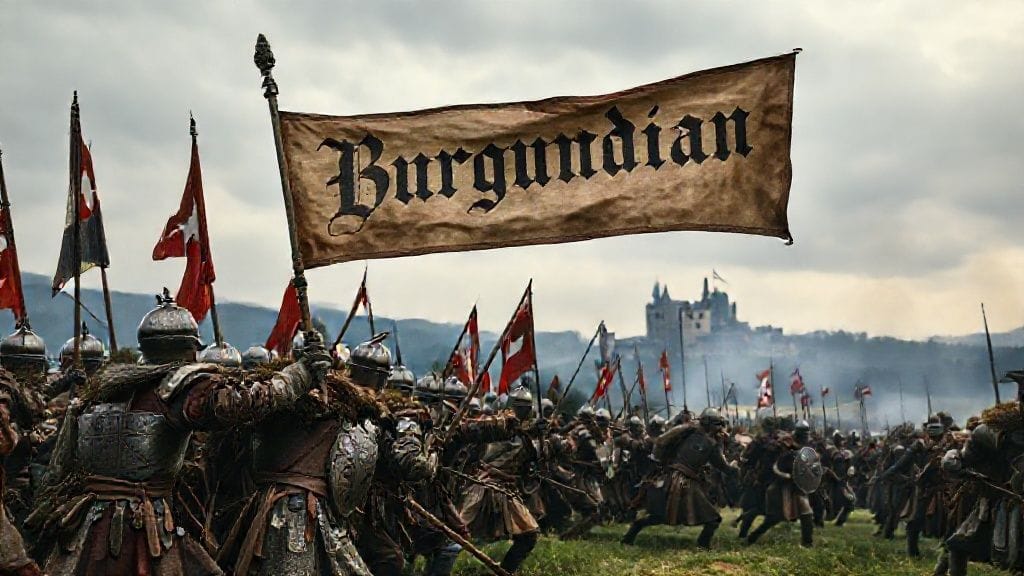
March 2, 1476. The air was cold, the ground muddy from relentless rain, and the distant clangor of armor was nearly drowned by the murmurs of anxious soldiers. Across the rolling hills near the small town of Grandson, a destiny was about to be cruelly rewritten. The looming confrontation between Charles the Bold, Duke of Burgundy, and the resilient Swiss Confederacy was not just a clash of armies but a contest of wills, cultures, and emerging power dynamics. The dull gleam of banners flickered under an overcast sky as thousands braced for the inevitable, unaware that what was about to unfold would echo through centuries as a turning point in European history.
Power Struggles in Late Medieval Europe
The late fifteenth century was an era marked by shifting power balances. The Holy Roman Empire, sprawling and fragmented, was a patchwork quilt of duchies, counties, bishoprics, and free cities, held loosely together by an elective emperor with limited central authority. Within this mosaic, Burgundy emerged as a formidable territorial power. Its wealthy duchy, stretching from the Low Countries to the fringes of modern-day eastern France and Switzerland, was a jewel coveted by monarchs and princes alike.
But Burgundy’s ascent was not uncontested. The Swiss Confederacy, a patchwork of mountain cantons united by an uncommon spirit of independence and communal governance, was gaining strength. No longer mere mountain peasants, the Swiss had shown remarkable military prowess in previous conflicts, earning respect and fear beyond the Alpine passes. Tensions had simmered for years, with Burgundian ambitions threatening to engulf these mountain republics.
The Ambitions of Charles the Bold
Charles the Bold was a man both shaped by and shaping his times. Ambitious, impetuous, and determined, he dreamt of elevating Burgundy to a kingdom, carving a state independent of the Holy Roman Emperor and rival kings. Yet, his path was fraught with peril: while expanding his holdings, he increasingly found himself at odds with the Swiss, whose obstructive resistance challenged his eastern ambitions.
For Charles, the conflict was personal and political. He saw the Swiss as obstinate obstacles to his vision of a grand Burgundian state stretching across key economic crossroads of Europe, controlling vital trade routes and strategic territories. Yet, underestimated he did the indomitable spirit of the mountain cantons, a crucial miscalculation that would soon unravel his dreams.
The Swiss Confederacy: A Rising Power
The Swiss Confederacy—a constellation of autonomous cantons such as Uri, Schwyz, and Unterwalden—had evolved from a defensive pact into a coherent political and military entity. Their success relied not on sheer numbers but on disciplined infantry, clever use of terrain, and a unique system of communal decision-making that fostered unity and resilience.
Their armies, largely composed of participating citizen-soldiers, wielded pikes and halberds with deadly effect, countering the heavily armored knights favored across Europe. By 1476, the Swiss were no longer regional players but a growing force demanding respect and space on the European stage.
March 2, 1476: The Battle of Grandson – A Shattering Defeat
The battlefield near Grandson was deceptively serene as dawn broke. Charles’ forces numbered approximately 20,000, a formidable army of armored knights, mercenaries, and foot soldiers. Opposite them, the Swiss arrayed fewer men but brimming with steely resolve.
The battle itself was swift and brutal. Charles' troops, confident in their superior numbers and heavy cavalry, underestimated the Swiss defensive formations. The Swiss pike squares, meticulously disciplined, held firm and began to push back the Burgundian cavalry. Following intense skirmishes and a collapse of morale, the Burgundian army disintegrated, abandoning artillery pieces, banners, and treasure, including the famed Grandson Treasure—a hoard of gold and jewels taken as spoils across Europe.
The defeat was humiliating and unexpected. Charles, stunned, watched as his troops fled or surrendered, the “Invincible” Duke reduced to a man scrambling for survival.
The Aftermath of Grandson: Panic and Resolve
The loss at Grandson sent shockwaves through Burgundy and the European aristocracy. More than a military defeat, it was a symbolic blow. Charles had been made a spectacle, his prestige momentarily shattered.
But far from conceding, both sides prepared for a larger reckoning. The Swiss joie de vivre was tempered by solemn acknowledgment of the war’s high cost. Burgundy, fueled by wounded pride and determination, marshaled reinforcements, vowing to crush the confederacy’s defiance.
The Gathering Storm: Preparations for Morat
As late spring turned towards summer, both armies rearmed and regrouped. The Burgundians fortified positions near the town of Morat (Murten), intending to use its strategic location to pivot further into Swiss territory. The Swiss, conversely, marshaled their forces with increasing coordination, aware that victory or defeat here would define their future.
Charles drafted elaborate battle plans, bolstered by fresh mercenaries and artillery. The Swiss relied on their veterans from Grandson, united by a common purpose, ready to defend their homes and liberties with fierce determination.
June 22, 1476: The Battle of Morat – Retribution and Triumph
The Battle of Morat is remembered as a dazzling chapter in Swiss military history, a testament to resolve overcoming adversity. Early dawn saw both armies arrayed on the plains and hills surrounding Morat.
Charles’ army, again superior in armor and numbers, launched aggressive assaults. However, the Swiss troops utilized the landscape expertly, drawing the attackers into deadly pike formations and well-timed counterattacks.
Hours of ferocious fighting ensued. The Burgundian knights, hampered by terrain and the Swiss infantry’s discipline, suffered massive casualties. The battle culminated in a decisive rout, with thousands of Burgundian soldiers killed or captured.
Charles himself narrowly escaped, his dreams of regional dominion irrevocably shattered.
Weaponry and Tactics: Innovation on the Battlefield
What set the Swiss apart were not just courage but a clear evolution in medieval warfare. The dominance of chivalric heavy cavalry was being challenged by foot soldiers wielding long pikes, halberds, and learning to coordinate tight formations impervious to traditional charges. The Swiss perfected the phalanx-like “Gewalthaufen,” a formidable wall of spears that could hold and break cavalry.
Furthermore, the Swiss made effective use of crossbows and early firearms, disrupting enemy ranks before melee ensued. Their intimate knowledge of their mountainous terrain allowed them tactical advantages unseen in Burgundian traditionalism.
The Human Face of War: Stories from the Frontlines
Beyond armies and leaders, these battles were made of countless individual stories—of fear, bravery, despair, and hope. Swiss farmers-turned-soldiers fought alongside seasoned veterans. Many Burgundian mercenaries, drawn from various European regions, were caught in this maelstrom far from home.
One legendary anecdote tells of Rudolf von Erlach, the Swiss commander who skillfully orchestrated defense maneuvers, lauded by contemporaries as a hero whose calm leadership turned the tides.
The civilians of towns like Grandson and Morat suffered displacement and devastation, their lives caught between the thrusts of ambition and survival.
The Role of Mercenaries and the Art of Medieval Warfare
Mercenaries played a pivotal role in these conflicts, particularly on the Burgundian side. Charles relied on professional soldiers-for-hire, skilled but often mercurial in loyalty. This reliance highlighted the changing nature of warfare—no longer purely feudal levies but increasingly professional armies with diverse recruitment.
However, this shift sometimes led to coordination problems and morale issues, particularly when confronted with unusual tactics like those deployed by the Swiss.
Political Ripples: Burgundy’s Waning Influence
The defeats at Grandson and Morat marked the beginning of Burgundy’s decline as a dominant regional power. The crushing military setbacks weakened Charles the Bold's position both at home and abroad, eroding his resources and alliances.
Eventually, his death at the Battle of Nancy in 1477 sealed the fate of Burgundy's independence, as neighboring powers absorbed its territories.
The Swiss Confederacy’s Rise to Prominence
For the Swiss, these wars solidified a confident identity and enhanced their reputation across Europe. The victories were not just military but symbolic affirmations of their communal ethos and desire for self-determination.
In the years that followed, the confederacy expanded its influence and established itself as a crucial player in European diplomacy and warfare.
Cultural Reflections: Songs, Poems, and Chronicles
The Burgundian Wars inspired a wealth of cultural production. Chronicles written by Swiss historians celebrated the heroes and martyrs of the fights. Ballads and oral traditions carried tales of battles and personal valor across generations.
Meanwhile, Burgundian poets lamented their losses, painting Charles the Bold as a tragic figure whose hubris precipitated downfall.
The Burgundian Wars in European Memory
These battles entered the European collective imagination as emblematic of changing warfare and political order. They were studied by military strategists and remembered in civic ceremonies. The Swiss victory over a powerful duke was a beacon of hope for smaller states asserting their sovereignty.
Shifting Alliances and the Larger Political Chessboard
The Burgundian Wars influenced alliances beyond the battlefield. The French crown saw opportunities in Burgundy’s weakening, and the Holy Roman Empire revised its strategies toward the increasingly powerful Swiss.
Countries like England, the Italian city-states, and the Habsburgs watched keenly, recalibrating their diplomatic plays in this volatile theatre.
Economic Consequences for Burgundy and the Alpine Regions
The loss of manpower, artillery, and wealth, especially the famous Grandson Treasure, strained Burgundy’s finances. Trade disruptions and ruined towns compounded the economic toll.
Conversely, the Swiss economy, though stressed by ongoing wars, benefited from enhanced control of trade routes and increased respect from European powers.
The Legacy of Charles the Bold’s Ambitions
Charles the Bold remains a paradoxical figure—a visionary duke undone by overreach. His dream of an independent Burgundy failed, yet he accelerated transformations in warfare, diplomacy, and statecraft that shaped late medieval Europe.
War and Identity: Crafting the Swiss Mythos
Perhaps the most lasting outcome was how these wars helped shape Swiss national identity. The stories of united cantons standing firm against a mighty duke forged a narrative of independence and courage that echoed through centuries.
Conclusion: When Small States Redefined Power
The Battles of Grandson and Morat were far more than fights for territory—they were transformative moments that redrew political maps and challenged long-standing hierarchies. Against all odds, the small but determined Swiss Confederacy reshaped the landscape of medieval Europe, demonstrating that discipline, unity, and innovation could topple even the most formidable foes.
History remembers these battles not just for their tactical details but for the human spirit they showcased—a testament to resilience against ambition, and a reminder that in the tides of power, the unexpected can always prevail.
FAQs
1. What triggered the Burgundian Wars?
The wars arose from the escalating territorial ambitions of Charles the Bold, Duke of Burgundy, who aimed to expand his influence into Swiss territories controlled by the confederacy, undermining their autonomy.
2. Who were the main combatants?
The primary parties were the Duchy of Burgundy, led by Charles the Bold, and the Swiss Confederacy, a coalition of independent cantons united by shared defense and political interests.
3. Why are the Battles of Grandson and Morat significant?
These battles marked critical defeats for Burgundy, highlighting the effectiveness of Swiss infantry tactics, and signaling a shift in medieval warfare away from heavy cavalry dominance.
4. What military tactics did the Swiss use to win?
The Swiss employed tight infantry formations armed with pikes and halberds, strong use of terrain, and coordinated defensive maneuvers that neutralized the Burgundian cavalry advantage.
5. What happened to Charles the Bold after these defeats?
Though initially escaping, Charles’s position was severely weakened, leading to his death at the Battle of Nancy later in 1477 and the eventual absorption of his territories by neighboring powers.
6. How did these battles affect the Swiss Confederacy?
They solidified the Swiss as a rising military and political power, boosting their confidence, expanding their territory, and fostering a distinct national identity.
7. Were mercenaries important in these battles?
Yes, particularly on the Burgundian side, mercenaries made up a significant portion of the forces, reflecting broader changes in medieval military recruitment.
8. How are these battles remembered today?
They remain iconic in Swiss history as moments of national pride and resilience, studied for their military innovations and lasting impact on European geopolitics.

