Table of Contents
- The Frigid Dawn of January 5, 1477: A Fateful Moment in Nancy
- Charles the Bold: Ambitions of a Duke and the Burden of Legacy
- Lorraine on the Brink: Geopolitical Crossroads in 15th Century Europe
- The Seeds of Conflict: Rivalries and Alliances Shaping the Battle
- The Marquis de Vaudémont and René II: The Unlikely Defenders of Nancy
- Prelude to Battle: Military Preparations Amidst a Harsh Winter
- January 5, 1477: The Clash That Shook the Duchy of Burgundy
- Tactics, Terrain, and the Turning Tide of Battle
- Death of a Duke: The End of Charles the Bold’s Reign
- The Aftermath in Nancy: Flames, Losses, and Shifting Power
- The Fall of Burgundy: Political Reverberations Across Europe
- A New Lorraine: René II’s Rise and the Restoration of the Duchy
- The French Crown’s Gains: The Path Towards Territorial Expansion
- Burgundy’s Legacy: A Duchy Dismantled but Not Forgotten
- The Battle’s Cultural Echo: Memory, Myth, and Identity in Lorraine
- Charles the Bold in Retrospect: Hero, Villain, or Tragic Figure?
- The Role of Mercenaries and the Changing Face of Medieval Warfare
- Women and Civilians: The Unsung Victims of the Battle
- Artifacts and Chronicles: How History Preserved the Battle of Nancy
- The Battle of Nancy in Modern Historiography and Popular Culture
- Conclusion: The Last Stand That Redrew Europe’s Map
- FAQs
- External Resource
- Internal Link
The Frigid Dawn of January 5, 1477: A Fateful Moment in Nancy
The cold gnawed at the bones of those who stood poised outside Nancy’s city walls on the bitter morning of January 5, 1477. Soldiers, noblemen, and townsfolk alike felt the icy wind not only on their skin but in their hearts, as the uncertain specter of war loomed large. The snow underfoot muffled the sounds of armored men preparing to face the inevitable—a fierce battle that would seal the fate of a powerful duke and alter the course of European history. As the frosty air shimmered with tension, there was no doubt this day would be remembered far beyond the borders of Lorraine.
Charles the Bold, the mighty Duke of Burgundy, had come to Nancy to reclaim his lost authority, but he found himself faced with forces of unexpected resolve. Opposing him were those loyal to René II of Lorraine, determined to defend their homeland from Burgundian rule. The clash that followed was brutal, swift, and catastrophic. It was a moment of destiny, where dreams clashed with harsh realities, ambitions met determination, and where a dying duke’s last gasp changed the map of Europe forever.
Yet, this was no mere military engagement; it was the fulcrum on which the power of a duchy turned, the eruption of long-simmering rivalries, and a mirror reflecting the turbulent tapestry of fifteenth-century politics and warfare. The Battle of Nancy was not just about armies—it was about legacies, identities, and the fragile nature of power itself.
Charles the Bold: Ambitions of a Duke and the Burden of Legacy
Born in 1433 as Charles the Bold, son of Philip the Good, Duke of Burgundy, and Isabella of Portugal, Charles inherited ambitions as vast as the territories over which he sought dominion. Burgundy was a patchwork of lands—Flanders, Artois, Brabant, and parts of today’s eastern France and western Germany—offering a rich and strategic domain. But Charles dreamed of forging a kingdom that could challenge France and the Holy Roman Empire alike, transforming Burgundy from a wealthy duchy into a sovereign power.
Yet, this vision was fraught with tension and contradiction. While he styled himself a feudal monarch, his territories owed allegiance to overlords scattered across Europe. His relentless drive for expansion and consolidation led him into frequent conflicts, alienating allies and stoking the fires of enmity. Underneath his armor and bold expression lay a man burdened by the weight of expectation—the son who would restore Burgundy’s grandeur, but also the duke unyielding to compromise.
Charles’s policies and campaigns from the 1460s surged and stumbled—a kingdom that never fully was, yet always on the brink. His siege of Neuss, wars against the Swiss Confederacy, and attempts to dominate interior Lorraine showed both terror and resolve. By 1477, however, Charles had stretched himself thin, with enemies surrounding him and loyalty uncertain. His fatal venture into Nancy would be the culmination, or the collapse, of decades of vision and strife.
Lorraine on the Brink: Geopolitical Crossroads in 15th Century Europe
Nestled between the Kingdom of France and the Holy Roman Empire, the region of Lorraine held enormous strategic significance. In the 15th century, it was a crossroads of competing influences—French, Burgundian, imperial German—and its cities and lords were often pawns and players in wider dramas.
Nancy, the duchy’s capital, was a city of culture and commerce, aware of its precarious position amid these titanic rivalries. Its duke, René II, found himself defending not just his own lands, but a claim to autonomy amid encroaching powers. Lorraine was fragmented, allegiances fluid, and the populace wary of the shadow of Burgundy’s growing might.
The clash at Nancy was thus about sovereignty as much as survival. Would Lorraine retain its relative independence, or would it be absorbed into the Burgundian dream, an appendage to a larger polity? This question made the battlefield a crucible of regional identity, where local pride converged with global forces.
The Seeds of Conflict: Rivalries and Alliances Shaping the Battle
The origins of the battle can be traced through delicate threads of political intrigue and familial claims. The Duke of Burgundy’s ambition met the resistance of the combined forces of René II of Lorraine and the Marquis de Vaudémont—his cousin, who had his own designs on Lorraine’s throne.
Tensions exploded following Charles’s failed campaign to exert direct control over Nancy. His siege and occupation attempts alienated local nobles while rallying those loyal to René II. The fractured loyalties of Lorraine’s nobility—some siding with Burgundy out of fear or calculation, others with René seeking liberation—set the stage for a cataclysmic confrontation.
Beyond local disputes, the wider European chessboard was in motion. The French king, Louis XI, saw in Charles’s potential downfall a priceless opportunity to reclaim lands and weaken Burgundy. Meanwhile, the Swiss Confederacy, with which Charles had clashed repeatedly, watched closely, poised to exploit any Burgundian setback.
Thus, the Battle of Nancy was not isolated—but a convergence of personal rivalries, territorial ambitions, and the ambitions of kings and emperors alike.
The Marquis de Vaudémont and René II: The Unlikely Defenders of Nancy
René II, Duke of Lorraine, was a determined leader with deep roots in the region but a cautious supporter among his nobles. His decisive alliance with his cousin Frederick, Marquis de Vaudémont, forged a broken but resilient front against Charles’s invasion.
Despite internal divisions, René marshaled an army composed of loyal Lorrainers, Vaudémont’s forces, and allies from the Holy Roman Empire keen on limiting Burgundy’s expansion. His leadership demonstrated both political acumen and a willingness to rally disparate groups under a common cause.
This alliance was a testament to the complexity of medieval loyalties—family ties intertwined with political expediency. Together, they represented the hope of Lorraine’s continued independence and the bulwark against the duke’s dreams.
Prelude to Battle: Military Preparations Amidst a Harsh Winter
As the first days of January 1477 turned bitter, both forces prepared with grim determination. Charles the Bold’s army was experienced, battle-hardened, and equipped with the era’s most advanced steel and artillery. Yet, they were depleted after months of campaigning and suffering the biting cold.
René II’s forces, though fewer in number, were motivated and intimately familiar with the terrain surrounding Nancy. The city’s fortifications provided a defensive edge, while the rolling hills and forests nearby offered opportunities for ambush and maneuver.
Winter’s grip made movement perilous, supplies scarce, and morale fragile. Yet both sides understood the urgency—the battle had to be resolved swiftly before fatigue, famine, and thaw would sap their strength. The stage was set for an encounter where leadership, resilience, and fortune would decide the day.
January 5, 1477: The Clash That Shook the Duchy of Burgundy
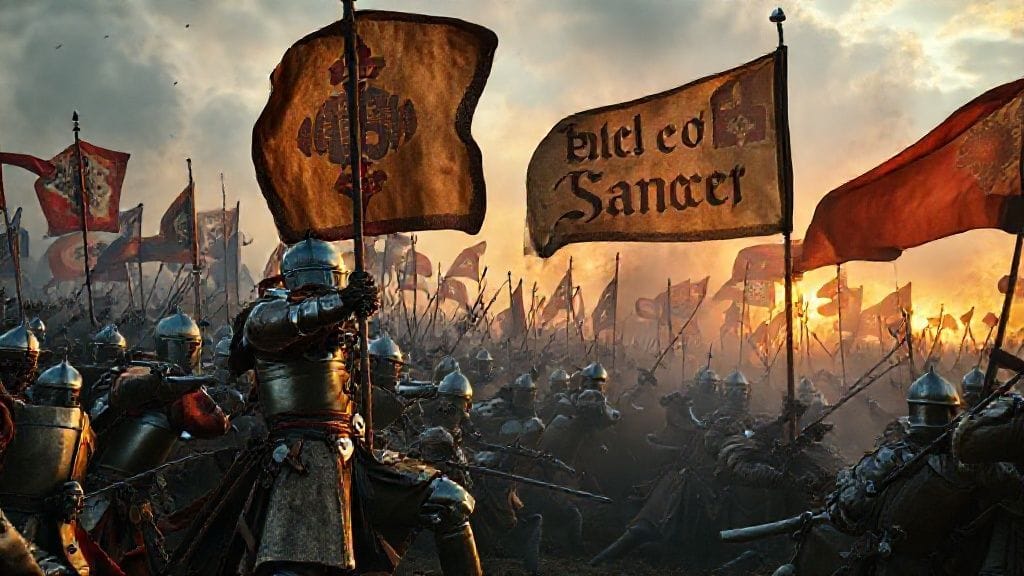
The morning fog lifted reluctantly over the rolling hills outside Nancy. The two armies faced each other, line against line, steel gleaming under pale sunlight filtered through winter clouds. The sound of drums beating a steady rhythm mingled with whispered prayers and the creak of armor.
Charles the Bold, towering in his red armor, was visible to all—a symbol of unstoppable force, or so his soldiers hoped. René and Vaudémont, modestly armored but resolute, awaited the charge. The silence fractured as the first arrows were loosed, the clash of swords thundered, and the ground trembled under the weight of foot soldiers and cavalry alike.
The battle was savage and chaotic. Charles sought to break the defenders quickly with cavalry charges and artillery bombardments. But Lorraine’s forces held firm, using the landscape’s natural defenses and quick counterattacks to stem the Burgundian tide.
Hours passed in a blur of violence, cries of pain, and banners torn. Then, in a turning moment, René’s troops pressed the advantage, exploiting a flank weakened by overextension. The Burgundian ranks faltered, confusion spreading. The duke himself fought bravely to rally his men but found himself isolated amidst the melee.
Tactics, Terrain, and the Turning Tide of Battle
The battle’s ebb and flow hinged on choices made in moments of heat and horror. The thick woods and rolling terrain around Nancy choked the effectiveness of Burgundian heavy cavalry, blunting the shock attacks that had brought Charles victories before.
René’s commanders executed a cunning encirclement, squeezing the Burgundian forces into a tightening noose. Ambushes sprung from wooded cover fragmented the enemy lines, while fortified positions in and around the city offered refuge and a rallying point.
Importantly, Burgundian artillery, formidable in open field battles, was less effective against a mobile and entrenched foe. The tactical mixture of persistence, knowledge of land, and improvisation wore down Charles’s forces.
The final blow came during a desperate cavalry charge when Charles was reportedly unhorsed and killed—his death sending shockwaves through his army, which soon disintegrated.
Death of a Duke: The End of Charles the Bold’s Reign
Charles the Bold’s death was as dramatic as it was decisive. Contemporary chroniclers describe his last stand with a mix of awe and pathos: a figure larger than life, falling amidst the smoke and slaughter, his red armor stained with blood.
His body was later retrieved from the battlefield but never buried in Burgundy—as political tides turned and his dynasty crumbled. Charles’s death symbolized the shattering of Burgundian aspirations; with no male heir to succeed him, his vast lands became a prize for neighboring powers.
The castle gates of Burgundy’s fortress fell silent, and the dreams of a Burgundian kingdom faded into history. Behind this loss lay not just military defeat, but the collapse of a vision held for decades—a poignant end for a man as grand as his ambitions.
The Aftermath in Nancy: Flames, Losses, and Shifting Power
Victory was costly. The city of Nancy mourned its dead and tended its wounded. Its streets bore the scars of battle and siege, as fires had ravaged sections and despair lingered in the eyes of survivors.
René II moved quickly to consolidate his power, offering clemency to collaborators, reorganizing defenses, and seeking to rebuild the shattered duchy. The victory sparked celebrations, but also an acute awareness of new threats amid Europe’s tumult.
The old order was broken, replaced by a fragile peace precariously balanced in the cold January air.
The Fall of Burgundy: Political Reverberations Across Europe
Charles’s demise at Nancy precipitated a political earthquake. The vast Burgundian territories, long a challenge to French and imperial dominance, were suddenly vulnerable.
The King of France, Louis XI, moved swiftly to claim key Burgundian lands, particularly in Picardy and Flanders, while the Holy Roman Empire eyed the eastern territories. Marriages and treaties followed, redrawing borders and realigning allegiances.
Burgundy as a unified entity ceased to exist—fragmented and absorbed, its former glory dissipated. Europe witnessed a realignment that would shape the coming centuries, from the Renaissance to the early modern state system.
A New Lorraine: René II’s Rise and the Restoration of the Duchy
For Lorraine, the battle marked a turning point. René II emerged not just as a military victor but as a legitimate and unchallenged duke. His victory restored dignity and autonomy to the duchy, securing its place as a recognized player amid the great powers.
While challenges remained, he navigated carefully between French and imperial interests—often playing one against the other to safeguard Lorraine’s independence. His legacy would be remembered as the founder of a revived duchy, standing resilient against the tides of conquest.
The French Crown’s Gains: The Path Towards Territorial Expansion
Louis XI may have been dubbed the "Universal Spider" for his cunning, but his moves post-Nancy revealed the monarch’s strategic patience and opportunism. With Burgundy weakened, he annexed key territories, centralizing French royal power.
These acquisitions accelerated France’s territorial expansion and paved the way for the development of a more cohesive kingdom. They were early steps in the centralization efforts that would culminate centuries later in the absolute monarchy.
Nancy’s battle was a catalyst, not just for lost Burgundian dreams but for the rise of France as a dominant European state.
Burgundy’s Legacy: A Duchy Dismantled but Not Forgotten
Though politically dissolved, Burgundy’s cultural and symbolic legacy persisted. The duchy had been a beacon of art, chivalry, and medieval magnificence. Its court attracted luminaries, patrons of the arts, and warriors of renown.
The fall at Nancy did not erase this heritage. Instead, it inspired romantic legends, poems, and artistic works celebrating Charles the Bold’s tragic grandeur and the era’s chivalric ideals.
Burgundy survived in memory—an emblem of medieval ambition, beauty, and tragic downfall.
The Battle’s Cultural Echo: Memory, Myth, and Identity in Lorraine
For Lorraine, the Battle of Nancy became more than history; it became identity. Commemorated in monuments, local lore, and annual remembrances, the victory nurtured pride and a sense of resilience.
Folklore imbued the battle with mythic dimensions—tales of heroism, sacrifice, and divine favor that transcended historical facts. It became a source of cohesion for a region often caught between larger powers.
Through centuries, the battle was retold as a symbol of resistance—not just military but cultural—shaping Lorraine’s self-perception.
Charles the Bold in Retrospect: Hero, Villain, or Tragic Figure?
Historians have debated Charles’s character endlessly. Was he a visionary forging a new kingdom or a reckless adventurer blinded by pride? A victim of his own ambition or a tyrant undone by his failures?
Contemporary observers often viewed him with awe and fear; modern scholarship tries to balance his complex legacy. His death at Nancy is seen as both a personal tragedy and a turning point in European power struggles.
His story resonates as a cautionary tale about the limits of ambition—and the human cost of power.
The Role of Mercenaries and the Changing Face of Medieval Warfare
The Battle of Nancy highlights shifts in military practice. Both sides employed mercenaries—professional soldiers whose loyalty was to pay rather than cause. The increasing use of artillery and evolving battlefield tactics marked the transition from medieval to early modern warfare.
These changes reflected broader societal transformations—where loyalty, technology, and economics intersected to alter how wars were fought and won.
Nancy thus stands as a pivotal moment in military history, capturing the twilight of knightly warfare and dawn of new techniques.
Women and Civilians: The Unsung Victims of the Battle
Amidst the grand narratives of dukes and generals, the stories of ordinary people often fade. The siege and battle brought suffering to Nancy’s civilian population—displacement, hunger, and death.
Women played vital roles, from organizing defenses to nursing wounded men, sustaining morale and managing scarce resources. Their resilience underpinned the survival of the city and its community.
Remembering their experiences adds depth to the human cost and communal strength from which history is woven.
Artifacts and Chronicles: How History Preserved the Battle of Nancy
The memory of the battle survives not only in books but in material culture. Weapons, armor, and documents recovered later provide tangible links to the struggle.
Chroniclers such as Philippe de Commynes offer vivid accounts that capture the battle’s drama, while local records trace its impact on the city and duchy.
Museums, archives, and monuments keep alive the tangible and narrative heritage of this defining moment, allowing future generations to engage with the past viscerally and intellectually.
The Battle of Nancy in Modern Historiography and Popular Culture
Today, historians revisit the battle through new perspectives, emphasizing social, cultural, and psychological dimensions. Trends in scholarship explore identity construction, myth-making, and regional history.
The battle appears in novels, films, and reenactments, captivating audiences with its blend of drama and historical significance. It embodies the enduring fascination with moments when the tides of history turn on single battlefields.
Nancy remains a beacon for those who seek to understand how history is lived and remembered.
Conclusion: The Last Stand That Redrew Europe’s Map
The Battle of Nancy was more than a clash of armies on a frozen January day; it was a crucible where ambition, loyalty, and identity collided with profound consequences. The death of Charles the Bold ended an era of Burgundian grandeur and unleashed forces that reshaped the political map of Europe.
Lorraine’s survival and France’s rise were direct legacies of that icy battlefield where men fought not only for territory but for the fate of their homelands. The echoes of Nancy resonate across time—not as a mere military encounter but as a human story of aspiration, loss, and resilience.
Remembering this battle calls us to reflect on the fragile nature of power and the enduring spirit of those who stand to defend their land and legacy against overwhelming odds. In the snow and mud of Nancy’s fields, history was written—not just with swords, but with the hopes and hearts of generations.
FAQs
Q1: What were the main causes leading to the Battle of Nancy?
A1: The battle stemmed from longstanding Burgundian territorial ambitions under Charles the Bold, conflicts over Lorraine’s sovereignty, rivalries among local nobility including Rene II and Marquis de Vaudémont, and broader European power struggles involving France and the Holy Roman Empire.
Q2: Who was Charles the Bold, and why was his death significant?
A2: Charles was the Duke of Burgundy, known for his grand ambitions to create a kingdom independent from France and the Empire. His death at Nancy ended Burgundian expansion and led to the fragmentation of his territories, profoundly altering European politics.
Q3: How did Lorraine manage to resist Burgundy successfully?
A3: Lorraine’s defense was bolstered by strong alliances between René II and local nobles like Vaudémont, utilizing their intimate knowledge of the terrain, effective tactics, and timely coalition-building—including support from imperial forces.
Q4: What were the immediate consequences of the battle for Burgundy and France?
A4: Burgundy lost unity and territorial control. France’s King Louis XI capitalized on this to annex much of Burgundy’s lands, strengthening French territorial integrity and weakening a long-standing rival significantly.
Q5: How is the Battle of Nancy remembered in local and European history?
A5: Locally, it is a symbol of resistance and resilience for Lorraine, celebrated in folklore and commemorations. More broadly, it is recognized as a pivotal event marking the end of medieval Burgundian power and shifts in European political landscapes.
Q6: Did the battle influence changes in medieval warfare?
A6: Yes, the Battle of Nancy illustrates the increasing use of artillery, mercenaries, and more sophisticated battlefield tactics, reflecting the transition from medieval to early modern warfare.
Q7: What role did civilians and women play during the battle?
A7: Civilians, especially women, were crucial in maintaining city defenses, caring for wounded soldiers, and managing resources during the siege and aftermath, embodying the often overlooked human resilience amid conflict.
Q8: Where can I learn more about the Battle of Nancy?
A8: Comprehensive information can be found on the Wikipedia page dedicated to the Battle of Nancy, which provides detailed historical context, accounts, and references.

