Table of Contents
- The Final Sunrise: Tutankhamun’s Last Day in Thebes
- Egypt in the Afterglow of Empire: Setting the Historical Scene
- A Boy King’s Rise: Tutankhamun’s Path to the Throne
- The Pharaoh’s Court: Politics, Religion, and Power in 14th Century BCE Egypt
- The Shadow of Akhenaten: Religious Upheaval and Artistic Rebellion
- Life in Thebes: The Vibrant Capital on the Nile's Edge
- The Mysterious Death: Unraveling the Enigma of Tutankhamun’s Demise
- Archaeological Discovery Centuries Later: Howard Carter’s Moment of Glory
- The Valley of the Kings: A Kingdom of Silence and Secrets
- The Burial Chamber: A Testament to Royal Splendor and Sudden Loss
- Tutankhamun’s Death: Political Reverberations in Ancient Egypt
- Scattered Clues: Forensic Studies and Scientific Investigations
- Myth and Memory: Tutankhamun in Egyptian and Western Imagination
- Egyptology’s Golden Boy: The Impact of the Discovery on Global Culture
- The Curse and the Controversies: Legend Versus Reality
- The Legacy of a Forgotten Monarch: Reassessing Tutankhamun’s Role
- Thebes Transformed: Continuities and Changes After the Boy King’s Death
- Artifacts and Artistry: The Symbolism of Tutankhamun’s Tomb Treasures
- The Death of a Pharaoh and the Eternal Nile: Spiritual Interpretations
- Modern Reflections: What Tutankhamun Teaches Us About Mortality and Power
- Conclusion: Echoes Across Millennia — The Enduring Mystery of Tutankhamun
- FAQs
- External Resource
- Internal Link
From dawn’s first light over the ancient city of Thebes, shadows stretched long across the golden sands as the Nile whispered its eternal song. In the heart of Egypt, where pharaohs ruled as gods, the last breath of one boy king was about to slip away—his death destined to resonate through the ages. It was the year 1323 BCE, and Tutankhamun, the young ruler scarcely into his teens, was laying down his royal diadem for the final time.
The Final Sunrise: Tutankhamun’s Last Day in Thebes
Imagine the soaring limestone cliffs of Thebes etched by the rising sun, casting a warm glow over the sprawling temples dedicated to mighty gods like Amun and Osiris. The city buzzed with the rituals of everyday life—the rich scent of incense, priests chanting ancient hymns, and artisans hammering away at statues and jewelry. Somewhere within the palace walls, a frail boy with the weight of the divine crown was slipping from youth into death.
Tutankhamun’s final hours remain shrouded in mystery—but the very environment that nurtured him was marked by recovery and transition. Egypt was still rising from the seismic religious revolution instigated by his father or predecessor, Akhenaten. To many, Tutankhamun was a symbol of restoration, a beacon attempting to mend the fragile unity of kingdom and faith. Yet, his demise struck like lightning—young, sudden, and unexpected.
Egypt in the Afterglow of Empire: Setting the Historical Scene
By the mid-14th century BCE, Egypt was a sun-drenched empire at the height of its New Kingdom glory. Great pharaohs had expanded borders, built colossal monuments, and cemented their divine authority through religion and military dominance. Yet beneath this grandeur, winds of change had stirred deep unrest.
Akhenaten, often seen as Tutankhamun’s father or predecessor, had shaken the very foundations of Egyptian spirituality by introducing Aten, a sun-disk god, as the sole deity in a dramatic monotheistic shift. This religious revolution fractured traditional priesthoods and alienated powerful factions within the city and the kingdom. Tutankhamun ascended the throne as a child in this volatile context, with Egypt yearning for a return to its orthodox gods and age-old traditions.
A Boy King’s Rise: Tutankhamun’s Path to the Throne
At roughly nine years old, Tutankhamun did not choose a royal career—it chose him. Installed as pharaoh following Akhenaten’s mysterious decline, his reign was orchestrated by powerful advisors, including the enigmatic vizier Ay and the general Horemheb. His name, meaning “Living Image of Amun,” symbolized Egypt’s deliberate return to age-old deities and repudiation of the Aten cult.
Despite his tender age and limited influence, the boy king’s brief reign was marked by significant religious and political restoration. Temples to Amun reopened, artwork reclaimed traditional motifs, and the capital subtly shifted back to Thebes. Still, Tutankhamun’s health and vitality appear to have been fragile, a fact later research would ominously confirm.
The Pharaoh’s Court: Politics, Religion, and Power in 14th Century BCE Egypt
Life at the royal court was a delicate dance of intrigue and survival. Between shifting alliances, famed officials oversaw administrations, ritual ceremonies fortified the pharaoh’s divinity, and the concept of ma’at—cosmic harmony—governed every aspect of governance.
Tutankhamun's court was no exception. His queen, Ankhesenamun, once his half-sister, stood beside him not only as consort but as a potential political actor in a turbulent time. Advisors like Ay wielded real power behind the scenes, guiding young Tutankhamun’s decisions and securing their own place in Egypt’s history. Yet the fragility of the regime and the shortness of the king’s life hinted at deeper uncertainties beneath the royal veneer.
The Shadow of Akhenaten: Religious Upheaval and Artistic Rebellion
Akhenaten’s reign had been a masterpiece of religious and artistic rebellion. By placing the Aten above all else, he ruptured centuries of tradition. Statues portrayed the royal family with exaggerated features, hips wide and faces distorted—radical departures from standard Egyptian idealism.
Tutankhamun’s era reversed many such elements. Under his aegis, statues and reliefs again reflected conventional Egyptian aesthetics: idealized forms, muscular males, and gracefully poised females. The restoration represented not only the return of the gods but the reclaiming of royal legitimacy after a decade of religious turmoil.
Life in Thebes: The Vibrant Capital on the Nile's Edge
Thebes was ancient Egypt’s jewel—a city of temples, markets, and artisans. Pilgrims streamed to Karnak to worship Amun, and merchants trafficked goods from Nubia to the Mediterranean. It was here that Tutankhamun’s fate would unfold.
The bustling streets contrasted sharply with the somber silence of the royal tombs nestled in the nearby Valley of the Kings. For most residents, life carried on in typical patterns, but for the royal family, each day was a chapter in the drama of survival, faith, and destiny.
The Mysterious Death: Unraveling the Enigma of Tutankhamun’s Demise
Tutankhamun died around age eighteen or nineteen—an age when many would be just stepping into maturity. Yet the cause of his death was veiled in mystery for millennia. Scholars, doctors, and scientists have endlessly debated whether he succumbed to complications of a leg fracture, malaria, genetic disorders from royal incest, or even foul play.
CT scans, X-rays, and DNA analysis in the 21st century revealed fractures, infections, and traces of malaria parasites. Coupled with indications of possible bone diseases and congenital defects, the picture emerges of a fragile young man battling multiple ailments. No clear evidence confirms assassination—yet the drama of a boy pharaoh’s untimely death keeps fascination alive.
Archaeological Discovery Centuries Later: Howard Carter’s Moment of Glory
Fast-forward to November 4, 1922. In the arid desert near Luxor, British archaeologist Howard Carter unearthed one of history’s most spectacular tombs—KV62, the final resting place of Tutankhamun. The discovery electrified the world, revealing incredible treasures and a royal burial remarkably intact despite centuries of grave robbers.
For decades, much of Egyptology revolved around understanding this young king and his treasures, now displayed or preserved in Cairo’s Egyptian Museum. Carter’s obsession with careful excavation set new standards for archaeological practice but also triggered myths of curses and hidden secrets.
The Valley of the Kings: A Kingdom of Silence and Secrets
The Valley of the Kings stretched like a silent necropolis beneath the cliffs of Thebes. For centuries, pharaohs had been buried here in tombs richly adorned with spells, murals, and precious objects intended to secure their passage into the afterlife.
Tutankhamun’s tomb was comparatively small but lavishly decorated. The hurried nature of its construction—possibly due to the sudden death of the boy king—and the stunning preservation of its contents make it an archaeological and historical miracle. Each artifact tells a story, from his gold funerary mask to the chariots and shrines surrounding the sarcophagus.
The Burial Chamber: A Testament to Royal Splendor and Sudden Loss
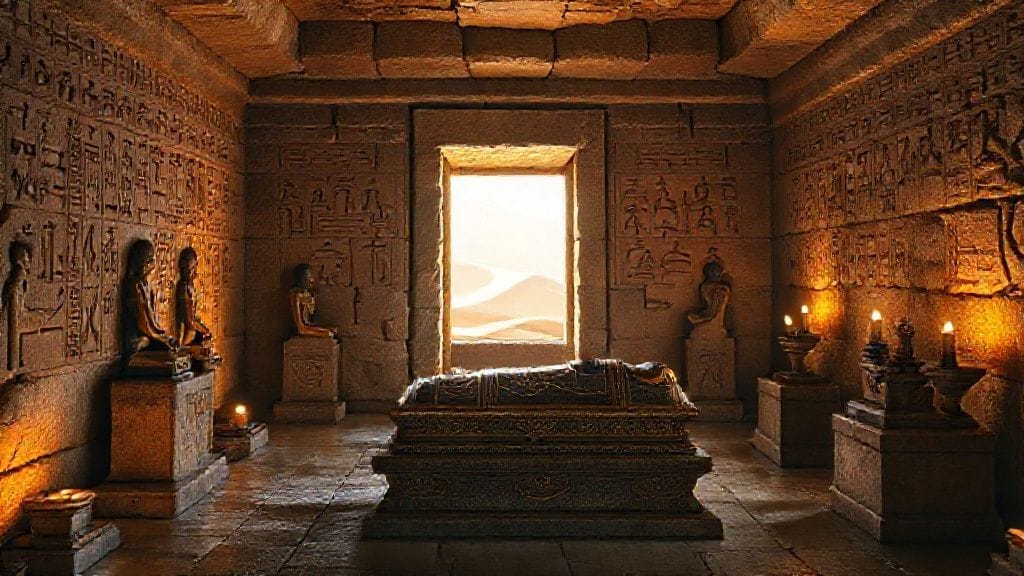
Inside the burial chamber, Tutankhamun’s body lay ensconced in nested coffins of gold and precious stones, surrounded by treasures meant to accompany him in eternity. Yet the tomb’s hurried preparation betrayed the suddenness of death.
The artifacts—objects of daily life, weapons, furniture—depict a young king prepared for the afterlife, offering glimpses into royal ceremonies and beliefs. The chamber encapsulates the contrast of youthful vigor and tragic finality.
Tutankhamun’s Death: Political Reverberations in Ancient Egypt
Though his reign was brief, Tutankhamun’s death opened a new chapter. The political vacuum allowed figures like Ay and Horemheb to ascend the throne. The restoration of the traditional religious order after Akhenaten's revolution persisted, shaped by the alliances and policies emerging in the king’s wake.
His death could have triggered instability, but it instead helped consolidate a return to stability and tradition. These shifts would influence Egypt’s trajectory for decades.
Scattered Clues: Forensic Studies and Scientific Investigations
In the modern age, science has brought new voices to Tutankhamun's story. Advanced imaging and genetic tests have unearthed details of his health including possible clubfoot, malaria infections, and bone necrosis.
Despite speculation, interpretations differ—some see genetic illness caused by royal intermarriage, others emphasize external injury or disease. The forensic tale intertwines medical fact with historical context, deepening the enigma rather than settling it.
Myth and Memory: Tutankhamun in Egyptian and Western Imagination
Before Howard Carter’s discovery, Tutankhamun was a footnote in history. Today, his name echoes worldwide as Egypt’s “boy king.” His legacy has been mythologized—his tomb’s riches conjuring fantasies of curses and treasure hunts.
In Egypt, he is remembered less as a great ruler and more as a symbolic figure who represents ancient Egypt's mystique. Western cultures have often exoticized him, a phenomenon shaped by imperial era fascination and the media frenzy surrounding the tomb’s excavation.
Egyptology’s Golden Boy: The Impact of the Discovery on Global Culture
Tutankhamun’s tomb galvanized the field of Egyptology, igniting public imagination and scholarly inquiry alike. Fashion, films, novels, and exhibitions have kept his image alive for nearly a century.
This fascination reshaped how ancient Egypt was perceived globally—no longer just a civilization of pyramids and pharaohs but a window into humanity’s timeless themes of ambition, youth, mortality, and faith.
The Curse and the Controversies: Legend Versus Reality
The so-called “curse of the pharaohs” was born from the deaths of some who entered Tutankhamun’s tomb soon after its discovery—a tantalizing narrative for popular culture. But historians largely dismiss it as myth.
Such stories reflect a Western fear of ancient powers and the mystique surrounding Egypt’s funerary practices. Scientific analysis attributes early deaths to natural causes, yet the curse endures as folklore embedded in the story’s emotional fabric.
The Legacy of a Forgotten Monarch: Reassessing Tutankhamun’s Role
Though his reign lasted less than a decade, modern scholarship reevaluates Tutankhamun’s political significance. He stands as a figure emblematic of restoration after religious upheaval and youthful vulnerability amid enormous responsibilities.
His brief rule, preserved by fortune and fate, offers a poignant lens on the human dimension of monarchy—where power, illness, and death intertwined with ritual and legacy.
Thebes Transformed: Continuities and Changes After the Boy King’s Death
After Tutankhamun’s passing, Thebes remained Egypt’s religious heartland. The power structures his reign helped restore persisted, but new rulers took the reins firmly, including Horemheb, who would extinguish lingering Amarna (Akhenaten's) ideological threads.
The city continued to flourish, temples expanded, and the Nile’s life-giving waters sustained the civilization’s pulse well into the future.
Artifacts and Artistry: The Symbolism of Tutankhamun’s Tomb Treasures
Each item inside the tomb carries profound symbolism—gold representing eternity, lotus flowers embodying rebirth, and depictions of gods signaling protection into the afterlife.
Craftsmanship hints at artisans’ devotion, royal aspirations, and funerary doctrine. These objects frame not just a young pharaoh’s death, but a civilization’s spiritual and artistic heartbeat.
The Death of a Pharaoh and the Eternal Nile: Spiritual Interpretations
In Egyptian theology, death was merely a transformation. Tutankhamun’s burial was designed to ensure his resurrection, mirroring the sun god’s daily cycle.
The Nile itself was part of this eternal rhythm—death gave way to life renewed. Tutankhamun's death was a passage, a sacred rehearsal of cosmic order and hope beyond mortality.
Modern Reflections: What Tutankhamun Teaches Us About Mortality and Power
Centuries later, Tutankhamun’s story draws us into reflection about youth, vulnerability, and the fragility of power. His brief reign juxtaposed with immense cultural resonance reminds us how history can immortalize even the briefest spark.
The boy king’s life and death invite empathy across millennia—a reminder that behind every crown lies a deeply human story shaped by fate and resilience.
Conclusion
The death of Tutankhamun in Thebes—a seemingly abrupt event in the twilight of Egypt’s storied 18th Dynasty—echoes far beyond the sandy tomb and gilded mask. It encapsulates the delicate dance between power and fragility, the tension of history’s grand transformations and intimate human realities. Though his reign was brief and his passage young, the boy king became a timeless symbol—of restoration amidst upheaval, of mystery wrapped in gold, and of a civilization’s eternal yearning for immortality.
His legacy, revealed millennia later through dust-covered treasures and cutting-edge science, continues to inspire and haunt our collective imagination. In the death of Tutankhamun, we glimpse the inexorable flow of life and the profound human quest to be remembered. The pharaoh’s final breath in Thebes still whispers along the Nile, a silent invocation to the ages: that beneath the masks and monuments, history is always about people—alive, vulnerable, and striving for eternity.
FAQs
1. Who was Tutankhamun and why is he famous?
Tutankhamun was an Egyptian pharaoh of the 18th Dynasty, best known for his young age at death and the discovery of his nearly intact tomb in 1922. His tomb’s treasures offer unparalleled insights into ancient Egyptian culture.
2. What caused Tutankhamun’s death?
While the exact cause is uncertain, modern studies suggest a combination of genetic disorders, a possible leg fracture, and malaria infections contributed to his early death at about 18 years old.
3. How did Tutankhamun’s death impact ancient Egypt politically?
His death facilitated the rise of his successors, notably Ay and later Horemheb, who continued restoring traditional religious and political order after Akhenaten’s upheaval.
4. Why is Thebes significant in Tutankhamun’s story?
Thebes was the religious and political capital of Egypt during Tutankhamun’s reign, serving as the cultural backdrop to his rule and burial.
5. What was unique about Tutankhamun’s tomb?
Unlike most royal tombs, his was found mostly intact, richly filled with artifacts, offering a rare and detailed glimpse into royal funerary practices.
6. What role did Howard Carter play in Tutankhamun’s modern legacy?
British archaeologist Howard Carter discovered Tutankhamun’s tomb in 1922, catapulting the boy king to global fame and transforming Egyptology.
7. Is the “curse of the pharaoh” real?
The curse is a myth popularized after the tomb’s discovery; scientific evidence does not support supernatural claims.
8. How does Tutankhamun’s story resonate today?
His story humanizes ancient history, reminding us of youth, mortality, and the enduring power of cultural memory.