Table of Contents
- The Twilight of an Icon: Sappho’s Final Days on Lesbos
- Ancient Lesbos: A Cradle of Culture and Controversy
- Who Was Sappho? The Poetess of Eros and Myth
- The World Around 570 BCE: Politics, Society, and the Role of Women
- The Lyric Tradition: How Sappho Revolutionized Poetry
- Rumors and Records: Sappho’s Death in Historical and Literary Sources
- The Mystery of the Poet’s Passing: Fact, Fiction, or Legend?
- Lesbos at the Turn of the Sixth Century: A Society in Flux
- Sappho’s Circle: Friends, Admirers, and Other Poets
- The Symbolism of Sappho’s Death: Love, Loss, and the Eternal Muse
- The Legacy of Sappho’s Life and Death in Antiquity
- From Ancient Myth to Modern Icon: How Sappho’s Death Was Reimagined
- The Archaeological Evidence of Sappho’s Time and Place
- Memory and Mythology: Sappho’s Tomb on Lesbos Through History
- Sappho’s Influence on Later Poetry and the Concept of Female Creativity
- The Gendered Lens: Interpretations of Sappho’s Life and Death Over Millennia
- Lesbos Today: Honoring the Poet and Her Enduring Home
- Conclusion: The End of Sappho — An Ambiguous Farewell That Echoes Through Time
- FAQs: Curiosities, Contradictions, and the Last Word on Sappho’s Death
- External Resource
- Internal Link
1. The Twilight of an Icon: Sappho’s Final Days on Lesbos
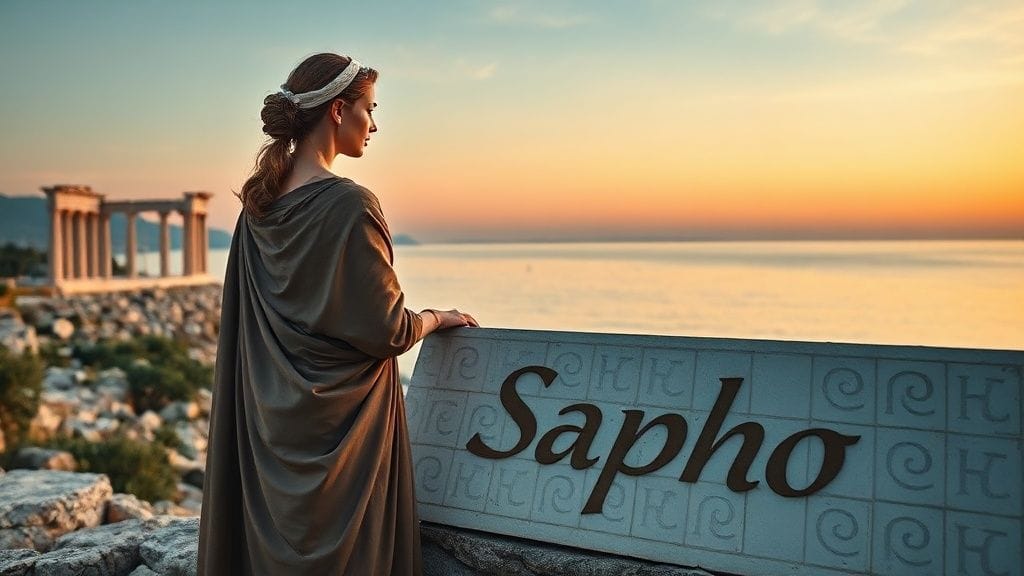
It was on the rugged, olive-scented hills of Lesbos, beneath the endless expanse of the Aegean sky, that Sappho, the revered lyric poetess, met her end. Around 570 BCE, the island bore silent witness to a departure that would ripple through the ages, though faint traces and whispering legends are all that remain of that final moment. Can we imagine the scene? The golden light filtering through laurel groves, friends gathered in quiet grief, perhaps a lyre softly strumming her own verses — the last echo of a voice that once sang so vividly of love, longing, and life’s tender passions.
But, as with much of Sappho’s story, certainty is elusive. The precise circumstances of her death are cloaked in mystery, scattered through fragmented testimonies, later inventions, and an aura of myth that envelops the woman as much as her poetry. This interplay of truth and legend is not a mere accident but highlights the enduring power of Sappho’s life and work — a beacon in the male-dominated world of antiquity.
Yet, what did her passing mean for those who knew her? For the island of Lesbos, known for its blossoming culture and artistic vibrancy, it was a turning point — the loss of a luminous spirit whose creative fire had forever transformed poetic expression. And beyond the local, Sappho’s death has been a fulcrum upon which questions of gender, artistry, and cultural memory balance to this day.
2. Ancient Lesbos: A Cradle of Culture and Controversy
To fully grasp the significance of Sappho’s death, we must first step back and explore Lesbos itself — an island of paradoxes. Situated in the northeastern Aegean Sea, Lesbos was a cultural crossroads, blending Greek traditions with Eastern influences. By the late sixth century BCE, it had established itself as a wealthy polis (city-state), famed for producing not only poets and philosophers but also intricate sculpture, innovative architecture, and a vibrant mercantile economy.
Yet, Lesbos was also a land of social complexities. Its communities upheld aristocratic values, but women — inspired perhaps by figures like Sappho — carved unique spaces for expression and agency, unusual in the wider Greek world. The island’s very name would one day become synonymous with female homoeroticism, though this is a modern interpretation layered over millennia of historical reality.
It’s here, amid thriving vineyards and bustling agora markets, that Sappho’s life unfolded, and where her death resonated — both as a loss and as an enigmatic event amplified by the island’s own cultural tensions.
3. Who Was Sappho? The Poetess of Eros and Myth
Sappho has always defied easy definition. Born into a noble family on Lesbos around 630 BCE, she quickly distinguished herself as a master of lyric poetry — compositions meant to be accompanied by the lyre, intimate, emotional, and personal. She wrote of desire and beauty, friendship and grief, revealing a distinctly female perspective rarely preserved in the ancient records.
Her poetry was renowned in antiquity and remained a touchstone throughout classical and post-classical literary traditions. Though only fragments survive today, they are suffused with an intensity that conveys the power of love in its many forms — a testament to a woman whose voice challenged and enriched the patriarchal literary canon.
By the time of her death, Sappho had become more than a poet. She was a cultural symbol, a figure enveloped not just in artistry but in the very fabric of myth, inspiring admiration, rumor, and sometimes controversy.
4. The World Around 570 BCE: Politics, Society, and the Role of Women
The late 6th century BCE was a time of upheaval across the Greek world. Democratic experiments, tyrannies, and shifting alliances shaped the political landscape. Lesbos, with its wealth from trade and agriculture, experienced its own internal dynamics between aristocratic families and burgeoning middle classes.
Women’s roles were circumscribed but nonetheless vital, especially in religious life, family lineages, and certain artistic circles. Sappho’s prominence as a female poet who led a circle of young women — sometimes characterized as a kind of salon — was remarkable in this context. Her authority as both artist and mentor stands out when many women’s voices were systematically suppressed.
This milieu, vibrant yet precarious, framed her final years — a world where love and politics were often entwined, and where the loss of a cultural figure like Sappho struck not only as personal tragedy but as a social event.
5. The Lyric Tradition: How Sappho Revolutionized Poetry
Sappho belonged to a tradition of lyric poetry rooted in oral performance and musical accompaniment. But she did something unique: moving beyond epic storytelling or grand myths, she plumbed the depths of personal experience, placing female desire and female voices at the core.
Her verses, tender and sharp, presented love not as an abstract ideal but as a raw, immediate force. She shaped language to evoke sensations, from the flutter of a lover’s glance to the sting of separation.
This poetic innovation has been recognized since antiquity, with Aristotle praising her work as both passionate and refined. Through her, lyric poetry became something intimate and accessible, forever altering the literary landscape and ensuring her name’s immortality even as her own life ended quietly on an island steeped in legend.
6. Rumors and Records: Sappho’s Death in Historical and Literary Sources
Despite her prominence, details about Sappho’s death remain frustratingly sparse. Ancient sources — often secondhand and contradictory — offer hints but no clear narrative.
One enduring story, likely apocryphal, claims she died by leaping from the Leucadian cliffs, supposedly for unrequited love of a man named Phaon. This romanticized version appeared centuries later, colored by later notions of passion and tragedy. The historian Plutarch dismisses it as hearsay, yet it has captivated imaginations, becoming a key piece of Sappho’s mythos.
Other accounts simply acknowledge that she died on Lesbos, without specifying how or when. The truth, perhaps deliberately obscured or irretrievably lost, remains elusive — but it hasn’t diminished the impact of her life’s work or the poignancy that has always surrounded her final moments.
7. The Mystery of the Poet’s Passing: Fact, Fiction, or Legend?
Why is Sappho’s death shrouded in such mystery? Partly, it’s a reflection of the fragmentary nature of ancient records, especially for women. Her story — a woman who celebrated female love and emotion — posed uncomfortable questions for later societies, where her sexuality was often censored or transformed into myth.
The cliff-leap tale, likely a later invention, serves a symbolic purpose. It encapsulates the intertwining of creativity, desire, and mortality, a dramatic exit befitting a woman whose poems danced so vividly with such themes.
In reality, Sappho likely died quietly in old age or illness, within the community she helped shape. But perhaps the very absence of facts invites the richness of interpretation — her death as a symbol rather than an event, a lament for all voices lost too soon.
8. Lesbos at the Turn of the Sixth Century: A Society in Flux
Lesbos itself was changing in Sappho’s lifetime and afterward. The island’s aristocratic families vied for power; commerce expanded but was met with social tensions. Religious cults evolved, and new philosophical ideas began circulating.
This dynamic environment inevitably affected artistic expression and social structures. Sappho’s poetry — emerging from intellectual salons and communal gatherings — became entwined with these transformations, giving insight into the hopes and anxieties of her era.
Her death marked a moment of transition — not just for Lesbos but for the Greek world’s evolving cultural consciousness about art, gender, and identity.
9. Sappho’s Circle: Friends, Admirers, and Other Poets
We cannot imagine Sappho dying in isolation. Her circle, composed of young women and possibly other male poets or philosophers, was integral to her creative life. These gatherings were spaces of learning, emotional exploration, and artistic collaboration.
The bonds she forged were profound — her poetry addresses specific individuals with warmth or longing. Some scholars believe her death would have deeply affected this community, even leading to changes in how women’s education and expression were viewed on Lesbos.
Such personal relationships imbue Sappho’s passing with a layer of human reality beneath its legendary veil.
10. The Symbolism of Sappho’s Death: Love, Loss, and the Eternal Muse
Death often immortalizes those who lived vividly. For Sappho, it crystallized themes her poetry had long explored: the painful sweetness of love and the inevitability of loss.
Her supposed tragic end on rocky cliffs, though likely fictive, has become a powerful metaphor — the blending of passion with self-sacrifice, of creative brilliance with vulnerability.
Across centuries, artists, writers, and scholars have returned to this image, seeking to understand the woman behind the verses and the meaning of her farewell to life and art.
11. The Legacy of Sappho’s Life and Death in Antiquity
Even as her death removed her from the physical world, Sappho’s influence surged. She was hailed by Greek contemporaries and later Romans as the “Tenth Muse,” a divine source of poetic inspiration.
Her work impacted lyric poets like Alcaeus, also from Lesbos, and echoing strains are found in the writings of Horace and Catullus. Ancient scholarship treated her with reverence, preserving fragments that would survive millennia’s worth of turmoil and censorship.
In many ways, Sappho’s death ushered in the myth-making process that solidified her place in history — turning a mortal poet into a symbol of artistic and emotional purity.
12. From Ancient Myth to Modern Icon: How Sappho’s Death Was Reimagined
Throughout history, Sappho’s death has been reinterpreted to suit changing cultural perspectives. In the Renaissance, her image was sanitized to fit Christian ideals; later Romantic poets embraced the tragic, impassioned figure of the cliff-leaping lover.
In the 20th and 21st centuries, Sappho became a symbol of female creativity and queer identity — her death, less about demise and more about resilience and the persistence of marginalized voices.
This evolving narrative reflects not just Sappho’s story but how societies grapple with female genius and sexual autonomy.
13. The Archaeological Evidence of Sappho’s Time and Place
Archaeological digs on Lesbos have unearthed artifacts dating to the sixth century BCE: temples, pottery decorated with scenes of music and banquets, inscriptions referencing poetry and cultic practices.
While no direct evidence of Sappho’s burial site has been found, these discoveries illuminate the cultural richness of her environment — a world where poetry, music, and ritual were deeply intertwined.
These material remnants reinforce how Sappho’s death was rooted in a vibrant community, rather than a solitary or isolated event.
14. Memory and Mythology: Sappho’s Tomb on Lesbos Through History
Ancient writers mention a site on Lesbos identified as Sappho’s tomb, a place pilgrims sought to honor the poetess. This shrine became a focal point for devotion to female artistic achievement.
Over centuries, the site’s exact location was lost or contested, reflecting the challenges of preserving women’s histories. Yet, in cultural memory, the tomb remains a potent symbol — a physical and metaphorical landmark of Sappho’s enduring presence.
15. Sappho’s Influence on Later Poetry and the Concept of Female Creativity
Sappho’s death did not end her creative influence; rather, it sealed her place as a prototype of the female poet who confronts and transcends societal limitations.
Her lyrical innovations inspired countless poets who followed, challenging gender roles and expanding the possibilities of poetic voice.
By her passing, Sappho had sparked a legacy that continues to inspire debates about creativity, identity, and the power of language.
16. The Gendered Lens: Interpretations of Sappho’s Life and Death Over Millennia
The story of Sappho’s death has often been filtered through patriarchal or heteronormative lenses that sought to diminish or distort her sexuality and artistic independence.
Modern scholarship seeks to reclaim her narrative, emphasizing her complexity and agency.
The contested nature of her death and life illustrates broader questions about how we remember women in history and the fragility of historical voices.
17. Lesbos Today: Honoring the Poet and Her Enduring Home
Today, Lesbos celebrates Sappho as a cultural heroine. Statues, museums, and festivals commemorate her life, breathing life into the island’s enduring connection to poetry and female artistry.
Visitors wander the same hills she once did, retracing a path where history and myth converge — a testament to a poet whose death sparked not silence, but a chorus across time.
18. Conclusion: The End of Sappho — An Ambiguous Farewell That Echoes Through Time
Sappho’s death, wrapped in the mists of antiquity and legend, remains one of history’s poetic enigmas. Perhaps it is fitting that such an extraordinary voice would leave the world shrouded in mystery — her final breath a silent lyric yet to be fully understood.
But beyond the uncertainties lies a truth illuminated by millennia of reflection: Sappho’s passing was less an end than an enduring beginning. Through her poems, her life, and yes, even her death, she continues to speak across centuries — a reminder of love’s complexity, the power of expression, and the timeless human yearning to be heard.
FAQs
Q1: What are the main sources about Sappho’s death?
Most information comes from later ancient writers like Plutarch, Ovid, and various scholiasts who reference legends or secondhand accounts. Direct historical records are nonexistent.
Q2: Did Sappho really leap from the Leucadian cliffs?
This story is almost certainly mythical, created centuries after her death as a romantic metaphor rather than an actual event.
Q3: How did Sappho die according to historical evidence?
The most likely scenario is natural causes—old age or illness—though no definitive evidence exists.
Q4: Why is Sappho’s death so mysterious?
Her gender, sexuality, and status meant her life was less thoroughly documented. Subsequent censorship and mythologizing further cloud the facts.
Q5: What impact did Sappho’s death have on Lesbos?
While specifics are unclear, her death was likely mourned within her community and symbolized a cultural loss in a society rich in artistic tradition.
Q6: How has Sappho’s death influenced modern interpretations of her work?
The ambiguity invites diverse interpretations, making her a symbol for themes like love, loss, artistic freedom, and queer identity.
Q7: Is there an archaeological site for Sappho’s tomb?
No confirmed tomb has been found, though ancient references suggest one existed on Lesbos.
Q8: How is Sappho remembered on Lesbos today?
She is celebrated as a pioneering poetess and local heroine, with festivals, monuments, and cultural programs honoring her legacy.