Table of Contents
- The Twilight of a Sage: Confucius’s Final Moments
- The World of Lu: Political Turmoil and Cultural Forge
- The Life Behind the Legend: Confucius’s Journey to Qufu
- A Philosopher Among Princes: Navigating the Courts of Lu
- The Ethical Revolution: Confucianism’s Seeds in Eastern Zhou
- The Fateful Year 479 BCE: Death in Qufu and the End of an Era
- Mourning the Master: Rituals, Reverence, and the Funeral
- Burial in Qufu: The Sacred Ground of a Wisdom Legacy
- The Immediate Aftermath: Disciples, Scholars, and Suppressed Teachings
- Confucianism’s Survival Amidst Political Instability
- The Transformation of Confucius into an Icon of Moral Authority
- The Role of the State of Lu in Preserving Confucian Thought
- The Legacy in Texts: From Analects to Eternal Teachings
- The Confucius Shrine and Cemetery: Pilgrimage Across the Centuries
- Confucius’s Influence on Chinese Society and Global Philosophy
- The Moral Foundation of East Asia: Confucianism’s Enduring Footprint
- Modern Reflections on Confucius’s Death and Its Symbolism
- The Myth and the Man: Separating History from Legend
- Conclusion: The Everlasting Shadow of a Fallen Sage
- FAQs about Confucius’s Death and Legacy
- External Resource
- Internal Link
1. The Twilight of a Sage: Confucius’s Final Moments
The evening sun bathed the ancient city of Qufu in a soft, amber glow—a city modest yet profound, a place where futures were debated, and ancient wisdom took root. It was in the quiet chambers of his modest home that Confucius, revered philosopher and sage of the State of Lu, took his last breath in 479 BCE. The stillness that followed was not just the passing of a man but the collapse of an era saturated with hope for moral renewal amid the chaotic fracturing of China’s Spring and Autumn period.
Confucius’s death did not just mark the end of a life; it heralded a silence pregnant with tension and anticipation. His disciples, distraught yet galvanized, would become carriers of a doctrine that—centuries later—would sculpt civilizations. The streets of Qufu, shadowed by the rudimentary wooden structures of their time, witnessed the closing chapter of a singular presence whose echoes would transcend time and geography.
Yet, when he died, Confucius was not the immortal icon we recognize today. He was a man weighed by the failures of his political ambitions, misunderstood even by his contemporaries, holding tightly to his vision of an ideal moral society, even as the world around him buckled under relentless strife.
2. The World of Lu: Political Turmoil and Cultural Forge
To understand Confucius’s death, we must first immerse ourselves in the turbulent political landscape of the State of Lu in the fifth century BCE. Lu, a modest feudal kingdom under the suzerainty of the Eastern Zhou dynasty, was more than a backdrop; it was a crucible of conflicting loyalties, power struggles, and cultural ferment. The ruling house was frail, authority unevenly maintained, and the aristocratic clans vying for influence often relegated moral governance to a distant ideal.
Confucius’s philosophy was born in this environment: a vision that sought to restore harmony through ritual propriety, filial piety, and virtuous leadership. Yet, the political reality was anything but harmonious. Feuds between noble families threatened the stability of Lu, and constant warfare fragmented the social fabric. The spring and autumn annals, chronicling this period, echo with battles, alliances, and betrayals—a cacophony against which Confucius’s voice was both desperately needed and, paradoxically, often ignored.
The philosophical ferment in Lu and the wider Zhou realm was intense. Competing schools emerged, including Moism and Daoism, challenging Confucius’s ideas and forcing him to sharpen his doctrines. His death thus signaled not just the loss of a thinker, but the silencing of a hopeful counterpoint within a maelstrom of competing ideologies.
3. The Life Behind the Legend: Confucius’s Journey to Qufu
Born Kong Qiu in 551 BCE, Confucius’s life journey brought him full circle to Qufu, the city of his origins in Lu. His path was one of dedication, constant learning, and tireless teaching. Orphaned young, he climbed social ranks through scholarship rather than birthright, embodying the ideal that virtue and wisdom should transcend caste.
His return to Qufu in his later years was poignant—a man determined to sow the seeds of reform at home after years of hoping to transform courts and kingdoms afar. The philosopher’s life was a mosaic of wanderings, political setbacks, public service, and private teaching—a tireless quest for an ethical order grounded in humaneness (ren) and righteousness (yi).
But as he aged, Confucius faced growing disillusionment. Political leaders, often corrupt or shortsighted, failed to heed his counsel. His final years in Qufu were thus tinged with personal sorrow and reflection—a profound sense of having laid down a message without seeing it truly liven.
4. A Philosopher Among Princes: Navigating the Courts of Lu
Confucius’s life was inextricably tied to his political ambitions. His brief tenure as a minister in Lu revealed his highest hopes and deepest frustrations. He sought to restore the ancient rites and rectitude lost to the decline of Zhou authority, dreaming of a society ruled by virtue rather than power or wealth.
His reforms, however, ruffled aristocratic feathers. His insistence on meritocracy and moral leadership threatened entrenched privileges. Forced to flee Lu for periods, he wandered through other states—Wey, Qi, and others—earning grudging respect but limited political success.
Confucius’s death in Qufu can be seen as the final capitulation of a thinker marginalized in life, yet whose ideas refused to die. The political context of his end was dark: Lu was fraught with disorder. Yet, within that chaos lay the silent promise of a teaching that would outlive fleeting reigns and rival ideologies.
5. The Ethical Revolution: Confucianism’s Seeds in Eastern Zhou
What Confucius died advocating was more than philosophy—it was an ethical revolution. Emphasizing the “Five Relationships” and the power of ritual to bind society, Confucianism was a call to humanity’s better angels in an age often ruled by might.
In the fractured territories of Eastern Zhou, where loyalties shifted like desert sands, Confucius’s insistence on mutual respect, hierarchy tempered by benevolence, and duty toward family and state was radical. He proposed that governance should be a moral duty, not mere realpolitik.
His death could have meant the loss of these ideals forever. Yet, the seeds he planted in his lifetime were picked up by a dedicated circle of disciples who codified his teachings with reverence and rigor.
6. The Fateful Year 479 BCE: Death in Qufu and the End of an Era
The year 479 BCE closed the chapter on a life devoted to the pursuit of “wen”—the cultivation of culture and ethical wisdom. Confucius’s death, while marking the cessation of his direct influence, paradoxically served as the ignition point for the spread of his ideas.
Accounts from early texts, like the “Spring and Autumn Annals” and later historical chronicles, describe a modest funeral punctuated with profound grief. His disciples gathered in Qufu, not just to mourn, but to swear fealty to the legacy he left tangled in the political disorder of the time.
While his passing was a quiet affair in terms of immediate political impact, the symbolic weight of losing such a figure in the storm of Spring and Autumn chaos was immense. The era itself was evolving, moving inexorably toward larger upheavals—yet Confucius’s death anchored a moral star in the turbulent skies of Chinese history.
7. Mourning the Master: Rituals, Reverence, and the Funeral
Confucius’s funeral followed the rites befitting a noble scholar, yet it was imbued with a profound emotional resonance. His followers observed rituals not only to honor the dead but to emphasize the living duty of maintaining his teachings.
The processions through Qufu were both somber and illuminating—the community confronting the tangible loss of its moral compass. Anecdotes from the Analects describe disciples weeping openly, struggling to reconcile the absence of their master with the task of becoming moral beacons themselves.
This blend of ritual and raw human emotion would characterize the Confucian tradition for centuries—mourning both as remembrance and recommitment.
8. Burial in Qufu: The Sacred Ground of a Wisdom Legacy
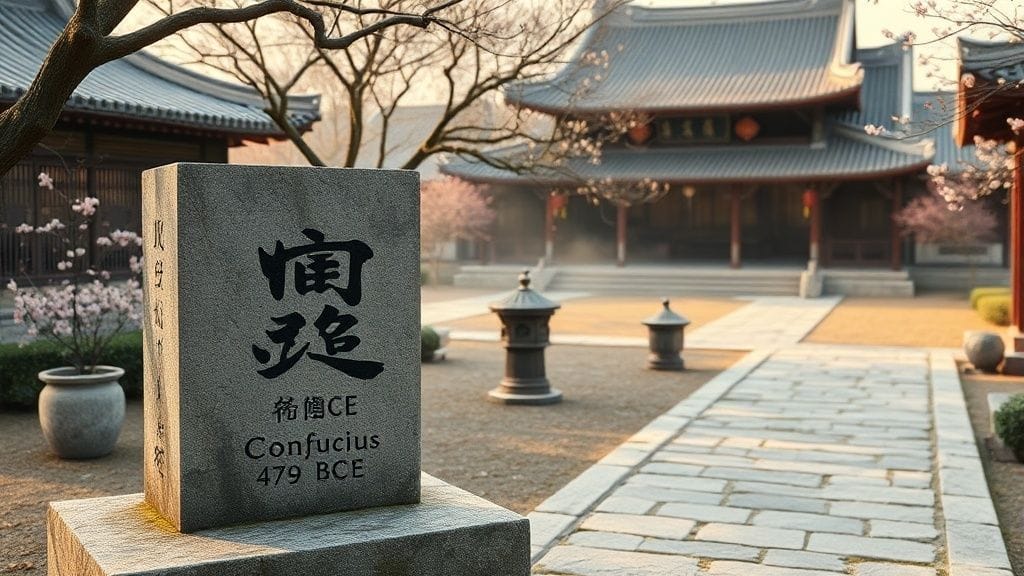
Confucius’s tomb in Qufu emerges as more than a resting place; it is a sacred geography of Chinese culture. Over successive dynasties, the site expanded into a sprawling complex of temples, gardens, and academies—a living monument to the man who sought to cast light into moral darkness.
The early burials were humble, yet descendants and rulers alike contributed to transforming Qufu into a pilgrimage destination. The burial grounds became hallowed as a wellspring of legitimacy for scholars and officials claiming Confucian virtue as their guiding principle.
Caring for this site through millennia was a form of political and cultural dialogue—affirmations of stability through an ancient source of wisdom.
9. The Immediate Aftermath: Disciples, Scholars, and Suppressed Teachings
In the immediate wake of Confucius’s passing, his disciples faced challenges beyond grief—their master's teachings were unrecognized by most political authorities, and sometimes outright opposed. They formed insular communities, traveling from court to court trying to promote their philosophy amid antagonistic regimes and competing traditions.
Not all states embraced Confucianism readily. The pragmatic and militaristic often dismissed its ethical idealism as idealistic or naïve. Despite these set-backs, these early scholars compiled the “Analects,” “Book of Rites,” and other texts that gave form and permanence to Confucius’s doctrines.
Their perseverance illustrates a remarkable historical truth: ideas rooted deeply in human ethics can endure far beyond the lifespan and fortunes of their originator.
10. Confucianism’s Survival Amidst Political Instability
The centuries following Confucius’s death were marked by disunity and conflict—the Warring States period threatening to erase the fragile cultural structures of the past. Yet, Confucianism endured through cyclical revivals tied to different regimes’ search for legitimacy.
This persistence speaks to the adaptability and profound appeal of Confucius’s message. Unlike harsh legalism or mystical Daoism, Confucianism offered a framework linking personal virtue to social order, making it irresistible to rulers conscious of their fragile mandates.
It was a testament to the strength of a legacy birthed in the small but pivotal city of Qufu that Confucius’s death was not an ending, but a beginning for institutionalized philosophy in China.
11. The Transformation of Confucius into an Icon of Moral Authority
Over time, Confucius himself was elevated from a mortal scholar to a semi-divine figure, a paragon of moral rectitude and wisdom. Emperors declared him the “Great Sage” and built temples in his honor, transforming his burial site into an imperial shrine.
This metamorphosis was gradual but decisive, mirroring China’s own evolution from fractious feudal kingdoms into centralized imperial power. Confucius’s teachings were enshrined as state orthodoxy under the Han dynasty, his death thereby sanctified as the final return of a moral titan to the underworld, leaving behind an immortal spiritual blueprint.
12. The Role of the State of Lu in Preserving Confucian Thought
Qufu and the State of Lu became central in the preservation of Confucian heritage. Local governance, recognizing the city’s symbolic importance, protected Confucius’s memorial sites and encouraged educational institutions centered on his philosophy.
Lu’s ongoing political survival was intertwined with its role as guardian of Confucianism. The state’s perceived moral authority reaffirmed by its association with Confucius helped legitimize ruling elites and project cultural dominance during periods of national fragmentation.
13. The Legacy in Texts: From Analects to Eternal Teachings
The texts most associated with Confucius, especially the “Analects” (Lunyu), serve as windows into his thought and the events surrounding his death. Compiled by disciples in the decades following 479 BCE, they offer both practical guidance and glimpses of his final days.
These writings became foundational to Chinese education and civil service, shaping the cultural and political development of East Asia. The immortal words protect a man who may have died quietly in Qufu but spoke eternally through his legacy.
14. The Confucius Shrine and Cemetery: Pilgrimage Across the Centuries
For over two millennia, pilgrims, scholars, and officials have journeyed to Qufu to pay homage. The Confucius Temple and Cemetery grew into grand cultural complexes, symbols of reverence that transcended time and political upheaval.
These sites were places not only of mourning but of celebration—annual ceremonies reenacting Confucius’s funeral rites serve as reminders that his death was less a loss than the passing of a torch.
15. Confucius’s Influence on Chinese Society and Global Philosophy
Confucius’s teachings—cultivated in life, institutionalized after his death—became the ethical bedrock of Chinese civilization. His ideas influenced governance, family life, education, and interpersonal relationships, creating social cohesion that endured until modern times.
Beyond China, Confucianism inspired Korea, Japan, and Vietnam, shaping East Asian societies profoundly. His death as a historical event is inseparable from this expansive ripple effect—the quiet passing of a man who reshaped the moral universe.
16. The Moral Foundation of East Asia: Confucianism’s Enduring Footprint
The ramifications of Confucius’s death and the survival of his teaching underpin the identity of several nations. Concepts like filial piety and the harmonious society remain powerful influencers of cultural norms, political philosophies, and social policies.
While modernity challenges aspects of Confucian ethos, the foundational ideas from that fateful year in 479 BCE continue to provoke thought and guide behavior, testament to a death that was actually a new dawn.
17. Modern Reflections on Confucius’s Death and Its Symbolism
Today, Confucius’s death invites reflection on mortality, legacy, and the power of ideas. In Qufu, events commemorating his death function as bridges linking past and present, reminding us of the fragile human pursuit of justice and virtue.
In an age grappling with moral and political uncertainty, Confucius’s final passage energizes debates on ethics, leadership, and cultural identity. His silent departure from the world challenges us to ask: what is the true measure of a life’s impact?
18. The Myth and the Man: Separating History from Legend
Over centuries, Confucius has become a mythic figure, blurring historical fact with symbolic grandeur. The exact details of his death—already sparse in contemporary records—are wrapped in layers of hagiography, ritual, and nationalist appropriation.
Yet, peeling back these layers reveals a man profoundly human: fallible, hopeful, stubbornly committed to an ideal. Recognizing this duality enriches our understanding of the man behind the legend and the enduring power of the legacy he left.
Conclusion
Confucius’s death in 479 BCE in the humble city of Qufu was more than the passing of an individual; it marked the renunciation of a lonely path toward moral restoration during times of chaos. Though his life was often met with political frustration, his death symbolized the transmission of an ethical torch to future generations.
From the quiet shadows of Qufu’s ancient lanes arose a beacon of wisdom whose light would traverse millennia, continents, and cultures. His legacy beckons us to contemplate the power of ideas resilient enough to survive death itself. In remembering Confucius’s final days, we recognize the eternal human thirst for virtue, justice, and meaningful community—a testament that even in death, true wisdom lives on.
FAQs
Q1: What were the main causes of Confucius’s death in Qufu?
A1: While Confucius died of natural causes as an elderly man, the stresses of political frustrations and his deep emotional investment in a renewed moral society weighed heavily on him in his final years.
Q2: How did the political climate of Lu influence Confucius’s last years?
A2: The State of Lu was politically unstable and fragmented, which limited Confucius’s ability to implement reforms and likely contributed to his sense of disillusionment before his death.
Q3: What significance does Qufu hold in Confucian history?
A3: Qufu is Confucius’s birthplace and where he died; it became the center of his burial site and has remained a pilgrimage destination preserving his memory and teachings.
Q4: How did Confucius’s disciples preserve his legacy after his death?
A4: They compiled his teachings into texts like the “Analects,” continued teaching his philosophy, and promoted Confucianism across various states despite political challenges.
Q5: Why is Confucius often seen as a moral authority rather than just a philosopher?
A5: Beyond philosophy, Confucius’s emphasis on ethics, social harmony, and ritual positioned him as a guide for righteous conduct, influencing governance and personal behavior across generations.
Q6: How has Confucius’s death been commemorated over the centuries?
A6: Through ritual ceremonies, temple offerings, pilgrimages to Qufu, and the preservation and reverence of his burial site, Confucius’s passing is both mourned and celebrated as a foundational moment.
Q7: What role did Confucius’s death play in the spread of Confucianism?
A7: His death galvanized his followers to safeguard and propagate his teachings, turning a moment of loss into a long-lasting intellectual and cultural movement.
Q8: Can we separate the myth from the historical Confucius?
A8: While many details of his life and death are shrouded in legend, scholarly research helps distinguish the historical figure—a dedicated, sometimes frustrated reformer—from the later mythologized sage.