Table of Contents
- A City Beneath the Shadow: Athens on the Eve of Pericles’ Death
- The Life and Legacy of the Athenian Titan
- The Rise of Pericles: From Orator to Architect of Democracy
- Athens at the Height of Its Power: Culture, War, and Society
- The Peloponnesian War: A Nation at War with Itself
- The Plague Arrives: Dark Clouds over Athens
- Pericles’ Final Speech: Defiance in the Face of Death
- The Death of a Statesman: Impact on Athens’ Morale and Politics
- Pericles’ Political Vision and Its Fragility
- The Immediate Aftermath: Athens Without Its Leader
- From Democracy to Turmoil: Athens’ Struggles Post-Pericles
- The Plague’s Toll: Beyond the Fall of a Leader
- How Pericles Shaped Athenian Identity for Centuries
- Historians’ Perspectives: Thucydides and the Narrative of Death
- The Myth and Memory of Pericles in Western Thought
- Pericles’ Death in the Broader Context of Greek History
- The Enduring Symbolism of Leadership During Crisis
- The Cultural Blossoming Interrupted: Art, Philosophy, and Tragedy
- Lessons from Athens: Democracy, Leadership, and Vulnerability
- Conclusion: The Twilight of an Era and the Dawn of History
- Frequently Asked Questions About Pericles’ Death and Its Era
- External Resource
- Internal Link
1. A City Beneath the Shadow: Athens on the Eve of Pericles’ Death
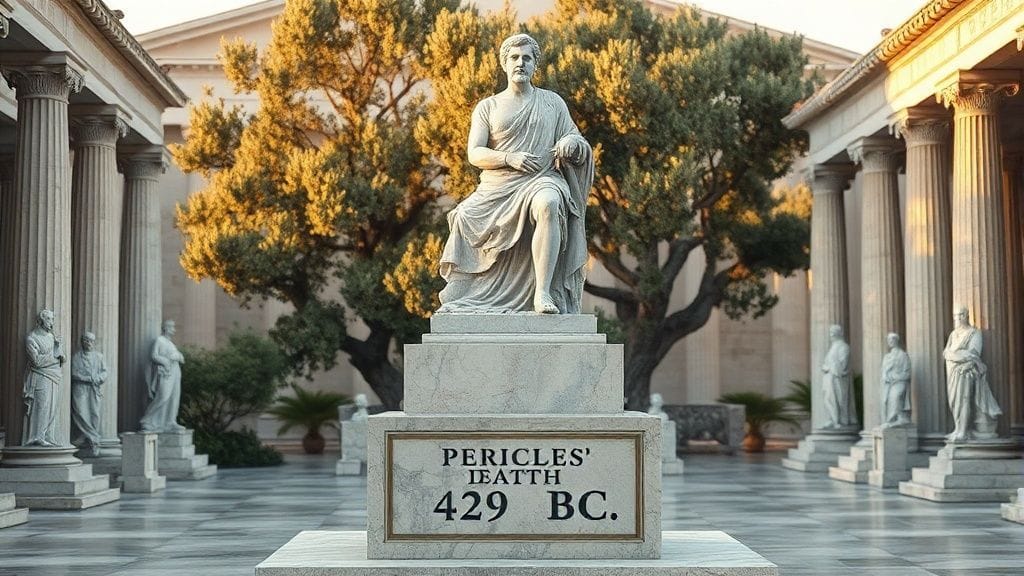
The sun scorched the ancient marble, casting long, haunting shadows through the bustling agora. The air was thick — not only with the dust of a hundred marketplaces but with whispers of war, fear, and defiance. Athens, the jewel of Greece, once radiant with promise and cultural achievement, found itself teetering on the edge of an abyss in the year 429 BCE. The tyrant was not a king but a statesman—Pericles, the very soul of Athenian democracy and imperial power. Yet, as the plague ran rampant through the city’s narrow streets, even his towering presence could not stem the tide of death. This was the beginning of the end for Athens’ golden age—a crucible of leadership, decline, and historical tragedy.
2. The Life and Legacy of the Athenian Titan
Pericles was no ordinary man. Born into the most aristocratic Athenian family—son of Xanthippus and Agariste—he rose through wit, charm, and unyielding ambition to become the preeminent leader of Athens. His voice echoed in the Pnyx, stirring the citizenry to unity and greatness. Under his stewardship, Athens not only thrived politically but also culturally; the Parthenon rose on the Acropolis as a temple to Athena and a symbol of Athenian pride. He was the architect of what historians call the “Age of Pericles,” a heady time when democracy was refined, empire expanded, and the arts flourished. Yet, as this golden era dawned, the shadows of war crept closer.
3. The Rise of Pericles: From Orator to Architect of Democracy
Before Pericles' age, Athens was fractured—aristocrats jostling for power, the polis divided by factional struggles. Pericles was the man who transcended these divisions, advocating a more inclusive democracy that empowered the demos, the citizens. His reforms transformed the political process: payment for public office made it possible for the less wealthy to participate, and juries were filled with ordinary Athenians rather than the elite. His oratory won hearts and swayed votes, and political rivals gradually yielded to his vision. But this was no simple populism—the man behind the speeches was a strategist, securing Athens’ imperial reach across the Aegean and channeling its wealth into monumental projects.
4. Athens at the Height of Its Power: Culture, War, and Society
Under Pericles, Athens was a radiant beacon of civilization. Philosophers like Anaxagoras debated in the shadow of the Acropolis; playwrights such as Sophocles premiered tragedies that still resonate today; and architects turned the city’s skyline into a masterpiece. But this beauty was married to conflict. Athens’ growing empire antagonized Sparta and its allies, setting the stage for the Peloponnesian War. Citizens forged ahead, convinced of their city’s destiny. Military dramas unfolded at the fringes of the Mediterranean, while at home, democracy hummed with vibrant energy—in the midst of booming trade, public feasts, and civic pride.
5. The Peloponnesian War: A Nation at War with Itself
When war erupted, it was not merely a military confrontation but a profound test of Athens’ social fabric and ideals. Sparta, the austere rival, challenged the Athenian vision of democracy and imperialism. The conflict was brutal and protracted; classical sources paint terrifying images of sieges, naval battles, and shifting alliances. At home, tensions rose, resources strained, and fear took root. Pericles himself advocated a cautious strategy—avoiding open battle yet relying on naval supremacy, calling on Athenians to abandon farmlands for the safety within city walls. But this strategy, innovative though it was, sowed unanticipated consequences.
6. The Plague Arrives: Dark Clouds over Athens
By 430 BCE, the unthinkable happened: a devastating plague swept into Athens. The cramped conditions inside the protective city walls created a perfect breeding ground for a mysterious illness. The Athenian population, already strained by war, now faced an invisible enemy. Physicians were helpless, rituals failed, and social order began to crumble. Houses emptied from fear; public assemblies grew nervous and despondent. It is said that families abandoned their sick, and public morals twisted under the weight of death. The plague’s arrival marked a turning point—beyond battle, this disease threatened what it meant to be Athenian.
7. Pericles’ Final Speech: Defiance in the Face of Death
Even as the plague ravaged the city, Pericles rose to inspire. In what historians regard as one of antiquity’s most memorable orations, he urged Athenians to hold fast to their principles of democracy and courage. He extolled the city’s greatness, their sacrifices, and the promise of a future built on freedom and citizenship. Yet, this defiance was tinged with pathos. The man who had led with unwavering confidence now knew his time was near. His speech, preserved by Thucydides, resonates like a poignant farewell—to the living and to history itself.
8. The Death of a Statesman: Impact on Athens’ Morale and Politics
Within months, Pericles succumbed to the plague. His death plunged Athens into mourning and uncertainty. The city had lost its master architect, the steady hand that balanced ambition with prudence. Politically, the vacuum created fierce competition among new leaders—many less prudent, some reckless. Morale sank as the population grappled with the double blows of war and disease. The democratic experiment that Pericles had cherished wobbled under strain; decisions grew erratic, and Athens’ hold over its empire weakened.
9. Pericles’ Political Vision and Its Fragility
Pericles had envisioned a durable democracy, one where citizens both ruled and were ruled in a symbiotic balance. He had tempered imperial ambition with caution. However, his death revealed the fragility beneath the surface. The war intensified without his unifying presence; factionalism re-emerged. The very mechanisms of democracy—debate, assembly, trial—were exploited for personal agendas, and strategic mistakes followed. Pericles’ genius had been in part his ability to reconcile competing pressures; once gone, Athens struggled to find the same rhythm.
10. The Immediate Aftermath: Athens Without Its Leader
What happened after Pericles’ death reveals how much Athens depended on him. Political leaders such as Cleon stepped forward with more hawkish, aggressive policies. These leaders capitalized on popular anger and fear but often led Athens into further missteps. The plague and war continued unabated—and the empire that Pericles had carefully nurtured started to fragment. Citizens felt the pulse of the civic heart weaken; public trust eroded. The city's eventual defeat in the Peloponnesian War can be traced back to the loss of that steady guiding force.
11. From Democracy to Turmoil: Athens’ Struggles Post-Pericles
The delicate democracy Pericles championed faced increased internal strife. Political purges, radical populism, and militarism took center stage. The loss of Pericles’ conciliatory diplomacy made compromise difficult. Athens drifted between authoritarian tendencies and chaotic assemblies. This internal inefficiency affected its military campaigns and empire management. Over the next decades, Athens lost its naval dominance, suffered significant defeats, and saw its influence wane. The death of Pericles, in this way, marks the beginning of a downward spiral from glory to exhaustion.
12. The Plague’s Toll: Beyond the Fall of a Leader
While Pericles’ death was emblematic, the plague itself left scars etched into the social fabric of Athens. Scholars estimate that perhaps one-third of the population perished within a few years. Among the dead were not only civilians but soldiers, sailors, and political figures. The epidemic forced changes in burial practices, religious observances, and community life. It disrupted economies and created a pervasive trauma. The psychological impact lingered—fear of disease, a sense of vulnerability, and fatalism seeped into Athenian culture and literature for decades.
13. How Pericles Shaped Athenian Identity for Centuries
Despite the chaos that followed, Pericles’ imprint remained indelible. Subsequent generations revered his vision of democracy and imperial achievement. Philosophers, poets, and politicians looked back to his "Golden Age" as both inspiration and benchmark. The Parthenon itself became a symbol not only of divine favor but of civic achievement made possible by leadership and unity. Pericles embodied the complex ideals of Athens—strength and creativity, democracy and empire. His life and death encapsulate the paradoxes of power and vulnerability that would shape Western political thought.
14. Historians’ Perspectives: Thucydides and the Narrative of Death
No account of Pericles’ death would be complete without Thucydides. The historian, a contemporary and often considered the father of historical empiricism, provides a vivid narrative of the plague and Pericles’ leadership. His portrayal is nuanced—Pericles is neither saint nor tyrant but a complex figure whose greatness shines brightest amid adversity. Thucydides’ account offers more than facts; it probes the human condition in crisis. His words immortalize not just the event, but the endurance and tragedy of Athens itself.
15. The Myth and Memory of Pericles in Western Thought
Over millennia, Pericles’ figure transcended history into myth. Renaissance thinkers evoked his democratic ideals to inspire political reform. Enlightenment philosophers saw in him a forerunner of civic republicanism. Artists and writers highlighted both his achievements and the tragic poignancy of his death. Yet, this mythologizing also risks oversimplification—Pericles remains a paradox: a champion of democracy who presided over empire and war. His memory challenges us to reconcile human greatness with its costs.
16. Pericles’ Death in the Broader Context of Greek History
In the broad sweep of Greek history, Pericles’ death signals a pivotal moment. It interrupts Athens’ ascendancy and heralds a period of fragmentation and war that would reshape the Hellenic world. It reminds us that history is contingent—dependent not only on ideas but on individuals and circumstances. The loss of a singular leader in a time of crisis echoes through ages as a cautionary tale about reliance on personality over institutions.
17. The Enduring Symbolism of Leadership During Crisis
The story of Pericles’ death resonates deeply with how societies face catastrophe. Leadership in times of war and plague reveals the human capacity to unite or fracture. Pericles’ courage and eloquence in his final days became a symbol of resilience against despair. His death, rather than simply an end, became a reflection on the qualities necessary to steer communities through uncertainty. Today, his legacy invites reflection on leadership’s limits and possibilities.
18. The Cultural Blossoming Interrupted: Art, Philosophy, and Tragedy
Had the plague and war not intervened, Athens’ cultural bloom might have reached further heights. Artists, philosophers, and playwrights labored during these difficult times, but their works carry marks of crisis. Tragedies like those of Euripides hint at the deeper anxieties of the era. The interruption caused by Pericles’ death and the subsequent turmoil underscored the fragile relationship between peace and creativity—how societal stability nourishes, or stifles, culture.
19. Lessons from Athens: Democracy, Leadership, and Vulnerability
Looking back, the death of Pericles teaches timeless lessons. Democracies depend on wise leadership but must build institutions resilient enough to survive beyond individuals. The dual pressures of external conflict and internal crisis test the social contract. Moreover, health and security remain fundamental to political stability. The Athenian tragedy reminds us that greatness is fragile and leadership, no matter how inspired, must reckon with forces beyond control.
20. Conclusion: The Twilight of an Era and the Dawn of History
Pericles’ death in 429 BCE was more than the passing of a statesman; it marked the twilight of Athens’ golden age. The city’s brilliance dimmed as war and plague ravaged it, yet the ideals and achievements of his leadership persisted as guiding stars for centuries. His life and death underscore the eternal tension between human ambition and mortal limitation. From the ruins of the Acropolis to the pages of history, Pericles’ story remains a testament to the complexities of power, democracy, and the human spirit in the face of adversity.
Conclusion
Pericles embodies a paradox as compelling as Athens itself: a visionary leader who lifted a city to unprecedented heights only to witness its vulnerability in the face of war and plague. His death in 429 BCE echoes across millennia as a poignant moment when history’s pulse felt both the fragile brilliance of human achievement and the inexorable shadow of mortality. In remembering Pericles, we confront questions of leadership, democracy, resilience, and the limits of power—themes as urgent today as they were nearly 2,500 years ago. Athens’ golden era may have faded, but its lessons continue to illuminate the path of civilization.
FAQs
1. What was the main cause of the plague that killed Pericles?
The exact nature of the plague remains uncertain. Ancient sources, especially Thucydides, describe symptoms resembling typhus, typhoid fever, or viral hemorrhagic fever. Modern scholars continue to debate the diagnosis due to the limited medical knowledge from the time.
2. How did Pericles’ leadership influence Athenian democracy?
Pericles expanded democratic participation by enabling broader citizen involvement, reforming the legal system, and emphasizing public service and merit over aristocratic privilege. His vision institutionalized many practices that became synonymous with Athenian identity.
3. What role did the Peloponnesian War play in Pericles’ death?
While the war did not directly cause his death, it created conditions—such as large populations confined within city walls—that facilitated the spread of the plague. The protracted conflict intensified political and social pressures on Athens, magnifying the impact of his loss.
4. How did Athens change politically after Pericles’ death?
Political moderation gave way to factionalism and more aggressive leadership, including figures like Cleon who pursued hawkish policies. Democracy became more volatile, and the city increasingly struggled to maintain cohesion and control of its empire.
5. Why is Pericles considered a pivotal figure in Greek history?
He symbolizes the apex of classical Athenian civilization—its democracy, culture, and imperial might. His leadership defines a golden age whose art, philosophy, and politics have profoundly shaped Western civilization.
6. What sources provide information about Pericles and his death?
Thucydides’ History of the Peloponnesian War is the primary source, offering detailed narrative and analysis. Other accounts include Plutarch’s Life of Pericles and various archaeological and literary sources from the period.
7. How has Pericles’ image evolved over time?
From revered statesman in antiquity to Renaissance and modern symbol of democracy, Pericles’ image has been both celebrated and critiqued. He is often portrayed as a model of enlightened leadership but also as a figure embodying the tensions within empire and democracy.