Table of Contents
- The Final Days of Demosthenes: A Shadow Over Calauria
- Demosthenes: The Voice of Athens and Its Defiant Spirit
- Greece in Turmoil: The Rise of Macedon and the Fall of City-States
- The Shadow of Alexander: Macedonian Expansion and Its Aftermath
- Demosthenes’ Last Stand: Defiance Against Macedonian Hegemony
- The Battle of Crannon: The End of Athenian Military Resistance
- Flight to Calauria: Seeking Solace on the Island of Poros
- A Poet’s Refuge: Calauria as a Shrine of Resistance
- The Macedonian Envoys: The Demand for Submission
- Demosthenes’ Choice: Honor over Life
- The Poet’s Death: Suicide or Execution?
- The Aftermath in Athens: Mourning a Hero
- The Legend of Demosthenes: From Orator to Martyr
- Political Consequences: Macedonian Domination Solidified
- Cultural Echoes: Democracy’s Last Roar in Ancient Greece
- Demosthenes’ Legacy in Rhetoric and Politics
- Reflections on Resistance: Democracy Versus Empire
- Lessons from Calauria: The Cost of Defiance
- Commemorations and Memory: How Greece Remembers Demosthenes
- Conclusion: The End of an Era and the Dawn of Macedonian Greece
- FAQs on Demosthenes and His Final Days
- External Resource
- Internal Link
The Final Days of Demosthenes: A Shadow Over Calauria
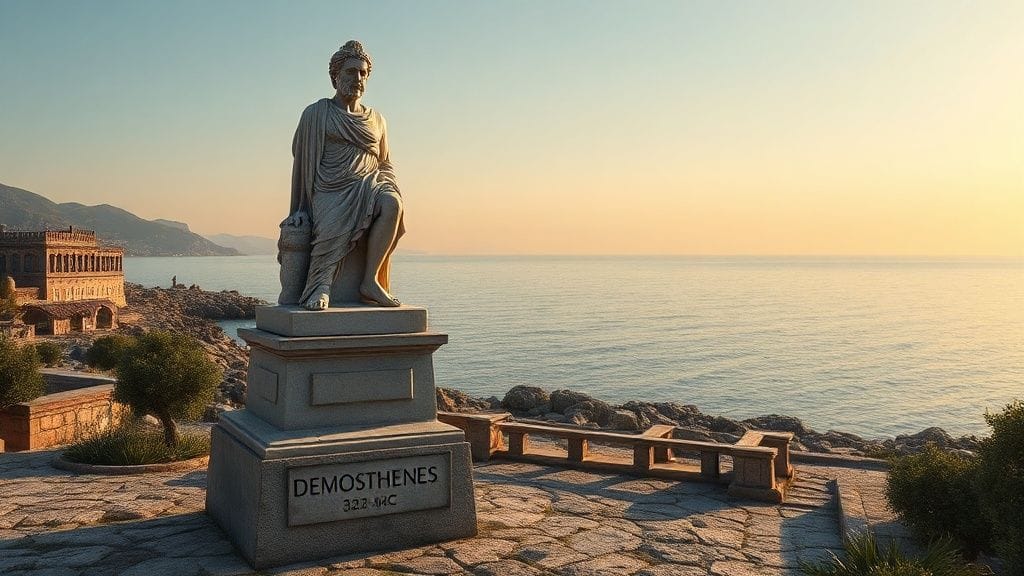
The sun dipped low over the tranquil waters of Calauria, its golden rays shimmering across the Aegean Sea. Yet, this serene evening in 322 BCE was stained by sorrow and dread. On this small island—known today as Poros—Demosthenes, once the most powerful voice of Athenian democracy, faced his final moments. His breath was heavy with the silent weight of a city crushed beneath foreign conquest, a democracy extinguished, and a spirit deeply wounded.
Demosthenes’ death was not merely the fall of a man but a poignant symbol of an epoch lost—a desperate act of resistance against the encroaching shadow of Macedonian dominance. His last stand on Calauria was charged with pathos, encapsulating the twilight of classical Greece and heralding a new era that many Greeks viewed with dread and defiance.
Demosthenes: The Voice of Athens and Its Defiant Spirit
Born in 384 BCE, Demosthenes rose from a modest background to become Athens’ greatest orator and the unyielding voice of its democracy. Known for his fiery speeches, or “Philippics,” he warned Athens and the Hellenic world of the growing danger posed by Philip II of Macedon and later his son, Alexander the Great.
In a city famed for its debate and democratic institutions, Demosthenes was more than a politician; he was the embodiment of civic courage. His eloquence rallied his fellow citizens to resist Macedonian expansion, to value freedom, and to defend the autonomy that was rapidly slipping through their fingers.
Greece in Turmoil: The Rise of Macedon and the Fall of City-States
The 4th century BCE saw Greece fractured—its city-states squabbling, weakened by endless wars, and losing influence. Meanwhile, Macedon, once a peripheral northern kingdom, was emerging as a juggernaut under Philip II’s strategic brilliance and relentless military reforms.
Macedon’s rise threatened the very fabric of Hellenic autonomy. Each polis—once proud, free, and independent—found itself at a crossroads: negotiate, resist, or collapse under Macedonian control. Athens, with its rich democratic tradition, chose to resist, with Demosthenes at the helm of this fluctuating storm.
The Shadow of Alexander: Macedonian Expansion and Its Aftermath
Alexander the Great inherited an empire poised to dominate the known world. His campaigns across Persia and Egypt expanded Macedonian influence far beyond Greece's borders, but his early death in 323 BCE unleashed a power vacuum and intensified struggles at home.
The Greek city-states seized this moment to attempt a resurgence of independence. However, Macedonian regents, determined to maintain control, moved swiftly. Their leverage was diplomacy, intimidation, and military might—forceful tools meant to crush any spark of rebellion.
Demosthenes’ Last Stand: Defiance Against Macedonian Hegemony
Despite the overwhelming power of Macedon, Demosthenes never wavered. His speeches urged Athens and its allies to raise arms in defense of freedom, to rally their spirits and resist subjugation.
This defiance culminated during the uneasy peace that followed Alexander’s death. With the Macedonian army stretched thin, hopes flared for a Greek resurgence. Yet, Macedonian strategy was ruthless and efficient.
The Battle of Crannon: The End of Athenian Military Resistance
The battle fought near Crannon in 322 BCE was pivotal. Macedonian forces decisively defeated the allied Greek army, breaking their hopes of regaining autonomy. This defeat proved catastrophic for Athens and its era of democracy.
The city was forced into humiliating terms, and Macedonian garrisons were established. Resistance leaders like Demosthenes became marked men, their fates sealed by the shifting tide of power.
Flight to Calauria: Seeking Solace on the Island of Poros
Aware of the growing threat, Demosthenes fled Athens to Calauria, a quiet island ideal for reflection and refuge. It was here, away from the political hubbub, that the orator confronted his impending doom.
The island provided a temporary sanctuary, but Macedonians sent envoys to demand his surrender, making it clear that escape was impossible.
A Poet’s Refuge: Calauria as a Shrine of Resistance
Calauria was more than a hiding place; for Demosthenes, it represented the last billboard of defiance. Amidst the island’s olive groves and ancient temples, one could almost hear the echoes of his speeches reverberating over the waves—a final refusal to submit.
His presence on Calauria resonated across Greece, inspiring those who valued freedom, even as Macedon tightened its grip.
The Macedonian Envoys: The Demand for Submission
Macedonian forces arrived with a clear ultimatum: surrender or face capture and humiliation. The fate of resistance leaders was grim—imprisonment or execution by the conquerors.
It was a moment heavy with tragedy, a clash of wills: the uncompromising pride of a free man and the cold strategy of imperial enforcers.
Demosthenes’ Choice: Honor over Life
The orator chose death over submission. According to historical accounts, Demosthenes took poison, ending his life with a dignity that would echo through history.
His final act was a statement—death was preferable to dishonor, silence, or captivity. It was a bitter but profoundly human decision that speaks to the soul of resistance.
The Poet’s Death: Suicide or Execution?
Some sources debate whether Demosthenes died by his own hand or was killed by Macedonian agents. Regardless, his death marked a definitive end to the era of Athens’ autonomy and the democratic ideals he championed.
This ambiguity only adds to his legend, as a man caught in history’s brutal currents, fiercely striving to chart his own fate.
The Aftermath in Athens: Mourning a Hero
When news of Demosthenes’ death reached Athens, it plunged the city into mourning. Public funerals celebrated him as a martyr for liberty. Statues and monuments began to commemorate his sacrifice.
But beneath the grief lay a sobering truth—the city was no longer the beacon of democracy it once had been.
The Legend of Demosthenes: From Orator to Martyr
Demosthenes transcended his mortal life, becoming a symbol for classical values: eloquence, courage, and the defense of freedom against tyranny.
For generations to come, poets, philosophers, and politicians would invoke his name as an ideal of resistance and patriotism.
Political Consequences: Macedonian Domination Solidified
Demosthenes’ death solidified Macedonian control over Athens and much of Greece. The political landscape was transformed, with democratic institutions weakened or replaced by oligarchic and Macedonian-friendly regimes.
The hopes for a free and united Greece dwindled, as empire and hegemony became the new order.
Cultural Echoes: Democracy’s Last Roar in Ancient Greece
Though Athens survived as a cultural center, the political freedom that defined its golden age was broken. The death of Demosthenes marked the sunset of classical democracy and the dawn of a new political reality dominated by monarchies and imperial powers.
His voice remained a haunting echo—the “last roar” of an era slipping away.
Demosthenes’ Legacy in Rhetoric and Politics
Beyond politics, Demosthenes’ influence on rhetoric and oratory persisted. His speeches became textbook examples for public speaking, persuasion, and political argumentation.
Scholars and statesmen throughout history have studied his work, making him a timeless figure in the art of persuasion and political engagement.
Reflections on Resistance: Democracy Versus Empire
The story of Demosthenes poses enduring questions: What is the cost of resistance? How does a democracy survive against overwhelming imperial power? His life and death illustrate the tension between liberty and domination—a narrative still relevant in modern political thought.
Lessons from Calauria: The Cost of Defiance
Demosthenes’ final refuge on Calauria warns of the dual nature of resistance—at once heroic and tragic. Sometimes, defiance demands the ultimate sacrifice, yet it can also inspire future generations to strive for freedom.
The island remains a silent witness to the complex choices faced by those who dare to oppose overwhelming odds.
Commemorations and Memory: How Greece Remembers Demosthenes
In contemporary Greece, Demosthenes is celebrated as a hero of democracy. His memory is preserved in literature, monuments, and public ceremonies. Schools teach his speeches as vital lessons in civic duty and courage.
His story is a bridge between ancient struggles and ongoing quests for freedom.
Conclusion: The End of an Era and the Dawn of Macedonian Greece
Demosthenes’ death on the shores of Calauria closed a chapter of Greek history. It was the poignant finale to the struggle of city-states for independence amidst the rise of empire. Yet, it was not just a defeat; it was a testament to the enduring human spirit.
In the quiet island winds, one still feels the echo of an orator’s last defiance—an eternal call for liberty against all odds.
FAQs on Demosthenes and His Final Days
Q1: Who was Demosthenes and why is he significant?
A1: Demosthenes was a celebrated Athenian orator and politician known for his powerful speeches advocating for Athenian democracy and resistance against Macedonian domination.
Q2: What were the main causes leading to the death of Demosthenes?
A2: The defeat of Athens and its allies by Macedon at the Battle of Crannon, the suppression of democratic resistance, and Macedonian demands for his surrender led Demosthenes to flee and ultimately die in exile.
Q3: How did Demosthenes’ death affect Athens politically?
A3: His death marked the end of Athenian independence and democracy’s golden age, solidifying Macedonian power and dramatically altering the political landscape.
Q4: Was Demosthenes’ death a suicide or an enforced execution?
A4: Historical accounts vary, but most agree he chose to take poison to avoid capture and humiliation by the Macedonians.
Q5: What is the legacy of Demosthenes in rhetoric and politics?
A5: He is regarded as one of history’s greatest orators, whose speeches continue to be studied for their rhetorical brilliance and political insight.
Q6: How is Demosthenes remembered in modern Greece?
A6: He is honored as a symbol of resistance, democracy, and civic courage, with monuments, literature, and education preserving his memory.
Q7: What does the story of Demosthenes teach about resistance to oppression?
A7: It illustrates the moral complexities and high costs of defiance, highlighting the value and tragedy inherent in the fight for freedom.
Q8: Why is Calauria/Poros significant in Greek history?
A8: Calauria served as the last refuge of Demosthenes, making it a symbolic site for the end of classical Greek democracy and the acts of resistance against Macedonian rule.

