Table of Contents
- The Fall of Syracuse: A Moment Frozen in Time
- The Siege of 212 BCE: Shadows of War Descend Upon Sicily
- Archimedes: The Man Behind the Genius
- The Political and Military Stakes: Rome Versus Syracuse
- The Prelude to Catastrophe: How War Engulfed a City of Wisdom
- Innovations Amidst Conflict: Archimedes’ War Machines
- The Roman Conquest: Fabius Maximus’ Relentless Advance
- Last Days of a Philosopher amidst Turmoil
- The Death of Archimedes: A Clash of Minds and Swords
- The Roman Soldier’s Story: Myth and Reality of Archimedes’ Demise
- The Destruction and Aftermath of Syracuse’s Golden Age
- Archimedes’ Legacy in Science and Philosophy
- The Historical Debate: Was Archimedes’ Death Inevitable?
- Syracuse’s Integration into the Roman World
- The Enduring Memory: Archimedes Through the Ages
- Modern Reflections on War and Intellectual Loss
- How Archimedes’ Death Transformed the Perception of Genius
- Wartime Science: When Knowledge Became a Weapon
- Sicily: Crossroads of Civilizations and Conflict
- The Ancient World’s Reckoning with Artisans of War
- Conclusion: The Eternal Spark of Archimedes
The Fall of Syracuse: A Moment Frozen in Time
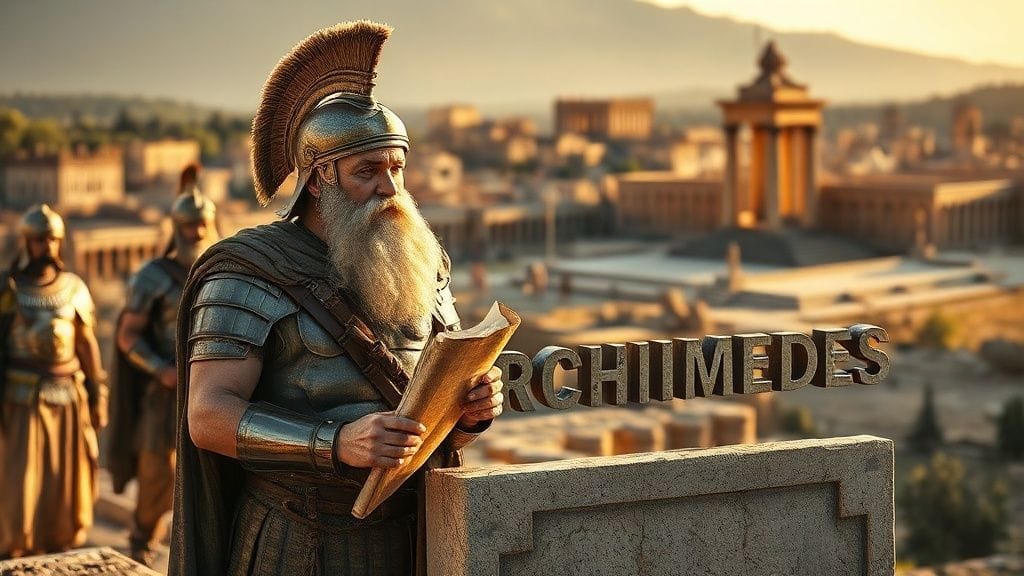
The sun-baked walls of Syracuse stood unyielding as the Roman legions encircled the city in 212 BCE. The air was heavy with dust and fear, mingled with the faint scent of olive groves that had long graced this Sicilian jewel. On its ancient streets roamed a man possessed not of sword or shield but of intellect and curiosity. Archimedes, the city’s most celebrated scientist and mathematician, was about to meet a fate as tragic as it was profound. His final moments, lost amidst the clamor of war, forever intertwined with the fall of Syracuse, marked a turning point not just for the city, but for the ancient world’s reverence of genius.
The Siege of 212 BCE: Shadows of War Descend Upon Sicily
The year was 212 BCE, during the throes of the Second Punic War, when Rome and Carthage vied for control over the Mediterranean’s wealth and power. Syracuse, a flourishing city-state on the island of Sicily, found itself caught in the vortex of this colossal struggle. Long allied with Carthage, Syracuse now faced the wrath of Rome under the command of the general Marcus Claudius Marcellus.
The siege lasted for months. Roman forces, relentless and resourceful, laid siege to the city’s formidable walls, seeking to break its spirit and defenses. The people of Syracuse, fueled by desperation and determination, bolstered by Archimedes’ ingenious war machines, held the Romans at bay far longer than expected.
Archimedes: The Man Behind the Genius
Born circa 287 BCE, Archimedes emerged from the rich cultural fabric of Syracuse as a polymath whose knowledge spanned mathematics, physics, engineering, and astronomy. Revered for his discoveries as much as his practical applications, Archimedes became a symbol of intellectual prowess. His contributions—ranging from the principle of buoyancy to the ingenious inventions designed to defend his city—reflected not just brilliance but a deep commitment to Syracuse’s survival.
But Archimedes’ mind was not merely a collection of formulas; it was a forge where ideas sparked life, where abstract concepts transformed into concrete mechanisms of war and peace.
The Political and Military Stakes: Rome Versus Syracuse
Rome’s ambition to control Sicily was motivated not only by territorial gain but also by strategic dominance over Mediterranean trade routes. Syracuse, enriched with cultural wealth and military might, was a critical obstacle. Its alliances oscillating between Carthage and Rome made it a prize and a threat.
For the Romans, taking Syracuse meant breaking Carthaginian influence and opening a path toward ultimate control of the region. For Syracuse’s rulers and citizens, it meant survival against the juggernaut that was Rome, a city whose growing power shadowed every corner of the ancient world.
The Prelude to Catastrophe: How War Engulfed a City of Wisdom
Syracuse’s brilliance in art, philosophy, and science could not shield it from the harsh realities of war. Even the genius of Archimedes, whose inventions stalled Roman progress, could not halt the tide of suffering that swept through the city—starvation, fear, death. Political factions within Syracuse added to confusion, weakening internal cohesion just as the external threat mounted.
The knowledge that the city might fall weighed heavily on Archimedes, who reportedly continued his calculations and designs with unwavering focus even as the world around him crumbled.
Innovations Amidst Conflict: Archimedes’ War Machines
In an era defined by swords and spears, Archimedes introduced war devices straight out of the realm of dreams and engineers’ blueprints. Catapults that hurled massive stones with deadly precision, pulleys and cranes that suspended huge masses to drop upon invaders, and perhaps most famously, the so-called “Claw of Archimedes,” a crane-like apparatus designed to lift Roman ships and hurl them into the waves.
These inventions prolonged the siege significantly. Roman soldiers marveled — and despaired — at the resilience of Syracuse’s defenses, powered by minds rather than mere muscle.
The Roman Conquest: Fabius Maximus’ Relentless Advance
Marcellus himself died during the siege, but command passed to Claudius Pulcher and then to Marcus Fabius Maximus. The siege tactics shifted from direct assault to attrition. Slowly, methodically, the Romans chiseled away at Syracuse’s defenses.
Despite the ingenuity of Archimedes’ machines, the inevitable finally descended. Rome’s sheer numbers, coupled with an internal betrayal that opened a gate, sealed Syracuse’s fate.
Last Days of a Philosopher amidst Turmoil
Legend has it that Archimedes, engrossed in a mathematical diagram drawn in the sand, lived in a bubble of concentration even as soldiers flooded the city. It is said he implored a Roman soldier not to disturb his work, a plea tragically ignored.
It is here, in these last moments, that the clash of worlds—of war and wisdom, destruction and intellect—played out in its most poignant form.
The Death of Archimedes: A Clash of Minds and Swords
The precise circumstances of Archimedes’ death have been debated for centuries. Some accounts claim he was killed by a soldier in the chaos of the conquest despite orders that he be spared. Others suggest more complex interactions between fear, misunderstanding, and the brutal necessities of war.
Yet the image of the venerable philosopher, slain over his sand-drawn geometry, endures as a symbol of the tragedy wrought when knowledge meets violence.
The Roman Soldier’s Story: Myth and Reality of Archimedes’ Demise
One Roman legend tells of a soldier ordered to keep Archimedes alive but who, unused to dealing with the eccentric scholar, struck him down. Another says the general Marcellus regretted the death profoundly, ordering that Archimedes receive a proper burial.
Such stories underscore the profound cultural dissonance between Roman martial pragmatism and Greek intellectual idealism—a gulf bridged perhaps only in memory.
The Destruction and Aftermath of Syracuse’s Golden Age
With Archimedes' death and Syracuse's fall, the city’s era as a preeminent center of Greek culture in the West waned. The Romans imposed their rule, initiating shifts in governance, society, and economy.
Yet, the devastation also marked the transmission of Greek knowledge into Roman hands, sowing seeds that would eventually bloom in Western scientific and philosophical traditions.
Archimedes’ Legacy in Science and Philosophy
Despite his violent end, Archimedes’ ideas transcended time. His writings on hydrostatics, levers, and mathematics inspired Renaissance thinkers and continue to underpin modern science and engineering.
His legacy illustrates the timeless nexus of theoretical exploration and practical application—a harmony often endangered in times of conflict.
The Historical Debate: Was Archimedes’ Death Inevitable?
Scholars have pondered whether Archimedes’ death was a tragic accident or an unavoidable consequence of war’s chaos. Could the Romans have protected their captive mind? Did Archimedes’ own detachment from his surroundings contribute?
These questions touch on the broader human struggle to reconcile intellectual pursuit with the brutal realities of power.
Syracuse’s Integration into the Roman World
Post-siege, Syracuse became fully absorbed into Roman Sicily. The city’s landscape and identity shifted—Roman infrastructure and political institutions took root.
Yet, Syracuse preserved elements of its heritage, blending Greek scholarship with Roman order in a complex cultural symbiosis.
The Enduring Memory: Archimedes Through the Ages
Over two millennia, Archimedes’ story has echoed as both inspiration and warning. Artists, writers, and historians have immortalized his death, reflecting on the price of innovation in turbulent times.
From Renaissance treatises to modern textbooks, his narrative endures—a beacon of human intellect’s fragility and resilience.
Modern Reflections on War and Intellectual Loss
The death of Archimedes remains a poignant allegory within the modern discourse on war’s cost—not merely in lives lost but in the silencing of minds whose ideas could enlighten generations.
It challenges us to consider how societies value knowledge and protect those who dedicate themselves to its expansion.
How Archimedes’ Death Transformed the Perception of Genius
The story also shaped the archetype of the "absent-minded genius"—deeply immersed in thought, sometimes oblivious to worldly dangers. This trope can be traced in artistic portrayals back to Archimedes’ legendary focus as the city fell.
His death crystallized a deeper human fascination with intellect amidst chaos.
Wartime Science: When Knowledge Became a Weapon
Archimedes epitomized a unique aspect of ancient warfare: the fusion of science and military tactics. His creations blurred the lines between philosopher and warrior, showing that knowledge itself could wield destructive power.
This duality continues to inform contemporary debates on the role of science in conflict.
Sicily: Crossroads of Civilizations and Conflict
Syracuse's story is inseparable from Sicily’s broader position as a Mediterranean crossroads—where cultures, empires, and armies collided for millennia.
Understanding Archimedes’ death within this context reveals layers of geopolitical complexity and cultural exchange.
The Ancient World’s Reckoning with Artisans of War
Archimedes embodied a paradox: a technician of death who sought truth in natural law. His life and death illustrate the ancient world’s tension between the quest for knowledge and the machinery of war.
This tension remains a powerful motif in historical memory.
Conclusion: The Eternal Spark of Archimedes
The siege of Syracuse and the death of Archimedes invite us into a moment where human creativity and destruction converged with devastating clarity. A man who unlocked the universe’s secrets was extinguished not by rational debate, but by the spear of war. Yet, his ideas outlived the fall of his city, transcending time and reminding us of the fragile brilliance of genius.
As we reflect on this tragic epoch, we recognize in Archimedes a symbol of resilience, a testament to the enduring power of thought even in the darkest hours. His legacy compels us to nurture knowledge amidst adversity and to honor those whose ideas shape humanity’s path.
FAQs
Q1: Who was Archimedes and why was he important?
Archimedes was an ancient Greek mathematician, physicist, and engineer from Syracuse, celebrated for foundational discoveries in geometry, hydrostatics, and mechanics. His innovations deeply influenced both ancient warfare and later scientific thought.
Q2: What led to the Siege of Syracuse in 212 BCE?
Syracuse’s alliance with Carthage during the Second Punic War made it a target for Rome, which sought control over Sicily and aimed to cut off Carthaginian influence in the Mediterranean.
Q3: How did Archimedes contribute to the defense of Syracuse?
He designed advanced war machines like catapults and cranes—the “Claw of Archimedes”—which delayed the Roman siege and showcased the application of scientific principles to military engineering.
Q4: What are the different accounts of Archimedes’ death?
Historical sources differ, but many agree Archimedes was killed by a Roman soldier during the city's fall despite orders to spare him. The precise circumstances remain debated.
Q5: What were the consequences of Syracuse’s fall?
The city's integration into the Roman Republic led to political reorganization and a decline in its independent cultural prominence, but it also facilitated the spread of Greek science and culture into Roman society.
Q6: How is Archimedes remembered today?
He is revered as a genius whose ideas laid groundwork for modern science and engineering. His life and death symbolize the conflict between intellect and warfare.
Q7: Did Archimedes’ death impact the scientific community of his time?
While his death was a profound loss, his writings survived and influenced scholars well beyond his era, ensuring his lasting impact on mathematics and physics.
Q8: Why does Archimedes’ story remain relevant?
His narrative embodies the eternal tension between war and knowledge, illustrating how intellectual achievements can be both weapons and victims in times of conflict.