Table of Contents
- The Final Dawn of an Emperor: Nero’s Last Hours
- A Rome on Edge: The Empire in 68 AD
- From Throne to Abyss: The Rise and Rule of Nero
- Seeds of Discontent: Political Intrigues and Social Unrest
- The Great Fire of Rome: Disaster and Scapegoats
- Drifting from Popularity: The Fall of Public Favor
- Rebellions in the Provinces: The Empire’s Cracks Widen
- The Senate’s Ultimatum: Declaring Nero an Enemy of the State
- Flight from Rome: The Emperor on the Run
- The Final Refuge: Nero’s Last Days in the Countryside
- The Suicide: A Tragic End to an Infamous Reign
- Public Reaction: Mourning, Mockery, and Myth
- The Aftermath: Rome’s Search for Stability
- The Year of the Four Emperors: Chaos Ensues
- Historical Perspectives: Nero’s Legacy in the Eyes of Posterity
- Cultural Depictions: Nero in Art, Literature, and Popular Imagination
- Lessons from a Tyrant: Power, Madness, and History
- Conclusion
- FAQs
- External Resource
- Internal Link
The Final Dawn of an Emperor: Nero’s Last Hours
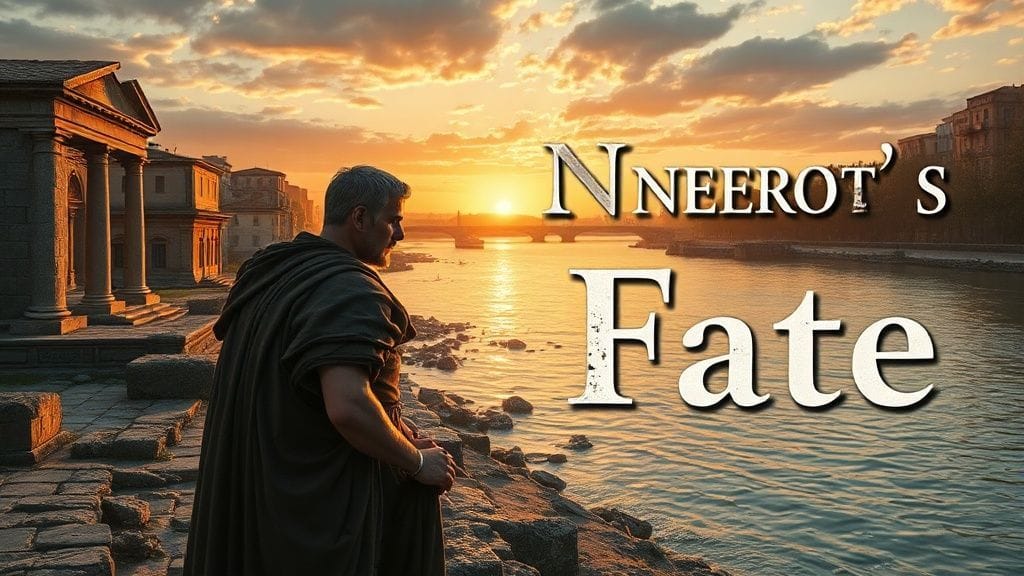
A faint, cold light brushed the low hill where Nero hid, far from the marble colonnades and bustling forums of Rome. The breeze carried with it a scent of scorched earth—a reminder of the fires that had once ravaged the heart of the city. His breath came shallow and quick, eyes darting through the sparse greenery as the echoes of his enemies’ footsteps grew nearer. The air was heavy with inevitability.
On June 9th, 68 AD, the last emperor of the Julio-Claudian dynasty would breathe his final breath beneath a grim sky, ending an era marked by grandeur, terror, and spectacle. His name was Nero Claudius Caesar Augustus Germanicus—a figure remembered with revulsion and fascination alike, whose death marked not just the fall of a man but the implosion of a fragile empire. What led to this ultimate collapse? How did a ruler once adored turn into a hunted fugitive? This story is not merely about one man’s demise, but about Rome standing at the precipice of chaos.
A Rome on Edge: The Empire in 68 AD
To understand the twilight of Nero, one must first glimpse the Rome of 68 AD—a city vibrant yet volatile, overflowing with power and peril. At the height of its imperial dominion, the Roman Empire was an amalgamation of diverse cultures, sprawling provinces, and shifting allegiances. The vast network of roads, aqueducts, and cities spoke of Roman ingenuity, but beneath this exterior simmered tensions—class disparities, political rivalries, and the constant challenge of maintaining control over restless territories.
The emperor wielded divine authority, but his power was anchored precariously on support from the Senate, the army, and the people. Yet cracks were showing. The financial strain from lavish building projects and military campaigns weighed heavily. The memory of civil wars and conspiracies lingered like ghosts haunting the marble halls.
Nero's Rome was a place where awe mingled with fear, and the line between spectacle and tragedy blurred—a city ready to explode.
From Throne to Abyss: The Rise and Rule of Nero
Born Lucius Domitius Ahenobarbus in 37 AD, Nero was thrust into the epicenter of imperial politics through a twist of dynastic fate. Adopted by his great-uncle Claudius and ultimately declared heir, Nero's ascent at the tender age of 16 in 54 AD was hailed as a moment of hope by many.
The early years of his reign showed promise. Guided by the philosopher Seneca and the prefect Burrus, Nero implemented policies favorable to the people, including relaxed taxation and public entertainment. His passion for arts and culture exuded a youthful energy that endeared him initially to Rome's elite and commoners alike.
But power is a double-edged sword. As the young emperor grew into his sovereignty, the indulgences of absolute rule began to corrupt. Court intrigues, ruthless purges, and a growing detachment from reality painted the contours of a darker reign. His notorious marriages, murders, and the relentless pursuit of fame sowed seeds of isolation.
Seeds of Discontent: Political Intrigues and Social Unrest
Behind the glitter of the Palatine Hill, whispers of conspiracy grew. The senators chafed under autocratic rule; the equestrian order bristled at lost privileges; and the populace, once enchanted by games and spectacles, now felt the sting of economic hardship.
Nero's paranoia intensified as he eliminated potential rivals — including his own mother Agrippina, whose influence had been both a safeguard and a threat. These familial bloody dramas enraged the Roman society accustomed to traditional norms but shocked by such personal violence.
Simultaneously, Nero’s lavish spending drained the treasury. To compensate, taxes increased disproportionately on provinces and merchants, fostering resentment across the empire. The senatorial class, already wary of imperial overreach, found an opportunity to undermine Nero’s legitimacy.
The Great Fire of Rome: Disaster and Scapegoats
The fire of July 64 AD stands as one of the defining catastrophes of Nero’s reign—both a literal and symbolic blaze.
Over six days, flames devoured Rome’s neighborhoods, leaving large swathes of the city reduced to ashes. Rumors spread that Nero sang while Rome burned, centering him in the popular imagination as a tyrant indifferent to human suffering.
To divert fury, Nero blamed the Christians—then a small but growing sect—marking one of the earliest state persecutions against them. This response intensified societal fractures, turning religious scapegoating into a political tool.
However, Nero also used the disaster to reconstruct Rome with grander urban planning, wide avenues, and lavish palaces, including his infamous Domus Aurea—the Golden House. Yet these extravagances exacerbated the emperor’s unpopularity among the displaced and impoverished.
Drifting from Popularity: The Fall of Public Favor
The initial support Nero enjoyed eroded rapidly as his government grew increasingly capricious and oppressive.
Public spectacles gave way to suspicion; once-cheered gestures now appeared cynical. The emperor’s obsession with poetry, music, and theater clashed with the traditional Roman ideals of military prowess and stoic leadership.
Rumors of extravagance, cruelty, and madness circulated throughout the city. Nero’s emotional volatility became predictable—outbursts replacing reasoned governance.
The army, the lifeblood of imperial power, began questioning their allegiance as the emperor’s strategic decisions faltered and promises remained unfulfilled.
Rebellions in the Provinces: The Empire’s Cracks Widen
Beyond Rome’s city walls, the empire faced open rebellion.
In Gaul and Hispania, unrest brewed amid oppressive taxes and neglect. The governor of Gaul, Gaius Julius Vindex, openly revolted in early 68 AD, seeking to depose Nero and restore order.
Simultaneously, in the East, support for Nero’s claim waned as military commanders weighed their options. The instability spread fast—provincial power bases on which Nero relied threatened to dissolve.
The threads holding the empire together frayed as ambitious generals and politicians positioned themselves for the inevitable power vacuum.
The Senate’s Ultimatum: Declaring Nero an Enemy of the State
On June 9th, 68 AD—a date seared into history—the Roman Senate passed a senatus consultum ultimum, effectively declaring Nero a public enemy.
In Rome, this was the final blow. The emperor was cut off from political legitimacy, stripped of protective loyalty from the elite.
Champions of the republic and empire alike viewed this as necessary to preserve the crumbling state. Yet it signaled the end of an era of imperial stability and the dawn of chaos.
Nero realized escape was the only option.
Flight from Rome: The Emperor on the Run
No longer welcomed in the imperial palace, Nero fled to a villa in the countryside, accompanied by a loyal few.
Hounded by assassins and revolutionaries, his isolation deepened. He faced the grim reality that former allies abandoned him; the Praetorian Guard, crucially, switched allegiance or fled.
Accounts describe Nero’s emotional collapse—once the master of Rome, now a fugitive haunted by the specter of betrayal and death.
He tried to summon the courage to face his destiny, but the burden was too great.
The Final Refuge: Nero’s Last Days in the Countryside
In a small villa near the river Anio, Nero spent his last hours away from the grandeur he once commanded.
His supporters urged him to fight, to rally, but the emperor's spirits were broken.
Historical witnesses recount his despair, his biting sarcasm, and fleeting moments of regret. Facing capture meant humiliation, torture, and likely a gruesome death.
Embracing death on his own terms became the only semblance of control he could reclaim.
The Suicide: A Tragic End to an Infamous Reign
It was in this lonely refuge that Nero took his own life on June 9th, 68 AD. The act was swift but fraught with dread.
His reported final words, "Qualis artifex pereo" ("What an artist dies in me!"), reveal the tortured soul beneath the tyrant’s mask. He mourned not for empire or people but for the loss of his own creative spirit.
His death was as shocking as it was inevitable—a vivid symbol of power’s dangerous fragility when wielded without restraint or wisdom.
Public Reaction: Mourning, Mockery, and Myth
News of Nero’s death rippled through Rome, eliciting contrasting reactions.
Some mourned—those who admired his early reign or who feared the uncertainty ahead. Others rejoiced, celebrating the end of his despotic rule.
Writers and artists began crafting images of Nero alternating between villain and victim. The emperor became a legend: the mad tyrant who fiddled while Rome burned, the unstable genius, the tragic fallen star.
His death closed a chapter but opened many myths that survived for centuries.
The Aftermath: Rome’s Search for Stability
Nero’s suicide plunged Rome into turmoil, sparking the Year of the Four Emperors.
Galba, Otho, Vitellius, and ultimately Vespasian would vie for control amidst civil wars and political chaos.
The state was fractured, its institutions tested like never before.
Yet this crucible forged a new chapter in Roman history—one that would lead to the Flavian dynasty and different conceptions of imperial power.
The Year of the Four Emperors: Chaos Ensues
The rapid succession of rulers in 69 AD reflected the empire’s instability following Nero’s demise.
Civil war broke out as factions aligned with competing pretenders. Rome’s populace faced uncertainty, violence, and famine.
But amid this tempest, new leaders emerged with lessons learned from Nero’s excesses.
The empire that once seemed fragile was reborn with reforms targeting military loyalty and governance balance.
Historical Perspectives: Nero’s Legacy in the Eyes of Posterity
Historians have long debated Nero’s place in the annals of history.
Tacitus and Suetonius offer damning portraits: a ruler consumed by vanity and cruelty.
Yet some modern scholars argue for a more nuanced view, recognizing his early initiatives and cultural contributions.
Nero’s legacy is a prism reflecting Rome’s complexities: power’s seduction and peril, the line between ruler and madman.
Cultural Depictions: Nero in Art, Literature, and Popular Imagination
From Renaissance paintings to modern films, Nero’s image captivates artistic imagination.
Often portrayed as the archetype of decadence and tyranny, he serves as a cautionary figure about unchecked authority.
His life inspired operas, novels, and dramas, underscoring how history and myth entwine.
The emperor whose life ended in tragedy finds eternal life in storytelling.
Lessons from a Tyrant: Power, Madness, and History
Nero’s story is a powerful reminder of the dangers inherent in absolute power without accountability.
His reign illuminates the intertwining of political ambition, personal psychodrama, and societal pressures.
Understanding Nero is not only about cataloging misdeeds but reflecting on leadership, legacy, and human frailty.
Conclusion
Nero’s death in 68 AD marks more than the end of an imperial reign—it symbolizes the fragile threshold between order and chaos, power and ruin. Amid the ruins of burned Rome and the echoes of rebellion, the emperor’s final act of suicide closes a dramatic saga filled with artistry, madness, and tragedy.
His life invites us to ponder the human dimension behind historical grandeur: a man capable of brilliance and brutality, adored and despised, immortalized as a villain and a victim. Rome survived him, transformed by his fall and ready to face anew the eternal challenges of empire.
In the shadows of his demise flickers a timeless truth—history is not just about empires and emperors, but about people, their passions, fears, and the legacies they leave behind.
FAQs
1. What led to Nero’s reputation as a tyrant?
Nero’s reign involved political purges, extravagant spending, the murder of close family members, and brutal persecution of Christians, which contributed to his image as a cruel and erratic ruler.
2. How did the Great Fire of Rome affect Nero’s rule?
The fire devastated much of Rome and forced Nero to rebuild large parts of the city, but rumors that he had started the fire or was indifferent to the populace caused widespread loss of support.
3. Why did the Senate declare Nero an enemy of the state?
The Senate turned against Nero due to his oppressive policies, erratic behavior, and the growing rebellions across the empire, ultimately stripping him of legitimacy and calling for his removal.
4. What was the significance of Nero’s suicide?
His suicide marked the first time a Roman emperor died by his own hand under political pressure, symbolizing the collapse of his regime and triggering a power vacuum in Rome.
5. How did Nero’s death impact the Roman Empire?
It unleashed a year of civil war — the Year of the Four Emperors — which eventually led to a new dynasty and reforms that altered the relationship between emperor, Senate, and army.
6. How is Nero viewed by historians today?
While traditionally viewed negatively, some modern historians acknowledge his early administrative measures and cultural patronage, arguing for a more balanced understanding of his complex character.
7. What cultural works have immortalized Nero?
Nero has been depicted in historical texts, Renaissance paintings, operas like Monteverdi’s L’incoronazione di Poppea, modern films, and literature as both a villainous tyrant and tragic artist.
8. Did Nero’s rule have any positive effects?
Despite his flaws, Nero is credited with some public works projects, supporting arts and culture, and initiating reforms in provincial administration.