Table of Contents
- The Final Breath of the Philosopher Emperor
- Marcus Aurelius: The Stoic Emperor's Legacy
- The Roman Empire on the Brink in 180 AD
- The March to Vindobona: The Northern Frontier’s Crucible
- War and Weariness: The Marcomannic Wars Unfold
- Vienna’s Ancient Face: Vindobona as Military Lifeline
- The Quiet Passing: Death in a War-Tent, Not a Palace
- News of the Emperor’s Death: Ripples Across Rome and Beyond
- Commodus’s Shadow: The Rise of a Controversial Heir
- The Stoicism of Marcus Aurelius: Reflections in Meditations
- Political and Military Ramifications of the Emperor’s Demise
- The Marcomannic Wars After Marcus: Continuity and Change
- The Roman Army’s Loyalty Tested and Transformed
- The Empire’s Fragile Stability: The End of the Pax Romana?
- Vienna as a Strategic Fortress: Vindobona after Marcus Aurelius
- Philosophical Immortality vs. Historical Reality
- Marcus Aurelius in Roman and Modern Memory
- History’s Judgment: The Philosopher King
- Lessons from the Death at Vindobona: Leadership amid Crisis
1. The Final Breath of the Philosopher Emperor
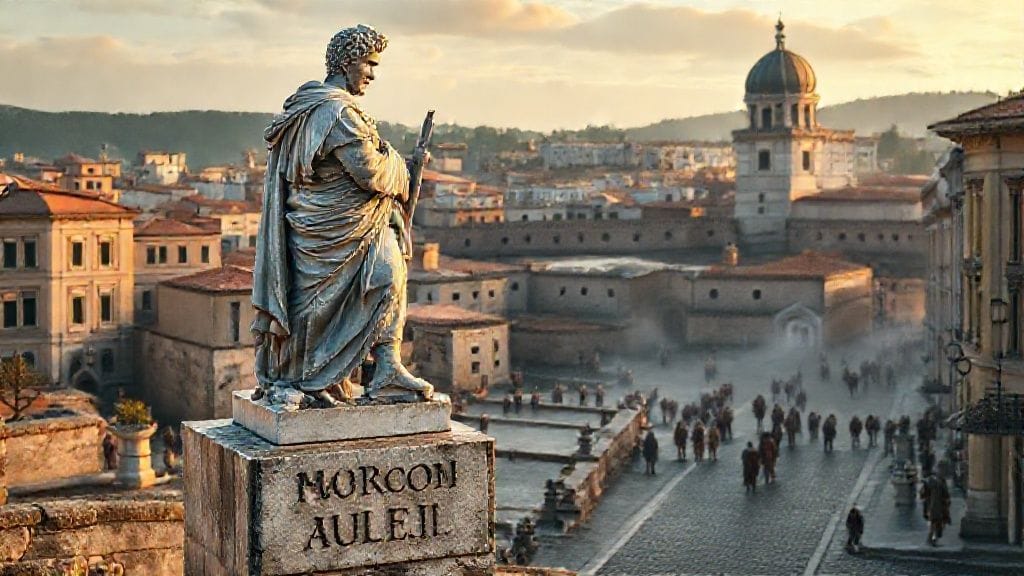
On a cold morning of March 17th, 180 AD, the twilight mists clung to the forests surrounding a Roman military camp at Vindobona — modern-day Vienna. There, amid the harsh sounds of war-hardened legions and distant barbarian threats, the last flicker in the life of one of Rome’s greatest emperors waned. Marcus Aurelius, philosopher, warrior, emperor, and reluctant heir to a fading golden age, breathed his final breath far from the marble palaces of Rome. His death marked not only the end of an era but the beginning of a fraught and turbulent passage for the empire he had labored tirelessly to preserve.
The scene was as unceremonious as it was poignant: an emperor dying not amidst luxury or splendor, but in a war camp surrounded by battle-scarred soldiers and hurried strategists. This was a man who had borne the weight of the world with stoic resolve, crafting his philosophical reflections while the empire trembled on Europe’s northern frontier. The result of decades of warfare, plague, and political strain pressed heavily on his body and spirit. Yet, even in death, Marcus Aurelius embodied a paradox — the stoic philosopher who ruled an empire teetering on the edge of crisis.
2. Marcus Aurelius: The Stoic Emperor's Legacy
Before delving into the dramatic circumstances of his death at Vindobona, one must understand who Marcus Aurelius was—and why his passing matters so deeply in the annals of Roman and world history. Born in 121 AD into Rome’s elite, Marcus was chosen for imperial rule not on birthright alone but through adoption by Emperor Antoninus Pius, a model of Roman governance and peace.
Marcus took the helm as emperor in 161 AD, sharing power with his adoptive brother Lucius Verus until the latter's death. A ruler steeped in Stoic philosophy, Marcus Aurelius’s reign was defined by thoughtful governance and a unique dedication to virtue and duty amidst relentless crises. His writing, Meditations, still resonates as a profound manual on inner strength and ethical leadership.
Despite his philosophical pursuits, Marcus was no detached intellectual. He was a soldier-emperor, compelled to face the brutal realities of the Marcomannic Wars along the Danube frontier. His reign’s challenges tested his resolve — barbarian invasions, epidemics, internal dissent, and the massive administrative machinery of the Roman state. His death at Vindobona symbolized the collision of contemplative leadership and unyielding military necessity.
3. The Roman Empire on the Brink in 180 AD
The Rome Marcus Aurelius inherited was vast, sprawling from Britain to Mesopotamia, yet increasingly vulnerable. The pax Romana—a near-century of relative peace—had frayed. External threats from migrating Germanic tribes surged on the empire’s northern borders, while internal tensions, economic strains, and plagues chipped away at its solidity.
By the late 170s AD, the northern frontiers bubbled with conflict. The Marcomanni, Quadi, and other tribes pressed against Rome’s limes, testing its legions. Italy itself faced plagues and resource depletion. Rome’s political structure, long based on layered senatorial authority and imperial oversight, was strained under the demands of war and succession.
Into this crucible stepped Marcus Aurelius: a committed philosopher but also a war leader. His reign was the last in the Antonine dynasty, a period often considered Rome’s high point. However, his death in 180 AD was the fulcrum, unbalancing an empire that would soon slide into instability.
4. The March to Vindobona: The Northern Frontier’s Crucible
Vindobona was not just a name on a map — it was a linchpin fortress at a strategic juncture in Roman defense. Situated on the Danube River’s northern banks, in what is now Vienna, Vindobona was a crucial military base guarding the empire’s vulnerable northeastern border against restless Germanic tribes.
Marcus Aurelius spent his final years campaigning in these forested borderlands, leading his legions in grueling sieges and skirmishes against a coalition of tribes. The region was rugged and perilous, its dense woodlands and marshes complicating logistics and combat. Communication with Rome was slow, and the emperor often faced the raw realities of leadership far from the marble forums and marble statues of the capital.
The presence of the emperor at Vindobona demonstrated his commitment to leading from the front. Yet this proximity to danger sealed his fate. The grueling campaigns, coupled with the stress of leadership and perhaps plague, wore him thin.
5. War and Weariness: The Marcomannic Wars Unfold
The wars Marcus Aurelius waged were long and grueling. The Marcomannic Wars (roughly 166–180 AD) were a series of fierce conflicts against Germanic and Sarmatian tribes. Unlike earlier frontier conflicts, these wars tested the empire’s endurance, manpower, and logistical capabilities to their limits.
These campaigns were fought over rugged terrain, during harsh winters and oppressive summers, with armies stretched thin and morale taxed. The Germanic tribes were no longer merely raiders; some sought permanent settlement inside Roman territory, inflaming tensions.
For Marcus, who prized order and discipline, these wars were a bitter necessity. His leadership was a blend of battlefield command and careful diplomatic negotiations with tribal leaders. His efforts delayed the empire’s fragmentation but could not restore the old peace.
6. Vienna’s Ancient Face: Vindobona as Military Lifeline
The city known today as Vienna had Roman roots deeply embedded in its military past. Vindobona was established as a legionary fortress under Emperor Augustus and evolved into a bustling military hub by the time of Marcus Aurelius.
More than a base, Vindobona was a frontline city balancing military readiness and civilian life. Barracks, walls, roads, and supply depots supported thousands of soldiers and their families. It was a microcosm of Roman organization, law, and engineering, set amidst a volatile landscape.
Marcus’s presence there symbolized the empire’s determination to hold the frontier, but it also underscored the limits of Roman dominance on the edge of the civilized world.
7. The Quiet Passing: Death in a War-Tent, Not a Palace
The death of Marcus Aurelius was not marked by imperial ceremony or grandeur. Instead, within the cramped and cold confines of a military tent, surrounded by physicians and loyal officers, the emperor succumbed to illness.
Ancient sources indicate he likely died of the plague that had ravaged the armies or possibly other ailments exacerbated by years in camp. His passing was peaceful but somber. Far from the marble structures of Rome’s palaces, his last moments were witnessed mostly by soldiers and attendants.
It is striking that such a towering figure of history died in such modest circumstances. Yet it was fitting for a man who had always championed Stoicism: dignity amid adversity, acceptance of fate’s hand.
8. News of the Emperor’s Death: Ripples Across Rome and Beyond
When word of Marcus Aurelius’s death spread, Rome was shaken. The public grief was profound — the “philosopher emperor” had ruled for nearly two decades through turbulent times, embodying an ideal of wise and virtuous leadership.
At the same time, anxiety gripped the empire. What would become of the military campaigns without Marcus’s steady hand? Could his son and successor, Commodus, rise to the challenge? Senators, soldiers, and citizens awaited news with bated breath.
The news reached Rome through messengers and heralds, triggering a blend of official mourning and political maneuvering. Temples held services, coins were minted in his honor, and the Senate debated the future.
9. Commodus’s Shadow: The Rise of a Controversial Heir
Marcus Aurelius’s choice to pass power to his biological son Commodus broke with the adoptive succession model that had served the empire so well. While Marcus was revered for his wisdom, Commodus was widely mistrusted for his erratic behavior and self-indulgence.
The transition exposed latent tensions within the empire’s elite and military. Commodus’s reign witnessed increasing moral and political decay, fueling historians’ judgment of the end of the “good emperors” era.
The death at Vindobona thus became a symbolic pivot — the moment the empire’s fortunes shifted from enlightened stewardship to decline and instability.
10. The Stoicism of Marcus Aurelius: Reflections in Meditations
If death is the ultimate teacher, Marcus Aurelius prepared for it thoughtfully long before his final moments. His Meditations, written intermittently on campaign, offer a window into an emperor wrestling with mortality, duty, and the nature of power.
These passages reveal a man committed to humility and endurance, grounding his leadership in a moral framework derived from Stoic principles. They humanize a figure otherwise overwhelmed by historical events, and they continue to inspire leaders and thinkers two millennia later.
11. Political and Military Ramifications of the Emperor’s Demise
Marcus Aurelius’s death meant more than a change of ruler—it created a vacuum of experience and authority at the apex of Roman power. The military momentum he had sustained slowed, and the carefully negotiated peace efforts on the frontier faltered.
Politically, his passing intensified factionalism in Rome. Senators vied for influence under the young Commodus; legions’ loyalty was tested without the familiar emperor’s guidance.
Beyond immediate effects, it marked the beginning of increasing instability that would haunt the empire for decades.
12. The Marcomannic Wars After Marcus: Continuity and Change
Though Marcus Aurelius died before the conclusion of the Marcomannic Wars, his generals continued the fight, demonstrating the institutional strength of Rome’s military.
However, without the emperor’s personal leadership, campaigns became less effective and more costly. The wars dragged on, exacting further tolls on soldiers and civilians alike.
Eventually, Rome adopted more defensive strategies, signaling a strategic shift and foreshadowing future pressures on frontier provinces.
13. The Roman Army’s Loyalty Tested and Transformed
The emperor’s death on a battlefield tent was a stark reminder of the personal link between the Roman army and its leader. Loyal to Marcus, the legions faced the new reality of Commodus’s reign with uncertainty.
Military discipline and morale fluctuated, affected by political interference and Commodus’s erratic policies. Over time, this strained the cohesion of Rome’s frontier defenses.
Nevertheless, the army remained Rome’s backbone, adapting to new challenges even as imperial authority wavered.
14. The Empire’s Fragile Stability: The End of the Pax Romana?
Many historians view Marcus Aurelius’s death as the symbolic end of the Pax Romana—a two-century period of relative peace and prosperity. That peace had been precarious, but it was anchored by strong leadership and institutional cohesion.
Post-180 AD, the empire confronted escalating internal strife, economic difficulties, and external threats that culminated in the crises of the third century.
Marcus’s death does not alone cause Rome’s decline, but it marks a profound turning point in the empire’s historical trajectory.
15. Vienna as a Strategic Fortress: Vindobona after Marcus Aurelius
Following Marcus’s death, Vindobona retained its primacy as a Roman military outpost. The city evolved, growing from fort to frontier metropolis, a bulwark against incoming tribes.
Archaeological remains attest to its continuous significance, including walls, barracks, and roads built and rebuilt over centuries.
Vindobona’s legacy as a sentinel city endures in Vienna’s modern identity, linking the metropolis to its Roman martial past.
16. Philosophical Immortality vs. Historical Reality
Marcus Aurelius’s death poses a striking contrast between the immortal legacy of ideas and the mortal frailty of leaders. While history records his death as an endpoint, his philosophical contributions transcend time.
In Meditations, he contemplates acceptance of death with grace. Yet history reminds us that human governance is relentlessly mundane, marked by uncertainty and impermanence.
His death in Vindobona humanizes the mythic “philosopher emperor,” reminding us of leadership’s demands and limitations.
17. Marcus Aurelius in Roman and Modern Memory
Ancient writers praised Marcus’s virtues, though some critiqued his inability to secure a stable succession. The Stoic ideal he personified shaped Roman notions of rulership.
In modern culture, Marcus remains a symbol of wise leadership and stoic endurance. Scholars, military leaders, and thinkers reference his life and works as guides for navigating adversity.
His death at Vindobona thus resonates as a powerful narrative of idealism meeting history’s harsh realities.
18. History’s Judgment: The Philosopher King
The label “philosopher king” encapsulates Marcus’s unique place in history. He governs not just through force, but through virtue and wisdom—a model epitomized in the classical ideal.
His death sealed his image as a tragic yet noble figure, an emperor who sought to administer a crumbling empire with dignity and rationality, even as the tides turned against him.
History judges him as one of Rome’s best and most human emperors, a beacon amid chaos.
19. Lessons from the Death at Vindobona: Leadership amid Crisis
The last moments of Marcus Aurelius offer enduring lessons about the burdens of leadership—especially in times of crisis. His perseverance, humility, and philosophical resolve resonate in any era faced with uncertainty and upheaval.
The quiet death of a man burdened by empire is a reminder that even the most powerful are vulnerable, and that true leadership lies as much in character as in conquest.
His life and death inspire reflection on values, mortality, and the heavy cost of responsibility.
Conclusion
Marcus Aurelius’s death on March 17th, 180 AD, at Vindobona transcends biography and politics to become a symbol of leadership’s complexity in a fractured world. Here, beneath the shadowed trees of an embattled frontier, a philosopher-emperor closed his eyes amid the rumble of war and uncertainty, embodying the timeless struggle between idealism and reality.
His passing marked the end of the Pax Romana and the beginning of a new, more turbulent chapter in Roman history. Yet, it also immortalized a man whose introspective writings and stoic virtues continue to speak across the centuries. Marcus Aurelius reminds us that the greatest empires are fragile, that leadership demands sacrifice, and that wisdom and resilience remain the most enduring legacies of power.
The death at Vindobona is not merely an ancient event; it is an eternal story of human courage, loss, and the search for meaning amid chaos.
FAQs
Q1: What caused Marcus Aurelius’s death at Vindobona?
A1: Ancient sources suggest Marcus Aurelius died of natural causes, likely exacerbated by the plague that ravaged his armies or other chronic illnesses. His years leading campaigns under harsh conditions weakened his health.
Q2: Why was Marcus Aurelius campaigning at Vindobona instead of ruling from Rome?
A2: Marcus believed in leading by example and personally overseeing the defense of Rome’s troubled northern frontiers. His presence was meant to inspire troops and manage complex military operations.
Q3: How did Marcus Aurelius’s death affect the Roman Empire politically?
A3: His death destabilized the imperial leadership, marking the end of the wise Antonine dynasty and the rise of his son Commodus, whose erratic reign contributed to political instability and decline.
Q4: What was the significance of Vindobona in the Roman Empire?
A4: Vindobona was a strategic military base protecting the Danube frontier. It served as a bulwark against Germanic invasions and a center of Roman military and administrative power in Central Europe.
Q5: How is Marcus Aurelius remembered today?
A5: He is venerated as a philosopher-king, symbolizing wisdom, duty, and stoic endurance. His Meditations remain influential works in philosophy, leadership, and personal resilience.
Q6: What were the main challenges facing the empire when Marcus Aurelius died?
A6: The empire grappled with external threats from Germanic tribes, ongoing wars, plagues, economic stress, and the looming uncertainty of imperial succession under Commodus.
Q7: How did the Marcomannic Wars continue after Marcus Aurelius’s death?
A7: Roman generals carried on the campaigns, but lacking Marcus’s leadership, progress slowed and the conflicts became more protracted, straining imperial resources.
Q8: Why did Marcus Aurelius’s death mark the end of the Pax Romana?
A8: His reign had maintained relative peace through strong leadership and diplomacy. After his death, the empire faced escalating crises and fragmentation, signaling the decline of the Pax Romana era.