Table of Contents
- The Final Days in Milan: April 4, 397
- Ambrose of Milan: A Life Forged in Faith and Power
- The Religious Landscape of Late 4th Century Italy
- The Rise to Bishopric: Ambrose’s Path to Milan
- The Emperor and the Bishop: Power and Piety Intertwined
- Ambrose’s Struggles Against Arianism and Paganism
- His Role in Shaping Early Western Christianity
- The Social and Political Influence of Ambrose in Milan
- The Last Sermons: Preparing a City for His Departure
- The Unexpected Death: Milan Mourns a Patriarch
- Public Reaction and the City's Grief
- Funeral Rites and the Burial of a Saint
- Ambrose’s Written Legacy: Hymns, Letters, and Treatises
- The Cult of Ambrose: Veneration and Sanctification
- The Long Shadow: Ambrose’s Influence Through the Middle Ages
- Modern Reflections on Ambrose’s Death and Impact
- Conclusion: A Bishop Whose End Marked a New Dawn
- FAQs: Exploring the Life and Death of Ambrose of Milan
- External Resource
- Internal Link
1. The Final Days in Milan: April 4, 397
Imagine the city of Milan at the cusp of spring in the year 397 AD. The air carried a biting chill common to northern Italy’s early April—a coldness that contrasted sharply with the warmth and constancy of the crowds that thronged the basilicas and forums. The streets buzzed with hushed whispers, for the towering figure of Ambrose, the great bishop who had shepherded this city through fire and upheaval, was gravely ill. His breath, once resonant with fiery sermons and commands, now barely stirred the still air of his chamber. On that day, April 4th, Ambrose of Milan quietly passed from this world, leaving behind a city—and a church—transformed by his indomitable spirit.
His death marked more than the passing of a man. It was the closing of an era that saw Christianity wrestle with paganism and heresy, intertwined deeply with the imperial power of Rome’s late antique rulers. Ambrose’s presence had been as much political as it was religious, and his departure would send ripples across the empire that would be felt for centuries. But as the city mourned, a new chapter for Milan and the Western Church was already on the horizon.
2. Ambrose of Milan: A Life Forged in Faith and Power
Flavius Ambrosius, known simply as Ambrose, was not born into a religious calling—it was the brutality of circumstances and a fate intertwined with the empire that thrust him into the episcopal throne. Born around 340 AD into a Roman family of senatorial rank, Ambrose was trained as a lawyer and statesman, a man of rhetoric and reason rather than of prayer and asceticism. Yet the course of his life altered dramatically when he was unexpectedly chosen as bishop of Milan in 374 AD, a nomination that stunned the city for he was still a catechumen, not even baptized.
Despite the shock of his appointment, Ambrose rose to the immense responsibilities with a firm resolve. His tenure as bishop was legendary—marked by fierce opposition to pagan and Arian factions, an unwavering defense of Nicene Christianity, and a keen sense of political savvy that often put him at odds with emperors. But it was this merging of spiritual zeal and worldly influence that made Ambrose such a pivotal character in early Church history.
3. The Religious Landscape of Late 4th Century Italy
To understand Ambrose’s death and its significance, one must first glimpse the turbulent religious waters of late 4th century Italy. Christianity had only recently become the favored religion of the empire after Constantine’s conversion and the Edict of Milan (313 AD). Still, myriad beliefs jostled for supremacy—traditional Roman paganism, various Christian sects like Arianism, which denied the full divinity of Christ, and other heterodox movements.
Milan, as the imperial capital in the West, was a hotbed for these competing ideologies. The religious conflicts were not merely theological—they were battles for social control, identity, and legitimacy. Ambrose, by firmly advocating the orthodox Nicene faith, positioned himself as the defender of both the city’s soul and the moral compass of the empire itself.
4. The Rise to Bishopric: Ambrose’s Path to Milan
Ambrose’s appointment to the bishopric was as dramatic as it was sudden. In 374 AD, following the death of the previous bishop, a tense stalemate between Arians and Nicenes emerged. As the city's governor overseeing the election, Ambrose’s name was unexpectedly acclaimed by the people, despite his own embarrassment—he was a pagan convert newly baptized and untrained for pastoral care.
Swept up by popular demand and despite his incompletion in ecclesiastical training, Ambrose embraced the role, setting out to learn and lead simultaneously. His ascension was a decisive moment that underscored the deep connection between civic and religious life in Milan, and the powerful grassroots support the Church was beginning to garner.
5. The Emperor and the Bishop: Power and Piety Intertwined
Throughout his episcopate, Ambrose walked a delicate, often contentious tightrope with the emperor. Milan housed the Western Roman Emperor’s court, and Ambrose developed a close yet complex rapport with emperors such as Valentinian II. Unlike many bishops who were mere spiritual advisors, Ambrose exercised incredible political influence.
One famous episode that encapsulates this relationship was the confrontation with Emperor Theodosius I following the massacre of Thessalonica’s inhabitants. Ambrose famously excommunicated the emperor, demanding public penance before readmitting him to communion. This bold move signaled a new era where the Church asserted moral authority even over imperial power, a precedent with far-reaching consequences.
6. Ambrose’s Struggles Against Arianism and Paganism
Ambrose’s lifetime coincided with a doctrinal turmoil that threatened the unity of the Church. Arianism, a creed denying Christ’s full divinity, enjoyed substantial popularity, including among some Roman elites and emperors. Simultaneously, paganism clung to its fading hold, especially among the aristocracy and traditional Roman institutions.
Ambrose wielded his voice, his pen, and his personal charisma against these rival faiths. He convened synods, preached tirelessly, and even physically protected Nicene worshippers, famously barring pagan rituals at the sacred sites of the city. His commitment culminated in enduring victories that cemented Christianity’s dominance in the West.
7. His Role in Shaping Early Western Christianity
Ambrose’s contributions extended beyond Milan’s walls. He was a father of Western theological thought, influencing key developments in ecclesiology and doctrine. His writings on the relationship between Church and State, the nature of grace, and Christian ethics shaped not only contemporaries but future generations.
Moreover, Ambrose’s promotion of hymns and liturgy enriched the spiritual life of the Church and birthed traditions that echo to this day. His role in mentoring young Augustine of Hippo stands as a testament to his intellectual and spiritual legacy.
8. The Social and Political Influence of Ambrose in Milan
Under Ambrose’s stewardship, the bishopric of Milan evolved into a powerful institution, blending spiritual leadership with social welfare and political advocacy. He championed the poor, negotiated city disputes, and reinforced the Church’s role as protector of the vulnerable against imperial and aristocratic exploitation.
Ambrose’s unique position allowed him to act as mediator and moral conscience, guiding Milan through times of famine, unrest, and imperial politics with a rare combination of empathy and authority.
9. The Last Sermons: Preparing a City for His Departure
As illness crept upon Ambrose in the spring of 397, his sermons gained an added poignancy. He spoke not only of salvation and the afterlife but also exhorted his flock to remain steadfast in faith and charity. His voice, though frail near the end, carried immense weight—his legacy already indelibly etched in the hearts of his contemporaries.
These final moments became emblematic of a spiritual patriarch readying his community to face the future without his guidance.
10. The Unexpected Death: Milan Mourns a Patriarch
Ambrose’s death on April 4, 397, came as a shock to Milan. Though his health had waned, few were prepared for the sudden void his passing would create. The city, deeply attached to its shepherd, plunged into collective mourning.
Documentation from the era describes the profound grief that engulfed Milan’s populace, transcending socio-economic boundaries and echoing in the silence of empty churches and closed shops.
11. Public Reaction and the City's Grief
Reports indicate that thousands gathered for public lamentations, with mourners lining funeral routes and clergy chanting hymns that Ambrose himself had composed. The bishop's role as both spiritual leader and civic icon meant his loss resonated as both holy and political.
Even pagan citizens, once adversaries, recognized the magnitude of the bishop’s influence, demonstrating his rare ability to unify Milan’s diverse inhabitants under shared devotion.
12. Funeral Rites and the Burial of a Saint
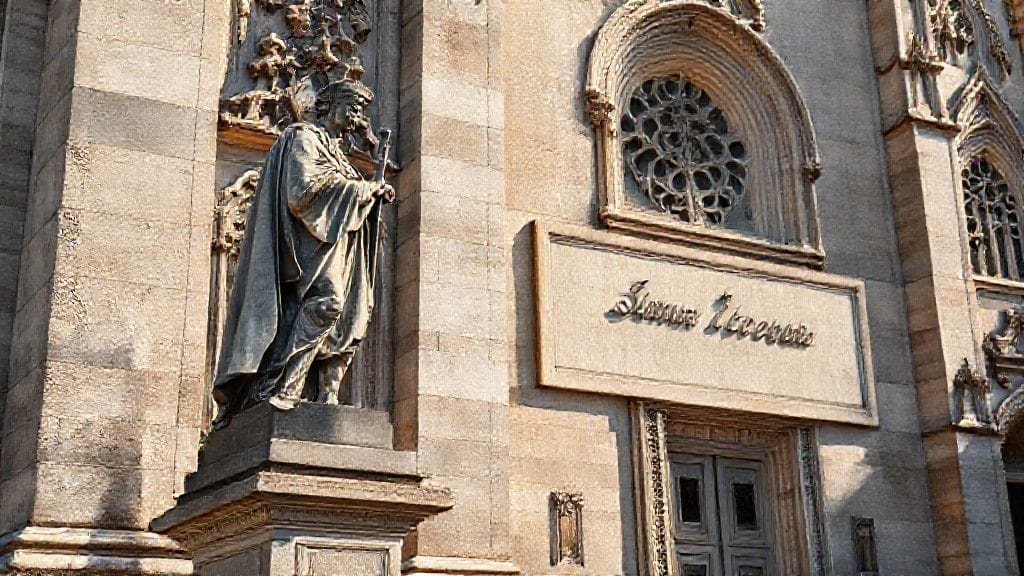
Ambrose was interred in the Basilica of St. Ambrose, a sacred site he had commissioned. The funeral rites intertwined Christian piety with the grandeur befitting a man of his stature. The ceremony was marked by prayers, processions, and the presence of clerics and imperial dignitaries alike.
Over time, the site became a pilgrimage destination, a tangible symbol of Ambrose’s enduring sanctity and the city’s gratitude.
13. Ambrose’s Written Legacy: Hymns, Letters, and Treatises
Ambrose left behind a rich corpus of writings—hymns that still find their place in liturgy, eloquent letters addressing theological and political issues, and treatises defending orthodox doctrine.
Among these, the hymn "Veni Redemptor Gentium" stands out as an early example of Western Christian hymnody. His letters reveal a vivid dialogue with emperors and church figures, offering a remarkable window into fourth-century Christendom's complexities.
14. The Cult of Ambrose: Veneration and Sanctification
Shortly after his death, Ambrose’s influence burgeoned into veneration as a saint. Miracles attributed to him began circulating, and his feast day became a fixture in the liturgical calendar. The cult of Ambrose played a vital role in strengthening the Milanese identity and promoting the sanctity of the Church’s mission.
His legacy was institutionalized through liturgy, iconography, and the dedication of churches across Italy and beyond.
15. The Long Shadow: Ambrose’s Influence Through the Middle Ages
Ambrose’s death did not diminish his impact; on the contrary, medieval theologians elevated him as a Church Father. His teachings informed the development of Western Christian thought, influencing figures like Gregory the Great and Thomas Aquinas.
Throughout centuries, Ambrose remained an authoritative voice concerning the relationship between spiritual and earthly powers, a legacy that profoundly shaped Christendom’s political theology.
16. Modern Reflections on Ambrose’s Death and Impact
Today, scholars continue to explore Ambrose’s death as a pivotal moment not only for Milan but for the trajectory of Western Christianity. Modern theology, history, and cultural studies alike recognize the bishop as a bridge between Roman imperial tradition and the burgeoning medieval world.
His life and death invite reflection on leadership, faith, and the power of conviction amid societal upheaval—a resonance as relevant in our time as in the late 4th century.
17. Conclusion: A Bishop Whose End Marked a New Dawn
Ambrose of Milan’s death was far more than the conclusion of a remarkable life—it was the passing of the torch from an age of turmoil to one of consolidation for the Western Church. His steadfast defense of orthodoxy, his bold assertion of the Church’s authority, and his pastoral care forged a template for episcopal leadership that would endure for millennia.
As Milan’s streets echoed with mourning and praise, history quietly acknowledged that though Ambrose was gone, his influence was immortal. From the embers of late antiquity, a new Christian Europe began to rise, animated by the legacy of its towering bishop.
18. FAQs: Exploring the Life and Death of Ambrose of Milan
Q1: Why was Ambrose chosen as bishop despite not being baptized at the time?
Ambrose was acclaimed by the people of Milan amidst conflict between religious factions. His reputation for fairness and leadership made him a unifying candidate, prompting his rapid baptism and subsequent ordination.
Q2: What was Ambrose’s role in the conflict with Emperor Theodosius?
He famously compelled Theodosius I to perform public penance for the massacre of Thessalonica, asserting the moral authority of the Church over imperial actions.
Q3: How did Ambrose combat Arianism and paganism in Milan?
Through sermons, synods, and direct intervention, Ambrose promoted Nicene Christianity and prohibited pagan worship, strengthening orthodox dominance.
Q4: What writings of Ambrose have had lasting influence?
His hymns, letters, and treatises—such as those on Church authority and Christian ethics—remain significant, with his hymns influencing Western liturgical music.
Q5: How was Ambrose’s death received by the people of Milan?
With profound grief and public mourning, reflecting his role as both spiritual leader and civic figure.
Q6: What is Ambrose’s legacy in Christian history?
As a Church Father, martyr in a metaphorical sense for doctrine, and architect of Church-State relations, his influence shaped medieval and modern Christian thought.
Q7: How is Ambrose commemorated today?
He is venerated as a saint with a feast day on December 7, and his writings and hymns continue to inspire Christian worship.