Table of Contents
- The Final Days of Augustine: Hippo Regius in Late August 430
- Augustine’s Last Breath: Death Amidst Siege and Turmoil
- The Rise of a Theologian: Augustine’s Early Life and Calling
- The Intellectual Landscape of Late Antiquity
- Hippo Regius: A City at the Crossroads of Empire and Invasion
- The Vandal Threat: A Kingdom on the Brink
- Augustine’s Role as Bishop: Shepherd in Troubled Times
- The Siege of Hippo: War, Famine, and Faith
- Writing in the Shadow of Death: Augustine’s Final Works
- “Confessions” and “The City of God”: Legacy in Words
- The Impact of Augustine’s Death on the Church and North Africa
- The Fall of Hippo and the Vandal Conquest
- Augustine’s Theology: Enduring Influence on Western Christianity
- The Human Side of a Saint: Personal Struggles and Spiritual Resolve
- Memory and Myth: Augustine’s Death in History and Tradition
- The Broader Context: Rome’s Waning Influence in Africa
- The Role of Numidia: Political and Cultural Backdrop
- Augustine’s Death as a Historical Symbol
- The Story Continues: Hippo Regius After Augustine
- How Augustine Shapes Contemporary Thought
- Conclusion: Augustine’s Death as a Turning Point for Church and Empire
- FAQs: Exploring Augustine’s Final Hours and Lasting Legacy
- External Resource
- Internal Link
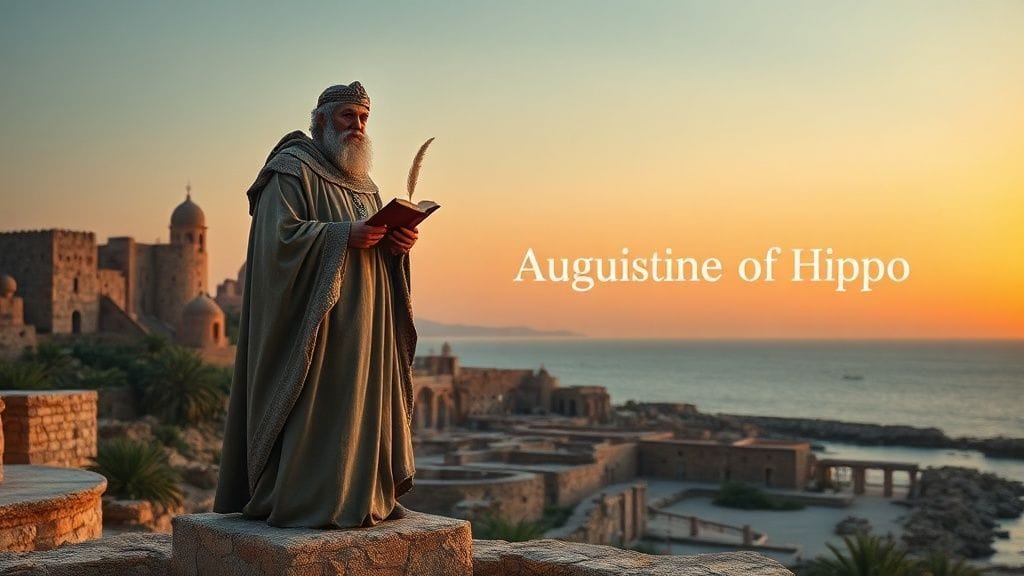
In the heat of a late August summer, the city of Hippo Regius, a once-thriving Roman port on the North African coast, found itself gripped by anxieties far beyond the ordinary. The year 430 AD marked a chilling moment in history where the relentless tide of barbarian invasions, political betrayals, and religious ferment converged upon this small but vital city. Amidst the clatter of siege engines and the murmur of prayers, Augustine of Hippo—bishop, theologian, philosopher—drew his final breath. That moment, August 28, 430, was not merely the passing of a man but the closing of an epoch.
The air was heavy with the dust of war and the scent of incense. Citizens huddled in dim churches, their eyes swimming between fear and faith, wondering if salvation might come from the heavens or take a more earthly shape. Augustine, worn but unyielding, had spent decades shaping the soul of Christendom and wrestling with the apocalyptic crises shaking the ancient world. As the Vandals pressed ever closer, he faced death with the calm of a shepherd comforting his flock amid the storm.
But who exactly was Augustine at his death? What had led the once wild youth from the shores of Numidia to become one of Christianity’s most towering figures? And how did his demise mark a subtle but profound turning point, echoing across centuries and continents alike? This is the story of Augustine of Hippo’s death—an event that encapsulates the twilight of Roman Africa, the rise of medieval Christendom, and the resilient spirit of human hope amid collapse.
The Final Days of Augustine: Hippo Regius in Late August 430
By August 430, Hippo Regius was no longer the tranquil city where Augustine had served as bishop for over three decades. The walls, built during more peaceful times, now shuddered under the fury of a Vandal siege. The tensions between the indigenous Berber communities, Roman settlers, and the invading forces created a volatile atmosphere. Augustine, now nearly 76 years old, was reportedly bedridden, weakened by years of illness, yet still immersed in theological reflection and pastoral care.
The siege itself was brutal but uneven. Food supplies dwindled, fires broke out within the city limits, and a nervous populace turned frequently to religion for solace. Augustine, aware of his looming mortality, continued to write letters and sermons, urging patience and faith. His death occurred just days before the final fall of the city, which happened under less auspicious conditions, heralding a new era under Vandal dominance.
Augustine’s Last Breath: Death Amidst Siege and Turmoil
Contemporary accounts suggest Augustine’s last moments were marked by a serene acceptance—far removed from the violence outside. Possessing a mind still sharp and a voice gentle, he was reported to have received the last rites in a quiet chapel. Witnesses spoke of his peace despite the chaotic backdrop, a testament to the spiritual conviction that had defined his life.
Yet it is important to imagine the emotional reality for those around him: the loss of a spiritual leader was a profound wound to a city already besieged by despair. His death was more than a historical fact—it was a mythic moment for Christianity, a passing of the torch in a time of upheaval and transformation.
The Rise of a Theologian: Augustine’s Early Life and Calling
Augustine’s journey to Hippo and eventual sainthood was anything but preordained. Born in 354 AD in Thagaste, Numidia (modern-day Souk Ahras, Algeria), he was the son of a Romanized middle-class family; his mother Monica was a devout Christian, and his father a pagan who converted late in life. Augustine’s youth was marked by intellectual restlessness and a search for meaning, ranging from rhetoric and philosophy to Manichaeism and skepticism.
It was only after a profound spiritual crisis and the influence of Bishop Ambrose of Milan that Augustine embraced Christianity fully. Returning to North Africa, he rose rapidly in ecclesiastical ranks, eventually becoming Bishop of Hippo in 395 AD. His early struggles and conversion experience added depth and humanity to his later theological work.
The Intellectual Landscape of Late Antiquity
Augustine lived in an era defined by both the decay of classical Roman institutions and the ferment of Christian theology. Philosophical schools mixed with diverse religious movements—Neoplatonism, Manichaeism, Donatism, and Pelagianism vied for followers. The Roman Empire itself was fracturing, east and west diverging politically and culturally.
In this milieu, Augustine stood as a towering mind, able to synthesize classical philosophy with Christian doctrine, advancing ideas about grace, free will, original sin, and the nature of the church. His writings sought to provide reassurance amidst uncertainty, asserting a divine order beneath human chaos.
Hippo Regius: A City at the Crossroads of Empire and Invasion
Once a prosperous hub in Roman Africa, Hippo Regius combined Mediterranean commerce, ecclesiastical importance, and local Berber influences. Its position made it vulnerable but also vital. By the early 5th century, the city faced mounting threats as the Western Roman Empire’s grip slackened.
Located near modern-day Annaba, Algeria, Hippo had been a melting pot of cultures and tensions—Roman settlers, Berber tribes, and Christian communities lived side by side, sometimes harmoniously, sometimes in strife. Under pressure from external invaders and internal fissures, Hippo came to symbolize the larger fate of Roman Africa.
The Vandal Threat: A Kingdom on the Brink
The Vandals, a Germanic people, crossed into North Africa in 429 under their king Geiseric. Initially invited as foederati (federated allies), the Vandals soon pursued conquest, challenging Roman control. Their campaign was swift and ruthless, reshaping the political and social landscape.
For Augustine, the Vandals represented not only a political threat but a religious one. The Vandals were Arian Christians, a sect considered heretical by orthodox Catholics, complicating sectarian divisions already present in the region. The siege of Hippo was thus both a military and spiritual confrontation.
Augustine’s Role as Bishop: Shepherd in Troubled Times
As the bishop of Hippo, Augustine was far more than a spiritual leader. He was an administrator, advisor, and sometimes political actor who mediated between Roman authorities and local tribes. His pastoral role grew heavier with each crisis: the Donatist schism divided his flock, famine and plague ravaged the region, and external threats mounted.
Augustine’s letters and sermons reveal a man deeply invested in the moral and social health of his community. Yet his position was precarious, balancing loyalty to a crumbling empire with the urgent realities on the ground.
The Siege of Hippo: War, Famine, and Faith
The siege that culminated in Augustine’s death was a crucible of suffering and endurance. Sources recount starvation, disease, and spiritual desperation. Churches became sanctuaries and hospitals; prayers echoed through battered streets. Augustine’s presence, even as his strength waned, was a beacon amid chaos.
The citizens faced not only the external enemy but internal divisions. Donatists opposed to Augustine’s orthodox faction undermined unity. Yet in these final days, a sense of shared fate emerged, binding the people through faith and hardship.
Writing in the Shadow of Death: Augustine’s Final Works
Even in his last years, Augustine remained intellectually productive. His ongoing battles with theology—particularly the nature of grace and predestination—found expression in unfinished treatises and intense correspondence.
These final writings, tinged with awareness of mortality, offer remarkable insight into a man who knew his life’s work was nearing its end amid uncertain times. The fragility and urgency in his words bridge the personal and the universal.
“Confessions” and “The City of God”: Legacy in Words
Augustine’s literary achievements are monumental. His Confessions, an autobiographical spiritual journey, revolutionized Christian introspection and autobiography. The City of God, written partly in response to Rome’s sack by the Visigoths in 410, redefined the relationship between the earthly and heavenly realms.
These works resonated far beyond their time, shaping Western thought, philosophy, and theology for millennia. Their influence colors how humanity contemplates faith, doubt, and the nature of history—making Augustine’s death not merely an endpoint but a gateway.
The Impact of Augustine’s Death on the Church and North Africa
Augustine’s passing left a spiritual vacuum in Hippo and the wider African church. The imminent Vandal conquest underlined the vulnerability of Roman Christianity in Africa. Over the coming decades, much of the region would oscillate between orthodox and Arian control, reflecting wider struggles within the Christian Church.
His death also galvanized his followers to preserve and disseminate his teachings, ensuring the continuation and dominance of his theological vision. Augustine became, posthumously, an icon of Christian orthodoxy and intellectual rigor.
The Fall of Hippo and the Vandal Conquest
Shortly after Augustine’s death, the Vandals successfully captured Hippo, turning it into an important center of their North African kingdom. The city’s fall symbolized the wider collapse of Roman authority across Africa, paving the way for a new phase in regional history. The Vandals ruled until the Byzantine reconquest in the 6th century, reshaping the religious and political fabric.
Augustine’s era was definitively over. Yet his legacy endured, even as empires and kingdoms rose and fell around the Mediterranean rim.
Augustine’s Theology: Enduring Influence on Western Christianity
Augustine’s codification of doctrines such as original sin, divine grace, and the nature of the Trinity laid foundations still central in Catholic, Protestant, and Orthodox thought. His intellectual rigor combined with deep spirituality bridged classical philosophy and medieval theology in a way few have matched.
His ideas impacted not only religion but also political philosophy, ethics, and psychology. The reverberations of his death were felt in the silence left behind and the ideas that lived on.
The Human Side of a Saint: Personal Struggles and Spiritual Resolve
Behind the theological giant was Augustine the man: a complex figure grappling with doubt, ambition, and frailty. His letters reveal moments of frustration, loneliness, and hope. His death in a besieged city, far from the grandeur of empires, grounds his story in human reality—a blend of suffering, faith, and resilience.
This personal dimension adds depth to the historical narrative, inviting empathy and reflection.
Memory and Myth: Augustine’s Death in History and Tradition
Over centuries, Augustine’s death has been surrounded by legend and hagiography. Stories emphasize miraculous calm, divine presence, and the fulfillment of prophetic vision. Medieval chroniclers and later historians have shaped these narratives, blending fact and faith.
Understanding these stories helps reveal how memory molds history, turning events into symbols and icons. Augustine’s death became as much an idea as a moment.
The Broader Context: Rome’s Waning Influence in Africa
Augustine’s final chapter was inseparable from the decline of Roman imperial power in the West. Africa had once been a jewel of the empire, providing grain, wealth, and stability. By 430, political fragmentation and external pressures made this prosperity fragile.
The loss of Africa to the Vandals was a severe blow to Rome and a foreshadowing of further collapse. Augustine stood at this intersection, a spiritual sentinel over a dying world.
The Role of Numidia: Political and Cultural Backdrop
Roman Numidia, Augustine’s homeland, was a mosaic of urban Romanized cities, rural Berber tribes, and emerging Christian communities. Its unique cultural synthesis shaped Augustine’s worldview—combining Roman education, African traditions, and Christian faith.
Political tensions and local conflicts framed the backdrop of Augustine’s ministry and eventual death, illustrating the complexities of identity and power in late antiquity.
Augustine’s Death as a Historical Symbol
Beyond the local tragedy, Augustine’s death assumed symbolic weight as a marker of change. It signified the end of an era of classical Christianity and the beginning of Christendom’s medieval phase. At a time when old orders collapsed and new forces emerged, Augustine’s life and death became a narrative of continuity amidst rupture.
The Story Continues: Hippo Regius After Augustine
Though Augustine was gone, Hippo’s story did not end. Under Vandal rule, and later Byzantine and Arab conquests, the city evolved, retaining traces of its Roman and Christian heritage. The memory of Augustine and his impact continued to inspire religious communities and intellectual traditions.
How Augustine Shapes Contemporary Thought
Today, Augustine remains a figure of intense study and debate. Philosophers, theologians, historians, and popular readers return to his works for insight into faith, reason, and the human condition. His reflections on memory, time, and the self resonate deeply in modern discussions.
Augustine’s death, therefore, did not silence his voice but amplified it through the centuries.
Conclusion
The death of Augustine of Hippo on August 28, 430, stands as more than a historical event—it is a timeless human drama set against the twilight of an empire, the turbulence of faith, and the unyielding search for meaning. In the besieged city of Hippo Regius, as warriors closed in and chaos reigned, a weary bishop closed his eyes with a serene heart, leaving behind a spiritual and intellectual legacy that continues to shape our world.
Augustine’s death symbolizes both an ending and a beginning—the close of Roman Africa’s golden age and the rise of a Christian Europe deeply marked by his thought. Far beyond political fallouts and military conquests, his passing invites reflection on endurance, conviction, and the power of ideas to transcend history’s upheavals.
In the silence after his final breath, the whisper of ancient wisdom took flight, navigating centuries, speaking still to those who seek understanding in the fragments of past and faith.
FAQs
Q1: What were the circumstances surrounding Augustine’s death?
A: Augustine died on August 28, 430, during the Vandal siege of Hippo Regius. Despite being ill and weakened, he remained engaged in pastoral work and writing until the end, passing away peacefully amid turmoil.
Q2: Why was Augustine in Hippo Regius?
A: Augustine served as Bishop of Hippo Regius for over 30 years, overseeing the Christian community, engaging theological debates, and guiding his flock through political and religious upheavals.
Q3: How did the Vandal invasion affect Augustine’s final days?
A: The Vandal siege created food shortages, fear, and social unrest in Hippo. Augustine continued to provide spiritual leadership during these hardships and died shortly before the city fell to the Vandals.
Q4: What is Augustine’s enduring legacy in Christianity?
A: Augustine’s theological contributions—including teachings on grace, original sin, and the nature of God—shaped Western Christian doctrine profoundly and continue to influence Christian thought to this day.
Q5: How did Augustine’s death affect the local community?
A: His death left a spiritual void in Hippo amid ongoing war and instability, but also inspired his followers to preserve his teachings, helping to maintain the Christian identity in a time of crisis.
Q6: What role did Augustine’s writings play in history?
A: Works like Confessions and The City of God not only responded to the crises of their times but became foundational texts for Christian theology, philosophy, and literature throughout the Middle Ages and beyond.
Q7: How is Augustine remembered today?
A: Augustine is venerated as a saint, Doctor of the Church, and one of the most influential thinkers in Western history, remembered both for his spiritual depth and intellectual brilliance.
Q8: What happened to Hippo Regius after Augustine’s death?
A: The city fell to the Vandals shortly after his passing, later changing hands through Byzantine and Arab rule, with Augustine’s legacy remaining a key element of its Christian heritage.