Table of Contents
- The Final Days of a Genius: Alhazen’s Last Breath in Cairo
- The World at the Dawn of the 11th Century: A Crossroads of Cultures and Knowledge
- Ibn al-Haytham: The Life of a Pioneer in Optics and Philosophy
- From Basra to Cairo: The Journey of a Visionary Scholar
- The Intellectual Climate of Medieval Egypt: A Fertile Ground for Innovation
- The Siege of Knowledge: Political Geography of the Islamic Golden Age
- Alhazen’s Magnum Opus: The “Book of Optics” as a Beacon of Rational Inquiry
- The Personal Struggles Behind the Scholar’s Triumphs
- The Twilight Years: Alhazen’s Declining Health and Continued Influence
- Death in the Heart of Cairo: The Passing of Ibn al-Haytham in 1040
- Immediate Reactions: How Scholars and Society Received His Passing
- The Legacy Embodied: Transmission of Alhazen’s Ideas to the Medieval West
- The Renaissance Rediscovery: From Arabic Manuscripts to European Thinkers
- Optical Science and Philosophy: A New Dawn Sparked by Ibn al-Haytham
- The Enduring Human Legacy: Vision, Skepticism, and the Scientific Method
- Cairo’s Historical Memory: How the City Remembers Its Forgotten Genius
- Alhazen in Modern Scholarship: A Reappraisal of His Contributions
- The Interplay of Faith and Reason in Alhazen’s Thought
- The Influence of Political Instability on Scholars’ Lives in Medieval Cairo
- How Alhazen’s Death Marked a Turning Point in the History of Science
- A Global Reverberation: The Spread of Alhazen’s Legacy Beyond Egypt and Islam
- Conclusion: The Eternal Sight of Ibn al-Haytham
- FAQs: Unraveling the Mysteries of Alhazen’s Life and Death
- External Resource
- Internal Link
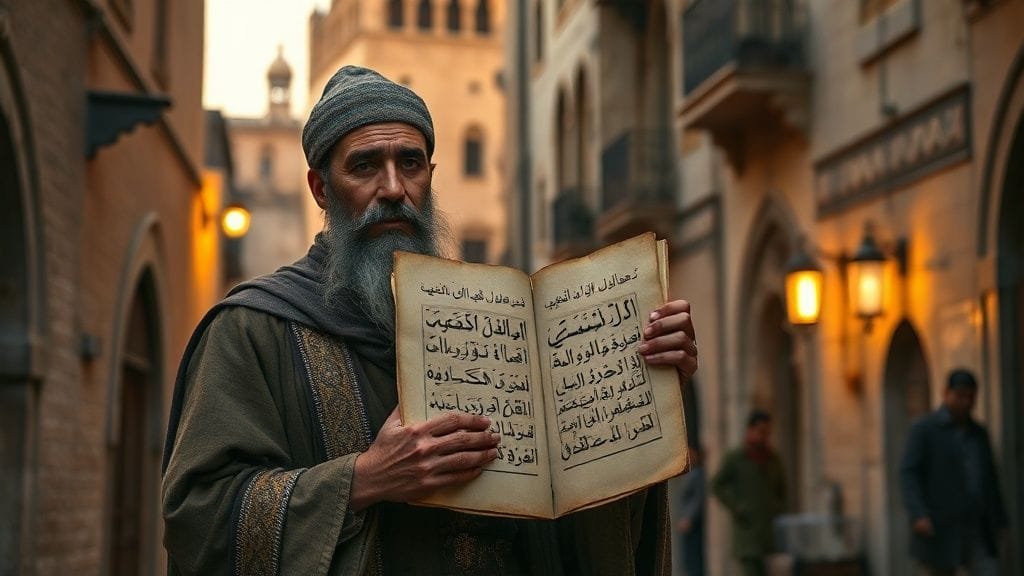
The bustling streets of Cairo, 1040 AD, were steeped in the vibrant hues and the mingling scents of spices, parchment, and philosophies whispered in the air. Yet within the solemn chambers of a modest home, a profound silence loomed—the silence of a man whose gaze had peered further into the mysteries of light and vision than most dared. Ibn al-Haytham, known in the West as Alhazen, was on his deathbed, his mind still ablaze with the echoes of inquiry that had defined an era of human thought. His final breaths went out quietly in the shadows of Cairo’s minarets, marking the end of a chapter but igniting a legacy that would illuminate centuries to come.
The World at the Dawn of the 11th Century: A Crossroads of Cultures and Knowledge
The turn of the millennium brought Cairo into the limelight as a vibrant cultural and scientific capital of the medieval Islamic world. The city, built upon the nuts and bolts of deserts and the Nile’s blessings, was a nexus where Byzantine legacies, Arab intellect, and Persian scholarship intermingled. While Europe was striking its tentative first chords of the medieval age, the Islamic world flourished in science, philosophy, and art. It was a time of fierce intellectual rivalry and fervent quest, a golden age fueled by libraries filled with scrolls echoing Homer and Ptolemy, juxtaposed with the preciseness of Arabic geometry and medicine.
Amidst this legendary backdrop, the figure of Ibn al-Haytham stood tall—not with the sword or throne, but with eyes and mind sharpened by rational skepticism and empirical method. Understanding the epoch means embracing the intricate layers of political power, religious discourse, and the sheer thirst for knowledge that shaped scholarly pursuits.
Ibn al-Haytham: The Life of a Pioneer in Optics and Philosophy
Few scholars embody the spirit of inquiry quite like Ibn al-Haytham. Born around 965 AD in Basra, in present-day Iraq, he emerged from the intellectual melting pot of the Abbasid Caliphate—a period marked by flourishing trade, translation movements, and an unprecedented circulation of texts. Yet, Alhazen was no mere consumer of knowledge; he was a transformative presence who questioned foundational assumptions about vision, optics, and scientific methodology. His work was relentlessly empirical, often skeptical of hearsay, preternaturally modern.
His journey through knowledge was inseparable from the cultural and political vicissitudes of his time. The interplay between faith and reason, the influence of Greek philosophy filtered through Arabic lenses, and the constant tension with prevailing doctrines shaped his thought and work.
From Basra to Cairo: The Journey of a Visionary Scholar
Though Basra was his birthplace, Alhazen’s path traversed the expansive map of the medieval Islamic world. He spent substantial time in Cairo, a city that offered both patronage and refuge. According to legend—and perhaps somewhat apocryphally—Alhazen feigned madness to avoid the wrath of governmental authorities displeased with his engineering failure on the Nile’s flooding control. This period of enforced isolation paradoxically became his most productive phase, allowing an undisturbed focus on his optical and philosophical experiments.
Cairo’s vibrant intellectual scene beckoned, with madrasas and scholars exchanging ideas that often crossed the boundaries between philosophy, theology, and natural science. It was here, in the pulse of the city’s academic and religious fervor, that Alhazen honed the details of his experiments, challenging and often rewriting accepted paradigms.
The Intellectual Climate of Medieval Egypt: A Fertile Ground for Innovation
Medieval Cairo was no mere city; it was an intellectual furnace fueled by endemic tensions between tradition and innovation. The religious orders held profound power, yet the spirit of inquiry persisted, fostered by caliphal patrons who regarded knowledge as divine pursuit. At the intersections of these forces, Ibn al-Haytham developed his visions, often confronted by the orthodoxy that long favored Aristotelian and Ptolemaic doctrines.
Yet the Madrasas, libraries, and thriving markets of knowledge empowered thinkers like Alhazen. His acute sense of skepticism would lay the groundwork for modern empirical science—a revolutionary stance in a world where dogma often eclipsed observation.
The Siege of Knowledge: Political Geography of the Islamic Golden Age
While scholars flourished, the political realities were less stable. Fragmentation of the Abbasid Caliphate, the rise of the Fatimid dynasty controlling Egypt, and constant battles for power colored the social landscape. Scholars often depended on patronage from rulers who saw intellectual achievements as means of legitimacy.
Alhazen’s own career was shaped by these forces. His work coincided with the Fatimid Caliphate’s rule over Egypt, a regime that sometimes revered scholars, other times persecuted dissenting voices. The precarious balance of power ensured that knowledge was both a prized treasure and a dangerous pursuit.
Alhazen’s Magnum Opus: The “Book of Optics” as a Beacon of Rational Inquiry
At the heart of Alhazen’s intellectual legacy lies the “Kitāb al-Manāẓir” or “Book of Optics.” Written largely during his time in Cairo, this extraordinary work revolutionized optics and perception theory. Unlike earlier theories, which posited that rays emitted from the eyes enabled vision, Alhazen demonstrated through painstaking experiments and lucid reasoning that vision resulted from light entering the eyes.
This work ventured beyond mere optics; it laid early foundations for experimental science through its insistence on controlled observation, reproducibility, and logical analysis. His use of the camera obscura principle, detailed study of reflection, refraction, and binocular vision, created a framework that would not be rivaled until centuries later.
The Personal Struggles Behind the Scholar’s Triumphs
Behind the breakthroughs, the story of Ibn al-Haytham was not without hardship. Forced retirement, the weight of political suspicion, and personal turmoil shadowed his brilliant career. Legend has it that after his failed hydraulic project on the Nile, he chose self-imposed house arrest in Cairo, a time during which he churned out his best work.
His perseverance amid adversity shows the human side of an otherwise towering intellect. It’s remarkable how creation often flourishes in the soil of hardship.
The Twilight Years: Alhazen’s Declining Health and Continued Influence
In the final years of his life, Alhazen’s physical health waned, but his intellectual vigor did not dim. Scholars visiting Cairo sought his wisdom; manuscripts of his writings began to circulate beyond Egypt. While the exact conditions of his death remain obscure, his last days in a city alive with minarets and the chatter of markets endowed his passing with a quiet dignity.
Alhazen died in 1040, leaving behind a treasure trove of knowledge at the boundary between late antiquity and the medieval scientific horizon.
Death in the Heart of Cairo: The Passing of Ibn al-Haytham in 1040
The moment of Alhazen’s death was less a public event than a personal, silent farewell—a contrast to the lasting public resonance his work would have centuries later. The legacy of a thinker is rarely evident in the immediate aftermath, and for Alhazen, recognition would bloom far beyond the narrow confines of 11th-century Cairo.
The city’s daily life carried on, its inhabitants perhaps unaware of the intellectual giant who had just departed. Yet, the loss resonated profoundly within elite scholarly circles.
Immediate Reactions: How Scholars and Society Received His Passing
Within Cairo’s scholarly communities and beyond, whispers of loss intertwined with admiration. His disciples and contemporaries lamented but continued to enroll his work into teaching curricula. Manuscripts were copied, discussed, and translated, while oral traditions ensured his methodologies persisted.
Despite the mixed receptions—some regarding his empirical approach skeptically—the seeds he planted were growing quietly in the fertile grounds of Islamic scholarship.
The Legacy Embodied: Transmission of Alhazen’s Ideas to the Medieval West
The true breadth of Ibn al-Haytham’s influence would only unfold with time. Centuries after his death, his texts traveled westward via translations in Latin and Hebrew. European intellectuals from Roger Bacon to Johannes Kepler would draw heavily on his scientific method and optics theory.
His works bridged cultural divides, serving as a crucial link in the Renaissance’s intellectual revival. The cross-pollination between Arabic sciences and European scholars shows how a man’s quiet death in Cairo shaped the burgeoning modern world.
The Renaissance Rediscovery: From Arabic Manuscripts to European Thinkers
By the 12th and 13th centuries, Europe thirsted for knowledge lost during the dark ages. Alhazen’s texts returned as precious cargo, decoded and absorbed. The “Book of Optics” ignited debates and innovations, inspiring Galileo and Newton centuries later.
His insistence on observation foreshadowed the scientific revolution—a rippling echo from his thoughtful room in Cairo to the universities emerging across Europe.
Optical Science and Philosophy: A New Dawn Sparked by Ibn al-Haytham
Long after his passing, Alhazen’s methods formed the backbone of optical science. The very nature of how humans understand sight, light, and vision owes immense debts to his insights. Philosophers also found in his skepticism and empirical rigor reasons to reexamine established dogmas.
His integration of mathematics, physics, and philosophy established an interdisciplinary approach fundamental to modern science.
The Enduring Human Legacy: Vision, Skepticism, and the Scientific Method
Ibn al-Haytham’s death did not silence his ideas; it amplified their resonance. From emphasizing doubt as a path to truth, to forging methodologies demanding proof through experiment, he anticipated principles of the modern scientific method centuries before Bacon or Descartes.
His legacy reminds us that human vision—literal and metaphorical—fuels progress and understanding.
Cairo’s Historical Memory: How the City Remembers Its Forgotten Genius
Despite his global influence, Ibn al-Haytham remained somewhat shadowed in his own homeland. Modern Cairo honors him with statues and academic programs, but for centuries, he was overshadowed by political upheavals and western scientific narratives.
Rediscoveries of his contributions have reawakened local pride and triggered debates on how history celebrates its intellectual heroes.
Alhazen in Modern Scholarship: A Reappraisal of His Contributions
Contemporary historians and scientists recognize Ibn al-Haytham as a monumental figure—sometimes called the "father of modern optics" or even an early "scientific method" pioneer. Modern technological advances in optics and imaging root their heritage in his insights, confirming his timelessness.
Scholarship continues to uncover nuances in his work, appreciating his unique blend of philosophy, science, and spirituality.
The Interplay of Faith and Reason in Alhazen’s Thought
Ibn al-Haytham’s rationalism was deeply embedded in his Islamic worldview. Unlike many contemporaries, he sought harmony between faith and reason, arguing that the natural world’s study reveals the Creator’s wisdom.
This balance between belief and inquiry enriches our understanding of medieval Islamic science as a vibrant tapestry of theology and empirical exploration—not a simple opposition.
The Influence of Political Instability on Scholars’ Lives in Medieval Cairo
The political upheavals and factional strife that roiled Cairo and the broader Islamic world shaped scholarly pursuits and personal lives. Scholars often had to negotiate patronage, censorship, and suspicion.
Alhazen’s own story—of forced confinement, political missteps, and cautious brilliance—exemplifies the precarious position of intellectuals navigating volatile power structures.
How Alhazen’s Death Marked a Turning Point in the History of Science
While the world did not immediately grasp it, Alhazen’s passing symbolized the end of an era and the illumination of another. He distilled cumulative knowledge and set in motion a mode of inquiry that would ultimately transcend cultural and temporal borders.
The gradual accession of empirical science over dogmatic authority owes much to his pioneering vision.
A Global Reverberation: The Spread of Alhazen’s Legacy Beyond Egypt and Islam
From Cairo, Ibn al-Haytham’s influence traveled across continents and epochs. His refraction theories reached Asia, his philosophical skepticism spread within Europe, and his optical techniques informed later scientific instruments worldwide.
He embodies the transcultural connectivity of medieval knowledge networks, a reminder that science is a shared human heritage.
Conclusion
Ibn al-Haytham’s death in 1040 was not the extinguishing of a light but a transformation—a passing of the torch in humanity’s eternal quest to understand sight, nature, and reality itself. In the quiet chambers of medieval Cairo, a scholar closed his eyes yet opened the eyes of countless generations to the power of observation, doubt, and reason. More than a footnote in history, Alhazen stands as a beacon shining across centuries, illuminating the path to modern science. His life and death remind us that brilliance often thrives amid adversity, and that true vision transcends time, culture, and circumstance.
FAQs
Q1: Why is Ibn al-Haytham often called the "father of modern optics"?
A1: Because his systematic experimental approach to studying light and vision, especially through his “Book of Optics,” corrected earlier misconceptions and established foundations for the scientific study of optics still relevant today.
Q2: What were the main causes leading Ibn al-Haytham to live in Cairo?
A2: Political turmoil and his alleged failure on a project regulating the Nile’s floods forced him into self-imposed confinement in Cairo, which ironically became his most intellectually fruitful period.
Q3: How did the political climate of 11th-century Egypt impact Alhazen’s work?
A3: The Fatimid regime’s complex patronage system meant scholars had to navigate power carefully; while some rulers supported scientific inquiry, others viewed intellectuals with suspicion, influencing Alhazen’s career trajectory.
Q4: What is the significance of the “Book of Optics”?
A4: It revolutionized understanding of vision by demonstrating that vision occurs when light enters the eye, introduced experimental methods, and laid the groundwork for modern optical science.
Q5: How did Alhazen’s ideas reach Europe?
A5: Through translations from Arabic to Latin during the 12th and 13th centuries, his works deeply influenced European scholars, aiding the burgeoning scientific revolution.
Q6: Did Ibn al-Haytham integrate his scientific work with his religious beliefs?
A6: Yes, he sought harmony between faith and reason, believing that studying the natural world illuminated divine wisdom, a perspective reflecting the intellectual spirit of his time.
Q7: Why was Ibn al-Haytham’s death in Cairo not widely recognized immediately?
A7: The social and political milieu, along with limited communication and historical recording, meant that his contributions were slowly appreciated and only achieved wider recognition much later.
Q8: What is Ibn al-Haytham’s lasting legacy in modern science?
A8: His pioneering use of experimental methods and skepticism laid critical foundations for the scientific method, and his optical theories remain integral to the discipline of vision science.