Table of Contents
- The Twilight of a Warrior: The Death of Charles Martel
- From Battlefield to Burial: The Final Days of a Frankish Titan
- The Legacy of Charles Martel: A Kingdom Poised on the Edge
- Quierzy: A Royal Palace Steeped in Power and Memory
- The Changing Hands of Power: Pepin the Short’s Inheritance
- The Frankish Kingdom in 741: A Realm in Transition
- The Political Landscape After Charles Martel
- Nobles, Clergy, and the Shaping of a New Order
- The Carolingian Dynasty: Seeds Sown at Quierzy
- The Role of the Mayors of the Palace: Custodians of Power
- The Church and Its Place in Frankish Politics
- Pepin’s Ascension: From Mayor to King
- Quierzy’s Capitularies: Documents That Cemented Authority
- The Military Foundations Left by Charles Martel
- Societal Shifts in the Frankish Realm Post-741
- Charles Martel’s Memory: Chronicles and Chronicles
- The Greater European Context: Frankish Influence Spreads
- The Foundations of Modern France and Germany
- Lessons from 741: Power, Transition, and Legacy
- Conclusion: Echoes of a Martelite World
- FAQs on Charles Martel, Quierzy, and the Frankish Kingdom
- External Resource
- Internal Link
1. The Twilight of a Warrior: The Death of Charles Martel
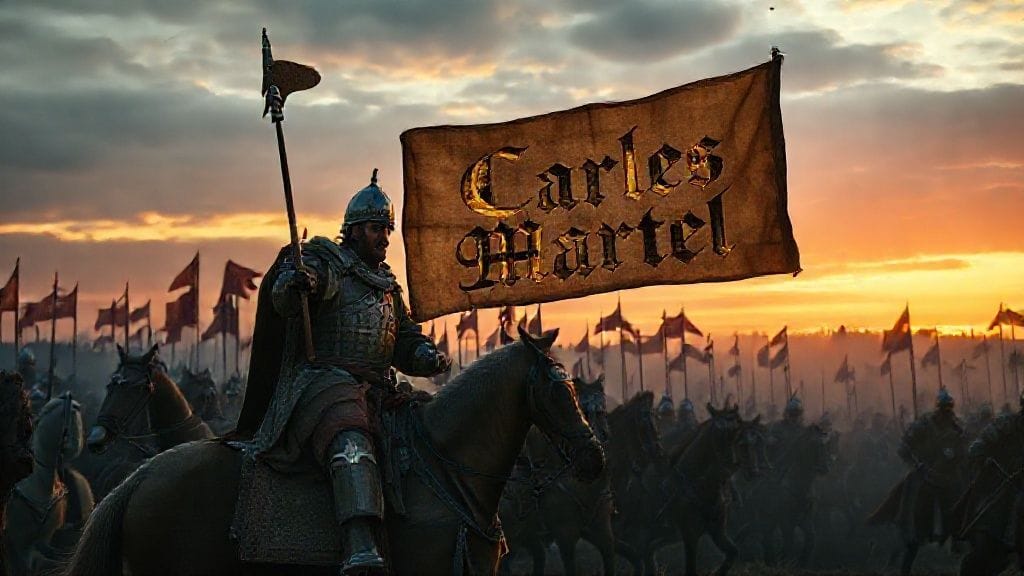
On a crisp autumn day in the year 741, the Frankish realm stood at the precipice of profound change. Charles Martel, the formidable “Hammer” of the Franks, the man whose sword had repelled Muslim forces at Tours and reshaped the destiny of Western Europe, breathed his last. The sun rose over the misty plains of Quierzy, casting a pale light on the faces of nobles and warriors alike, gathered in somber tribute. The air was thick with grief and uncertainty—what would become of the kingdom without its ironclad leader?
Charles’s death was more than the passing of a man; it was the end of an era that had forged the Frankish kingdom into an unassailable force. His campaigns had been ruthless, his political maneuvering astute, and his consolidation of power unprecedented. That day in October, the Frankish nobility looked forward, apprehensive and hopeful, while the fallen general’s legacy imposed a heavy silence over the lands he had ruled with unwavering might.
2. From Battlefield to Burial: The Final Days of a Frankish Titan
Charles Martel’s last days were marked by a quiet withdrawal from the incessant warfare that had defined his life. Though history often remembers him clad in armor and brandishing his mighty mace, his final moments were cloaked in the solemnity of a ruler preparing for the inevitable end. His protégé and illegitimate son, Pepin the Short, stood by his side, learning the unspoken rituals of power transfer.
While chroniclers of the time offer scant detail on Charles’s declining health, the signs of exhaustion after decades of campaigns were clear. That the great “Hammer” had survived so many battles only to fall to age is itself a testament to his stamina. Quierzy, a royal residence of the Merovingian kings nestled along the Oise River, became the site not only of his death but also of the ceremonial affirmations of succession.
It was here, amid the vaulted halls and the murmurs of courtiers, that the first seeds of the Carolingian transformation took root.
3. The Legacy of Charles Martel: A Kingdom Poised on the Edge
Charles Martel’s legacy was laid in blood and stone. His victories against the Umayyad Caliphate at Tours in 732 demonstrated military genius and preserved Christian Western Europe from a sweeping Islamic expansion. Yet, beyond the battlefield, his governance left an indelible imprint on the Frankish Kingdom’s political structure.
By asserting the authority of the mayors of the palace—traditionally royal household stewards—Charles effectively eclipsed the Merovingian kings, who had become figureheads. In his hands, the office became the true seat of power, a transformation that would redefine monarchy itself.
When he died, the kingdom was both unified and fragile—unified under arms and administration, but fragile in its lack of clear, uncontested royal sovereignty. This balance underscored the tensions and possibilities awaiting his heirs at Quierzy.
4. Quierzy: A Royal Palace Steeped in Power and Memory
Quierzy-sur-Oise was not merely a backdrop for a dying ruler. The palace was a nucleus of Frankish political life, a symbol of monarchy and majesty drifting toward renewal. Its halls saw Merovingian kings once reign supreme, but by the 8th century, it had become a bastion for the power brokers behind the throne.
The significance of Quierzy in 741 lay in its dual nature: a relic of the past and a crucible for the future. Charles Martel’s death there underscored the transition from Merovingian formal royalty to Carolingian pragmatic dominance.
From this site, Pepin and his brothers would claim the mantle of leadership, setting precedents in governance, law, and diplomacy that echoed across Europe for centuries.
5. The Changing Hands of Power: Pepin the Short’s Inheritance
Pepin the Short, Charles Martel’s illegitimate but recognized son, was poised to inherit a realm heavy with expectation and fraught with political complexity. At Quierzy, the transition of power was less a coronation than a tacit passing of strength from father to son.
Pepin’s claim was not without rivals—his brothers Carloman and Grifo also eyed the spoils of their father’s vast domain. Yet Pepin’s ability to assert authority, aided by alliances with the Church and nobility, would soon eclipse his siblings.
The division of the Frankish territories and the management of loyalty were delicate tasks requiring both the martial skill and the political acumen that Charles had modeled.
6. The Frankish Kingdom in 741: A Realm in Transition
The kingdom Charles Martel left behind was formidable but unsteady. Its borders stretched from the Pyrenees to the Rhine, encompassing diverse peoples and cultures. Governing such a realm in a pre-modern era demanded constant negotiation, martial readiness, and an evolving administrative system.
The Merovingian kings, descendants of Clovis, had long lost effective power. Instead, real authority rested with the mayors of the palace—the status Charles had elevated dramatically. The aristocracy wielded local power, yet they needed the unifying force of the mayor to maintain cohesion.
Fragile alliances, seasonal warfare, and ecclesiastical influence shaped the landscape. The death of Charles Martel was a moment ripe for either disintegration or reinvention.
7. The Political Landscape After Charles Martel
Immediately following Charles’s death, the Frankish nobility faced the precarious question: who would assume the leadership mantle? The vacuum was enormous, but the networks Charles had forged offered a framework.
Pepin and Carloman jointly exercised power, an arrangement fraught with potential conflict but seemingly effective. The brothers demonstrated restraint initially, mindful of the fragile peace Charles had maintained by force.
Meanwhile, the Merovingian king Childeric III remained a ceremonial figurehead, increasingly irrelevant in governance. Within this political theater, the Carolingian family prepared to redefine kingship itself.
8. Nobles, Clergy, and the Shaping of a New Order
Charles Martel’s reign had relied heavily on cooperation with the Church, especially the bishops and monasteries. These relationships were formalized by granting lands and protection in exchange for loyalty and moral legitimacy.
The Church’s role in legitimizing secular authority grew exponentially after 741. Pepin, following in his father’s footsteps, would turn this relationship into a cornerstone of his eventual royal claim.
Nobles, too, were pivotal—they controlled land and armies but required strong leadership to prevent internal conflict. The balance between devotion to the Crown and personal ambition was delicate and constantly negotiated.
9. The Carolingian Dynasty: Seeds Sown at Quierzy
The death of Charles Martel at Quierzy signified not just the end of a chapter but the beginning of a dynasty. Whereas Merovingians ruled by heritage and tradition, the Carolingians emphasized strength, alliance, and reform.
Pepin’s consolidation of power culminated in his anointing as king in 751, a groundbreaking moment that altered the framework of European monarchy. But it all began in those somber days at Quierzy, where the elder’s shadow loomed large.
This new lineage would govern not just Franks but inspire the Holy Roman Empire and the shaping of medieval Christendom.
10. The Role of the Mayors of the Palace: Custodians of Power
The mayor of the palace was once merely a household manager—until Charles Martel transformed the office into the true power behind the throne. His administrative reforms, fiscal control, and military command redefined the role irrevocably.
After 741, Pepin and Carloman wielded this title with authority far beyond anything their predecessors possessed. This shift decentralized the Merovingian kings’ legitimacy and laid the groundwork for the Crown’s eventual reassignment.
Understanding this evolution is critical to grasping the political upheaval surrounding Charles Martel’s death.
11. The Church and Its Place in Frankish Politics
Christianity was more than faith in the Frankish kingdom—it was a unifying institution that wielded immense political power. Charles Martel’s relationship with the church was pragmatic; his victories preserved Christendom, and in return, Church leaders provided a veneer of sanctity to his authority.
Following his death, the Catholic Church emerged as a kingmaker, especially as Pepin sought legitimacy. The alliance culminated in the 751 anointing by Pope Zachary, marking a new era of Church-State symbiosis.
12. Pepin’s Ascension: From Mayor to King
The seeds planted in Quierzy blossomed with Pepin’s bold move to crown himself king, supplanting the Merovingians. His reign, validated by both aristocracy and the papacy, established a precedent where military and political acumen underpinned royal authority.
Pepin’s rise was not unchallenged; his fraternal strife and rival noble factions required deft handling. Yet his claim transformed the Frankish realm into the Carolingian Empire, ushering in an era of reform, conquest, and cultural renaissance.
13. Quierzy’s Capitularies: Documents That Cemented Authority
In the years following Charles Martel’s death, a series of capitularies—royal edicts—issued at Quierzy codified the new order. These documents addressed legal reforms, land grants, and administrative divisions that strengthened central authority.
The rulings emphasized the need for loyalty, military service, and the Church’s cooperation. They hinted at the sophisticated governance structures emerging after 741.
14. The Military Foundations Left by Charles Martel
Charles’s military reforms endured long after his death. His creation of a disciplined cavalry and network of fortified holdings ensured that the Frankish kingdom maintained superiority over rivals.
This military system facilitated Pepin’s campaigns and those of Charlemagne, his son, making the Carolingian expansion possible.
15. Societal Shifts in the Frankish Realm Post-741
Beyond kings and battles, Charles’s death occasioned shifts in everyday life across the kingdom. The redistribution of land to loyal nobles and the Church altered social hierarchies, while emerging legal codes began shaping the lives of peasants and merchants.
The growing centralization of power created new relations and dependencies, slowly drawing the medieval societal structures into focus.
16. Charles Martel’s Memory: Chronicles and Chronicles
Medieval chroniclers painted Charles Martel as a heroic figure, often toned with myths and hagiography. Einhard and the Continuations of Fredegar portrayed him as the guardian of Christian Europe.
His memory was a tool for legitimization, invoked by successors to justify new political projects. Yet the man behind the legend was undeniably a master of realpolitik.
17. The Greater European Context: Frankish Influence Spreads
Charles Martel’s death coincided with a Europe in flux. The Islamic presence halted at Tours, the Byzantine Empire waned, and the Slavs and Saxons stirred in the East.
The Frankish kingdom’s role as a stabilizing force increased, especially as Pepin and later Charlemagne extended their influence, shaping continental borders and alliances.
18. The Foundations of Modern France and Germany
The territories united under the Carolingians after 741 laid foundations for future nation-states. France and Germany’s histories trace back to this era of consolidation and expansion, where tribal identities merged into political entities.
Charles Martel’s actions and their aftermath at Quierzy created the political map from which modern Europe would emerge.
19. Lessons from 741: Power, Transition, and Legacy
The cycle of death and succession in 741 offers timeless lessons about leadership and transformation. Charles Martel’s passing is a study in how the death of a giant shapes not just mourning but also reinvention.
Quierzy’s story reminds us that power is fluid, legitimacy crafted, and history made in moments of both loss and hope.
20. Conclusion: Echoes of a Martelite World
Charles Martel died at Quierzy, leaving a kingdom that bore the scars and triumphs of his reign. Yet from the shadows of his passing rose a new era—the Carolingian epoch—that would define medieval Europe’s contours for centuries.
The “Hammer” of the Franks may have dropped his mace, but the echoes of his victories resounded in every stone of the empire that his descendants would build. His story is an epic of war, statecraft, faith, and transformation—reminding us that history is both the end of one chapter and the beginning of another.
FAQs on Charles Martel, Quierzy, and the Frankish Kingdom
Q1: Who was Charles Martel, and why is he significant?
A1: Charles Martel, known as “The Hammer,” was a Frankish military leader and mayor of the palace who halted Islamic expansion into Western Europe at the Battle of Tours in 732. He laid the groundwork for the Carolingian dynasty and transformed Frankish governance.
Q2: What happened at Quierzy following Charles Martel’s death?
A2: Quierzy became the scene of Charles’s death and the political transition to his sons, particularly Pepin the Short. It was a venue for royal administration and set the stage for the shift from Merovingian to Carolingian rule.
Q3: How did the Frankish Kingdom change after 741?
A3: The kingdom saw a shift in power from the Merovingian kings to the mayors of the palace, especially Pepin the Short, who would eventually become king. The political and military structures Charles established were consolidated and expanded.
Q4: What is the importance of the Mayor of the Palace?
A4: Originally a household official, the mayor of the palace became the real ruler under Charles Martel, holding military, political, and fiscal control, effectively overshadowing Merovingian monarchs.
Q5: How did the Church influence Frankish politics after Charles’s death?
A5: The Church grew in power as a legitimizing force, endorsing Pepin’s claim to the throne and reinforcing Christian authority in governance, establishing a precedent for Church-State relations in medieval Europe.
Q6: What is the legacy of Charles Martel in modern Europe?
A6: Charles Martel’s victories preserved Western Europe’s Christian identity and his political reforms paved the way for the Carolingian Empire, which strongly influenced the development of modern European states like France and Germany.
Q7: What role did Quierzy play in the Carolingian dynasty?
A7: Quierzy was a crucial royal residence where important decisions, capitularies, and successions took place, symbolizing the shift from Merovingian to Carolingian power.
Q8: Why is the Battle of Tours so often linked to Charles Martel?
A8: The 732 Battle of Tours is seen as a decisive moment where Charles Martel stopped Muslim advances into Europe, a cornerstone of his legendary military reputation and symbolic defense of Christendom.