Table of Contents
- A Kingdom on the Brink: Setting the Stage for Pepin’s Final Days
- The Man Behind the Crown: Pepin the Short’s Rise and Reign
- The Frankish Kingdom’s Landscape in 768
- The Waning Days of the King: September 768
- The Last Journey to Saint-Denis: Symbolism and Spirituality
- Death of a Monarch: The Final Moments of Pepin the Short
- Political Ramifications: The Succession Crisis and the Sons’ Ascendance
- The Legacy of Pepin the Short: From Usurper to Father of Charlemagne
- Saint-Denis: The Royal Necropolis and Its Mystique
- Burial Rituals and Royal Funerary Traditions in the Frankish World
- How Pepin’s Death Reshaped Frankish Politics and Society
- The Carolingian Dynasty’s Strength After 768
- Monsignor Einhard’s Account: Chronicling Pepin’s Demise
- The Power of Symbolism: Saint-Denis as a Political Statement
- The Frankish Kingdom’s Fragmentation and Future Conflicts
- Influences on Medieval France: Pepin’s Enduring Footprint
- Pepin’s Death in Contemporary Chronicles and Poetry
- Comparing Pepin’s Death to Other Medieval Monarchs’ Demises
- The Transition from Merovingians to Carolingians: Cementing a Dynasty
- The Spiritual Dimension: Pepin’s Piety and Legacy in the Church
- Historiographical Debates: Pepin’s Death and Its Interpretation
- Conclusion: The End of an Era and the Dawn of a New Kingdom
- FAQs on Pepin the Short’s Death and Its Historical Impact
- External Resource
- Internal Link
In the fading light of a September day in 768, the Frankish Kingdom stood at the crossroads of uncertainty and hope. King Pepin the Short—once a nobleman who defied destiny to rewrite the story of medieval Europe—breathed his final breaths in the venerable Abbey of Saint-Denis. The air was heavy with a palpable tension: the abrupt end of a reign that had shifted the continent’s balance of power.
No mere footnote in the annals of history, Pepin’s death was a watershed moment that rippled far beyond the abbey walls. It was both a climax and a prelude—signaling not only the end of a formidable king’s life, but also the dawn of an era shaped by the titanic figures who succeeded him. His passing illuminated the pains of succession, the fragility of newly forged dynasties, and the deep intertwining of faith and kingship in the medieval imagination.
But to understand the gravity of that event, one must journey back through Pepin’s life, the Frankish Kingdom's trials and triumphs, and the sacred symbolism of Saint-Denis itself. Only then can we grasp how a single death transformed an empire’s destiny.
A Kingdom on the Brink: Setting the Stage for Pepin’s Final Days
The Frankish kingdom in 768 was a realm of sprawling forests, rivers, and fortified towns—a patchwork of cultures and early medieval tensions. Pepin the Short stood as its undisputed king, but the stability he commanded was both hard-won and brittle.
Born into the Carolingian family, Pepin’s ascent defied the fading Merovingian tradition. Through martial prowess and shrewd alliance-building, he had supplanted the Merovingians as king, a transition blessed by the papacy itself in a maneuver that merged divine sanction with political realism.
Yet, the wheels of history never halted. By September of 768, Pepin sensed the inexorable approach of mortality. The kingdom, though consolidated, was a fragile construct—fragmented in loyalties, burdened by external threats from Saxons and Lombards, and constrained by the need for a smooth succession. The king’s thoughts inevitably turned from conquest and governance to legacy.
The Man Behind the Crown: Pepin the Short’s Rise and Reign
Pepin was far from a typical monarch. Son of Charles Martel, the net-breaker who halted Islamic expansion at Poitiers, Pepin inherited a legacy of both military glory and non-royal status (the “Mayors of the Palace” before him exercised power but never claimed kingship). Defying tradition, he cast aside the Merovingian “do-nothing kings” and claimed the throne for himself in 751—a bold act sanctioned by Pope Zachary, introducing a new model of papal kingship alliance that changed medieval Europe forever.
His reign was marked by consolidation: land reforms, promoting ecclesiastical ties, and military campaigns to secure borders. The transformation was dramatic: from fragile mayoral authority to kingly majesty, Pepin shaped the Frankish Kingdom as a power to reckon with.
Yet, Pepin’s reign was not without controversy. The shift disrupted established aristocratic balances, sowing seeds of future conflict. Even in death, his legacy would provoke turmoil—especially between his sons, Carloman and Charles (later Charlemagne), whose rivalry would define what was to come.
The Frankish Kingdom’s Landscape in 768
Stretching from the Rhine to the Pyrenees and beyond, the Frankish Kingdom was no monolith but a mosaic of tribes, loyalties, and competing interests. The old Merovingian aristocracy clung to traditions, while new Carolingian nobles sought to imprint their vision.
Economically, the realm was agrarian but brimming with cities that held dawns of trade and cultural exchange. Religiously, Christianity had deeply seated itself, with the Church becoming a central pillar of political legitimacy.
Pepin’s assassinations of pagan threats and his campaigns against Lombards intensified his role as defender of Christendom, intertwining his personal fate with the spiritual destiny of his domain.
The Waning Days of the King: September 768
As the summer of 768 bled toward its close, the once-vigorous king showed signs of decline. Chroniclers like Einhard describe his last days as a blend of stoicism and faith—a man confronting his mortality with the same resolve that marked his reign.
Despite medical limitations of the time, Pepin’s attendants spoke of a calm demeanor marked by reflection. His physical weakness contrasted sharply with the enduring mental acuity that had guided his policies.
The court at Saint-Denis, to which Pepin had retreated, was a hive of somber preparation: advisors readied for the impending transition, nobles whispered about the future, and clerics chanted for the king’s soul.
The Last Journey to Saint-Denis: Symbolism and Spirituality
Saint-Denis was no random choice for Pepin's final days. The abbey, resting on hallowed ground north of Paris, housed the tombs of France’s earliest kings and saints. For Pepin, dying here was a statement—a final affirmation of divine right and continuity with the sacred past.
The abbey embodied the medieval fusion of power and piety—royalty ordained not just by blood but by God’s grace mediated through the Church. Pepin’s pilgrimage to Saint-Denis was thus both literal and metaphorical: a king returning to his spiritual roots, enshrining his reign in the sanctity of history.
Death of a Monarch: The Final Moments of Pepin the Short
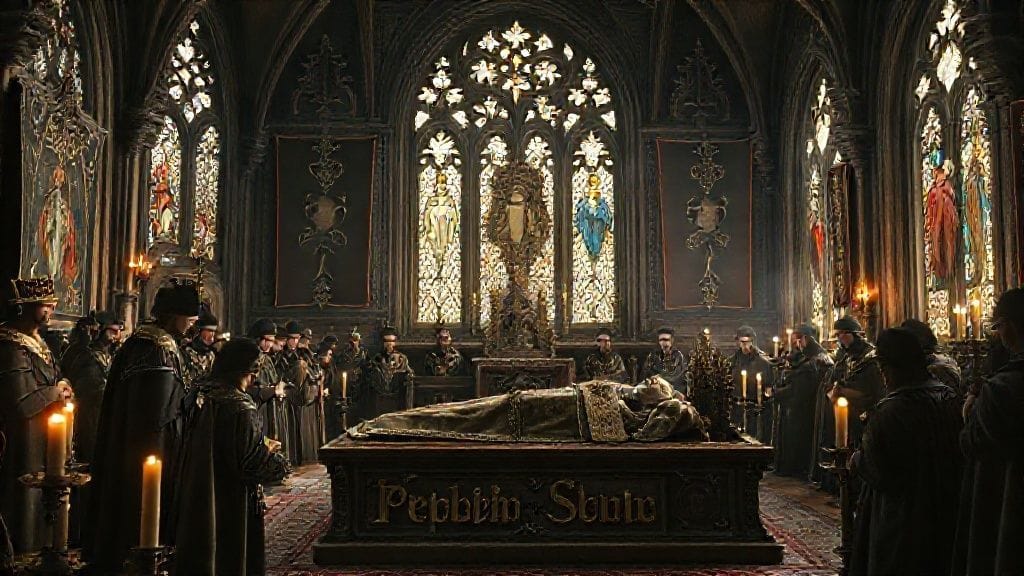
On September 24, 768, Pepin passed away. The exact circumstances remain partly shrouded in mystery, but sources hint at a death surrounded by dignity and solemn rites. His family gathered, and prayers filled the stone cloisters as the king’s eyes closed on a kingdom he had fiercely shaped.
This death was not merely a personal loss—it was a tectonic shift. The vacuum left behind tested the strength of the Carolingian house, and the kingdom braced itself for inevitable upheaval.
Political Ramifications: The Succession Crisis and the Sons’ Ascendance
With Pepin’s demise, a struggle for power ignited between his two legitimate sons: Carloman and Charles. Their joint inheritance of the kingdom was fraught with tension.
Unlike primogeniture’s stabilizing force in later centuries, Frankish succession often split realms, leading to conflicts that could fracture kingdoms. The brothers divided the lands, but rivalry simmered beneath the surface.
This succession crisis would pave the way for Charlemagne’s eventual dominance, yet it also reflected the delicate balance Pepin left behind.
The Legacy of Pepin the Short: From Usurper to Father of Charlemagne
Pepin's life and death sit at the fulcrum of early medieval European transformation. From undermining Merovingian kings to establishing the Carolingian dynasty, he reshaped notions of kingship.
Often overshadowed by his son Charlemagne, Pepin’s legacy is nonetheless foundational. He laid the groundwork for an empire, centralizing power while affirming the Church’s political role.
His death tested the durability of his vision—a test that, despite initial turbulence, his successors passed with lasting effect.
Saint-Denis: The Royal Necropolis and Its Mystique
The Abbey of Saint-Denis would become the quintessential necropolis of French royalty. By choosing it as his final rest, Pepin aligned himself with a lineage that stretched back to France’s earliest kings and saints.
The site’s abbots wielded considerable influence, blending ecclesiastical reverence with political clout. The symbolism of royal burial at Saint-Denis carried meanings far beyond death—asserting dynasty, faith, and legitimacy.
Burial Rituals and Royal Funerary Traditions in the Frankish World
Pepin’s burial was enveloped in rites that underscored medieval understandings of kingship and sanctity. The body was anointed, dressed in ceremonial garb, and placed in a tomb marking divine favor.
Such rites also reinforced socio-political messages: the king’s death was a communal event, uniting subjects under a sacred ideal that would weather the uncertainty ahead.
How Pepin’s Death Reshaped Frankish Politics and Society
Beyond succession, Pepin’s death created ripples in the kingdom’s governance structures. Nobles jostled for favor, alliances shifted, and the Church’s role grew even more pivotal as mediator.
It also intensified military pressures from external enemies, testing the young rulers’ capacity to uphold their father’s legacy.
The Carolingian Dynasty’s Strength After 768
Despite internal strife, the Carolingian dynasty survived—and indeed flourished—after Pepin's passing. With Charlemagne’s eventual rise, the family protagonized the revival of an empire reminiscent of Rome’s grandeur.
Pepin’s death, paradoxically, marked both an end and a launching point for this Carolingian renaissance of power, culture, and Christian kingship.
Monsignor Einhard’s Account: Chronicling Pepin’s Demise
Einhard, the great biographer of Charlemagne, provides invaluable glimpses into Pepin’s reign and death. His accounts mix admiration with a chronicler’s objectivity, painting a picture of a king both human and monumental.
Einhard’s narratives are our windows into a world where kings were more than rulers—they were symbols, saints, and fathers to nations.
The Power of Symbolism: Saint-Denis as a Political Statement
Pepin’s death at Saint-Denis was as much a political message as a spiritual event. By resting among sainted kings, he proclaimed Carolingian legitimacy over Gallic heritage.
This choice reverberated through history, cementing Saint-Denis's role as a nexus of royal power, sanctity, and national identity.
The Frankish Kingdom’s Fragmentation and Future Conflicts
The division of power following Pepin’s death foreshadowed centuries of Frankish intrigue and regional fragmentation. Rivalries, alliances, and wars would frequently redefine boundaries.
Yet from this complex tapestry emerged the foundations of medieval France and Germany—nations shaped by the troubled legacies of this era.
Influences on Medieval France: Pepin’s Enduring Footprint
Pepin’s reforms of land, military, and Church relations reverberated through medieval France. His model of kingship inspired centuries of monarchs seeking divine sanction for authority.
The intertwining of faith and power, epitomized in his reign and death, set precedents for the medieval state system.
Pepin’s Death in Contemporary Chronicles and Poetry
Beyond official chronicle, Pepin's death stirred contemporary poets and clerics. Elegies mourned the loss, while hagiographies hinted at sanctity—some even attributed miracles posthumously.
These expressions reveal medieval society’s efforts to grapple with death’s meaning for kings and kingdoms.
Comparing Pepin’s Death to Other Medieval Monarchs’ Demises
Pepin’s passing contrasts with more dramatic or violent ends of many medieval rulers. His death was relatively peaceful and ritualized, emphasizing order amid transition.
This juxtaposition highlights evolving medieval attitudes toward royal mortality and continuity.
The Transition from Merovingians to Carolingians: Cementing a Dynasty
Pepin’s death was a critical step in distancing the Frankish Kingdom from Merovingian roots and solidifying Carolingian rule.
With his sons, the dynasty secured a legacy that would lead to imperial ambitions unheard of since antiquity.
The Spiritual Dimension: Pepin’s Piety and Legacy in the Church
Pepin’s close alliance with the Church earned him sainthood-like reverence. His death reaffirmed this spiritual bond, with prayers and rituals celebrating both king and Christian warrior.
This intertwining of sacred and secular spheres shaped medieval kingship’s evolution.
Historiographical Debates: Pepin’s Death and Its Interpretation
Scholars debate the precise impact of Pepin’s death. Was it a moment of crisis or seamless transition? Did it undermine or bolster Carolingian power? Interpretations diverge, reflecting evolving methodologies and sources.
Such debates underline how history itself is a living dialogue with the past.
Conclusion
Pepin the Short’s death on that autumn day in 768 was far more than the end of a king—it was the turning point of an epoch. In the serene halls of Saint-Denis, a man who had reshaped Europe lay at rest, leaving a kingdom buoyed with hope and shadowed by uncertainty.
His passing illuminated the fragile dance of power and faith that defined the early medieval world. It tested the roots of a new dynasty, setting the stage for the legendary rise of his son Charlemagne. Through political acumen, military might, and a visionary alliance with the Church, Pepin redefined kingship itself.
Yet, as history reveals, death in a realm such as his was never simply an end. It was a passage—a bridge between eras, a crucible of transformation. Pepin’s legacy continues to echo in the annals of medieval history, a testament to the enduring power of leadership, faith, and ambition.
FAQs
Q1: Who was Pepin the Short and why was his death significant?
A: Pepin the Short was the first Carolingian king of the Franks, overthrowing the Merovingians with papal approval. His death marked the end of his leadership and the beginning of a complex succession that set the stage for Charlemagne’s empire.
Q2: Why was Saint-Denis chosen as Pepin’s final resting place?
A: Saint-Denis was the royal necropolis symbolizing divine kingship. Being buried there linked Pepin to France’s sacred royal lineage, asserting his legitimacy and piety.
Q3: What challenges did Pepin’s sons face after his death?
A: Carloman and Charles inherited a divided kingdom, leading to rivalry and political tension. Their struggle reflected the problems of succession and foreshadowed future internal conflicts.
Q4: How did Pepin’s death affect the relationship between the Frankish kingdom and the Church?
A: Pepin’s close alliance with the Church was reinforced, with the institution gaining more political influence during the transition, helping to legitimize his heirs.
Q5: In what ways did Pepin’s death influence the future of medieval Europe?
A: It ushered in the era of Charlemagne, influencing the political, religious, and cultural landscape of Europe by establishing the Carolingian Empire and the model of Christian kingship.
Q6: Are there contemporary sources describing Pepin’s death?
A: Yes. Einhard’s writings and other Frankish chronicles provide descriptions, mixing historical fact with hagiographic elements.
Q7: How did Pepin the Short’s burial customs reflect medieval royal traditions?
A: His burial featured ceremonies emphasizing sanctity and kingship, reinforcing the notion of divinely approved authority common in medieval Europe.
Q8: What historiographical debates surround Pepin’s death?
A: Scholars dispute the smoothness of succession and the long-term effects on Carolingian consolidation, reflecting broader discussions about medieval power transitions.