Table of Contents
- The Twilight of an Emperor: January 28, 814
- A Life Forged in Iron and Faith
- The Rise of Charlemagne: King of the Franks to Emperor of the Romans
- Aachen: The Imperial Capital and Charlemagne's Home
- The Empire at Its Zenith: Uniting Western Europe
- Charlemagne’s Final Days: A Waning Flame
- The Death of an Emperor: Witnesses and Reactions
- The Political Landscape at the Moment of Passing
- The Legacy of Aachen as a Symbol of Power
- The Succession Crisis: Louis the Pious Takes the Throne
- The Fate of the Carolingian Empire after Charlemagne
- Carolingian Renaissance: A Cultural Rebirth in the Shadow of Death
- Religious Influence and the Emperor’s Relationship with the Church
- The Myth and Memory of Charlemagne: From History to Legend
- The Political and Cultural Ripple Effects across Medieval Europe
- Charlemagne’s Burial and the Sanctity of Aachen Cathedral
- The Fragmentation of Power: The Seeds of Future Kingdoms
- The Carolingian Empire’s Role in European Identity Formation
- The Importance of Charlemagne’s Death in Medieval Historiography
- Conclusion: The End of an Era and the Dawn of a Legacy
- FAQs: Understanding Charlemagne’s Final Chapter
- External Resource
- Internal Link
On that cold January day in 814, a hush fell over Aachen, the vibrant seat of an empire that had shaped much of medieval Europe. The great halls, once filled with the noise of councils and emperors’ decrees, were now enveloped in a somber stillness. Charlemagne, the towering figure whose name still resonates through the corridors of history, breathed his last. His death was both an end and a beginning, a moment heavy with the passing of a golden age and the uncertainties of what lay beyond.
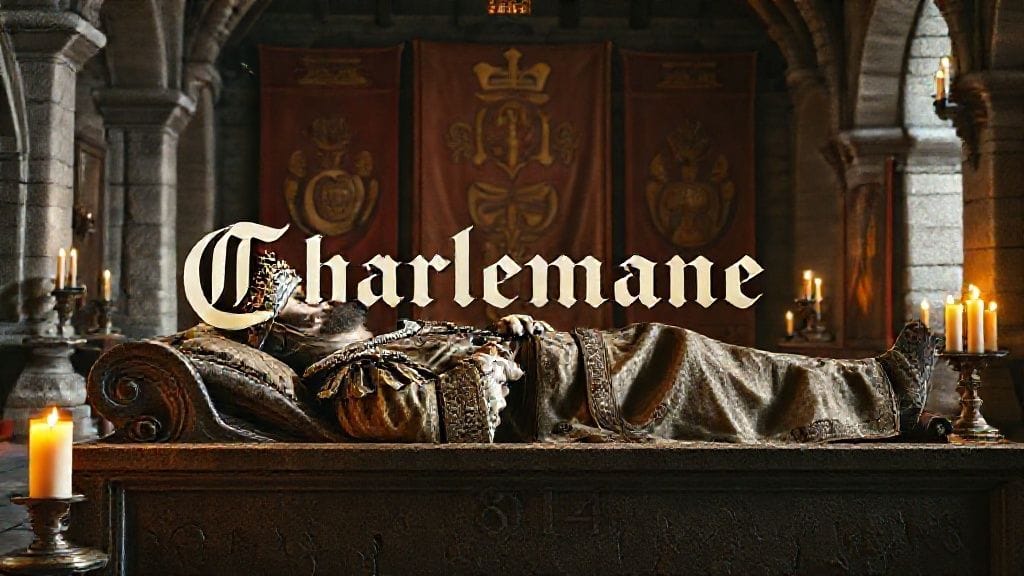
Charlemagne's final moments were neither sudden nor dramatic in the popular sense, but they carried with them the weight of immense consequence. The man who had stitched together a fractured continent with sword, word, and faith now lay bedridden, fragile against the relentless march of time. In the silent chambers of Aachen palace, amidst flickering candles and the murmurs of loyal retainers, a colossal chapter of European history was quietly closing.
The story of Charlemagne’s death unfolds against a backdrop as vast and complex as the empire he ruled. To understand this moment, one must look back at the relentless forces that forged his reign, the intricacies of his power, and the rich tapestry of cultural and religious transformation that his life embodied. It is a tale that moves beyond a mere passing into history books—it is the intimate farewell to an era that would define the contours of a continent for centuries to come.
A Life Forged in Iron and Faith
Born around 742, Charlemagne was the son of Pepin the Short, the first King of the Franks from the Carolingian dynasty. His ascension wasn’t merely a product of hereditary claim but a triumph of military genius, political savvy, and deep Christian conviction. With each conquest and alliance, he not only expanded his realm but also laid the cultural foundation of a unified Christendom. His crowned title as Emperor by Pope Leo III in 800 AD was a resurrection of the Western Roman Empire — a bold statement that Europe would never be the same.
From his early days, Charlemagne’s life was marked by ceaseless campaigns and a passion for learning that would ignite the Carolingian Renaissance. Straddling the roles of a warrior and a scholar, he surrounded himself with theologians, poets, and scholars, importing knowledge from Byzantium and the Islamic world. His vision was ambitious: a realm unified not only politically but also intellectually and spiritually.
The Rise of Charlemagne: King of the Franks to Emperor of the Romans
Few medieval rulers experienced a rise as dramatic and transformative as Charlemagne. His remarkable leadership culminated in the coronation at St. Peter’s Basilica in Rome on Christmas Day, 800 AD. This moment was not merely ceremonial; it symbolized a revival of the imperial ideal that had been dormant since the fall of Rome and set the stage for the future Holy Roman Empire.
Yet, the years leading up to this peak were riddled with battles, both external and internal. Against Saxon rebels, Lombards, and Moors, Charlemagne proved relentless; within his own court, he balanced the demands of powerful nobles and an expanding bureaucracy. Aachen emerged as the heart of this realm—a city shaped by his vision, replete with a palace chapel that would later become a physical monument to his legacy.
Aachen: The Imperial Capital and Charlemagne’s Home
Aachen was more than a city; it was Charlemagne’s chosen seat of power, a vibrant hub where politics, religion, and culture converged. Its chapel, with its striking octagonal design, echoed the grandeur of Byzantine structures and served as Charlemagne’s mausoleum. The city was a living testament to his reign—a place where the past merged with ambitions for the future.
In Aachen’s corridors, emissaries from distant lands gathered, church officials negotiated doctrine, and scholars debated the preservation of classical texts. This was the space where Charlemagne sought not just to govern but to inspire—a court that aspired to mirror the glories of Rome and a realm embracing the dawn of a new European identity.
The Empire at Its Zenith: Uniting Western Europe
By the early 9th century, Charlemagne’s empire spanned from the Pyrenees in the southwest to the Elbe River in the east, encompassing modern France, Germany, Switzerland, Austria, and northern Italy. This sprawling territory was ethnically diverse and politically fragmented before his conquests. His success lay in his ability to integrate these disparate peoples under a centralized administration guided by Christian ideals.
However, unification was a daily challenge. Standards of law, currency, and language varied widely; religious conversion efforts toward pagan tribes often incited fierce resistance. Charlemagne’s use of missi dominici—royal agents dispatched to supervise local administrators—revealed a novel approach to governance, balancing centralized control and regional autonomy.
Charlemagne’s Final Days: A Waning Flame
In the winter of 813-814, the Emperor showed signs of serious illness. Sources, including Einhard’s Vita Karoli Magni, depict a steadily weakening figure who, despite his affliction, remained concerned with the empire’s future. Out of respect for tradition and his own dignity, Charlemagne retreated to Aachen to spend his final days in the comfort of familiar surroundings and the company of his trusted companions.
His declining health was a matter of intense anxiety for all those within his orbit. The empire's fate was inextricably linked to his person, and rumors circulated about potential succession disputes should he succumb. Reports suggest a poignant moment: Charlemagne, conscious of his mortality, took communion and prepared himself spiritually for the journey ahead.
The Death of an Emperor: Witnesses and Reactions
On January 28, 814, Charlemagne died quietly. His passing was witnessed by close family members and pious attendants, some of whom recorded the scene with reverence and solemnity. The echo of his death rippled quickly across the empire. Towns and castles observed a period of mourning; emissaries carried the news to distant provinces, where loyalty to the late Emperor mingled with uncertainty.
This moment was not marked by grand public ceremonies, but it was weighted with the profound recognition of the end of an epoch. Charlemagne was revered not only as a ruler but as a divinely sanctioned monarch—the “Father of Europe”—a title that would outlive him by centuries.
The Political Landscape at the Moment of Passing
Charlemagne’s death precipitated immediate political questions. His son, Louis the Pious, was the designated heir, yet the vastness and diversity of the empire foreshadowed formidable challenges. Loyalty from nobles and vassals needed reaffirmation; restive borderlands threatened rebellion.
Moreover, external threats loomed—Vikings probing northern coasts, Saracens in the south, and internal unrest simmered. The transition from Charlemagne’s energetic command to Louis’s more cautious stewardship was critical. This shift would expose fissures within the empire, revealing the inherent difficulties of governing such a sprawling realm.
The Legacy of Aachen as a Symbol of Power
Aachen’s significance did not wane with Charlemagne’s death. Its palace chapel became one of medieval Europe’s most important religious sites, eventually evolving into Aachen Cathedral. There, Charlemagne was interred—his tomb symbolizing the sacred union of empire and church.
The city remained a pilgrimage destination, deeply connected with the emperor’s mythos and memory. Aachen stood as a glowing beacon of Carolingian culture, a testament to the blending of Roman heritage with Germanic roots and Christian tradition.
The Succession Crisis: Louis the Pious Takes the Throne
Louis the Pious, Charlemagne’s sole surviving legitimate son, ascended the throne amidst reverence but also inevitable difficulty. Unlike his father, Louis lacked military prowess and was more inclined toward monastic discipline and ecclesiastical reform.
His reign would face internal revolts and increasingly fractioned noble loyalties. While he inherited a vast, unified empire, the seeds of fragmentation had been sown—the inevitable consequence of a polity built largely on personal authority rather than institutional permanence.
The Fate of the Carolingian Empire after Charlemagne
Following Charlemagne's death, the Carolingian Empire gradually fragmented. Though it maintained a semblance of unity during Louis’s rule, divisions intensified, culminating in the Treaty of Verdun in 843, which split the empire among Louis’s sons.
This partition laid the foundation for modern European states, including France and Germany. While the empire itself declined, the inspiration drawn from Charlemagne’s reign endured, influencing medieval politics and identity formation.
Carolingian Renaissance: A Cultural Rebirth in the Shadow of Death
Charlemagne’s patronage extended beyond mere conquest to encompass a profound cultural revival known as the Carolingian Renaissance. Manuscripts were copied, schools founded, and reforms in Latin literacy promoted.
Even after his death, this intellectual movement flourished across monastic centers, spreading the knowledge of antiquity and fostering the early European scholarly tradition that would culminate centuries later in the universities of the High Middle Ages.
Religious Influence and the Emperor’s Relationship with the Church
Charlemagne’s power was inseparably linked to the Church. Crowned by the Pope himself, his rule was presented as a divine mandate. This close relationship secured mutual reinforcement: the Church gained protection and influence, while the emperor enjoyed sacred legitimacy.
Charlemagne’s death tested this alliance’s durability. His successors continued to rely on ecclesiastical support, but the balance of power shifted, foreshadowing future tensions between secular and religious authorities in Europe.
The Myth and Memory of Charlemagne: From History to Legend
Over the centuries, Charlemagne transcended the historical to become a legendary figure—a symbol of European unity, justice, and Christian kingship. Epic poems, chansons de geste, and later historical works embellished his deeds, creating a mythical past that would inspire nationalism and cultural revivalism.
His death, the closing of a luminous chapter, became a focal point in medieval collective memory, embodying aspirations for order amid an often chaotic continent.
The Political and Cultural Ripple Effects across Medieval Europe
The immediate aftermath of Charlemagne’s death was a period of uncertainty and transformation. His centralization of power was tested, his reforms challenged, and his empire’s borders increasingly vulnerable.
Nonetheless, the structural and ideological groundwork he laid endured, informing medieval European governance, the concept of kingship, and the revival of urban centers. The echoes of his reign shaped the continent’s medieval, and even modern, identity.
Charlemagne’s Burial and the Sanctity of Aachen Cathedral
Charlemagne’s remains were laid to rest in Aachen Cathedral—a resting place befitting an emperor. His tomb became a relic of immense significance, underscoring the sanctity accorded to him by his subjects.
The cathedral itself stands as a masterpiece of early medieval architecture, preserving the spiritual and political heart of the Carolingian world. Pilgrimages and liturgical celebrations there kept Charlemagne’s memory alive for generations.
The Fragmentation of Power: The Seeds of Future Kingdoms
With the dissolution of Charlemagne’s empire came the rebirth of smaller, often warring kingdoms. The Carolingian example revealed both the possibilities and limits of imperial authority in medieval Europe.
Yet from these fragments emerged the cultural and political entities that would evolve into France, Germany, and other nations—thus, Charlemagne’s death indirectly gave birth to the mosaic of medieval European power.
The Carolingian Empire’s Role in European Identity Formation
Charlemagne’s empire is often viewed as the embryo of a united Europe. His reign introduced the notion that disparate territories could be under a single Christian emperor.
His death, while ushering in division, could not erase this ideological foundation. The dream of a united Christian Europe, with echoes in the Holy Roman Empire and later European projects, owes much to his memory.
The Importance of Charlemagne’s Death in Medieval Historiography
Medieval chroniclers and later historians grappled with Charlemagne’s death as a turning point. Einhard’s Vita Karoli Magni remains an invaluable source, combining respect with critical insight.
His passing is often portrayed as the close of a golden age, a narrative that colored subsequent historical interpretations and shaped Europe’s understanding of its medieval heritage.
Conclusion
The death of Charlemagne on that winter’s day in Aachen was far more than the cessation of a single life; it was the twilight of an epoch that forged Europe’s medieval soul. From the flickering candles of Aachen’s imperial chapel to the distant reaches of his empire, his passing marked an emotional and political crossroads.
Charlemagne died as he had lived—immersed in faith, burdened with responsibility, and conscious of the fragile nature of earthly power. Yet, the legacy he left was indelible. His empire may have fragmented, but his vision of a united Christendom endured in memory, culture, and polity. The man who sought to revive the glory of Rome laid a foundation upon which Europe would be reborn again and again.
His death reminds us that empire is mortal, but ideas—of unity, justice, faith, and learning—hold the power to transcend time. As Aachen’s cathedral endures, so too does the legacy of the “Father of Europe,” whose final breath signaled not an end, but the continuing journey of a continent forever shaped by his hand.
FAQs
Q1: What caused Charlemagne’s death?
A1: While precise medical details remain unknown, it is believed that Charlemagne died of natural causes related to old age and poor health at around 72 years old, likely compounded by a stroke or an illness during winter.
Q2: Why was Aachen significant at the time of Charlemagne’s death?
A2: Aachen was Charlemagne’s chosen imperial capital, representing his political authority and cultural vision. It housed his palace, chapel, and eventually his tomb, making it the spiritual and administrative heart of the Carolingian Empire.
Q3: Who succeeded Charlemagne, and how was the succession handled?
A3: His son, Louis the Pious, succeeded him smoothly due to Charlemagne’s clear designation of heir. However, Louis faced challenges maintaining the unity and strength of the empire.
Q4: How did Charlemagne’s death affect the Carolingian Empire politically?
A4: Charlemagne’s death marked the beginning of fragmentation and decline. Without his unifying force, regional nobles’ power grew, leading to the eventual division of the empire among his heirs.
Q5: What is the “Carolingian Renaissance,” and how did it relate to Charlemagne’s reign?
A5: The Carolingian Renaissance was a cultural and intellectual revival under Charlemagne’s patronage that promoted learning, literacy, and preservation of classical knowledge across his empire.
Q6: How did Charlemagne’s relationship with the Church influence his reign and death?
A6: The Church legitimized Charlemagne’s rule through coronation, and in turn, he supported ecclesiastical reform and spread Christianity throughout his realm, cementing a powerful alliance that shaped medieval Europe.
Q7: What legacy did Charlemagne’s death leave on European history?
A7: His death ended an era of centralized power but left a lasting imprint on European political structures, cultural development, and the idea of a united Christian Europe.
Q8: How is Charlemagne remembered today?
A8: Charlemagne is remembered as the “Father of Europe,” a symbol of unity and Christian kingship, celebrated in history, literature, and collective European identity.