Table of Contents
- The Final Days of Peter Abelard: A Farewell to Intellect
- The Quiet Village of Saint-Marcel: Setting of a Historical Goodbye
- Burgundy in the Twelfth Century: A Land of Faith and Feudalism
- Peter Abelard: The Philosopher Torn Between Love and Doctrine
- The Journey to Saint-Marcel: From Parisian Fame to Provincial Quietude
- Abelard’s Legacy Before Death: The Storm of Controversy and Reverence
- April 21, 1142: The Last Hours of a Troubled Giant
- The Deathbed Scene: Between Pain and Reflection
- The Surrounding Monks and Disciples: Witnesses to History
- Burial and Initial Memory: The Beginning of a Legend
- Abelard’s Death in Context: The Twelfth-Century Intellectual Landscape
- The Role of Burgundy in Religious and Philosophical Movements
- The Immediate Aftermath: Reactions Across Europe
- Héloïse’s Grief and Devotion: A Love Frozen in Time
- The Transformation of Abelard’s Image in the Medieval Mind
- Abelard’s Influence on Scholasticism and Medieval Thought
- The Intertwining of Philosophy, Religion, and Personal Tragedy
- How the Death at Saint-Marcel Shaped Memories of Abelard
- Long-Term Cultural and Theological Impacts Rooted in 1142
- Remembering Abelard Through Art, Literature, and Modern Scholarship
- The Enduring Symbol of Saint-Marcel: Pilgrimage and Memory
- Conclusion: Death as the Dawn of Eternity for a Troubled Mind
- FAQs on Peter Abelard and His Final Days
- External Resource
- Internal Link
The Final Days of Peter Abelard: A Farewell to Intellect
It was a grey morning in late April 1142, in the quiet folds of Burgundy’s rolling hills, when Peter Abelard, one of the most brilliant yet contentious minds of the 12th century, breathed his last. The spring air was thick with the scent of blooming wildflowers and damp earth, a fragile contrast to the lethargy of mind and body that had seeped over the philosopher. Here, in the small village of Saint-Marcel-sur-Aude, far from the bustling intellectual arenas of Paris, Abelard’s life ebbed away in the simplest of surroundings, shadowed by monastic humility and human frailty. This was not merely the death of a man: it was the closing chapter of an age—the fade of a towering intellect caught between love, faith, and reason.
Yet, to understand this final moment, we must look beyond the lingering fog of his death chamber, beyond the still silence of Saint-Marcel’s abbey walls, to a life lived in the tumult of ideas and heartache—a life that mirrored the complex transition of medieval Europe itself. The death of Peter Abelard is a story not only of a single individual but of a world poised on the cusp of intellectual revolution and spiritual conflict.
The Quiet Village of Saint-Marcel: Setting of a Historical Goodbye
Saint-Marcel-sur-Aude, nestled quietly in the Duchy of Burgundy, was hardly the sort of grand stage that would naturally host the last moments of a man like Abelard. Located among green meadows and vine-wrapped hills, it offered nothing of the scholarly bustle of Paris or the political intrigue of Rome. Instead, this small abbey was a place for repose, penance, and perhaps reconciliation—a fitting retreat for Abelard after decades embroiled in scholastic battles and personal sorrows.
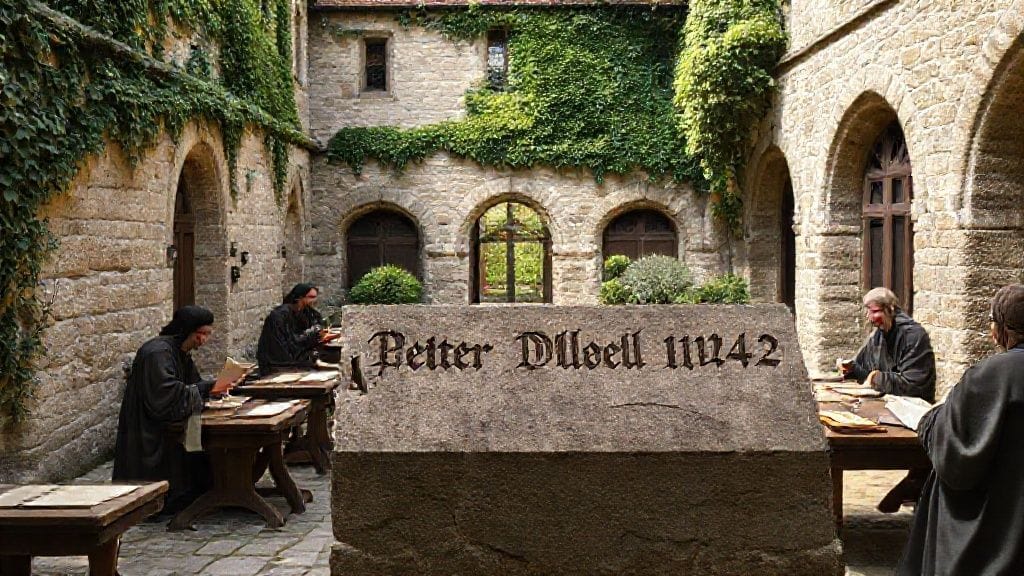
The abbey itself, modest and partially cloaked in ivy, was a community of monks devoted to prayer and study, shielded from the noisy world of court and university. Here, the rhythms of daily life were dictated by the Gregorian chant and the ceaseless turning of parchment. The village remained unaware, for the most part, of the significance of the man who had found his final refuge within the cloistered stone walls.
Burgundy in the Twelfth Century: A Land of Faith and Feudalism
In the mid-12th century, Burgundy was a patchwork of dense forests, fertile fields, and feudal domains, with monasteries and abbeys serving as centers of power, culture, and religious life. The region was a microcosm of the medieval world—poised between the vestiges of feudal loyalty and emerging currents of intellectual life fostered by the Church. Burgundy’s monasteries were not only sanctuaries of piety; they were also hubs of manuscript production and scholastic thought, influencing the crosscurrents of faith and reason that Abelard himself embodied.
Within this landscape, the tension between tradition and innovation played out not only on the battlefield, but within the cloisters and lecture halls where Abelard had waged his own war of words—a war that had been both academic and deeply personal.
Peter Abelard: The Philosopher Torn Between Love and Doctrine
Peter Abelard’s story is widely known for its emotional undercurrents as much as its intellectual triumphs. Born around 1079 in Le Pallet, France, Abelard emerged as one of the most original and daring thinkers of his time, challenging theological dogma and pioneering dialectical reasoning that would lay the groundwork for scholasticism.
But his legend is inseparable from the tragic love affair with Héloïse, whose wit and passion matched Abelard’s own brilliance. Their romance was a tempestuous saga of love, betrayal, social scandal, and spiritual transformation, culminating in monastic vows that shaped their futures. Abelard’s internal conflict—between worldly desires, philosophical inquiry, and spiritual devotion—was emblematic of the broader medieval struggle to reconcile reason with faith.
The Journey to Saint-Marcel: From Parisian Fame to Provincial Quietude
Once celebrated in the great schools and courts of Paris as a master of logic and theology, Abelard’s later life was marked by exile and retreat. Following years of public controversy—including condemnations by ecclesiastical authorities and personal tragedy—he withdrew from the intellectual spotlight.
His journey to Saint-Marcel was more than a physical relocation; it was a symbolic passage away from the contentious debates and towards a quieter, reflective end. Burgundy’s abbey provided a sanctuary where Abelard could contemplate the legacy of his work and seek solace from the pain—both bodily and spiritual—that had shadowed his final years.
Abelard’s Legacy Before Death: The Storm of Controversy and Reverence
Even before his death, Abelard was a figure of division. Admirers hailed him as a pioneer who dared question received wisdom, while detractors accused him of heresy and pride. His writings on logic, ethics, and theology influenced generations of scholars and churchmen. Yet his methods—particularly his application of dialectic to theology—were feared as unsettling innovations.
The debates surrounding Abelard’s work reflect the wider medieval struggle within the Church to define the boundaries of faith and reason. His death in 1142 thus occurred at a pivotal moment—when scholasticism was emerging as a dominant intellectual force under careful ecclesiastical scrutiny.
April 21, 1142: The Last Hours of a Troubled Giant
Eyewitness accounts, sparse but poignant, describe Abelard’s final day as a solemn witness to both human frailty and spiritual determination. Suffering from chronic illness—likely the sequelae of decades of hardship and perhaps the effects of physical trauma—the philosopher faced death with a mixture of resignation and piety.
Monks gathered around, chanting prayers, while Abelard spoke in halting breaths about the soul’s journey, the pursuit of truth, and the hope of divine mercy. It was a scene marked by quiet dignity but charged with the intensity of a life spent wrestling with the profoundest questions.
The Deathbed Scene: Between Pain and Reflection
The image of Abelard on his deathbed is both tragic and profoundly human—a man stripped of his worldly armor, confronting the ultimate unknown. Reports suggest he remained intellectually alert almost to the end, articulating his faith even as his body failed.
The interplay between his physical suffering and the strength of his spirit offers a powerful meditation on the medieval concept of suffering as a path to redemption. As the candles flickered and the sun dipped behind Burgundy’s hills, Abelard’s final breaths marked the transition from earthly conflict to eternal rest.
The Surrounding Monks and Disciples: Witnesses to History
The monks of Saint-Marcel, devoted but humble, bore witness to an extraordinary passing. Among them may have been a few disciples—some drawn to Abelard’s controversial teachings, others simply bound by religious charity.
Their presence articulated the broader medieval dynamic: the tension between innovation and obedience, between the pursuit of knowledge and the submission to faith. The narrative of Abelard’s death thus becomes more than an individual moment; it is a reflection of the community entrusting his soul to God and his memory to history.
Burial and Initial Memory: The Beginning of a Legend
Following his death, Abelard was buried at Saint-Marcel, in accordance with his wish for humility and simplicity. Yet from this modest grave would grow a persistent legacy. Pilgrims and scholars later sought the site, drawn by reverence and curiosity.
The early memory of Abelard was inevitably shaped by the narratives of his life’s loves and struggles, as well as by the contentious reception of his ideas. His tomb became a silent witness to the layered complexity of a man who transcended his age.
Abelard’s Death in Context: The Twelfth-Century Intellectual Landscape
Abelard’s passing coincided with a remarkable epoch in European history. The 12th century was an age of renaissance—renewed interest in classical texts, the founding of universities, and a flourishing of scholastic inquiry.
Yet it was also a time when the Church sought to assert doctrinal orthodoxy amid growing intellectual curiosity. Abelard’s life and death encapsulated this epochal tension—between faith that demanded submission and reason that beckoned exploration.
The Role of Burgundy in Religious and Philosophical Movements
Though often overshadowed by centers like Paris or Canterbury, Burgundy occupied an important place in the religious life of medieval Europe. Its abbeys and bishoprics were key nodes in a network that preserved texts, nurtured philosophical discourse, and sustained monastic reform movements.
By ending his days here, Abelard symbolically linked his legacy to a region where faith and intellect could coexist, albeit cautiously. Burgundy thus serves not merely as a backdrop but as a part of Abelard’s continuing story.
The Immediate Aftermath: Reactions Across Europe
News of Abelard’s death rippled slowly but steadily across medieval Christendom. Scholars debated his writings, clerics assessed his orthodoxy, and lovers of his tragic romance mourned the loss of a figure whose life was marked by brilliance and suffering.
Some called for his canonization, others for silence. His personal story, entwined with the story of Héloïse, infused his death with a poignancy that resonated beyond scholarly circles.
Héloïse’s Grief and Devotion: A Love Frozen in Time
Though separated by monastic vows and distance, Héloïse’s grief was profound and enduring. Her letters from this period are suffused with sorrow, love, and theological reflection, capturing the emotional depth of their bond.
For Héloïse, Abelard was not only a lover but a spiritual companion. His death marked a loss that would shape her life and writings, perpetuating their story across centuries as one of the great tragic and intellectual romances of history.
The Transformation of Abelard’s Image in the Medieval Mind
Over time, Abelard’s image evolved from that of a contentious scholar and scandalous lover to a semi-sainted figure—complex, flawed, yet deeply human. His life became a parable for the dangers and possibilities of intellectual daring.
Medieval chroniclers and later historians grappled with his legacy, often projecting contemporary concerns onto his persona, yet always recognizing the extraordinary breadth of his influence.
Abelard’s Influence on Scholasticism and Medieval Thought
Abelard’s methods—his emphasis on reasoned argument, critical questioning, and systematic theology—laid foundational stones for scholasticism, which would dominate medieval intellectual life.
His death did not diminish his influence but rather intensified interest in his approaches, shaping theological and philosophical debate for generations, including figures such as Thomas Aquinas and Bonaventure.
The Intertwining of Philosophy, Religion, and Personal Tragedy
Abelard’s death exemplifies the intimate entanglement of intellectual pursuit and personal experience in medieval life. His tragedy—intellectual isolation, bodily suffering, lost love—echoed broader themes of human vulnerability and divine aspiration.
This intersection remains one of the reasons his story captivates modern readers and scholars alike.
How the Death at Saint-Marcel Shaped Memories of Abelard
Dying far from the centers of power, Abelard’s passing at Saint-Marcel heightened the pathos of his narrative. The quietude of the village became a symbol of final reconciliation and ultimate humility.
His death at this modest abbey, away from academic parliaments, allowed memory to crystallize into legend, unbound by immediate controversy, and inviting eternal reflection.
Long-Term Cultural and Theological Impacts Rooted in 1142
The death of Abelard did not end the debates ignited by his life. Instead, it set the stage for continued philosophical exploration of faith and reason. His legacy informed not only theology but also literary traditions.
Ideas he championed would echo through the medieval universities and into the Renaissance, affecting Western thought profoundly.
Remembering Abelard Through Art, Literature, and Modern Scholarship
From medieval illuminated manuscripts to Romantic literature and contemporary historical studies, Abelard’s life and death have inspired countless creators and thinkers.
Artistic portrayals often emphasize the tragic romance and intellectual brilliance, while scholars continue to reassess his place in the history of ideas, ensuring that his story remains vivid and relevant.
The Enduring Symbol of Saint-Marcel: Pilgrimage and Memory
The abbey of Saint-Marcel evolved into a pilgrimage site, drawing visitors wishing to connect with Abelard’s memory. This humble village thus became a node where history, myth, and faith converge.
Over centuries, the site has been a testimony to the enduring power of memory in shaping historical narratives.
Conclusion: Death as the Dawn of Eternity for a Troubled Mind
Peter Abelard’s death in 1142 at Saint-Marcel represents more than the end of a brilliant but troubled life—it marks the transition of a singular intellect from earthly struggle to eternal remembrance. His final hours encapsulated the tension between suffering and hope, faith and reason, personal loss and spiritual peace.
In the quiet abbey of Burgundy, far from Parisian acclaim, Abelard closed his eyes on a world he had challenged and, in doing so, opened new paths for thought and emotion. His death was both an ending and a beginning—a profound reminder that great minds, no less than great loves, transcend time.
FAQs on Peter Abelard and His Final Days
Q1: Who was Peter Abelard, and why is he significant?
Peter Abelard was a medieval philosopher, theologian, and logician known for his pioneering work in scholasticism and his tragic love affair with Héloïse. His intellectual contributions reshaped medieval theology and philosophy.
Q2: Why did Abelard die in Saint-Marcel rather than a major center like Paris?
After years of controversy and personal hardship, Abelard sought refuge in the peaceful abbey at Saint-Marcel, away from political and academic storms. It was a place for contemplation and rest.
Q3: What illness or condition caused Abelard’s death?
While exact details are uncertain, Abelard suffered from chronic ailments likely exacerbated by past injuries, stress, and age. Some suggest he was weakened by years of hardship and possibly physical trauma.
Q4: How did Abelard’s death affect medieval intellectual life?
His death crystallized his legacy, prompting renewed interest and debate about the relationship between faith and reason, and influencing the development of scholasticism.
Q5: What role did Héloïse play after Abelard’s death?
Héloïse mourned deeply and continued to write letters that shaped Abelard’s posthumous reputation, intertwining their personal story with the intellectual history of the period.
Q6: Is Abelard considered a saint or a heretic?
He was never canonized but was venerated by some as a saintly figure. His works were sometimes condemned as controversial, highlighting the complex perceptions of his contributions.
Q7: What was the significance of Burgundy during Abelard’s time?
Burgundy was a region of both political power and religious devotion, with monasteries serving as cultural and intellectual centers. It provided a retreat that symbolized a bridge between worldly affairs and spiritual reflection.
Q8: How is Abelard remembered today?
He is remembered as a brilliant thinker and tragic lover whose life and death continue to inspire scholarship, literature, and artistic representation, embodying the medieval tension between reason and faith.