Table of Contents
- The Final Days of a Legend: Saladin’s Last Breath in Damascus
- The Rise of the Crescent’s Lion: A Brief Recap of Saladin’s Legacy
- Damascus, 1193: A City Poised on the Edge of Transition
- The Shadow of Death: Saladin’s Illness and the Court’s Unease
- The Strategic Heart of Syria: Damascus under Saladin’s Reign
- Saladin’s Last Council: Decisions that Shaped the Islamic World’s Future
- Family and Heirs: The Dynastic Drama Behind Saladin’s Passing
- Saladin’s Deathbed: The Farewell of a Sultan and Warrior
- The Mourning of a Sultan: Damascus in Grief and Reverence
- The Power Vacuum: Succession Struggles and Political Shifts
- Saladin’s Legacy in the Crusades: Final Reflections After His Death
- The Sultan’s Tomb: Memory and Myth in the Streets of Damascus
- How Saladin’s Death Changed the Muslim-Christian Dynamics
- Chroniclers and Poets: The Storytellers of Saladin’s End
- The Echoes Across the Middle East: The Aftermath in Egypt and Beyond
- Conquests Frozen in Time: Saladin’s Achievements Reconsidered
- Damascus’s Transformation Post-1193: From Sultanate to New Order
- The Historical Significance of Saladin’s Death Today
- Conclusion: The Man Behind the Legend, and What Endures
- FAQs: Understanding the Death and Legacy of Saladin
- External Resource: Saladin on Wikipedia
- Internal Link: Visit History Sphere
The Final Days of a Legend: Saladin’s Last Breath in Damascus
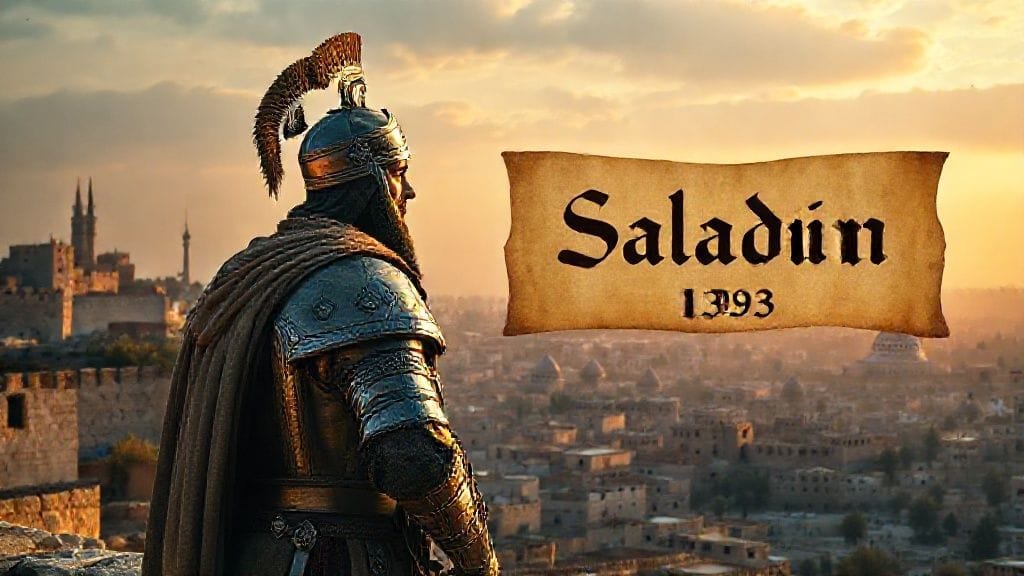
It was a cold and somber day on March 4, 1193, when the pulse of a great empire began to slow in the heart of Damascus. Nur ad-Din Yusuf ibn Ayyub — known to the world simply as Saladin — lay on his deathbed, surrounded by the murmurs of courtiers, the whispered prayers of scholars, and the restless silence of a city that understood the weight of the moment. The air was thick with the scent of frankincense and myrrh, mingled with something deeper — the palpable tension of an era nearing its close.
Saladin’s breath came unevenly, his once fierce eyes subdued but still carrying the indomitable spirit of a man who had forged an empire from the ashes of turmoil. With the Crusades raging around him and the lands of the Levant poised between conflict and fragile truce, his passing was more than the death of a leader. It was the sunset of a chapter that had reshaped history.
The streets of Damascus were quiet, as if holding their breath. In the palace chambers where silk tapestries hung heavy and the call to prayer echoed softly over stone courtyards, the Sultan’s family prepared for a reality they had long feared but never fully dared to face. Here, at this crossroads of faith and power, the story of Saladin would end — and yet, it was only the beginning of a new tale for the Islamic world.
The Rise of the Crescent’s Lion: A Brief Recap of Saladin’s Legacy
To grasp the gravity of that day in Damascus, one must step back to the grand tapestry of Saladin’s life — a story carved out of war, faith, and vision. Born in Tikrit in 1137, Saladin emerged from the echoing shadows of the Seljuk Turks and the Egyptian Fatimid rulers to become the undisputed champion of Sunni Islam and the scourge of the Crusaders.
His ascent was nothing short of remarkable. With a blend of fierce military acumen, diplomatic savvy, and a humane approach to governance, Saladin united fractured Muslim factions and recaptured Jerusalem in 1187, a moment that sent ripples through Christendom and the Islamic world alike.
Yet, Saladin was not just a warrior king; he was a man of principle and culture. His respect for opponents, his generosity towards vanquished foes, and his deep commitment to Islamic law made him a revered figure, the very embodiment of chivalry in a brutal age.
Damascus, 1193: A City Poised on the Edge of Transition
Damascus — the jewel of the Levant — had been transformed under Saladin’s stewardship from a walled city caught between empires to the radiant heart of his dominion. By 1193, this sprawling metropolis was more than a fortress or a capital. It was the beating pulse of an empire teeming with scholars, merchants, pilgrims, and soldiers, the crossroads of continents and faiths.
But beneath its bustling bazaars and minarets, Damascus stood on the edge of profound change. Saladin’s illness had sown uncertainty within the city’s walls. Rivalries simmered quietly, alliances began to tremble, and the city that had been a symbol of Muslim unity was bracing itself for the turbulence that the Sultan’s death would bring.
The Shadow of Death: Saladin’s Illness and the Court’s Unease
As winter turned to early spring, Saladin’s health declined steadily. Historical chronicles speak of a mysterious ailment — some whisper it was fever, others suspect a stroke, yet none can pinpoint the exact cause. He became frail, summoned his closest confidants and family, and faced the inevitable with a quiet dignity that defined much of his life.
Within the palace, the atmosphere was heavy. Advisors debated the future, the heirs sought favor, and foreign envoys watched cautiously from afar. The once invincible Sultan was now a man facing his mortality, and as the days passed, an uneasy question loomed: who would seize the mantle of power when the Crescent’s Lion finally fell?
The Strategic Heart of Syria: Damascus under Saladin’s Reign
Damascus was no mere backdrop; it was the arena in which Saladin’s grand vision took physical form. His reign saw the modernization of the city’s defenses, the patronage of institutions of learning and religion, and a consolidation of power that linked Egypt, Syria, and beyond under one banner.
Understanding Saladin’s final days requires recognizing how Damascus had come to embody the political and spiritual ambitions of the Ayyubid Sultan. The city’s vast citadel, its networks of caravanserais and madrasas, were testaments to his desire for stability amid chaos.
Saladin’s Last Council: Decisions that Shaped the Islamic World’s Future
Before his passing, Saladin convened a final council, a gathering of trusted generals, viziers, and family members. The agenda was fraught with complexity: succession plans, defense strategies against Crusader counterattacks, and the administration of a sprawling empire vulnerable without its unifying figurehead.
Every word spoken in this room echoed far beyond its walls. Saladin insisted on unity and peaceful succession, but these iron-clad intentions could not easily bind the ambitions and jealousies of men poised to inherit his immense legacy.
Family and Heirs: The Dynastic Drama Behind Saladin’s Passing
Saladin fathered numerous children, but his most prominent heirs were his sons, al-Afdal and al-Aziz, both powerful but very different personalities. The question of succession was a tinderbox for rivalries that would fracture the empire in years to come.
Al-Afdal inherited Damascus, while al-Aziz controlled Egypt — a division that tested the fragile cohesion of Saladin’s conquests. Intrigues behind palace doors complicated the transition, and familial loyalty mixed uneasily with political ambition.
Saladin’s Deathbed: The Farewell of a Sultan and Warrior
At last, on the morning of March 4, 1193, Saladin’s life slipped away. Eyewitnesses recount the final moments with reverence and solemnity. The Sultan, despite his weakness, offered prayers for his enemies and blessings for his followers.
His death was not accompanied by grand fanfare but by a profound silence — the quiet surrender of a man who had known war and peace, glory and defeat. His breathing slowed, his gaze softened, and Damascus mourned a hero who had become a symbol for unity and resilience.
The Mourning of a Sultan: Damascus in Grief and Reverence
News of Saladin’s passing spread swiftly, plunging Damascus into profound mourning. The streets filled with cries of lamentation as townspeople and nobles alike paid tribute. Mosques held special prayers; candles flickered through the night.
The sultan’s coffin was draped in fine silks and carried through the city with a solemnity fit for a king. Poets composed elegies; scholars reflected on his deeds. It was a public catharsis, a moment for a city and an empire to confront the future without its guiding star.
The Power Vacuum: Succession Struggles and Political Shifts
Saladin’s death unleashed the political dragons held at bay during his lifetime. The Ayyubid dynasty, instead of presenting a united front, began to fracture under competing interests.
Al-Afdal’s control of Damascus was contested by cousins and emirs, while Egypt became a separate power base under al-Aziz. The Crusaders, sensing weakness, probed borders anew. The fragile coalition that Saladin had painstakingly built started to unravel.
Saladin’s Legacy in the Crusades: Final Reflections After His Death
Saladin’s demise marked the end of an era in the long saga of the Crusades. His victories, particularly the recapture of Jerusalem, had shifted balance of power, but his death threw that hard-won order into uncertainty.
Europe watched the transition with both hope and apprehension, while Muslim lands braced for internal conflicts. Yet, the myth and memory of Saladin as a noble opponent endured, influencing both Muslim and Christian perceptions for centuries.
The Sultan’s Tomb: Memory and Myth in the Streets of Damascus
Saladin was buried in a modest tomb, fittingly humble for a man of his stature and faith, located in the al-Qutayfah Mosque in Damascus. Over time, the site became a place of pilgrimage and respect, a tangible symbol of unity, justice, and piety.
The stories around his final resting place — whispered legends of miracles and divine favor — contributed to his larger-than-life image, weaving history and myth into the fabric of Middle Eastern identity.
How Saladin’s Death Changed the Muslim-Christian Dynamics
Beyond the immediate political shifts, the death of Saladin influenced the broader religious and cultural dynamics in the Levant.
With the loss of such a unifying figure, Muslim unity fractured and Crusader states exploited the divisions. This altered the rhythm of the Crusades, shifting tactics and alliances, but also sowing seeds for future confrontations and reconciliations.
Chroniclers and Poets: The Storytellers of Saladin’s End
From Ibn al-Athir to Baha ad-Din ibn Shaddad, chroniclers immortalized Saladin’s final days with vivid detail and emotional depth. Their accounts combined reverence with human insight, painting a picture that would inspire generations.
Poets composed elegies mourning the sultan, highlighting his virtues and the sorrow of his loss. Their words helped transform a historical figure into a timeless symbol of chivalry and honor.
The Echoes Across the Middle East: The Aftermath in Egypt and Beyond
Saladin’s death rippled far from Damascus, touching Egypt, Yemen, and beyond the reaches of his empire. Regional governors asserted autonomy, and new power centers emerged.
In Egypt, political maneuvering intensified, eventually leading to new dynastic configurations. The unity Saladin had forged was fragile, and his absence created a vacuum eagerly filled by rival factions.
Conquests Frozen in Time: Saladin’s Achievements Reconsidered
Looking back from our vantage point, Saladin’s conquests reflect a complex interplay of military genius, political pragmatism, and religious devotion.
His death invites us to reassess the fleeting nature of empires and the permanence of legacy. Although his territorial gains fragmented, the ideas and models of leadership he championed endured, echoing through the annals of history.
Damascus’s Transformation Post-1193: From Sultanate to New Order
The city of Damascus, cradling the memory of Saladin, evolved dramatically in the decades following his death. New rulers, different policies, and shifting alliances redefined its place in the medieval world.
Balancing between Persian, Arab, and Crusader influences, Damascus’s identity continued to be shaped by the legacy of the Sultan who had once ruled its streets and skies.
The Historical Significance of Saladin’s Death Today
More than eight centuries later, Saladin’s death remains a profound historical landmark. For students of history, it marks the moment when unity gave way to fragmentation; for others, the passing of a hero whose model of leadership transcends time.
Saladin is remembered not just for the battles he won but for his humanity — a reminder that even great leaders are mortal, and their legacies depend on more than mere conquest.
Conclusion
Saladin’s death in Damascus on that cool day in March 1193 was more than the fall of a great leader; it was the closing of an epoch that transformed the medieval world. Surrounded by the ancient stones of a city that bore witness to glory and grief, Saladin breathed his last, leaving behind an empire riddled with challenges but rich with hope.
His life embodied the complexities of faith, power, and compassion, and his passing signaled the fragility of human endeavors amid the relentless march of history. Yet, despite the turmoil that followed, his legacy endured — a beacon of courage and unity in a fractured world.
In remembering Saladin, we confront the eternal questions of leadership, mortality, and the meaning of legacy — questions that still resonate as strongly today as they did in the shadowed halls of medieval Damascus.
FAQs
Q1: What caused Saladin’s death in 1193?
While historical accounts vary, Saladin is believed to have died from an illness, possibly a fever or stroke-like condition, after a period of steadily declining health.
Q2: Where did Saladin die?
Saladin died in Damascus, Syria, the political and cultural heart of his empire at the time.
Q3: Who succeeded Saladin after his death?
His sons and relatives divided his empire, with al-Afdal inheriting Damascus and al-Aziz controlling Egypt, leading to fragmentation and internal strife.
Q4: How did Saladin’s death affect the Crusades?
Saladin’s death weakened Muslim unity, allowing Crusader states to press their advantages, although his legacy continued to inspire Muslim resistance.
Q5: What is the significance of Saladin’s tomb?
Saladin’s tomb in Damascus became a symbol of reverence and a site of pilgrimage, embodying his enduring spiritual and political legacy.
Q6: How is Saladin remembered today?
He is venerated as a model of chivalry, leadership, and Islamic unity, often celebrated for his humanity and magnanimity in both Western and Middle Eastern traditions.
Q7: Did Saladin’s empire survive intact after his death?
No, the empire fragmented into smaller principalities ruled by his heirs and other local rulers, losing the unified strength Saladin had achieved.
Q8: What role did Damascus play during Saladin’s final days?
Damascus was the capital and symbolic center of Saladin’s reign, a city mourning the loss of its great sultan and bracing for political upheaval.