Table of Contents
- The Final Days of the Lionheart: Setting the Scene at Châlus
- Richard I: The Lionheart’s Life and Legend
- The Strategic Importance of Limousin in the Late 12th Century
- Wrath and Wound: The Siege of Châlus-Chabrol
- The Fateful Arrow: Death by a Crossbow Bolt
- The Last Hours: Richard’s Pain, Pride, and Final Wishes
- The Burial in Fontevraud Abbey: A King Among Kings and Queens
- Political Fallout: The Succession Crisis and Power Shifts
- England and the Angevin Empire After Richard’s Death
- Myth and Memory: The Lionheart’s Posthumous Reputation
- The Crossbowmen and Medieval Warfare: A Deadly New Technology
- The Role of Vassals and Rebellions in Richard’s Final Campaign
- The Legend of the Blackened Heart
- The Limits of Chivalry: Richard’s Ruthlessness at Châlus
- The Broader European Context: France, England, and the Crusades
- Personal Anecdotes from Chroniclers: Voices of Medieval Witnesses
- The Lasting Impact on Limousin and Local History
- The Lionheart in Popular Culture: From Shakespeare to Hollywood
- Reflections on Mortality, Power, and Legacy
- Conclusion: The Death that Marked the End of an Era
- FAQs: Unraveling the Mysteries of Richard I’s Death
- External Resource
- Internal Link
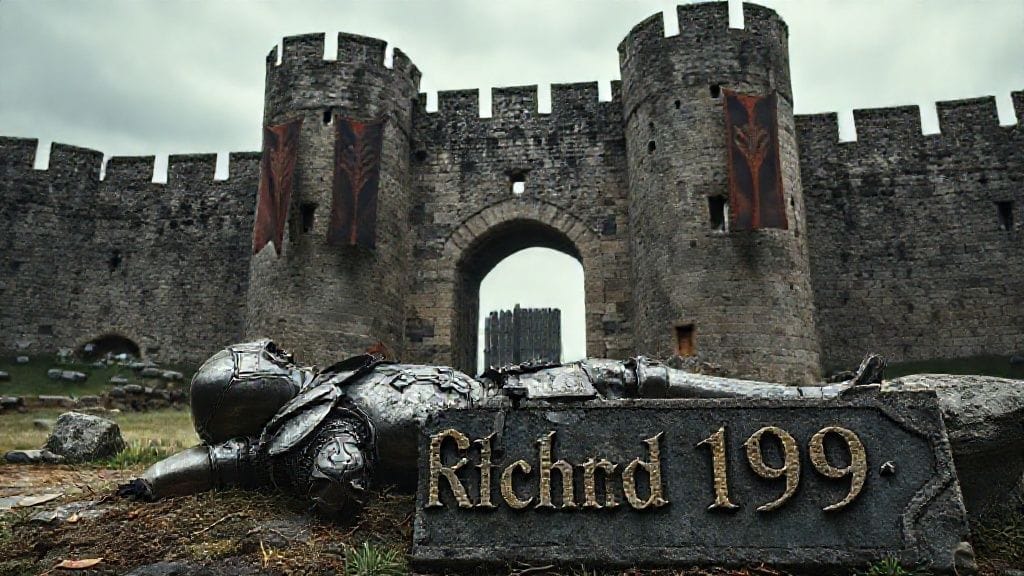
The sun hung low over the rolling green hills of Limousin, casting long shadows across the rugged landscape. At the fortress of Châlus-Chabrol, a tense stillness crackled through the cold April air of 1199, as men readied themselves for what would become the final chapter in the extraordinary saga of Richard I of England, the legendary “Lionheart.” The king, known for his relentless courage and iron will, had come to this forgotten stronghold to quell rebellion, yet a single, unremarkable crossbow bolt would change the course of history forever. The event was not merely a tragic casualty of medieval battle, but a resonance echoing beyond the immediate death, shaping politics, mythologies, and kingdoms across Europe.
The Final Days of the Lionheart: Setting the Scene at Châlus
Picture the stark stone walls of Châlus-Chabrol rising grimly against a brooding sky. It was April 1199, and Richard, despite his wounds and weariness from years of crusades and campaigns, sat astride his fate. The siege was not among the grand battles for the Holy Land or the high courts of France, but a gritty local contest. Yet within this modest frame bleeds the essence of medieval kingship—violence, honor, defiance, and the fragility of human life.
Richard I: The Lionheart’s Life and Legend
Born in 1157, Richard Plantagenet was the third son of Henry II and Eleanor of Aquitaine, a scion of one of Europe’s most powerful dynasties. His life seemed predestined for conflict and conquest. From the Crusades to his brutal political campaigns against France and rebellious vassals, Richard embodied the chivalric warrior-king, fearless and fiery. Stories of his valor were already woven by troubadours and chroniclers alike.
His heart, so often called “lion-like” for its courage and ferocity, was both a symbol and a curse. A ruler who led from the front, he courted danger relentlessly—a trait that would bring about his undoing.
The Strategic Importance of Limousin in the Late 12th Century
Limousin, nestled in the heart of present-day France, was not the most glamorous region of the Angevin Empire, but its castles and strongholds were vital for control over Aquitaine and surrounding territories.
Richard’s grasp on his French domains was tenuous. Rebellions festered, fueled by local lords chafing under royal authority. Châlus-Chabrol belonged to a rebellious lord who dared resist the king’s might. To maintain his honor and suppress insubordination, Richard personally led the siege—a testament to his hands-on approach.
Wrath and Wound: The Siege of Châlus-Chabrol
The siege was meant to be swift, but the defenders of Châlus fought fiercely. Accounts describe a relentless bombardment, men scaling walls, and arrows darkening the skies—a violent ballet of destruction. Yet, amid the chaos, a single crossbow bolt found its mark.
The weapon used was relatively new to warfare but devastatingly effective. Unlike the longbow, the crossbow required less skill, but could pierce armor at close range. A simple weapon for such a complex king.
The Fateful Arrow: Death by a Crossbow Bolt
Richard’s injury, though initially not seen as mortal, worsened rapidly. A bolt struck him in the left shoulder or side—accounts vary—piercing flesh, muscle, and perhaps even bone. What could have been dismissed as a wound turned deadly due to infection, a silent killer in an era before antibiotics.
The king’s physical agony was immense, but so was his bitterness. Chroniclers tell of his fury at the man who shot him, a defender named Pierre Basile. Richard’s legend enshrined both cruelty and mercy: some say he ordered the man’s execution; others argue for a pardon.
The Last Hours: Richard’s Pain, Pride, and Final Wishes
In the dim light of his chamber, away from battlefields and banners, Richard’s thoughts apparently turned to legacy. Reports suggest he refused to remove the arrow to avoid further harm, clinging to life with fierce resolve.
His final days saw messages sent, alliances renewed, and preparations for succession. His characteristic warrior spirit did not wane until the very end.
The Burial in Fontevraud Abbey: A King Among Kings and Queens
Richard’s body was transported with solemn ceremony to Fontevraud Abbey, founded by his grandfather Geoffrey Plantagenet. The abbey became a resting place for the Plantagenet dynasty, including Henry II and Eleanor of Aquitaine.
The burial was lavish, befitting a king—but Richard’s heart, legend says, was buried separately, embalmed and sent on a different journey—a poetic symbol of his indomitable spirit.
Political Fallout: The Succession Crisis and Power Shifts
Richard left no legitimate heirs. His brother John, often called “Lackland,” was next in line. The news of Richard’s death triggered nervous power struggles.
Many of Richard’s continental holdings were vulnerable to French King Philip II’s ambitions. The fragile Angevin Empire began to unravel, signaling major shifts in English and French medieval politics.
England and the Angevin Empire After Richard’s Death
Richard’s death marked the slow demise of the vast Angevin dominions. John’s reign reignited conflicts, rebellions, and eventually led to the signing of the Magna Carta in 1215.
The loss of Richard’s charismatic leadership underscored the challenges medieval monarchs faced in balancing personal valor with political necessity.
Myth and Memory: The Lionheart’s Posthumous Reputation
Notably, Richard’s death became fertile ground for myth-making. The lion’s heart was enshrined as a symbol of courage beyond the grave. Troubadours and storytellers elevated his deeds into legend.
Yet his human flaws—temper, ruthlessness, and neglect of England during his absences—were often glossed over or forgotten.
The Crossbowmen and Medieval Warfare: A Deadly New Technology
Richard’s death also marked a turning point in medieval arms. The crossbow, feared and forbidden by Church law for its deadly efficiency, challenged the dominance of traditional knightly combat.
It symbolized the increasing lethality and democratization of warfare, foreshadowing transformations in the centuries to come.
The Role of Vassals and Rebellions in Richard’s Final Campaign
Richard’s campaigns against rebellious vassals like the lord of Châlus reflected deeper tensions within feudal society. Lords guarded their autonomy jealously; kings sought to consolidate power.
The siege was as much a dispute over honor and control as a simple military maneuver—a melancholic finale to an age of chivalric struggle.
The Legend of the Blackened Heart
One chilling anecdote recounts that Richard’s heart blackened after death—a possible sign of gangrene—but rapidly mythologized as a literal 'black heart,' symbolizing his complex nature: brave yet ruthless, fiery yet vulnerable.
This image contributed to his lasting enigmatic presence in history.
The Limits of Chivalry: Richard’s Ruthlessness at Châlus
The siege revealed an uncomfortable side of medieval chivalry. The stubborn fight and harsh reprisals at Châlus contrasted with ideals of knightly honor and mercy.
Richard’s determination to crush dissent by force showed the harsh realities behind romanticized tales of the Middle Ages.
The Broader European Context: France, England, and the Crusades
Richard’s death intersected with wider European dynamics: the crusading spirit was waning; French power expanding; English kings struggling with continental lands.
His demise accelerated the tension between the monarchies of England and France, shaping the geopolitical landscape of the High Middle Ages.
Personal Anecdotes from Chroniclers: Voices of Medieval Witnesses
Chroniclers like Roger of Hoveden and Ralph of Diceto provide fevered firsthand glimpses into Richard’s last moments. They describe his bravado, excruciating pain, and moments of introspection.
These personal details humanize the legend and connect us across centuries with that April day in Limousin.
The Lasting Impact on Limousin and Local History
For the people of Limousin, the siege and Richard’s death became defining moments. Châlus remains a historic site; the memory still resonates in local tradition and heritage.
The event connects a small French region to the grand tapestry of medieval kings and crusaders.
The Lionheart in Popular Culture: From Shakespeare to Hollywood
Richard I’s death has inspired countless artistic interpretations—from medieval ballads to Shakespeare’s plays to modern films.
Each retelling emphasizes different facets of his persona—heroism, tragedy, or political symbol—confirming the enduring fascination with this lion-hearted monarch.
Reflections on Mortality, Power, and Legacy
Richard’s death is ultimately a meditation on the fragile nature of power. The warrior king, invincible in battle, was conquered by a simple wound and infection.
It reminds us that history is not only shaped by grand battles and kings but also by chance, human frailty, and the unpredictable turns of fate.
Conclusion
Richard I of England died as he lived: fiercely, dramatically, and on his own terms. His death at Châlus-Chabrol was more than a historical footnote; it was the closing of a chapter in medieval Europe’s grand tale of ambition, crusade, and chivalry. The “Lionheart” was a man of contradictions—brave yet merciless, distant yet commanding. His passing reshaped kingdoms and myths alike. In the quiet hills of Limousin, beyond the clanging swords and faltering banners, the echo of his life and death continues to inspire reflection on the costs of glory and the ephemeral nature of human endeavor.
FAQs
1. What caused Richard I to die at Châlus?
Richard died from an infected wound sustained during the siege of Châlus-Chabrol in April 1199. A crossbow bolt pierced his shoulder, and the infection proved fatal in an age without effective medical treatment.
2. Why was Richard besieging Châlus?
He was attempting to suppress a rebellion led by a local lord who refused allegiance, seeking to maintain control over his French territories.
3. Who succeeded Richard as King of England?
His brother John became king after his death, inheriting a fragile empire facing internal and external threats.
4. How did Richard’s death affect the Angevin Empire?
His death led to territorial losses in France and contributed to a decline in English continental power, with many lands eventually falling to King Philip II of France.
5. Was Richard merciful to the man who shot him?
Historical accounts vary; some suggest Richard ordered Pierre Basile’s execution, while others claim he pardoned him. The full truth remains uncertain.
6. How has Richard’s death been remembered in history and culture?
Richard became a legendary figure, romanticized for bravery and knightly virtues despite his flaws. His death at Châlus has been retold in literature, art, and film, cementing his iconic status.
7. Why is the crossbow significant in Richard’s death?
The crossbow represented a shift in medieval warfare; it was a deadly, relatively easy-to-use weapon that challenged the dominance of knights and heralded changes in military technology.
8. What is the significance of Richard’s burial at Fontevraud Abbey?
Fontevraud was a dynastic necropolis linking Richard to his royal lineage. The separate burial of his heart became symbolic of his enduring spirit and legacy.

