Table of Contents
- The Final Days of a Great Khan
- The Vast Mongol Steppe: A Land of Winds and Legends
- Genghis Khan: The Conqueror’s Last Campaign
- The Yin Mountains: Strategic Borderlands of Empire
- August 1227: The End Approaches in the Mongol Heartland
- Illness, Battle, or Mystery? The Enigma of Genghis Khan’s Death
- Mourning a Legend: The Immediate Aftermath Among the Mongols
- The Secrecy Surrounding the Khan’s Passing
- Burial Traditions and the Lost Tomb of Genghis Khan
- The Empire Without Its Creator: Succession and Power Struggles
- The Silk Roads and Beyond: Cementing a Legacy
- The Khan’s Death Seen Through Foreign Eyes
- Mongol Oral Traditions and the Memory of the Great Khan
- The Impact on Mongol Military Campaigns Post-1227
- The Enduring Mythos of Genghis Khan’s Final Journey
- Archaeological Pursuits to Uncover the Truth
- Modern Interpretations and Popular Culture
- Genghis Khan’s Death as a Historical Turning Point
- Lessons from the Steppe: Leadership and Mortality
- Conclusion: The End of an Era, The Birth of an Empire’s Legend
- FAQs
- External Resource
- Internal Link
The Final Days of a Great Khan
The wind ripped across the endless plains of the Mongol steppe, buffeting the few scattered figures who rode hard beneath a gray sky heavy with oncoming storms. It was August of 1227, the air thick with a strange, somber tension—a whisper of doom carried on the horse’s breath. In the vastness near the Yin Mountains, a figure wrapped in furs sat motionless atop his mount, eyes clouded but still fierce. Genghis Khan—the man who had united the Mongol tribes and carved an empire larger than any before—was dying.
The once unyielding force that had swept Asia from the Sea of Japan to the Caspian Sea was slowing, folding into the harsh realities of mortality. Around him, the familiar world of restless nomads, thunderous hooves, and crackling campfires awaited news that would shape history. Yet even in death, the Great Khan’s shadow loomed larger than life.
The Vast Mongol Steppe: A Land of Winds and Legends
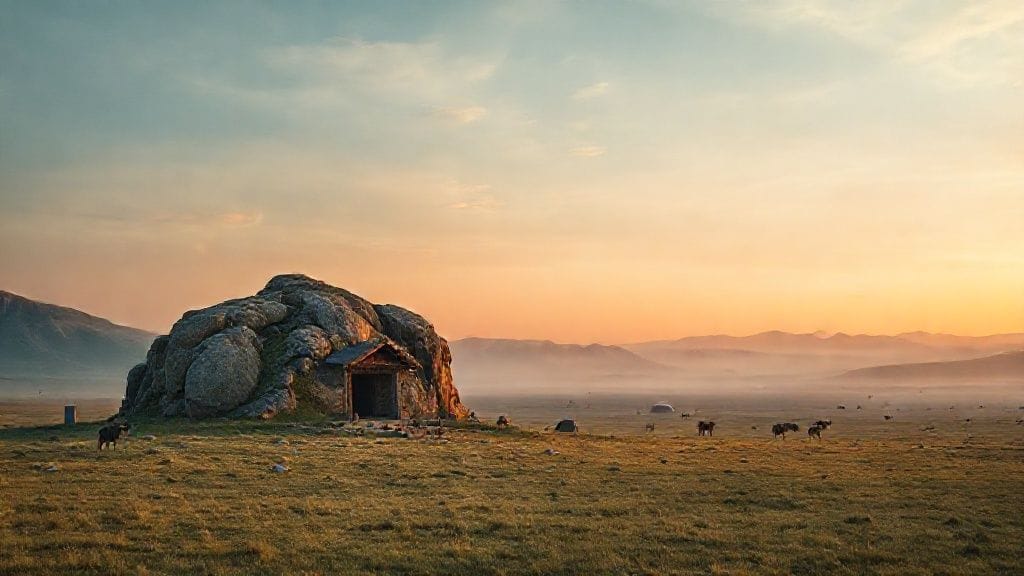
To understand the gravity of Genghis Khan’s passing, one must first grasp the land that bore him—a vast, rolling sea of grasses blanketing Central Asia, punctuated by rugged mountains, wide rivers, and an ever-changing sky. The Mongol steppe was not merely a setting; it was a crucible, forging warriors and leaders hardened by its merciless climate and ceaseless winds.
Nomadic life demanded toughness and adaptability. It was here that Genghis, born Temüjin in the dusty year of 1162, learned to ride before he could walk and to fight before his first knife was sharpened. The endless horizons taught the Mongols to think expansively and fiercely protect their freedoms.
By 1227, this landscape had become a chessboard where an empire was being stretched across continents. But it remained a fierce and unpredictable home, where nature could just as easily conquer man.
Genghis Khan: The Conqueror’s Last Campaign
The lion staggers in his twilight. For years, Genghis Khan had led brutal campaigns, extending Mongol dominion into territories both foreign and fractious—Northern China’s Jin dynasty trembled under his assault, as did the Khwarezmian Empire to the west. But in his final campaign, the Great Khan’s forces were entangled in the protracted siege and conquest of the Western Xia kingdom, a formidable foe nestled in the shadow of the Yin Mountains.
Inexplicably, the final crushing blow was never delivered before fate intervened. The campaigns, marked by savage brilliance and relentless momentum, suddenly slowed. The Great Khan—once the embodiment of unstoppable might—was struck down not by an enemy's blade, but by something more ephemeral.
The Yin Mountains: Strategic Borderlands of Empire
Bordering the Mongol heartland to the north and west, the Yin Mountains formed a jagged spine across the landscape—rocky and rugged, solitarily crowned with ancient forests and narrow passes. For centuries, these peaks had defined frontiers and guarded tribal domains.
By 1227, the Yin Mountains marked the eastern periphery of the Western Xia realm and had become a strategic fulcrum in the Mongol military calculus. It was here that campaigns converged, men and animals fatigued by months of siege warfare and the harsh terrain.
This rugged environment was witness to the Great Khan’s final moments, the very place where the unstoppable tide met the bitter shore of mortality.
August 1227: The End Approaches in the Mongol Heartland
The exact date and circumstances of Genghis Khan’s death remain shrouded in mystery, but most sources converge on August 1227 as the fatal month. Some chronicles report that he fell ill, weakened by years of wounds and exhaustion. Others speak of a fatal accident—possibly a fall from his horse or fatal injuries sustained during battle.
The mood among the Mongol hordes was grim. Commanders whispered fearfully of omens; shamans sought signs from the spirits. Even the loyalty of his sons and generals was tested by the weight of grief and uncertainty.
But amid sorrow, discipline prevailed. The empire could not afford fragmentation. It was as if the very soil swallowed the tears and replaced them with steel determination.
Illness, Battle, or Mystery? The Enigma of Genghis Khan’s Death
Legends abound—some speak in riddles, others in stark historical hints—but no consensus exists. The Secret History of the Mongols, the oldest surviving Mongol chronicle, offers tantalizing ambiguities. Chinese, Persian, and later European records provide conflicting details: some claim wounds from battle, others a sudden illness, and still another rumor suggests assassination or poison.
Why this cloak of secrecy? The Mongols themselves were notoriously discreet about their leader’s death, sealing the event behind layers of myth and silence.
Interpretations vary: was this concealment simply to maintain order? Or did the emperor’s enigmatic style persist in death, protecting the empire against chaos by transforming loss into legend?
Mourning a Legend: The Immediate Aftermath Among the Mongols
When the news leaked beyond the surviving inner circle, a nation mourned silently. Genghis Khan was not merely a ruler; he was the father of a nation, a living god to many Mongols. His death shook the very foundations of Mongol identity.
Tribal alliances were tested; the customary feast and wailing ensued in some clans, but public displays were muted, for fear the enemy might perceive weakness. The curtains of night shielded grief even as fires burned brighter across winter camps.
Mongols—and indeed the wider world—felt as if a great wind had ceased, leaving only echoes and dust.
The Secrecy Surrounding the Khan’s Passing
It is said that the Mongols went to extraordinary lengths to ensure the secrecy of their leader’s death. According to tradition, the burial party killed all who witnessed the entombment, masked the site, and diverted the course of a river to conceal the grave.
This veil of silence was practical and sacred—practical to prevent rival powers from exploiting the transition, sacred because Genghis Khan was no ordinary man. His very spirit was believed to protect and animate the Mongol people.
Thus, no contemporary map, record, or eyewitness can pinpoint his final resting place’s location—a mystery that has tantalized generations of adventurers and historians.
Burial Traditions and the Lost Tomb of Genghis Khan
Within the Mongol worldview, death was a transformation. Burial rituals were designed to honor the spirits and ensure new life. Yet Genghis Khan’s tomb defies all known archeological evidence. Unlike other Mongol nobles, his tomb remains hidden, echoing the shamanic desire for privacy in death.
Was his body buried under stones and earth, concealed by beasts or magic? Or did his followers employ a ritual so secret it erased all trace?
For centuries, the tomb has been the object of reverence, exploration, and speculation—a potent symbol of a lost chapter in human history.
The Empire Without Its Creator: Succession and Power Struggles
The death of Genghis Khan was also the birth of a delicate political transition. His third son, Ögedei, was designated successor in a carefully managed process. But the empire was still raw—massive territories, diverse peoples, and fractious generals complicated continuity.
In those chaotic months, Mongolia held its breath to see if the vision and unity forged by Temüjin would persevere—or if the vast empire would fracture under competing ambitions.
The stability of the Mongol Empire owes much to the capable leadership that followed—yet none could fully replace the magnetic force of the Great Khan himself.
The Silk Roads and Beyond: Cementing a Legacy
Even as the empire mourned, campaigns beyond the original conquests surged ahead. The Mongol armies pushed further into Eastern Europe, Persia, and Southeast Asia.
The pathways of the Silk Roads—once perilous and fragmented—became arteries of trade, culture, and communication under Mongol patronage, a phenomenon sometimes dubbed “Pax Mongolica.”
It was an extraordinary paradox: the death of the founding ruler coincided with his empire’s blossoming into a new phase of influence, shaping Eurasian history for centuries.
The Khan’s Death Seen Through Foreign Eyes
Outside Mongolia, Genghis Khan’s death was met with a mixture of awe and apprehension. The Chinese Jin dynasty saw it as a sign to resist, while the Khwarezmian realm hoped for respite.
Persian chroniclers recorded the event with a mixture of fear and fascination; European sources, limited and often mythologized, grasped at rumors of a “black scourge” fading.
This international reverberation underscores the global reach of his life and death—how one man’s passing rippled across continents.
Mongol Oral Traditions and the Memory of the Great Khan
In Mongolia, the death has never been merely a historical fact but a living story, passed down in songs, epics, and shamans’ invocations.
The great khan exists not just as a man but as a timeless force shaping identity and purpose. Across generations, his memory is a conduit for national pride and mythopoetic continuity.
Thus, understanding Genghis Khan’s death requires listening to those ancient voices, filled with reverence, longing, and awe.
The Impact on Mongol Military Campaigns Post-1227
Despite—or perhaps because of—the loss, the Mongol war machine continued its relentless advance. Under Ögedei and subsequent khans, the empire reached peaks even Genghis might have struggled to imagine.
His death infused campaigns with a mixture of vengeance, duty, and destiny. Lessons from his leadership endured, forging one of the most effective military organizations in history.
Still, some historians argue that the drive to honor his name sometimes led to reckless decisions, changing the character of Mongol expansion.
The Enduring Mythos of Genghis Khan’s Final Journey
Genghis Khan’s death inhabits the crossroads of fact and legend. Stories speak of his spirit riding alongside warriors, of the sky mourning with storms, and of the earth swallowing his horse’s hoofprints.
This interplay between history and myth ensures that the moment remains a powerful narrative—one of endings and beginnings, mortality and transcendence.
It is incredible that, nearly eight centuries later, this final chapter remains as mysterious and compelling as the man himself.
Archaeological Pursuits to Uncover the Truth
Over the last century, explorers and scientists have scoured the Mongol heartland, combing the Yin Mountains and steppe for clues to the Khan’s resting place.
From Soviet expeditions to recent multinational efforts, every discovery is met with breathless excitement, yet concrete proof remains elusive.
These quests reveal much about nomadic culture and archaeology, and each tantalizing hint adds layers to a deepening historical puzzle.
Modern Interpretations and Popular Culture
Today, Genghis Khan’s death and life inspire novels, films, documentaries, and scholarly debates alike. Globally, he is portrayed alternately as a brutal conqueror or visionary unifier.
In Mongolia, he is a national hero, celebrated with festivals and public monuments, while the international community wrestles with his complex legacy.
This multifaceted image highlights how the past continually informs identity, memory, and cultural dialogue.
Genghis Khan’s Death as a Historical Turning Point
More than just the end of a life, Genghis Khan’s death was a hinge on which the medieval world turned.
It marked the transition from unification and conquest to administration and governance, from the raw power of invaders to the subtleties of empire-building.
In this sense, the passing near the Yin Mountains was not defeat, but evolution—a moment where history’s turning wheel propelled the Mongol Empire into its golden age.
Lessons from the Steppe: Leadership and Mortality
From the steppes to the palace, Genghis Khan’s death reminds us that even the mightiest are vulnerable. His final hours evoke reflections on leadership’s burdens: the necessity of vision, resilience, but also humility before fate.
How does a leader prepare for the inevitable? How does an empire endure when its founder has passed? These questions resonate beyond history into timeless human experience.
Conclusion: The End of an Era, The Birth of an Empire’s Legend
In late summer 1227, as the sun sank behind the Yin Mountains, a chapter closed on one of history’s most extraordinary lives. Genghis Khan’s death—shrouded in silence, myth, and awe—did not diminish his immense legacy but immortalized it.
From the windscapes of the Mongol steppe to the courts of Europe and Asia, the echoes of that moment ripple still. The empire he forged stretched beyond his mortal span, forever changing the world’s vision of power, unity, and destiny.
It is, perhaps, this fusion of earthly finality and immortal legend that makes the story of Genghis Khan’s death so compelling: the eternal dance of man, myth, and history.
FAQs
Q1: How exactly did Genghis Khan die?
The precise cause remains unknown. Accounts vary between illness, injury from battle, or accident. The secrecy of Mongol tradition has obscured the truth. Modern historians accept that the details may be lost forever.
Q2: Why was there such secrecy around his death?
The Mongols believed that revealing the leader’s death could destabilize the empire. Secrecy helped maintain order and mystique, preventing enemies from exploiting the moment of vulnerability.
Q3: Where is Genghis Khan buried?
The location of his tomb remains one of history’s greatest mysteries. Tradition claims the burial site was hidden near the Yin Mountains, but no confirmed archaeological discovery has been made.
Q4: Who succeeded Genghis Khan as ruler?
His third son, Ögedei Khan, was chosen by Genghis himself and was formally elected khagan after his death. He continued the empire’s expansion and institutional consolidation.
Q5: How did Genghis Khan’s death affect Mongol military campaigns?
Despite the loss, Mongol campaigns intensified, reaching further territories. While leadership changed, the army remained effective, driven by loyalty and the desire to honor their founder.
Q6: How is Genghis Khan remembered in Mongolia today?
He is celebrated as a national hero and founding father of the Mongol state. Festivals, monuments, and cultural events honor his legacy, emphasizing his role in uniting the Mongol people.
Q7: What makes the Mongol steppe important to the story of Genghis Khan’s death?
The steppe was both his cradle and final stage—a land that embodied the nomadic spirit, tested his leadership, and now guards his final secret in its vast windswept openness.
Q8: What ongoing efforts exist to find Genghis Khan’s tomb?
Archaeologists and historians continue to investigate potential sites using modern technology like satellite imagery and ground-penetrating radar, but the tomb remains undiscovered.

