Table of Contents
- Introduction
- Birth and Early Life in Paris
- Education and Scientific Beginnings
- Breaking with Alchemy
- The Discovery of Oxygen’s Role
- Combustion and the Demise of the Phlogiston Theory
- Reforming Chemical Nomenclature
- Lavoisier’s Role in Public Service
- The French Revolution and His Arrest
- Trial and Execution
- Legacy in Modern Science
- Anecdotes and Lesser-Known Facts
- Death and Public Reaction
- External Resource
- Internal Link
Introduction
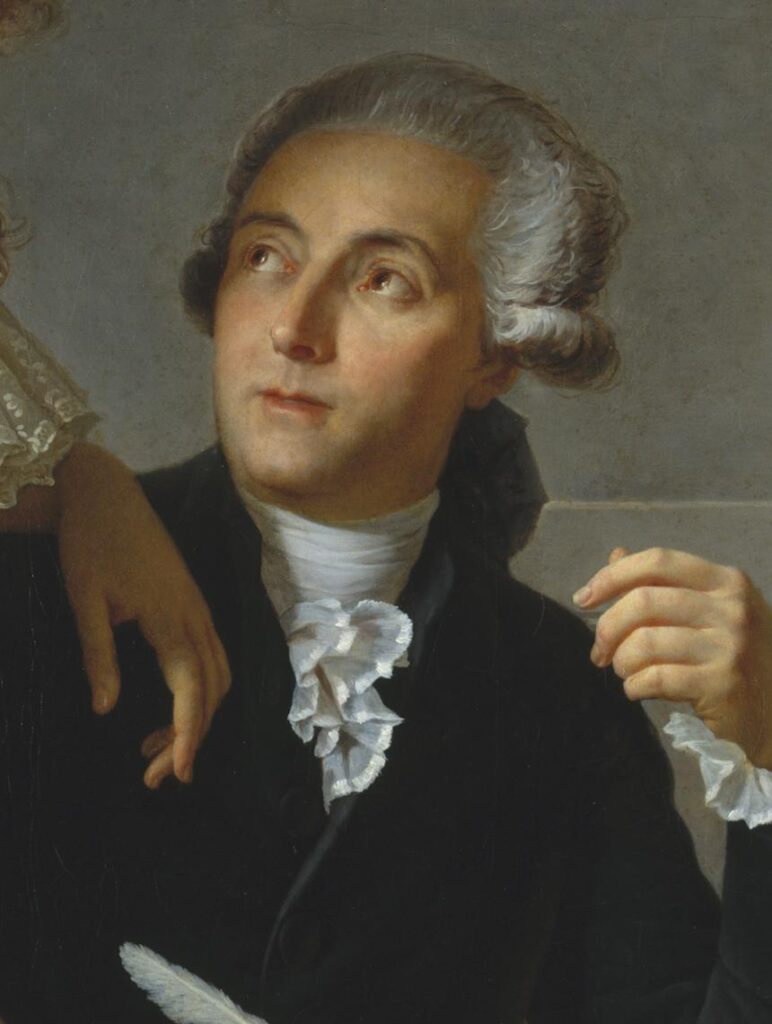
Antoine Lavoisier, often called the Father of Modern Chemistry, was born on August 26, 1743, in Paris, France. His work transformed chemistry from a mysterious art practiced by alchemists into a precise, quantitative science. Through rigorous experiments and careful observation, he uncovered the true nature of combustion, identified oxygen’s role in chemical reactions, and developed a standardized chemical language that scientists still rely on today.
Birth and Early Life in Paris
Lavoisier was born into a wealthy family, which afforded him an excellent education. His father was a lawyer, and the young Antoine initially seemed destined to follow in his footsteps. But Paris in the mid-18th century was a city alive with Enlightenment ideas, and Lavoisier’s curiosity soon pulled him toward the natural sciences.
Even as a teenager, he showed a love for experimentation. While most boys his age were content with games, Lavoisier was studying minerals, experimenting with water, and reading works by leading natural philosophers.
Education and Scientific Beginnings
At the Collège Mazarin, Lavoisier studied mathematics, astronomy, and chemistry. By the age of 22, he had already won a prize from the French Academy of Sciences for designing an efficient street-lighting system for Paris. His blend of practical engineering and scientific theory would become a hallmark of his career.
In the 1760s, chemistry was still dominated by alchemical traditions and vague theories. Lavoisier believed it could — and should — be a science grounded in measurable facts.
Breaking with Alchemy
The prevailing theory of the time was the phlogiston theory, which claimed that a fire-like element called “phlogiston” was released during combustion. This idea was intuitive but unproven, and many scientists accepted it without question.
Lavoisier was skeptical. He set out to design experiments that could weigh materials before and after combustion. If matter could be measured, he reasoned, the mystery could be solved.
The Discovery of Oxygen’s Role
In the 1770s, Lavoisier began collaborating with other chemists, including Joseph Priestley, who had isolated a gas he called “dephlogisticated air.” Lavoisier recognized this gas as a key player in combustion and named it oxygen.
Through meticulous experiments, he demonstrated that combustion was not the release of phlogiston but rather a chemical reaction in which oxygen combined with other elements. This was revolutionary — it not only overturned centuries of accepted wisdom but also laid the foundation for modern chemical understanding.
Combustion and the Demise of the Phlogiston Theory
Lavoisier’s experiments involved sealed containers, precision balances, and careful measurement. He showed that when metals rusted or burned, their mass increased because they combined with oxygen from the air.
His work definitively disproved the phlogiston theory. It also established the law of conservation of mass — matter is neither created nor destroyed in chemical reactions. This principle became one of the cornerstones of modern science.
Reforming Chemical Nomenclature
Before Lavoisier, chemical language was chaotic. Substances often had multiple names, and descriptions were imprecise. In 1787, he and colleagues published a systematic chemical nomenclature, assigning logical names to elements and compounds based on their composition.
This new language allowed scientists across Europe to communicate clearly and advance the field more efficiently.
Lavoisier’s Role in Public Service
Beyond his laboratory, Lavoisier held public offices. He served as a tax collector for the Ferme Générale, worked on agricultural reforms, and was involved in improving gunpowder production. He also contributed to public health by studying air quality in Paris and promoting hygiene measures.
While these roles gave him influence, his position as a tax official would later become a fatal liability.
The French Revolution and His Arrest
When the French Revolution erupted in 1789, Lavoisier initially supported its ideals. But his work for the Ferme Générale, an institution despised for collecting taxes, made him a target for revolutionary hostility.
In 1794, during the Reign of Terror, Lavoisier was arrested along with other tax officials. Despite his immense scientific contributions, the political climate was unforgiving.
Trial and Execution
On May 8, 1794, Lavoisier was tried and sentenced to death by guillotine — the same day as his conviction. The judge famously declared, “The Republic has no need of scientists or chemists.” His execution shocked the intellectual world.
Legacy in Modern Science
Lavoisier’s death cut short a brilliant career, but his influence endured. His work laid the foundation for modern chemistry, shaping everything from industrial processes to environmental science. Schools still teach the conservation of mass and oxygen’s role in combustion — concepts that trace directly to his experiments.
Anecdotes and Lesser-Known Facts
- Lavoisier conducted experiments with his wife, Marie-Anne Paulze, who illustrated his research and translated scientific works for him.
- He was passionate about public education, promoting science as a tool for societal progress.
- Some of his laboratory equipment survives today and is displayed in museums in Paris.
Death and Public Reaction
Lavoisier’s execution provoked outrage among scientists across Europe. Mathematician Joseph-Louis Lagrange mourned, “It took them only an instant to cut off his head, but France may not produce another like it in a century.”
External Resource
🌐 Wikipedia – Antoine Lavoisier