Table of Contents
- The Fateful Summer of 1415: A City Frozen in Anticipation
- Jan Hus: The Voice from Bohemia
- The Brewing Storm: Religious Dissent in Early 15th Century Europe
- The Council of Constance: Setting the Stage for Judgment
- Arrival at Constance: Hus Steps Into the Lion’s Den
- The Trial Begins: Accusations, Heresy, and the Power of Words
- Hus’s Defense: Courage in the Face of Death
- The Political Chessboard: Empire, Church, and Reformers
- The Verdict Rendered: Condemned and Delivered
- The Burning Pyre: A Moment Etched in Pain and Defiance
- Europe’s Reaction: Shockwaves Across Christendom
- Bohemia Afire: Hus’s Martyrdom Ignites Revolt
- Seeds of Change: The Hussite Wars and Religious Turmoil
- Lingering Echoes: Hus’s Legacy in Theology and Nationalism
- The Empire’s Dilemma: Reform or Repression?
- Hus in Memory and Myth: From Martyr to Hero
- The Human Cost: Lives Torn Apart by Faith and Politics
- The Council’s Paradox: Unity Sought, Schism Deepened
- Reflections on Justice, Faith, and Power
- Conclusion: The Flame That Refused to Die
- FAQs about Jan Hus and the Council of Constance
- External Resource
- Internal Link
The Fateful Summer of 1415: A City Frozen in Anticipation
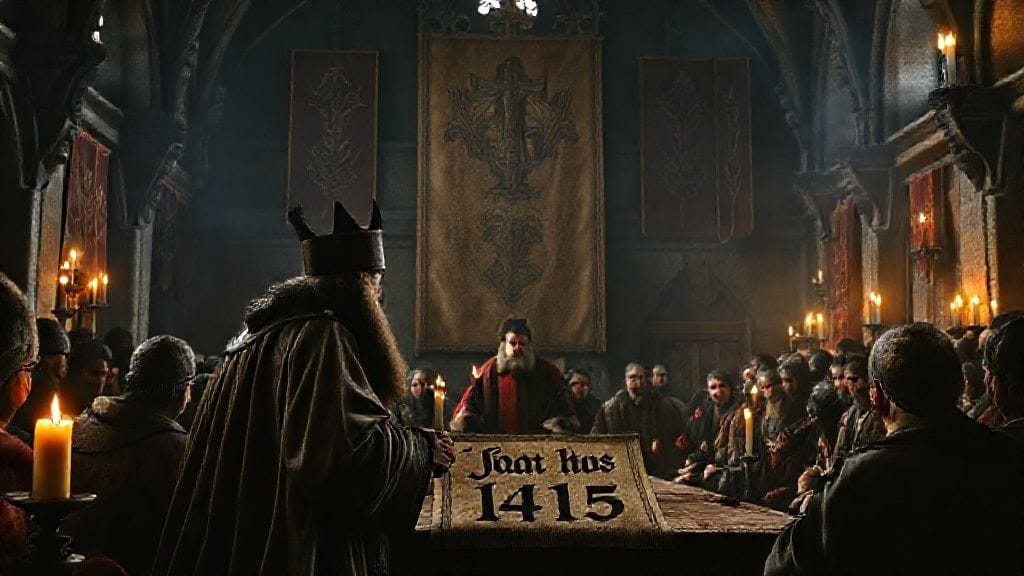
The city of Constance in July 1415 swelled with an uneasy tension. Nestled on the border between the Holy Roman Empire and Switzerland, it was no ordinary summer gathering. Merchants mingled uneasily with clerics draped in finely embroidered robes; spectators whispered in the streets; the air was heavy with expectation and dread. The sprawling cathedral shadowed the grand halls where matters of faith and empire would wrestle over the soul of a man. Jan Hus, a Czech preacher whose voice had already stirred the hearts and angered the rulers of Bohemia, was to face judgment here. The world seemed to hold its breath. What would become of this fierce reformer with his fiery words that challenged the established order? Would he save his life, or was this the moment when his flame would be extinguished—forever altering Europe’s religious landscape?
Jan Hus: The Voice from Bohemia
Jan Hus was no mere preacher; he was a symbol of awakening conscience. Born around 1369 in the Kingdom of Bohemia (modern-day Czech Republic), Hus was educated in Prague and deeply influenced by the writings of John Wycliffe, the English scholar who challenged the wealth and power of the Church. Hus returned to Bohemia with a conviction to reform what he saw as corruption and moral decay within the clergy.
His sermons burst with passion and clarity, preaching for a return to the scriptures and condemning the sale of indulgences and ecclesiastical abuses. His popularity soared among commoners and scholars alike, but he was a thorn in the side of the Church hierarchy and the Holy Roman Emperor. Hus planted a seed that would grow far beyond his lifetime—a call for reform that resonated with a growing desire for spiritual purity and social justice.
The Brewing Storm: Religious Dissent in Early 15th Century Europe
Before Hus’s trial, Europe was already roiled by tensions. The Church’s authority was under strain. The Great Schism had divided Christendom, with rival popes claiming legitimacy. Corruption, simony, and moral laxity in clerical ranks bred widespread dissatisfaction. Reformers like Wycliffe had ignited flames of dissent, but the machinery of the Church remained powerful.
The empire itself, ruled by Sigismund of Luxembourg, sought to maintain religious unity and imperial harmony. Yet beneath the surface, competing political factions and religious factions threatened to explode. The demand for reform clashed headlong with the determination of the ecclesiastical authorities to preserve the status quo. Hus stood at the crossroads of these forces, his fate symbolic of the broader crisis shaking Europe.
The Council of Constance: Setting the Stage for Judgment
Convened in 1414, the Council of Constance was designed to resolve the Papal Schism and restore unity to the Church. But it quickly expanded into a forum for confronting heresy and reform. The council assembled an international entourage of princes, theologians, and churchmen. It was a spectacle of grandeur and power—a stage on which the fate of Jan Hus would be decided.
Though the council promised Hus safe conduct to attend and defend his views, the atmosphere was lethal. The quest for religious settlement was intertwined with political calculation. Hus’s fate would not only address theological dissent but also confirm or challenge the empire’s authority. The mood was tense, the stakes immense.
Arrival at Constance: Hus Steps Into the Lion’s Den
In late 1414, Hus arrived, cloaked in the dignity of a scholar but shadowed by apprehension. His journey had been perilous, with warnings from friends to avoid the council. Yet Hus was resolute—he believed his cause was just, and that the truth would prevail under the scrutiny of reasoned debate.
As he stepped into the halls of power, the reality struck him sharply. Friendly locals mixed with hostile officials. The safe conduct promised by Emperor Sigismund became a fragile shield. Hus’s calm defiance was both inspiring and perilous. Every step deeper into the city was a step into judgment, a moment suspended between hope and doom.
The Trial Begins: Accusations, Heresy, and the Power of Words
The trial commenced with hushed deliberations and loud accusations. Hus was charged with heresy, primarily for his rejection of certain church doctrines including the authority of the Pope, the nature of the Eucharist, and the sale of indulgences. His teachings, it was said, threatened the unity and sanctity of Christendom.
But Hus was no defendant meekly accepting fate. He spoke boldly, refusing to recant unless convinced by scripture and reason. His eloquence unsettled his judges, who alternated between attempts at dialogue and rising frustration. The trial became a dramatic battle of words where faith, politics, and power all collided with explosive consequence.
Hus’s Defense: Courage in the Face of Death
Throughout the hearings, Hus displayed profound courage. He held fast to his beliefs, quoting scripture and defending his calls for reform. When pressed to recant, he declared famously, “I die today for the truth of Christ.” His unwavering stance made him a martyr in the eyes of many, though it sealed his fate.
Hus’s defense was not only theological but deeply human—a man confronting the might of institution with conscience and faith. His calm firmness questioned the legitimacy of a Church unwilling to self-examine. This moment illuminated the power of individual conviction against overwhelming authority.
The Political Chessboard: Empire, Church, and Reformers
Beneath the surface of the trial, complex political games played out. Emperor Sigismund sought to assert imperial control over a fracturing realm. The Church hierarchy wanted unity at all costs, fearful that Hus’s teachings would inspire rebellion and schism. The reform movements risked losing their voice entirely if Hus fell.
This intricate dance of power, fear, and faith shaped the outcome. No verdict could be separated purely from theology; it was entangled with the ambitions and fears of empire. Hus became a pawn, a symbol, and a threat all at once—a tension that would reverberate far beyond the courtroom walls.
The Verdict Rendered: Condemned and Delivered
On July 6, 1415, the verdict was pronounced: Jan Hus was declared a heretic. Stripped of his clerical title and dignity, he was handed over to the secular authorities—a death sentence. The finality of the moment closed the space for further debate. Hus’s doom was sealed not just by the judges but by centuries of entrenched power resistant to change.
The sentence carried with it a heavy symbolic weight. It was the Church’s iron fist wielded to silence dissent, but also a spark that ignited unforeseen fires. The tragedy of Hus was that his execution was meant to extinguish the reform movement, but instead, it fanned its flames.
The Burning Pyre: A Moment Etched in Pain and Defiance
On that scorching summer day, Hus was led to the stake. Bound and resolute, he faced the flames that would consume his body but not his spirit. Eyewitnesses described the scene with a mixture of horror and amazement. Hus’s final moments were marked by prayer and steadfastness—a defiance that seared itself into the collective memory.
As the fire roared, many said that the smoke carried a message far beyond Constance—that reform could not be burned away by violence. It was a moment of brutal suppression but also sacred sacrifice.
Europe’s Reaction: Shockwaves Across Christendom
News of Hus’s execution rippled across Europe like a thunderclap. In Bohemia, grief turned quickly to outrage. Hus had become more than a man; he was a martyr for conscience and reform. Scholars, clergy, and common folk debated the legitimacy of his condemnation, polarizing opinion throughout Christendom.
The event challenged the Church’s moral authority and destabilized imperial control in the region. It exposed the fragility of a religious order unable to reconcile truth and power. Europe was, indeed, entering an era of profound spiritual and political upheaval.
Bohemia Afire: Hus’s Martyrdom Ignites Revolt
The spark lit by Hus’s death quickly became a conflagration. The Hussite movement, fueled by a fierce commitment to his principles, erupted into open revolt. Led by dynamic figures like Jan Žižka, the Hussites confronted armies, clergy, and nobles alike in wars that would last for decades.
This popular uprising was not only religious but deeply social and nationalistic—a clash of ideas, identities, and power. Hus’s legacy transformed Bohemia into a crucible of change, setting in motion conflicts that prefigured the wider Reformation to come.
Seeds of Change: The Hussite Wars and Religious Turmoil
The Hussite Wars (1419-1434) became a defining chapter in European history, rooted in Hus’s teachings and martyrdom. They were characterized by innovative military tactics, theological debates, and social demands for justice and reform.
This period revealed the limits of medieval Christendom’s centralized control and the rising tide of popular movements demanding change. The wars unsettled neighboring powers and inspired reflection throughout the Church about reform’s urgency and the dangers of repression.
Lingering Echoes: Hus’s Legacy in Theology and Nationalism
Jan Hus’s influence did not fade with time; it only grew. His calls for scriptural authority and moral reform echoed centuries later in the writings of Martin Luther and the Protestant Reformation. In Bohemia, Hus became a symbol of Czech identity and resistance to foreign domination, intertwining faith and nationalism.
The theological ideas Hus championed—about the nature of the Church, the role of laity, and the need for genuine spirituality—continued to challenge institutional power and inspire seekers of reform long after the smoke over Constance had cleared.
The Empire’s Dilemma: Reform or Repression?
The Holy Roman Empire and the Church found themselves trapped in a painful dilemma. Hus’s fate underscored the difficulty of balancing order with renewal. On the one hand, suppression was imperative to prevent chaos; on the other, the cries for reform demanded attention.
This tension would haunt the empire and the Church for decades, revealing cracks that no political edict or council could fully seal. Hus’s martyrdom was both a warning and an omen—a call to reconcile the many fractures in Christendom or face further turmoil.
Hus in Memory and Myth: From Martyr to Hero
Over centuries, Jan Hus’s portrayal evolved—sometimes sanctified as a saintly martyr, sometimes framed as a political insurgent. His image became a powerful cultural symbol, inspiring art, literature, and national movements. He was buried not in body but in history, his execution site a place of pilgrimage and reflection.
The myths surrounding Hus mixed fact and emotion, ensuring no one forgets the preacher who dared to speak truth to power. His story reminds us that history contains not only dates and decrees but the enduring human struggle for justice and faith.
The Human Cost: Lives Torn Apart by Faith and Politics
Behind the grand narratives lay human suffering—families torn by conflict, communities divided, and individuals persecuted. Hus’s execution was a catalyst for violence that cost thousands of lives. The battlefield of ideas often became a battlefield of blood.
Yet human resilience also shone through; the hope for reform and understanding persisted. The story of Jan Hus is, at its core, a story of human courage, tragedy, and hope amid turbulent times.
The Council’s Paradox: Unity Sought, Schism Deepened
The Council of Constance succeeded in ending the papal schism but failed to reconcile the deeper issues Hus’s trial exposed. The paradox of attempting unity through exclusion and repression became painfully clear.
Rather than closing the door on reform, the council’s actions widened divides—between lay and clergy, empire and subjects, old traditions and newfound aspirations. Hus’s martyrdom was the crucible in which these contradictions became impossible to ignore.
Reflections on Justice, Faith, and Power
Jan Hus’s trial and execution invite reflection on the eternal clashes between conscience and authority, faith and politics, reform and tradition. Justice was wielded not as a search for truth but as an instrument of power—a lesson that echoes through history.
His story challenges us to consider the cost of silence and the courage required to speak out. It questions the role of institutions in nurturing or crushing the human spirit, reminding us that reform is often born in sacrifice.
Conclusion: The Flame That Refused to Die
Jan Hus’s execution in 1415 was meant to snuff out a flame of dissent, but instead, it ignited a movement that changed the course of European history. His courage and conviction in the face of death transcended the moment, planting seeds of religious reform, national identity, and human dignity.
Centuries later, his story remains a beacon—a testament to the enduring power of faith, the reckoning of conscience, and the relentless human quest for truth and justice. Hus’s flame refused to die; it transformed, illuminating a path through the dark centuries and inspiring generations to come.
FAQs about Jan Hus and the Council of Constance
Q1: What were the primary charges against Jan Hus during his trial?
Hus was charged mainly with heresy for opposing the authority of the Pope, criticizing the sale of indulgences, and advocating for church reform based on scripture. His teachings were deemed dangerous to the unity and teachings of the Church.
Q2: Why was Hus granted safe conduct to attend the Council of Constance?
Emperor Sigismund guaranteed Hus safe conduct to encourage open debate and resolution of religious disputes. However, this guarantee was not upheld when Hus was handed over to the Church for trial and execution.
Q3: How did Jan Hus’s execution affect Bohemia politically?
His execution sparked the Hussite Wars, a religious and social revolt that challenged imperial authority and ecclesiastical control. This conflict reshaped Bohemia’s political landscape for decades.
Q4: In what ways did Hus influence later reformers like Martin Luther?
Hus’s emphasis on scripture’s authority over Church tradition and criticism of clerical corruption influenced Luther and the Protestant Reformation’s theological foundations.
Q5: What was the significance of the Council of Constance beyond Hus’s trial?
The council ended the Papal Schism by resolving rival claims to the papacy but struggled to address broader calls for reform, leading to ongoing religious tensions.
Q6: How is Jan Hus remembered today?
Hus is honored as a martyr, a national hero in the Czech Republic, and a pioneer of church reform. His legacy persists in religious thought and cultural identity.
Q7: What role did Emperor Sigismund play in Hus’s trial and execution?
Sigismund invited Hus to the Council but ultimately failed to protect him, balancing his imperial ambitions with the Church’s demands to maintain order.
Q8: Why did the Church see Hus’s teachings as such a threat?
They challenged the central authority and doctrines of the Church, risking schism and undermining the Church’s political and spiritual power.

