Table of Contents
- The Twilight of a Sultan: Mehmed I’s Final Days in Edirne
- A Legacy Tested: The Ottoman Empire on the Brink
- The Rise of Mehmed I: From Civil War to Imperial Renewal
- The Battle for Succession: Seeds of Conflict and Resolution
- The Political Landscape of Early 15th Century Anatolia
- Edirne: The Imperial Capital at the Crossroads of Power
- Mehmed I’s Leadership Style: Consolidation through Diplomacy and Force
- The Final Illness: Chronicles from the Court and Chroniclers
- The Sultan’s Death: Rumors, Realities, and Immediate Aftermath
- Succession Secured: Murad II and the Continuity of the Ottoman Line
- The Empire’s Political Stability after Mehmed’s Demise
- Cultural and Religious Dimensions of Mehmed I’s Reign
- Ottoman Relations with Byzantium and Balkan Powers at the Time
- The Military Campaigns of Mehmed I: Lasting Impressions
- The Economic Foundation and Challenges Facing the Empire in 1421
- Human Stories: Courtiers, Soldiers, and Citizens in the Shadow of the Sultan’s Death
- Historical Reflections: Mehmed I’s Place in Ottoman Historiography
- The Myth and Memory of Mehmed I in Later Ottoman Culture
- Lessons from the Sultan’s Passing: Dynastic Challenges and Imperial Survival
- The Deathbed Scene: Symbolism, Power, and Transition
- Echoes Beyond Edirne: The Ottoman World Reacts
- Conclusion: The Threads of Empire Woven Through Death and Renewal
- FAQs: Understanding Mehmed I’s Death and its Impact
- External Resource
- Internal Link
The shadow of dusk fell softly over the ancient city of Edirne, the once-splendid imperial capital nestled between Europe and Asia. The year was 1421. Within the palace walls, the air was thick with the weight of impending loss. Mehmed I, the sultan who had pieced together the shattered shards of an empire torn by civil war, was breathing his last. His death would mark not only the end of a reign but signal a fulcrum point in the Ottoman story—between tenuous survival and hopeful expansion. The silent corridors whispered stories of resilience, power struggles, and human fragility all tangled in the slow exhale of a great ruler at the sunset of his life.
This was no ordinary farewell. It was the closing chapter of a man who had lived through an empire’s darkest hour—the Ottoman Interregnum—and had emerged as a uniter, a survivor, and a builder of futures. Yet, around Mehmed I’s deathbed, uncertainty and anticipation intertwined. Would the fragile order he had reestablished upon turbulent foundations survive the transition? What fate awaited Edirne, the empire, and a young dynasty in a volatile world? To understand this moment fully, one must journey back to the origins of Mehmed’s reign and the arduous path leading to his final days. This is a story of death and rebirth intertwined, of a Sultan’s humanity woven into the grand tapestry of history.
The Twilight of a Sultan: Mehmed I’s Final Days in Edirne
Edirne in 1421 was a city caught in the liminal space between glory and uncertainty. The capital thrived on its strategic position, an artery for commerce and military ventures into the Balkans and Anatolia. Yet inside the citadel, solemn faces and hushed tones reflected the severity of the moment. Sultan Mehmed I, who had weathered a brutal civil war pitting brothers against brothers, could no longer rally the dawn. The chroniclers, like Doukas and later Ottoman historians, recorded those final moments with reverence—portraying a ruler conscious of his legacy and the fragile political order he had built.
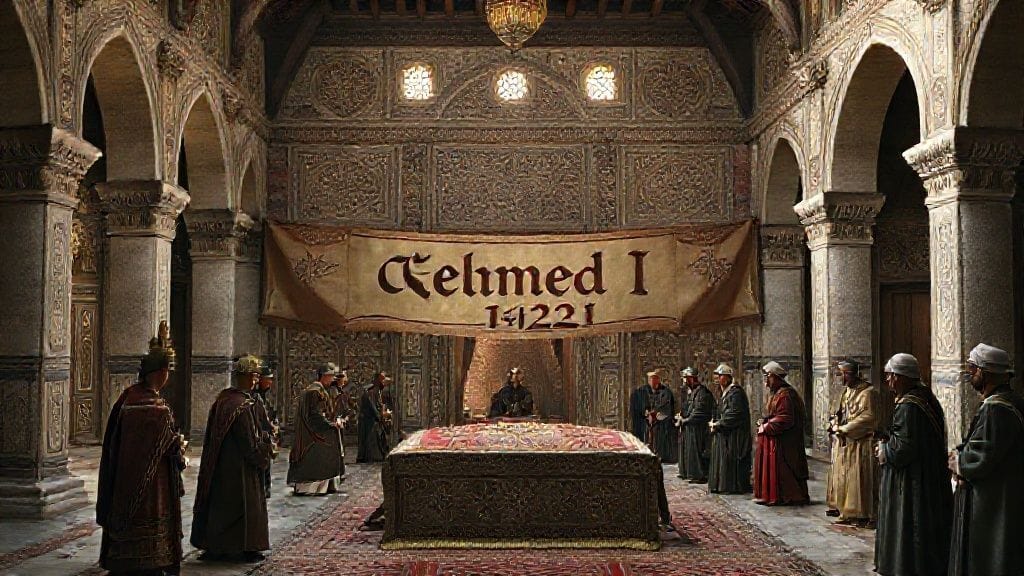
Contemporary reports fix on the gathering of advisors, generals, and family near Mehmed’s bedside. His voice, weakened but resolute, reportedly passed command to his son Murad II, preparing the empire for survival beyond his mortal coil. This scene, evoking images of dynastic continuity and poignant human vulnerability, shaped the tone of the empire’s future course. But this was also a moment pregnant with tension. The seeds of Ottoman power had been sown, but their fruitfulness was far from assured—reflecting the deep political and familial complexities that underscored this era.
A Legacy Tested: The Ottoman Empire on the Brink
The Ottoman state that Mehmed I fought to restore was precariously perched on the extensible threads of political legitimacy and military strength. The preceding decade, marked by the Interregnum—essentially a civil war between Mehmed and his brothers following the defeat of their father Bayezid I by Timur in 1402—had fractured the empire’s coherence. Mehmed’s victory at the Battle of Çamurlu in 1413, where he decisively defeated his last brother Musa, had reasserted centralized authority. Yet a war-ravaged realm demanded more than conquest: it needed restoration, governance, and charisma to bind its diverse peoples.
Mehmed’s reign thus became a laboratory of political reintegration, balancing military campaigns, diplomacy, and internal governance. However, by 1421, the question was less about conquest and more about survival: could the empire transcend the legacy of division? Could a young sultan, Murad II, inherit a solid foundation from a sultan whose personal health and vigor were fading?
The Rise of Mehmed I: From Civil War to Imperial Renewal
Mehmed I’s accession did not happen on smooth roads. After the devastating defeat of Bayezid I against Timur at the Battle of Ankara, the empire descended into chaos. Mehmed, one of Bayezid’s sons, emerged as a central figure by virtue of tactical brilliance, political savvy, and fortitude. His struggle, spanning nearly a decade, took a toll that could be felt beyond campaign maps—deep in the civic administration, the military order, and the social fabric of the Ottoman domains.
His ability to unify the Ottomans created the crucial turning point: the temporary restoration of the empire’s cohesion and imperial identity. It is often said that Mehmed was the “Sultan of Restoration,” a title both apt and melancholic, since the empire he held together was a phoenix born from ashes – yet held in fragile flight.
The Battle for Succession: Seeds of Conflict and Resolution
The shadow of dynastic rivalry loomed large throughout Mehmed’s reign. Ottoman succession was traditionally fraught with fratricidal violence—a brutal calculus to enable the strongest heir’s dominance. Mehmed’s own path to the throne was written in blood, shaping a political reality where clemency was scarce, and alliances were transient.
His death in 1421 revived the ever-present question: who would inherit the empire? While Mehmed attempted a peaceful transition to Murad II, the reality on the ground was more unstable. Various local lords, Balkan chieftains, and rival claimants observed the unfolding drama closely, ready to seize advantage of potential weakness. Yet history shows us that Mehmed’s final decisions on succession were crucial to preventing an immediate relapse into internecine strife.
The Political Landscape of Early 15th Century Anatolia
Beyond the borders of Edirne, Anatolia and the Balkans were a complex mosaic of competing powers and shifting loyalties. The Byzantine Empire, though diminished, still exerted influence in the region, particularly around Constantinople. The fragmented Anatolian beyliks also posed both threats and opportunities for Ottoman diplomacy.
Mehmed I’s reign was marked by careful navigation through this treacherous environment. Restoring Ottoman authority was not simply a matter of military might; it required adroit negotiation with vassals, religious leaders, and foreign powers. The geopolitical balance of the early 15th century ensured that Edirne's sultanate, as the seat of power, was perpetually alert to intrigue and sudden shifts in alliances.
Edirne: The Imperial Capital at the Crossroads of Power
Edirne was much more than a city—it was the nerve center of Ottoman governance between 1365 and 1453, before Istanbul’s elevation. Its palaces, mosques, and administrative halls symbolized Ottoman ambition and statecraft. The city was a hub for merchants, craftsmen, soldiers, and diplomats.
As Mehmed’s health declined, the city became an arena of subtle power plays: court officials jockeyed to secure influence with the future Murad II, religious authorities underscored their roles as spiritual legitimizers, and military commanders guarded their provinces, awaiting the sultan’s will. The late-phase Edirne presented a mirror to the multifaceted nature of Ottoman power—where sacred and secular coexisted, and where the fate of a vast empire was negotiated daily.
Mehmed I’s Leadership Style: Consolidation through Diplomacy and Force
Unlike his father Bayezid I, known as “Yıldırım” (the Thunderbolt) for his ferocity, Mehmed I was a craftsman of compromise and cautious governance. Balancing military campaigns with administrative reforms, his reign focused on state-building and healing fractured bonds within the empire.
Fierce when needed, Mehmed demonstrated flexibility in using marriages, alliances, and political offices to strengthen loyalty. His approach to succession also revealed pragmatism—he groomed Murad II carefully to avoid another bloody civil war. In his final days, this measured exercise of power was deeply tested.
The Final Illness: Chronicles from the Court and Chroniclers
Sources from the period describe Mehmed’s final illness with a mixture of pathos and political gravity. Chroniclers such as Ashik Pasha-Zade depicted the sultan’s gradual decline: fevers, fatigue, and bodily weakness, contrasted with a mind sharp enough to issue instructions concerning the empire’s governance. Reports speak of guards standing vigil, poets composing elegies, and a court sensitive to the meaning of this transition.
While precise medical details elude historians, the emotional tenor is striking—Mehmed’s awareness of the impermanence of life and empire resonates deeply, reminding us that rulers, no matter how powerful, are ultimately human.
The Sultan’s Death: Rumors, Realities, and Immediate Aftermath
When Mehmed I passed away in Edirne in May 1421, reactions spanned from mourning to opportunism. News spread swiftly, carried by messengers and merchants, causing ripples across Ottoman lands. Some attempted to capitalize on potential instability; others braced to support Murad II’s claim.
The death stirred memories of past rivalries but also hopes for continued order. The loyalists swiftly moved to affirm Murad II’s succession. Structures of governance, including the divan council and military elite, coalesced to prevent chaos—showing the effectiveness of Mehmed’s legacy in statecraft.
Succession Secured: Murad II and the Continuity of the Ottoman Line
Murad II, the sixteen-year-old heir, was swiftly proclaimed sultan. His mother, Emine Hatun, and influential viziers played pivotal roles in quelling dissent and consolidating power. Murad’s accession was a test of the new generation’s capacity to uphold his father’s achievements.
Historical accounts note that Murad II faced challenges later, including rebellions and external threats, but the stability inherited from Mehmed I’s reign provided a crucial platform. It signified the resilience of the Ottoman dynasty and the institution of sultanship amid turbulent times.
The Empire’s Political Stability after Mehmed’s Demise
The smooth transition in 1421 was no mere happenstance but the result of deliberate preparation by Mehmed and his circle. The Ottoman state apparatus demonstrated adaptability and strength. The military, bureaucrats, and religious leaders aligned to discourage fragmentation.
This stability allowed the empire not just to endure, but to resume expansionist ambitions in the Balkans and Anatolia. Over the following decades, the early survival secured by Mehmed’s death would become the launching pad for further Ottoman ascendancy.
Cultural and Religious Dimensions of Mehmed I’s Reign
Under Mehmed I, Ottoman patronage of arts and religious institutions continued. Mosques, madrasas, and charitable foundations benefited from his sponsorship, helping weave a shared imperial culture.
His reign also reinforced Sunni Islam as central to Ottoman legitimacy, integrating religious authority with political sovereignty. The Sultan was both ruler and caliphate representative—an idea that would evolve further under his successors but rooted in this transitional period.
Ottoman Relations with Byzantium and Balkan Powers at the Time
Edirne’s proximity to Byzantine territories and Balkan principalities placed Mehmed I at the heart of Balkan geopolitics. Even weakened, the Byzantine Empire was not a mere relic but an active player leveraging diplomacy, marriage alliances, and occasional conflict.
Mehmed maintained a cautious but assertive posture—allowing tributary relationships while preparing for territorial gain. This balance was crucial to avoiding exhausting wars and preserving the empire’s fragile unity as Mehmed faced his final days.
The Military Campaigns of Mehmed I: Lasting Impressions
While Mehmed’s reign was quieter than that of Bayezid or Murad II in terms of battlefield conquests, his campaigns were vital for reasserting control—especially in recovering lost territory and subduing rebellious beys.
His military strategy emphasized consolidation and integration rather than rapid expansion, reflecting a cautious optimism aligned with a recovering empire’s needs.
The Economic Foundation and Challenges Facing the Empire in 1421
The empire Mehmed inherited was ravaged by war and disrupted trade routes. Recovering economic vitality was essential for sustaining governance and military capabilities.
Edirne’s strategic position as a trade nexus facilitated commerce in goods ranging from silk to cereals. Mehmed’s administration sought to rebuild infrastructure, tax collection systems, and market stability—foundations critical for the empire’s longer-term resilience.
Human Stories: Courtiers, Soldiers, and Citizens in the Shadow of the Sultan’s Death
Beyond grand politics, the death of Mehmed I touched many lives. Soldiers unsure of pay or command, merchants anticipating new opportunities or risks, and common citizens caught between imperial edicts and local realities all experienced the event intimately.
Poetry and oral traditions later celebrated Mehmed as a father of the empire, mixing historical record with legend—revealing the human dimension behind imperial history.
Historical Reflections: Mehmed I’s Place in Ottoman Historiography
Ottoman chroniclers often portrayed Mehmed I as the “restorer” in a narrative that valorizes unity and continuity. His reign, set between crisis and conquest, is sometimes overshadowed by the more dramatic figures of Bayezid I or Mehmed II, but modern historians recognize its crucial role.
The nuanced historiography reveals Mehmed as more than a transition figure—a shrewd strategist and caretaker of imperial integrity.
The Myth and Memory of Mehmed I in Later Ottoman Culture
In Ottoman cultural memory, Mehmed I is celebrated for healing fratricidal wounds and rebuilding the empire's foundations. His image appears in manuscripts and palace lore as a symbol of patience and renewal. The posthumous veneration reflects Ottoman ideals about rulership and family.
Such memory contributed to the shaping of imperial identity, emphasizing stability over conquest during perilous times.
Lessons from the Sultan’s Passing: Dynastic Challenges and Imperial Survival
Mehmed I’s death illustrates the perennial challenges of dynastic politics—where the survival of empire depended on managing family rivalries, elite loyalties, and external threats.
The Ottoman experience demonstrated that survival was often as heroic as expansion. Mehmed’s life and death stand testimony to the limits and possibilities of sultanic power.
The Deathbed Scene: Symbolism, Power, and Transition
The imagery of Mehmed I on his deathbed—surrounded by advisors, whispering final orders—encapsulates the drama of impermanence in power. It evokes the tension between human frailty and the imperial dream, highlighting the Sultan’s dual role as man and monarch.
This pivotal moment inspired later political rhetoric and remains a poignant symbol of empire’s vulnerability and endurance.
Echoes Beyond Edirne: The Ottoman World Reacts
The news of Mehmed’s death spread beyond the capital to Anatolia, the Balkans, and even distant courts. Allies, rivals, and the populace watched closely, measuring the empire's strength by its response.
That response, marked by swift consolidation around Murad II, demonstrated Ottoman political maturity and the potency of Mehmed’s preparatory measures.
Conclusion
The death of Mehmed I in Edirne, 1421, was more than an end; it was a decisive turning point in the Ottoman saga. This moment reflected the fractious history of a dynasty forged through strife and survival, as well as its capacity for regeneration. Mehmed’s reign, framed by civil war and restoration, left a legacy of resilience in governance, military recalibration, economic recovery, and cultural affirmation.
In the quiet chambers where Mehmed breathed his last, one can almost hear the echoes of empire’s heartbeat—tenuous but determined. His passing tested the fragile architecture of power he had reconstructed but ultimately underscored the strength of a political system built to endure. The accession of Murad II illuminated potential horizons of conquest, growth, and transformation for the Ottoman Empire.
History, as always, is a story of human endeavor amid uncertainty. Mehmed I’s death teaches us that sometimes the greatest victories lie not in expansion but in the art of preserving what is precious—unity, legitimacy, and hope for the future.
FAQs
Q1: What caused Mehmed I’s death?
A1: The exact cause remains unclear, but historical sources indicate a gradual illness, likely natural and age-related, which led to his decline and death in Edirne in 1421.
Q2: How did Mehmed I secure the succession for his son Murad II?
A2: Through careful political maneuvering, grooming of Murad II as heir, support from key advisors and military commanders, and rapid consolidation of power following Mehmed’s death, the succession was made as smooth as possible.
Q3: What was the significance of Edirne during Mehmed I’s reign?
A3: Edirne served as the Ottoman capital and strategic administrative center between Europe and Asia, vital for its military and commercial control.
Q4: How did Mehmed I rebuild the Ottoman state after the Interregnum?
A4: By reconquering lost territories, defeating rival brothers, restoring administrative control, stabilizing the economy, and fostering loyalty among elites, Mehmed I reunited the empire fractured after 1402.
Q5: What challenges did the Ottoman Empire face immediately after Mehmed’s death?
A5: Internal dissent, potential rival claims, regional unrest, and external threats from Byzantines and Balkan lords threatened the empire, but rapid centralization under Murad II helped avert crisis.
Q6: How is Mehmed I remembered in Ottoman historiography and culture?
A6: He is celebrated as the “restorer” who healed dynastic wounds and rebuilt the empire’s foundations, remembered with respect and as a symbol of patience and unity.
Q7: What role did religion play in Mehmed I’s reign and death?
A7: Sunni Islam underpinned the sultan’s legitimacy, with religious leaders supporting governance and succession, reinforcing the intertwining of spiritual and political authority.
Q8: Did Mehmed I expand the empire significantly during his reign?
A8: Mehmed’s reign was more focused on consolidation than expansion, prioritizing recovery and stabilization rather than new conquests.