Table of Contents
- The Final Days of Edward IV: A King’s Last Moments
- The Political Climate of England in 1483
- Edward IV’s Reign: Triumphs and Trials
- The Fragile Health of a Warrior King
- Death in Westminster: April 9, 1483
- The Court in Mourning: Reactions to the King’s Passing
- The Legacy of Edward IV: Architect of York’s Resurgence
- Richard, Duke of Gloucester: The Shadow by the King’s Deathbed
- The Princes in the Tower: A Tale Born from Edward’s Demise
- Succession Crisis: The End of Stability in the Wars of the Roses
- Queen Elizabeth Woodville: A Widow’s Ordeal
- Political Intrigue and Power Struggles Following Edward’s Death
- The Boy King: Edward V’s Ill-Fated Accession
- The Role of the Woodville Family Amidst the Chaos
- The Rise of Richard III: From Protector to Usurper
- Historical Perspectives on Edward IV’s Death
- The Emotional Weight of a Kingdom in Transition
- Edward IV’s Burial at Westminster Abbey: Ceremony and Symbolism
- Cultural and Artistic Representations of the Late King
- The Death of Edward IV in the Context of the Wars of the Roses
- The Impact on England’s Political Landscape and Beyond
- Reflections on Mortality and Kingship in the Late Middle Ages
- Conclusion: The End of an Era, The Dawn of Turmoil
- FAQs About Edward IV’s Death and Its Aftermath
- External and Internal Resources for Further Study
1. The Final Days of Edward IV: A King’s Last Moments
April 1483. The air in Westminster was thick with foreboding. Outside the stone walls of the palace, spring tried to assert itself with tentative blooms, yet within, the heartbeat of England’s realm faltered. Edward IV, the redoubtable Yorkist king who had clawed his way back from exile and civil war to reclaim the throne, lay grievously ill. His once vigorous frame, hardened by decades of martial command and royal defiance, was now frail and vulnerable. The flickering candlelight cast long shadows across his chamber, where courtiers whispered anxiously, grappling with the imminent loss of their monarch.
This was not merely the death of a man; it was the collapse of a pillar upon which England’s precarious peace rested. Edward IV’s passing would set off a chain of events that plunged the kingdom back into chaos and despair. The king’s candle guttered and faltered on April 9th, 1483, but the flame of conflict it ignited would blaze for years to come.
2. The Political Climate of England in 1483
Edward IV’s death arrived at a tempestuous moment. The Wars of the Roses, a dynastic conflict that had rent England since 1455, had yet to settle into lasting peace. The country was fractured between the houses of York and Lancaster; alliances were fragile, loyalties often shifting like the winds. Edward’s reign had brought hope—and contested authority.
His accession had itself been a violent upheaval, a rebellion that ousted the Lancastrian Henry VI. Yet beneath the veneer of Yorkist triumph lay simmering resentments: noble families wary of the king’s centralization, factions supporting rival claims, and the ever-tactical Queen Elizabeth Woodville, whose rapid rise and family’s enrichment bred bitter enmity.
In this charged atmosphere, the king’s death was not just a personal tragedy; it was a political bombshell. England stood at the edge of an uncertain future, where the question was no longer who would reign, but who could.
3. Edward IV’s Reign: Triumphs and Trials
To understand the gravity of Edward’s death, one must delve into his turbulent reign. Rising to the throne in 1461 at just 18 years old, Edward was a charismatic leader and brilliant tactician. His victories at battles like Towton secured the Yorkist claim, ushering in a period of relative stability.
His reign was marked by efforts to restore royal authority, rebuild the economy, and promote justice. Yet Edward was also a man of contradictions: a fierce warrior and a shrewd politician, yet prone to bouts of capriciousness. His marriage to Elizabeth Woodville without the king’s council’s consent sparked noble unrest and stirred conflicts that would later exacerbate factional rivalries.
Despite setbacks, including temporary exile in Burgundy, Edward’s restoration in 1471 reaffirmed his strength. His government nurtured the arts and centralized power, but beneath this progress lay the tensions that exploded after his death.
4. The Fragile Health of a Warrior King
Edward’s robust visage belied a delicate constitution in his final months. Historical accounts hint at an unknown illness—possibly pneumonia or tuberculosis—that sapped his energies with cruel relentlessness. The king's health deteriorated rapidly in early 1483, confounding the hopes of courtiers and physicians alike.
Reports from the period describe a ruler who, until near his death, attempted to maintain command, holding councils and managing affairs. However, as the days passed, it became clear that the king was fading. His weakness invited not only pity but opportunism, as various factions sensed a power vacuum growing by the hour.
5. Death in Westminster: April 9, 1483
On the morning of April 9th, Edward IV passed away—his final breath signaling the end of the Yorkist ascendancy that he had so fiercely defended. The deathbed scene was reportedly somber yet charged with tension. Surrounded by close family, including his queen and eldest son Edward V, the dying king's presence lingered as a silent challenge to those who would vie for his crown.
Westminster, a traditional heart of English kingship, witnessed the fall of a king whose life embodied the brutal uncertainty of his age. News swept quickly through London, and the court plunged into mourning and political maneuvering.
6. The Court in Mourning: Reactions to the King’s Passing
The immediate aftermath saw expressions of grief, but these were intermingled with concern and calculation. Nobles and advisers struggled to present a united front as the kingdom faced the challenge of succession.
Elizabeth Woodville’s sadness was immense; as a widow, her future and that of her children suddenly precarious. The Woodville faction sought to protect their interests and the young heir, but they navigated a court rife with jealousies and rivalries.
For many, Edward’s death was a catalyst that exposed the fragile alliances built over two decades. Mourning was reluctantly accompanied by whispered plotting.
7. The Legacy of Edward IV: Architect of York’s Resurgence
Edward IV’s forty-one years had changed England. From the ashes of factional warfare, he had carved out a renewed Yorkist kingship. His victories reinvigorated not only his dynasty but a vision of centralized monarchy.
In law, administration, and art, Edward left a legacy heralded by some as the foundation for Tudor stability. But his premature death laid bare the limitations of his work—no system could withstand the turbulent ambitions unleashed in his absence.
8. Richard, Duke of Gloucester: The Shadow by the King’s Deathbed
Among those nearest to Edward IV’s passing was his younger brother Richard, Duke of Gloucester. Known as a fierce and loyal figure, Richard’s role in the king’s final day was both intimate and pivotal.
The immediate period after Edward’s death saw Richard move swiftly to assume the Protector role for the crowned but juvenile Edward V. But the shadows around Richard grew longer, with whispers of ambition and power struggles that would shape history’s darkest moments.
9. The Princes in the Tower: A Tale Born from Edward’s Demise
The tragic tale of the Princes in the Tower—Edward V and his younger brother Richard—sprang directly from the chaos after Edward IV’s death. The boys were confined within the Tower of London under Richard’s protection… or, as history would later debate, possibly imprisonment.
This episode embodies the uncertainty and intrigue unleashed after April 1483, when the fate of England’s future hung precariously in the balance. Were the princes victims or pawns? The mystery endures, a haunting legacy of Edward’s death.
10. Succession Crisis: The End of Stability in the Wars of the Roses
Edward IV’s death marked the shattering of a fragile peace. Edward V’s brief reign was overshadowed by a violent swirl of claims, accusations of illegitimacy, and claims of usurpation. The fragile thread that Edward IV had woven was quickly torn.
The Wars of the Roses flared anew, dragging England deeper into civil war, with alliances shifting rapidly and blood spilled in pursuit of thrones and power.
11. Queen Elizabeth Woodville: A Widow’s Ordeal
Elizabeth Woodville emerged as a tragic figure in the wake of Edward’s death. Once queen consort, she found herself bereft of power and protection. The queen mother tried desperately to secure the safety of her children amid hostile factions.
Her plight reveals the vulnerability of royal women in a period where queenship could be as precarious as it was exalted.
12. Political Intrigue and Power Struggles Following Edward’s Death
The corridors of power filled with tension as nobles jockeyed to shape the future. Richard of Gloucester’s Protectorate soon gave way to dramatic usurpation, while the Woodvilles sought to defend their position.
This was an era where courtly alliances could unmake kings, and secret plots simmered behind the façade of loyalty.
13. The Boy King: Edward V’s Ill-Fated Accession
At just twelve years old, Edward V’s ascension was more symbol than governance. His reign lasted mere months before Richard declared him illegitimate and seized the crown as Richard III.
Edward V’s short, tragic story illuminates the vulnerabilities of childhood kingship made cruel in the harsh realities of dynastic politics.
14. The Role of the Woodville Family Amidst the Chaos
The Woodville family, propelled by their queen mother’s influence, became central players and scapegoats in the post-Edward IV power drama. Their rapid rise had fueled noble disdain, and their fall was swift and ruthless.
Understanding their trajectory is key to grasping the personal dimensions of the political crisis sparked by Edward’s death.
15. The Rise of Richard III: From Protector to Usurper
Richard’s move from loyal brother to king remains one of the most contentious and dramatic moments in English history. His decision to declare Edward V illegitimate and seize power altered the course of the realm.
His reign would be short and tragic but forever intertwined with the death of Edward IV and the fate of his nephews.
16. Historical Perspectives on Edward IV’s Death
Historians have long debated the nature and significance of Edward’s death. Was it an arrow to a battleground, or a quiet collapse of a tired king? How much did his passing shape or accelerate England’s descent into renewed conflict?
Recent scholarship sheds nuanced light on the event’s multilayered impact on the fifteenth-century political landscape.
17. The Emotional Weight of a Kingdom in Transition
Beyond politics and power, Edward IV’s death was a human tragedy—felt deeply by family, courtiers, and common people alike. The passing of a king stirred reflections on mortality, legacy, and the uncertainty that shadows all human institutions.
This emotional resonance adds depth to the dry pages of history.
18. Edward IV’s Burial at Westminster Abbey: Ceremony and Symbolism
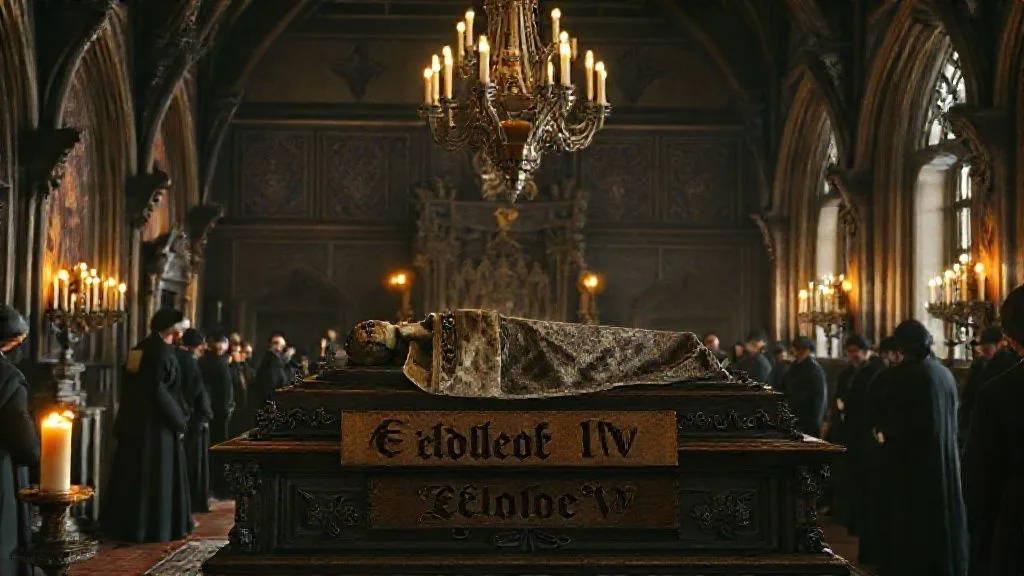
His interment in Westminster Abbey was both a religious rite and a political statement. The pomp and ceremony underscored Edward’s status and the Yorkist claim, even as turmoil churned beyond the abbey walls.
This final chapter in his life offers insight into medieval kingship and remembrance.
19. Cultural and Artistic Representations of the Late King
From Tudor chroniclers to modern historians and artists, Edward IV’s image has been recast countless times—sometimes as a warrior hero, sometimes as a flawed ruler. His death and legacy feature prominently in the literature and art inspired by the Wars of the Roses.
These portrayals shape public memory and historical understanding.
20. The Death of Edward IV in the Context of the Wars of the Roses
As a turning point, Edward’s death did not end the Wars of the Roses but intensified them. It exposed the fragility of dynastic claims and the mercurial nature of power.
The event is a vivid example of how individual mortality can redirect a nation’s fate.
21. The Impact on England’s Political Landscape and Beyond
The instability following Edward’s death rippled beyond England’s shores. Neighboring powers watched closely as internal strife offered opportunities and dangers alike.
Moreover, it set the stage for the eventual rise of the Tudors and the profound transformation of English monarchy and society.
22. Reflections on Mortality and Kingship in the Late Middle Ages
Edward IV’s death invites contemplation on what it meant to be a medieval king: the burden of rule, the ever-present shadow of mortality, and the fragile nature of political legitimacy.
His passing encapsulates the human condition behind the crown.
23. Conclusion: The End of an Era, The Dawn of Turmoil
Edward IV died as a king who had restored hope and order to a fractured realm but whose death reopened wounds thought healed. In Westminster on April 9th, 1483, an era came to a close, and a darker chapter unfurled—one of betrayal, disappearance, and civil war.
The echoes of that day resound through history, reminding us how fragile peace and power truly are.
Conclusion
Edward IV’s death was more than the passing of a monarch; it was the fulcrum upon which the 15th century tilted itself toward renewed conflict and transformation. His life had been one of war and reconciliation, brilliance and foibles, power and vulnerability. His death laid bare the fragile infrastructure of a kingdom desperately yearning for stability but trapped in cycles of ambition and betrayal.
At Westminster, the candle of York’s ascendancy flickered out, but the fires it ignited endured. The sorrow and turmoil it unleashed would shape England’s destiny for decades, reminding us that in history, as in life, an end is never truly an end, but a passage to the unknown.
FAQs About Edward IV’s Death and Its Aftermath
Q1: What caused Edward IV’s death?
The precise cause remains uncertain, though historical accounts suggest illness like pneumonia or tuberculosis. His health declined rapidly, leading to his death in April 1483.
Q2: How did Edward IV’s death affect the Wars of the Roses?
His death fractured Yorkist stability, reigniting dynastic conflict, succession crises, and widespread civil war that continued until the rise of the Tudors.
Q3: Who succeeded Edward IV?
His eldest son, Edward V, a boy of twelve, was crowned but never effectively ruled, as his uncle Richard later usurped the throne.
Q4: What was Queen Elizabeth Woodville’s role after her husband’s death?
She sought to protect her children and maintain power for her family but faced hostility and political marginalization.
Q5: Why are the “Princes in the Tower” significant?
They symbolize the tragic uncertainty following Edward IV’s death, as Edward V and his brother disappeared under suspicious circumstances, their fate shrouded in mystery.
Q6: How did Edward IV’s death influence Richard III’s rise?
Richard used the king’s death to position himself as Protector, then declared Edward V illegitimate and crowned himself, dramatically altering England’s power dynamics.
Q7: How is Edward IV remembered today?
As a complex monarch—skilled and resilient, yet flawed and ultimately undone by the turbulent politics he helped engender.
Q8: What was the significance of Edward IV’s burial at Westminster Abbey?
It was a statement of royal legitimacy and continuity amid chaos, reinforcing Yorkist claims through ceremony and tradition.