Table of Contents
- The Last Breath of a Revolutionary Mind: Marsilius of Padua’s Final Days
- Marsilius of Padua: The Man Behind the Controversy
- Europe in the Early 14th Century: A Continent on the Brink
- The Intellectual Storm: Marsilius’s Defiance Against Papal Authority
- From Padua to Munich: The Shadowy Journey of a Dissident Scholar
- The Political Chessboard of the Holy Roman Empire in 1342
- A Confluence of Ideologies: Empire, Church, and Secular Rule
- Munich in 1342: Where History Witnessed a Quiet End
- Unraveling the Death: Mysteries and Theories
- The Immediate Aftershock: Reactions Across Europe
- Marsilius’s Legacy: Laying the Groundwork for Political Thought
- The Empire’s Response: Power, Control, and Censorship
- Echoes in Later Political Philosophy: From Marsilius to Machiavelli
- The Death and the Ideas: How One Influenced the Other
- Cultural and Religious Ripples Beyond the Medieval Era
- Marsilius Remembered: Monuments, Manuscripts, and Memory
- The Renaissance and the Reinterpretation of Marsilius’s Work
- Modern Scholarship: Debates and Discoveries about Marsilius’s Death
- The Ongoing Influence on Church-State Relations
- Munich’s Historical Identity Shaped by a Forgotten Philosopher
- Conclusion: The Eternal Dialogue Between Power and Conscience
- FAQs: Deepening the Understanding of Marsilius and His Era
- External Resource
- Internal Link
1. The Last Breath of a Revolutionary Mind: Marsilius of Padua’s Final Days
It was an unremarkable day in Munich, 1342—a cold, gray sky hanging low, as if the heavens themselves mourned the passing of an extraordinary man. Marsilius of Padua, the relentless thinker whose ideas had challenged the very foundation of medieval authority, lay gravely ill, encircled not by pomp but by whispers, wary eyes, and the tight grip of political powers desperate to silence his influence. The city, a bustling junction of the Holy Roman Empire, now unwittingly held the backdrop to the final chapter of a tumultuous life devoted to questioning the divine right of kings and popes alike. Though his death was quiet, the reverberations would echo through centuries of political philosophy and ecclesiastical reform.
How did a figure sowing seeds of change in 14th-century Italy end his days in a Bavarian city, far from his birthplace? What did his demise symbolize in an empire teetering between fragmentation and centralization? To grasp the magnitude of Marsilius’s life—and death—we must traverse the complex web of medieval politics, ideology, and the fraught battle between temporal and spiritual power.
2. Marsilius of Padua: The Man Behind the Controversy
Marsilius was no ordinary scholar. Born in the late 13th century in Padua, a lively intellectual hub, he emerged not just as a philosopher but as a fiery democrat advocating for the sovereignty of the people and the supremacy of secular governance. His greatest work, Defensor Pacis (The Defender of the Peace), penned amidst wars and church intrigues, attacked the papacy’s claims over secular rulers and argued for a separation of spiritual and political powers. In an era when the divine right of the church was near unquestionable, Marsilius’s proclamations were revolutionary—and incendiary.
Yet, beyond the polemics and academic disputes, Marsilius was a pragmatic thinker, a man deeply invested in practical solutions to the chaos besetting Italy and Europe. His propositions did not merely challenge; they offered a blueprint for peace, governance, and the empowerment of citizen assemblies. Throughout his life, Marsilius walked a perilous path between doctrine and defiance, courage and caution.
3. Europe in the Early 14th Century: A Continent on the Brink
To understand Marsilius, one must picture Europe in the early 1300s—a continent fragmented by emergent states, rival monarchies, and an overreaching church asserting dominion over kings and commoners alike. The Holy Roman Empire straddled Central Europe, its patchwork realms held tenuously together by competing noble houses and a weak emperor whose authority was often more aspirational than actual.
Meanwhile, the papacy, enthroned in Avignon since 1309, claimed supremacy over temporal rulers, exacerbating local conflicts and feeding the fires of dissent. The Black Death, looming just a few years ahead, promised to transform society, but in 1342, the seeds of crisis were already visible: economic troubles, social unrest, and deadly power struggles.
4. The Intellectual Storm: Marsilius’s Defiance Against Papal Authority
In this volatile climate, Marsilius published Defensor Pacis (1324), dismantling centuries of Church supremacy claims. To him, the pope was merely a spiritual leader, subordinate ultimately to the will of the people and the laws of the land. His proposition that laws and rulers derive legitimacy from the collective consent of the governed was nothing short of revolutionary.
This work was condemned by the Church, but its influence spread in intellectual and political circles, inspiring rulers tempted by the idea of defying Rome’s overreach. Marsilius did not envision an anarchic world, but a carefully balanced one where spiritual guidance and political governance operated within defined, separate spheres.
5. From Padua to Munich: The Shadowy Journey of a Dissident Scholar
After intense opposition in Italy, Marsilius found refuge within the domains of Emperor Louis IV, a ruler locked in his own conflict with the papacy. Invited to Bavaria, Marsilius settled in Munich, the imperial capital, aligning himself with the emperor’s vision of a reformed empire where secular authority would not bow to Rome. But this sanctuary was far from safe.
Murky political alliances, the emperor's contentious relationship with the pope, and local hostility made Munich a precarious place. Marsilius’s last years were marked by political intrigue and mounting pressure—a weary exile amidst shifting loyalties.
6. The Political Chessboard of the Holy Roman Empire in 1342
1342 was pivotal. The Holy Roman Empire, a tangle of duchies, bishoprics, and principalities, was ruled nominally by Louis IV, whose reign was marred by conflicts over imperial coronation and papal endorsement. Marsilius, as a close intellectual ally, operated within this strained environment where each city and noble house pulled loyalties in competing directions.
The emperor’s rejection of papal authority resonated with Marsilius’s ideas, but their combined defiance only heightened tensions. This precarious balance colored Marsilius’s final days, as the empire’s fragility threatened to undo any hopeful visions of reform.
7. A Confluence of Ideologies: Empire, Church, and Secular Rule
At the heart of this era was an ideological war—a struggle to define the source and limits of power. The papacy asserted itself as God’s earthly representative, with authority over kings and emperors. The empire, especially under Louis IV, sought to reclaim autonomous sovereignty, drawing on thinkers like Marsilius to justify this stance intellectually.
This confluence set the stage for enduring debates on governance, law, and the role of religion in public life, debates that would resonate through the Reformation and beyond. Marsilius’s challenge was not just political but profoundly philosophical: Who truly holds authority, and why?
8. Munich in 1342: Where History Witnessed a Quiet End
Munich in the summer of 1342 was a city caught between medieval tradition and the stirrings of change. Narrow stone streets echoed with the clamor of merchants, the clang of artisans’ hammers, and the murmur of scholars. Yet within its walls, Marsilius of Padua’s presence was waning.
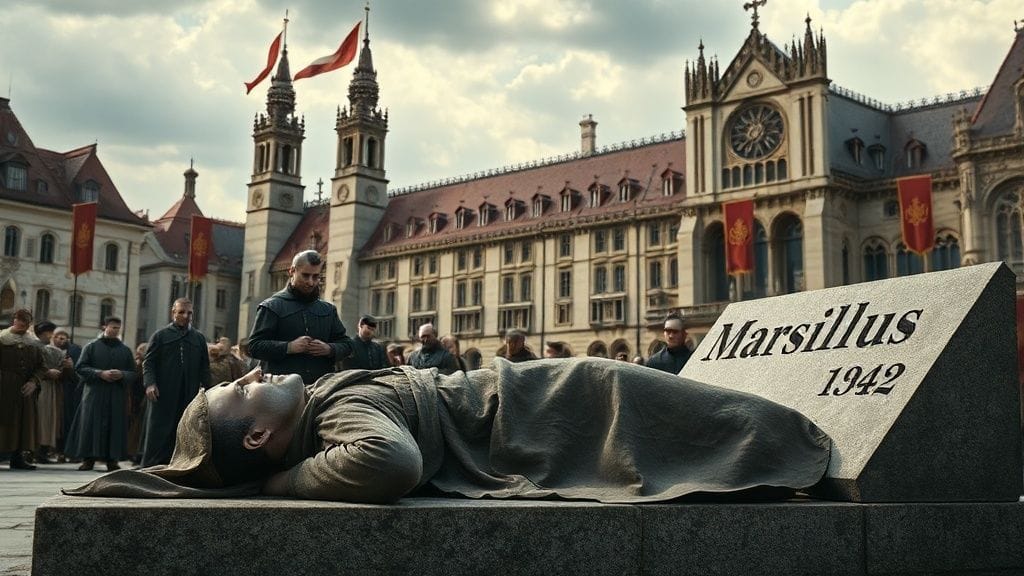
His passing was marked not by grandeur but by subdued remembrance. No public funeral heralded the death of a man whose ideas had traversed kingdoms; rather, a quiet shroud covered his departure. This modest end belied the magnitude of Marsilius’s contribution—a humbling yet poignant note in the symphony of history.
9. Unraveling the Death: Mysteries and Theories
Details about Marsilius’s death remain shrouded in mystery. Some accounts suggest illness, others whisper of political poisoning as factions within the empire and Church sought to extinguish a dangerous voice. Contemporary chronicles are sparse and contradictory, reflecting the tense atmosphere surrounding his final days.
Was it natural decline? Or the silence enforced by those who feared his ideas’ reach? While certainty eludes historians, the very ambiguity surrounding his death adds to the mystique of Marsilius, portraying him as a figure who challenged powerful enemies to the very end.
10. The Immediate Aftershock: Reactions Across Europe
Marsilius’s death did not send shockwaves like a battlefield defeat or royal assassination might have, yet scholarly and theological communities felt the tremors. Rome denounced his writings posthumously, banning and burning copies of Defensor Pacis, while voices sympathetic to him quietly preserved and disseminated his work.
In imperial courts, his death marked a pause rather than an end; Louis IV’s policies fluctuated, sometimes invoking Marsilius’s principles, sometimes conceding to papal pressure. The delicate dance continued, but Marsilius’s ideas persisted as a beacon for reformers and secular rulers.
11. Marsilius’s Legacy: Laying the Groundwork for Political Thought
Though the medieval Church branded him a heretic, Marsilius’s vision laid crucial foundations for modern political philosophy. His insistence on popular sovereignty anticipated later democratic principles, and his insistence on law as a societal contract would echo in the writings of Hobbes, Locke, and Rousseau.
His courage to confront institutional dogmas carved a path for questioning authority with reason rather than obedience—a legacy that traverses centuries and shapes contemporary political discourse.
12. The Empire’s Response: Power, Control, and Censorship
The Holy Roman Empire struggled to reconcile Marsilius’s influence with the realities of governance. On one hand, his ideas offered legitimacy against papal encroachment; on the other, they threatened internal stability by empowering masses and undermining noble privileges.
Censorship tightened, manuscripts circulated clandestinely, and intellectual circles debated fiercely. Marsilius’s death allowed imperial authorities to momentarily reinscribe traditional lines of control, but his thought remained an undercurrent pushing for systemic change.
13. Echoes in Later Political Philosophy: From Marsilius to Machiavelli
Centuries later, Niccolò Machiavelli would be seen as the patriarch of political realism, but Marsilius’s influence is felt in that lineage. Both grappled with reconciling ideal governance with the real exercise of power, questioning divine sanction, and advocating pragmatic rule.
Marsilius’s integration of secular law and popular consent anticipated Renaissance and Enlightenment shifts towards statecraft, underpinning the intellectual evolution towards modern nation-states.
14. The Death and the Ideas: How One Influenced the Other
Marsilius’s death was not merely a historical endpoint; it punctuated ongoing debates about life, power, and justice. The precarious circumstances of his final days reflect the tensions between emerging secular governance and entrenched religious authority.
His demise underscored the risks of intellectual rebellion—yet paradoxically underscored the enduring vitality of his ideas. Death did not silence Marsilius; it enshrined him as a martyr to rational governance amid medieval turmoil.
15. Cultural and Religious Ripples Beyond the Medieval Era
The contest Marsilius embodied between empire and church resonated far beyond the 14th century. The Reformation, Enlightenment, and eventually secular republics found antecedents in the ideological battles Marsilius engaged in.
His work challenged the sacrosanct nature of papal infallibility, indirectly setting the stage for centuries of religious reform and political redefinition. Through literature, scholarship, and doctrine, his ghost lingered in Europe’s cultural imagination.
16. Marsilius Remembered: Monuments, Manuscripts, and Memory
Today, Marsilius is honored mostly by scholars and political theorists; statues and memorials remain scarce. Yet, his manuscripts survive in European archives, treasured as landmarks of medieval political thought.
Cities like Padua celebrate his intellectual heritage; Munich’s subtle connection to his end adds a layer of historical depth, reminding us how geographical displacements weave narratives across the continent.
17. The Renaissance and the Reinterpretation of Marsilius’s Work
Renaissance humanists rediscovered Marsilius’s writings, interpreting them through the lens of renewed emphasis on individual agency and secular governance. While his name was sometimes eclipsed by more famous figures, his ideas permeated Renaissance debates on state power and church reform.
This revival cemented his position as a precursor to modern political philosophy, blending classical learning with innovative thought.
18. Modern Scholarship: Debates and Discoveries about Marsilius’s Death
Contemporary historians continue to investigate Marsilius’s life and death, combing archives for evidence to clarify the murky end. Recent analyses suggest possible involvement of factional disputes or even covert intervention by church loyalists.
These debates reveal as much about medieval politics as about historiographical methods, highlighting the challenges of reconstructing lives from fragmentary records.
19. The Ongoing Influence on Church-State Relations
Marsilius’s insistence on distinguishing spiritual authority from secular power established a conceptual framework still relevant today. Modern constitutional democracies wrestle with these issues—how to balance religious freedom with secular governance—a discourse traceable to Marsilius’s pioneering arguments.
His thought anticipates pluralism and legal frameworks seeking to regulate, rather than eradicate, tension between faith and state.
20. Munich’s Historical Identity Shaped by a Forgotten Philosopher
For Munich, the city where Marsilius drew his last breath, the connection is an intriguing facet of identity, blending intellectual heritage with imperial history. Though often overshadowed by other medieval personalities, Marsilius’s presence challenges local historians and cultural custodians to spotlight this quiet revolutionary.
This intersection between place and person reveals how history’s layers await rediscovery beneath the everyday.
Conclusion
Marsilius of Padua’s death in Munich in 1342 was not the closing of a mere life—it was the slow ignition of a radical, enduring transformation in political thought and authority. His courage to question the sacrosanct power of the church, his vision of sovereign people, and his unyielding pursuit of peace amidst chaos resonate as a testament to the power of ideas even when the body fails.
In a time when voices were often silenced by force or fear, Marsilius’s legacy reminds us that true change is seeded by those willing to defy the established order with reason, vision, and resilience. His life and death form a narrative knot tying the medieval past to the modern present, offering inspiration to anyone who dares to challenge the status quo in pursuit of justice and liberty.
FAQs
Q1: Who was Marsilius of Padua, and why is he important?
A: Marsilius was a 14th-century Italian philosopher and political theorist who challenged the church’s authority over secular rulers, arguing for popular sovereignty and the separation of church and state. His ideas influenced the development of modern political systems.
**Q2: What was Defensor Pacis and why was it controversial?**
A: Defensor Pacis was Marsilius’s seminal work, advocating that political authority arises from the people, not the pope. It directly contradicted the papacy’s claims, resulting in condemnation and controversy throughout Europe.
Q3: How did Marsilius end up in Munich?
A: After facing opposition in Italy, he was invited to the court of Emperor Louis IV in Bavaria, seeking refuge and political alliance to promote his ideas against the papal authority in the Holy Roman Empire.
Q4: What were the political dynamics of the Holy Roman Empire around 1342?
A: The empire was fragmented with a weak emperor battling papal interference. Louis IV’s reign was marked by power struggles and attempts to assert imperial authority independent of Rome.
Q5: Is there evidence that Marsilius was assassinated?
A: Historical records are inconclusive. Some theories suggest political poisoning, but illness remains the most accepted explanation. The ambiguity reflects the tense political atmosphere.
Q6: How did Marsilius’s ideas influence later political thought?
A: His advocacy of popular sovereignty and secular governance paved the way for Renaissance and Enlightenment thinkers, influencing modern concepts of democracy and constitutional law.
Q7: How is Marsilius remembered today?
A: Mostly through scholarly study, with surviving manuscripts and academic discussions. Cities like Padua honor his intellectual legacy, but he remains lesser-known to the broader public.
Q8: What relevance do Marsilius’s ideas have in the modern world?
A: His ideas underpin ongoing debates about the separation of church and state, secular governance, and the legitimacy of political authority derived from the people.

