Table of Contents
- The Dusk of a Renaissance Mind: London, 6 July 1535
- The Early Life and Rise of Thomas More
- The Political and Religious Turmoil of Tudor England
- More’s Intellectual and Moral Convictions
- The Clash with Henry VIII: Catalyst for Tragedy
- The Act of Supremacy: A Kingdom Divided
- More’s Refusal: A Stand Beyond Politics
- Arrest and Trial: The Shattered Shield of Justice
- The Tower of London: Walls That Heard Conviction
- The Last Days of Sir Thomas More
- The Execution: A Public Spectacle of Defiance
- Reactions in England and Abroad: Reverberations of a Death
- Thomas More’s Legacy: Martyrdom and Memory
- The Making of a Saint: Canonization and Controversy
- More’s Influence on Law, Politics, and Ethics
- The Human Face Behind the Scholar’s Mask
- The Broader Impact on Religious Reformation in England
- Reflections on Integrity in a Time of Tyranny
- Thomas More in Literature and Popular Culture
- The Enduring Questions of Conscience and Power
- Conclusion: The Timeless Echo of a Moment of Courage
- FAQs About Thomas More’s Execution
- External Resource
- Internal Link
1. The Dusk of a Renaissance Mind: London, 6 July 1535
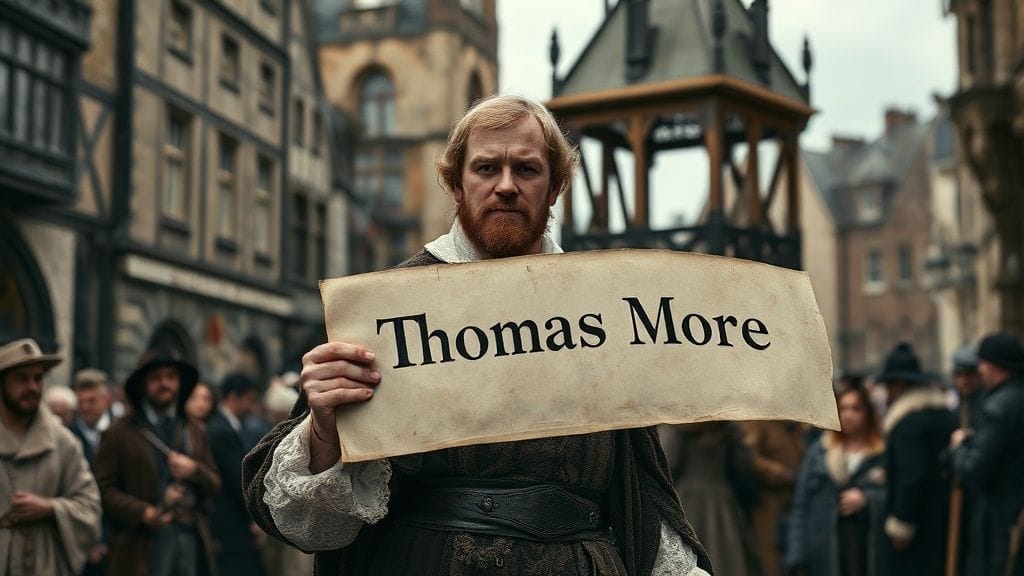
On a gloomy summer’s afternoon in London, the air was heavy with a mixture of anticipation, dread, and the sweet undertone of rebellion—the scent of freshly cut wood mingling with the quiet murmurs of a crowd gathered at Tower Hill. It was 6 July 1535, a day that would seal the fate of one of England’s most extraordinary minds and moral compasses. Sir Thomas More, once the King's most trusted counselor, now stood facing the harshest sentence imaginable: death by beheading. His crime was not of petty theft or treasonous violence but something far more profound—conscience. As the executioner’s blade glinted in the overcast light, the story of a man caught between the unforgiving demands of power and the inviolable laws of conscience unfolded like a tragic drama etched deeply into the soul of a nation.
2. The Early Life and Rise of Thomas More
Thomas More was born in London in 1478, into a family that valued education and service to the Crown. The son of a lawyer, More's intelligence blossomed early, nurtured in the halls of Oxford and later through rigorous legal training. His rise was meteoric: a scholar, a statesman, a humanist deeply influenced by the Renaissance’s ideals of reason and virtue. By the 1520s, More had become one of Henry VIII’s closest advisers, embodying the very spirit of Tudor England’s hopes for wisdom, justice, and moral governance.
Yet, beneath this polished exterior was a man driven by profound religious faith and an unwavering sense of duty—not just to the King, but to a higher law. More’s writings, especially Utopia, revealed a mind wrestling with the ideal society, one governed by reason and ethics rather than ruthless ambition or caprice.
3. The Political and Religious Turmoil of Tudor England
England in the early 16th century was a land trembling on the edge of monumental change. The Catholic Church, which had ruled spiritual and moral life for centuries, faced challenges from emerging Protestant reformers, whose critiques of papal authority questioned the very foundation of medieval Christendom. Across Europe, theological debates ignited reformations and counter-reformations, often punctuated by violence and persecution.
In the midst of this uncertainty stood Henry VIII, a monarch whose intimate desires had unexpectedly thrust England into the eye of this storm. When the Pope refused to annul Henry’s marriage to Catherine of Aragon, the King’s impatience with Rome grew into outright rebellion, culminating in his decisive break with the Church of England, and the establishment of himself as its supreme head.
4. More’s Intellectual and Moral Convictions
For Thomas More, this seismic shift was not just political; it was a betrayal of everything he held sacred. He believed ardently in the primacy of the Catholic Church and Pope. More’s convictions were anchored in a medieval worldview that saw the Church as the essential bulwark of moral and social order. His opposition to Reformation thinkers such as Martin Luther and William Tyndale was fierce. More’s defense of Catholicism was not merely dogmatic but deeply intertwined with his vision of law, justice, and the good life.
His moral rigor, while admired, often placed him at odds with the shifting currents of his time. More saw himself as a servant not of a king’s will, but of divine law—a position that soon became untenable.
5. The Clash with Henry VIII: Catalyst for Tragedy
The tension between loyalty to sovereign and obedience to conscience reached a crisis when Henry VIII sought More’s public approval of the Act of Supremacy in 1534, which declared the King the Supreme Head of the Church of England. More, though reluctant to break publicly with the King, could not formally endorse what he saw as heresy and tyranny.
This refusal was not merely defiance but a profound act of resistance, a declaration that some demands of power lie beyond the bounds of moral legitimacy. Henry, once More’s friend and confidant, perceived this opposition as betrayal. More’s fall from favor was swift and irrevocable.
6. The Act of Supremacy: A Kingdom Divided
The 1534 Act of Supremacy was a bold legal maneuver that robbed the Pope of his English authority. Parliament’s unanimous passage conferred on Henry VIII spiritual sovereignty, forcing his subjects into an impossible position—submission or treason. It was a direct challenge to centuries-old religious and political structures.
For many, accepting the act was a survival tactic; for others, like More, it was an existential crisis. The Act rived the nation’s fabric, creating factions of zealots, opportunists, and martyrs. The period following was marked by purges, imprisonments, and executions—Henry’s realm had become a chessboard of conscience and power.
7. More’s Refusal: A Stand Beyond Politics
Unlike many nobles and clerics who outwardly swore allegiance to the King’s spiritual headship, More chose silence and later open refusal, retreating into a principled opposition. This resistance was dangerous. In a regime where personal loyalty was equated with survival, More’s steadfastness became an act of defiant courage.
He claimed, “I die the King’s good servant, but God’s first.” This phrase, simple yet profound, encapsulated the heart of his struggle—a refusal to place temporal authority above the moral and spiritual order he revered.
8. Arrest and Trial: The Shattered Shield of Justice
Thomas More’s arrest in April 1534 and subsequent imprisonment in the Tower of London marked the downfall of England’s most brilliant lawyer. His trial in 1535 was a spectacle, marred by political theatre and legal manipulation. The charges—treason—stemmed chiefly from More’s silence and failure to acknowledge the King as head of the Church.
The trial revealed a court bent on conviction, relying on dubious testimony and legal machinations. More’s responses were measured, eloquent, and resolute, showcasing a man who, even in the shadow of death, wielded his intellect as a shield.
9. The Tower of London: Walls That Heard Conviction
The years within the Tower before More’s execution were marked by isolation and reflection. Yet, even behind these cold stone walls, More’s spirit did not wane; he continued to write letters, defend his position, and maintain dignity that inspired those around him.
The Tower, an infamous symbol of royal power, also became the stage for More’s moral resistance. His treatment, though harsh, highlighted tensions between authority’s reach and the individual’s conscience.
10. The Last Days of Sir Thomas More
June and July of 1535 saw More prepared for his final hours with calm and resolve. Accounts of his last days evoke images of a man both serene and unyielding—a complex portrait of humility and intellectual vigor facing mortality.
On the morning of 6 July, More donned his executioner’s shirt, reportedly having requested to speak to the crowd to explain his actions. His composure moved many onlookers, his farewell a testament to his faith and beliefs.
11. The Execution: A Public Spectacle of Defiance
The execution itself was brutal but tinged with dignity. Climbing the scaffold, More reportedly declared his conscience had never wavered. The executioner’s axe struck swiftly, ending the life of a man whose death would resonate far beyond that summer day.
Witnesses described a crowd silenced, moved, many reportedly weeping. In death, More transcended the fate assigned to him—he became something far greater than a condemned traitor.
12. Reactions in England and Abroad: Reverberations of a Death
The death of Thomas More sent shockwaves through Europe’s religious and intellectual communities. Catholic powers mourned the loss of an able defender against Protestantism. In England, reactions were mixed—fear, respect, skepticism.
Foreign ambassadors noted in their dispatches the profound impact; More was already becoming a symbol of conscience and resistance in a world increasingly polarized by faith and politics.
13. Thomas More’s Legacy: Martyrdom and Memory
More’s execution planted the seeds of a legacy that would grow over centuries. He became a martyr in the eyes of many, a symbol of the conflict between conscience and authority. His life story was preserved in chronicles, hagiographies, and later, in the annals of the Catholic Church.
The English Reformation continued unabated, but More’s name endured as a beacon—a reminder that some sacrifices transcend immediate politics.
14. The Making of a Saint: Canonization and Controversy
In 1935, four centuries after his death, Thomas More was canonized by Pope Pius XI, cementing his status as a saint and martyr. This act sparked both praise and controversy. Admirers heralded his unwavering faith; critics highlighted his role in persecuting heretics and the complexities of his character.
This duality makes More’s sainthood not just an honor but a lens into the challenging intersection of faith, morality, and historical judgment.
15. More’s Influence on Law, Politics, and Ethics
Beyond his religious significance, More shaped ideas on law and governance. His belief that the law should serve justice and conscience rather than brute power remains influential. More’s writings on the rule of law, ethics, and the limits of political authority continue to resonate in legal and philosophical discourse.
He challenged the idea that rulers are above right—an idea that underpins modern democratic thought.
16. The Human Face Behind the Scholar’s Mask
While often portrayed as a stern and lofty figure, Thomas More was a complex man: a devoted family man, a friend, a scholar with a sense of humor, and a man wrestling with competing loyalties. Letters from his family, especially his daughter Margaret Roper, reveal warmth and tenderness rarely associated with his public persona.
This humanization allows us to see More not only as a historical icon but as a flesh-and-blood person caught in extraordinary times.
17. The Broader Impact on Religious Reformation in England
More’s death was emblematic of the broader religious schism shaking England. It marked a hardening of the schism that would culminate in decades of religious conflict and experimentation—from the reigns of Edward VI and Mary I to Elizabeth I’s establishment of a Protestant Church of England.
The martyrdom of More underscored the human cost of these transformations and the deep divisions that still echo today.
18. Reflections on Integrity in a Time of Tyranny
More’s story is a poignant reminder of the price of integrity in the face of authoritarian demands. His courage invites reflection on the role of conscience in governance, the limits of obedience, and the enduring tension between power and principle.
It raises questions that remain urgent: When should one resist authority? And what does true loyalty demand?
19. Thomas More in Literature and Popular Culture
The legacy of More inspired numerous works, from Robert Bolt’s acclaimed play A Man for All Seasons to films and novels. These portrayals explore his moral steadfastness, human frailty, and the dilemmas of conscience, ensuring that More’s story remains accessible and compelling.
Through art, More’s sacrifice continues to challenge and inspire new generations.
20. The Enduring Questions of Conscience and Power
Thomas More’s life and death crystallize a timeless conflict: the struggle between individual conscience and the demands of political authority. His narrative forces us to ask: Can one serve both God and king? What price must be paid for moral fidelity?
These questions resonate across history, embodying the perpetual human quest for justice and meaning.
21. Conclusion: The Timeless Echo of a Moment of Courage
The execution of Thomas More on that July day in 1535 was not merely the end of a man, but an enduring chapter in the story of human conscience confronting power. His courage—rooted deeply in faith and reason—illuminates the shadows cast by tyranny, reminding us that the true measure of a person lies in the steadfastness of their convictions.
More’s legacy continues to inspire those who wrestle with the demands of conscience, revealing that in moments of profound challenge, the human spirit can shine with an unvanquished light.
FAQs About Thomas More’s Execution
Q1: What were the main reasons for Thomas More’s execution?
Thomas More was executed primarily for refusing to acknowledge Henry VIII as the Supreme Head of the Church of England following the Act of Supremacy in 1534. His refusal was seen as treason against the King since it challenged the new religious and political order.
Q2: How did Thomas More’s trial reflect the political climate of Tudor England?
The trial was heavily influenced by political power rather than justice. Legal processes were manipulated to secure a conviction, demonstrating the Crown's intolerance for dissent during a time of religious upheaval and consolidation of royal power.
Q3: Was Thomas More’s execution widely supported or condemned at the time?
Reactions were mixed. Among Catholics and some foreign diplomats, he was mourned as a martyr. However, many in England accepted the King's authority and saw More’s resistance as dangerous defiance.
Q4: How did Thomas More’s religious beliefs influence his political decisions?
More’s Catholic faith was integral to his identity. He believed in the supreme authority of the Pope and the Church's spiritual leadership. His political decisions reflected this worldview, prioritizing divine law over royal demands.
Q5: In what ways has Thomas More influenced modern thought on law and conscience?
More is often cited as an early advocate for the rule of law and the necessity of moral conscience in governance. His stand against authoritarianism inspired later debates on civil disobedience and the limits of obedience to state power.
Q6: When and why was Thomas More canonized?
He was canonized in 1935, marking 400 years since his death, because of his steadfast faith and martyrdom in defense of the Catholic Church during the Reformation.
Q7: How is Thomas More remembered in popular culture today?
More’s life has been dramatized in plays (notably A Man for All Seasons), films, and literature, portraying him as a symbol of integrity and moral courage.
Q8: What lessons can contemporary society draw from Thomas More’s story?
His story challenges us to consider the importance of conscience, the dangers of unchecked power, and the courage required to uphold principles against oppression.