Table of Contents
- The Final Days of a Monarch: January 1547 in London
- England on the Brink: The Tudor Turmoil Before Henry’s Death
- The Life and Reign of Henry VIII: Power, Passion, and Transformation
- The Illness and Decline: Henry’s Last Months in the Palace
- The Court’s Atmosphere: Anxiety and Anticipation
- The Deathbed Scene: Witnesses to a King’s Last Breath
- The Impact on England: Immediate Political Reactions
- The Succession Question: Edward VI and the Fragile Future
- England’s Religious Landscape at Henry’s Death
- International Context: Europe’s Watchful Eyes on Tudor England
- The Funeral of Henry VIII: Display of Majesty and Mortality
- The Personal Legacy: Family Divisions and Tudor Drama
- Henry VIII in Memory and Myth: The Making of a Legendary King
- Political Shifts: The Regency and the Reformation’s Continuity
- Social and Cultural Aftermath: England’s Changing Identity
- Historiographical Perspectives: How Historians Have Viewed Henry’s Death
- The Tudor Dynasty’s Shadow: Long-Term Consequences
- Conclusion: The End of an Era and the Dawn of New Challenges
- FAQs: Understanding the Death of Henry VIII
- External Resource: Wikimedia Link on Henry VIII
- Internal Link: Visit History Sphere
The Final Days of a Monarch: January 1547 in London
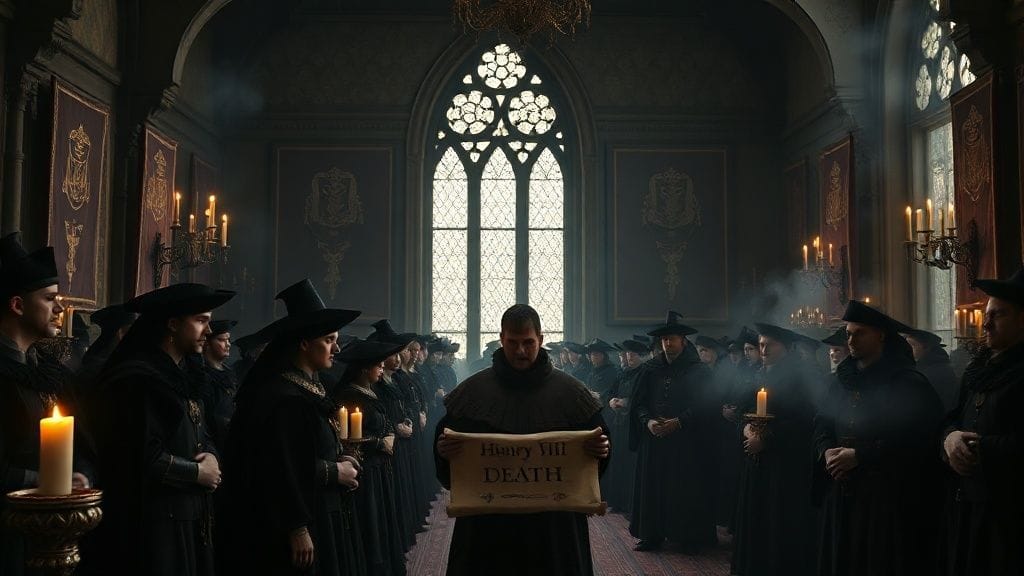
January in London was bitterly cold, the chill biting deep beneath the heavy winter cloaks of courtiers and commoners alike. The air in the Tudor palaces carried a heavy mix of despair and expectancy, for the great Henry VIII, King of England, was dying. The once formidable monarch, who had reshaped the religious and political landscape of England, now lay in his bed—swollen, crippled, surrounded by the shadow of his past triumphs and failings. On the 28th day of that cold January in 1547, a chapter closed not only on a man but on an age. The death of Henry VIII was less an ending than a reckoning, the moment when the Tudor dynasty faced the uncertain dawn ahead.
England on the Brink: The Tudor Turmoil Before Henry’s Death
The years leading to Henry VIII’s death were marked by turmoil and transformation. England in the mid-16th century was a nation gripped by religious upheaval, political intrigue, and economic strain. The king’s break from Rome had sparked waves of dissent and reform, rippling through ecclesiastical structures and common life alike. Behind the cold stones of Whitehall Palace, factions jostled for influence, while the population bore the burdens of costly wars and religious uncertainty.
Henry’s personal life, famed for its scandals and passions, had deeply impacted the direction of the kingdom. His six marriages, particularly the fateful divorce from Catherine of Aragon and the execution of Anne Boleyn, illustrated the merging of personal desire with brutal political necessity. By the time his health waned, England was a land divided — both politically and spiritually.
The Life and Reign of Henry VIII: Power, Passion, and Transformation
Born in 1491, Henry VIII had ascended the throne in 1509 as a handsome, athletic young man eager to assert England’s prominence on the European stage. His early reign shimmered with promise and grandeur: lavish celebrations, ambitious law reforms, and a burgeoning navy. Yet, the king’s character soon revealed a complexity marked by ruthless ambition and mercurial temper.
Henry's desire for a male heir set the stage for his defining action: the English Reformation. His break from the Catholic Church was as much a personal resolve—the Pope’s refusal to annul his first marriage—as it was a wrenching national upheaval. The dissolution of monasteries, the establishment of the Church of England, and the redistribution of wealth and power reshaped the country fundamentally.
But power exacted a cost. The king’s body sagged under the weight of his years, his health ravaged by obesity, leg ulcers, and possibly diabetes. By the mid-1540s, the once indomitable Henry was confined mostly to his chambers, distant from the bustling courts he had ruled with iron will.
The Illness and Decline: Henry’s Last Months in the Palace
Henry VIII’s decline was slow and marked by suffering. The King’s legs, ravaged by painful ulcers, forced him into a sedentary life. His weight ballooned to over 400 pounds, rendering movement arduous. The court doctors, armed with the limited medical knowledge of the day, could do little but offer comfort.
In early January 1547, the king’s condition worsened dramatically. His attendants whispered of his probable death, yet the monarch clung fiercely to life amid bouts of delirium and agony. His physical decline mirrored political uncertainty; the future could not rely on the weakened king.
The Court’s Atmosphere: Anxiety and Anticipation
At Whitehall and Hampton Court, tension was palpable. The courtiers, their ambitions cloaked behind ritual deference, awaited news with bated breath. Some plotted quietly, others prayed fervently. The fragile heir, Edward Seymour, brother to Jane Seymour (Henry’s third wife and Edward VI’s mother), was already gaining influence in shadows.
As Henry’s death approached, power shifted in whispers and glances rather than open declarations. The larger fate of the nation was inextricably tied to the fate of this ailing man, the pivot of centuries of change.
The Deathbed Scene: Witnesses to a King’s Last Breath
On the cold morning of January 28, the king finally succumbed. Accounts describe a silent room, punctuated only by muffled sobs and the soft weeping of Maids of Honor. Henry VIII’s passing was not marked by grand declarations, but by a quiet slipping away from a man who had cast a long shadow over England’s history.
Contemporary witnesses recorded the king's final words as a plea for God's mercy and a prayer for his son. “I die a Christian according to the profession which I have hitherto professed,” he reputedly declared. The last breath of the monarch was the end of an epoch: Tudor England waned in the winter light.
The Impact on England: Immediate Political Reactions
News of Henry VIII’s death cascaded rapidly throughout London and beyond. Parliament convened swiftly to affirm the succession of Edward VI, a boy of just nine years old, ushering in a daunting regency period. The reactions were mixed: fear, hope, and uncertainty all mingled in the city’s taverns and courts.
Politically, conservative factions feared the acceleration of Protestant reforms, while reformers worried about the return of Catholic sympathies. The king had been a polarizing figure—both Tyrant and Father of the English Nation—and his absence triggered a fragile balance of power.
The Succession Question: Edward VI and the Fragile Future
The nine-year-old Edward Tudor was proclaimed king with acclamation, but England’s fate was vulnerable in the hands of a child. Edward Seymour, his uncle, soon emerged as Lord Protector, guiding the kingdom through tumultuous religious reforms and threats from abroad.
Edward’s reign promised to be a baptism by fire—revolutions of faith, court intrigues, and external challenges loomed large. The transition from Henry VIII’s iron-fisted command to Edward’s regency marked the beginning of an uncertain chapter in English history.
England’s Religious Landscape at Henry’s Death
At the moment Henry VIII died, England was midway through a painful transformation. The break with Rome had dismantled centuries-old institutions, yet the new English Church was in flux. Religious tensions simmered under the surface — conservative Catholics resented the reform, while evangelical Protestants sought further radical change.
Henry’s religious policies had been pragmatic and often contradictory: he dissolved monasteries but persecuted Protestants, asserting royal supremacy while maintaining much traditional worship. The question of England’s spiritual future was unresolved, awaiting the decisive hand of his successor.
International Context: Europe’s Watchful Eyes on Tudor England
Across continental Europe, monarchs and diplomats observed Henry VIII’s demise keenly. The balance of power between Catholic France, the Holy Roman Empire, and Protestant influences was delicate. England’s shift toward Protestantism deepened the divide.
Henry’s death affected alliances and diplomacy immediately. His daughter Mary, a staunch Catholic, was sidelined, while foreign powers pondered the stability of England under a child-king. The continent braced for changes that would ripple far beyond English shores.
The Funeral of Henry VIII: Display of Majesty and Mortality
Henry VIII’s funeral was a spectacle blending pomp and somber reflection. Held in February 1547 at St George’s Chapel, Windsor, the ceremonies underscored royal grandeur but also mankind’s fragile end.
The king was interred beside Jane Seymour, his most beloved queen and mother of Edward VI. His tomb, adorned with an elaborate effigy, spoke of glory and mortality entwined. The procession was a vibrant display intended to assert continuity despite the monarch’s passing.
The Personal Legacy: Family Divisions and Tudor Drama
Despite his power, Henry VIII’s family life was riddled with tragedy and conflict. His children’s destinies diverged dramatically: Edward’s brief, Protestant reign; Mary’s fiery Catholic restoration; Elizabeth’s eventual iconic rule. These fractures were seeded in the final days of Henry’s life and the succession he secured, but barely controlled.
Rivalries among noble families — Howards, Seymours, and others — intensified in the vacuum Henry left, turning the court into a stage for political theatre that would shape Tudor England’s fate.
Henry VIII in Memory and Myth: The Making of a Legendary King
In death, Henry VIII was larger than life. Contemporaries and subsequent generations crafted narratives that oscillated between demonization and glorification. The image of the king as a tempestuous tyrant, a passionate lover, and an agent of English independence crystallized in collective memory.
Cultural works across centuries have echoed this complex figure, immortalizing him as one of history’s most dramatic monarchs — a king whose death marked more than a passing, but a cultural symbol.
Political Shifts: The Regency and the Reformation’s Continuity
The dawn of Edward VI’s reign inaugurated a regency dominated by Edward Seymour, who sought to press forward Protestant reforms more vigorously. The continuity of Henry’s policies was tenuous, with court factions and the public divided.
Under the Protectorship, England saw the introduction of the Book of Common Prayer and further dismantling of Catholic rites — reforms far more radical than Henry had dared enact himself. The death of the king thus accelerated the religious revolution.
Social and Cultural Aftermath: England’s Changing Identity
Beyond politics, Henry VIII’s death marked a societal transformation. The dissolution of the monasteries had redistributed lands, affecting social structures. The nobility grew in prominence, yet common folk navigated religious confusion and economic upheaval.
The cultural flowering that would peak under Elizabeth I already hinted in this era — literature, music, and art responded to new religious and political realities, weaving a fabric of emerging English identity.
Historiographical Perspectives: How Historians Have Viewed Henry’s Death
The death of Henry VIII has inspired centuries of historical inquiry and debate. Tudor historiography reveals shifting interpretations: from Victorian moralism painting him as a tyrant, to revisionist views emphasizing his political acumen.
Modern scholars probe the interconnections between his personal health, political decisions, and England’s development, showing how Henry’s death was a pivotal fulcrum in Renaissance history.
The Tudor Dynasty’s Shadow: Long-Term Consequences
Ultimately, Henry VIII’s death began the process by which the Tudor dynasty would reach both its zenith under Elizabeth I and its decline. The religious divisions, succession crises, and political reforms he engendered resonated far beyond 1547, shaping England’s future for centuries.
The reign of his successors would be haunted by his legacy—both as a symbol of national sovereignty and a cautionary tale of absolute power.
Conclusion
As Henry VIII breathed his last on that cold January day in 1547, England stood at a crossroads. The towering figure who had redefined monarchy, religion, and society vacated the throne, leaving behind a legacy as complex and bruising as the man himself. His death was not a quiet end but the inception of change — one of hope, terror, and unyielding transformation.
For England, it marked the conclusion of a fiery chapter and the uncertain dawn of a fragile youth ascending. The story of Henry’s death is a testament not only to the mortality of kings but to the enduring tides of history they command and challenge. It reminds us how a single life’s end can ripple through generations, shaping identity, belief, and power for centuries to come.
FAQs
Q1: What caused Henry VIII’s death?
A1: Henry VIII died likely from complications related to obesity, leg ulcers, possible diabetes, and heart issues. His health had been deteriorating for years by 1547.
Q2: Who succeeded Henry VIII?
A2: His nine-year-old son, Edward VI, succeeded him, with Edward’s uncle Edward Seymour acting as Lord Protector during the regency.
Q3: How did Henry VIII’s death affect the English Reformation?
A3: His death accelerated Protestant reforms under Edward VI’s regency, where religious policies became more radical than under Henry’s pragmatic approach.
Q4: What was public reaction in England to Henry VIII’s death?
A4: The public’s reaction was mixed with fear, hope, and uncertainty—amid religious and political tensions, many awaited the future under a child king with apprehension.
Q5: How is Henry VIII remembered today?
A5: Henry VIII is remembered as a complex figure—a powerful monarch, a controversial reformer, and a man whose life symbolized the turbulent transformation of England.
Q6: What was the significance of Henry VIII’s funeral?
A6: The funeral was a grand display of royal majesty, underscoring both the power of the Tudor monarchy and the human inevitability of death.
Q7: How stable was England after Henry’s death?
A7: England was politically fragile; the regency had to manage factionalism, religious upheaval, and external threats during Edward VI’s minority.
Q8: Did Henry VIII’s children maintain his legacy?
A8: Each child shaped divergent legacies—Edward VI furthered Protestantism, Mary sought to restore Catholicism, and Elizabeth I forged a religious settlement balancing both.